Domain Owners Must Coordinate DNSSEC Signing and Delegation
Enable and maintain DNSSEC with clear responsibility for signing, parent DS records, provider migrations, and recovery.

- domains
- dns
- guide
- security
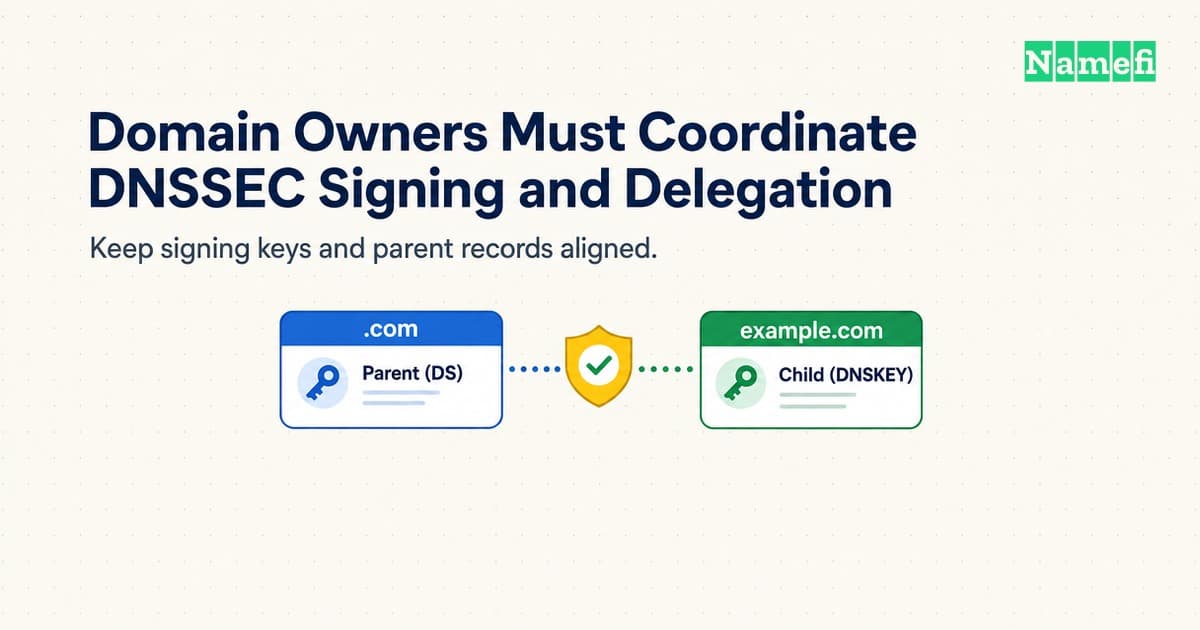
A DNSSEC switch in a dashboard represents only part of a working configuration. The domain's signing keys and the parent zone's delegation data must agree. Domain owners need a maintenance plan for both sides.
DNSSEC helps validating resolvers detect unauthenticated changes to DNS data. DNSSEC does not encrypt queries, protect an unlocked registrar account, or install a website certificate. A useful deployment starts with that narrower purpose.
This guide follows an ordinary registered domain from preparation through migration and recovery. The examples use example.com as a hypothetical domain. Follow the current procedures of the actual registrar and DNS operator before changing production data.
DNSSEC validation requires a complete trust relationship
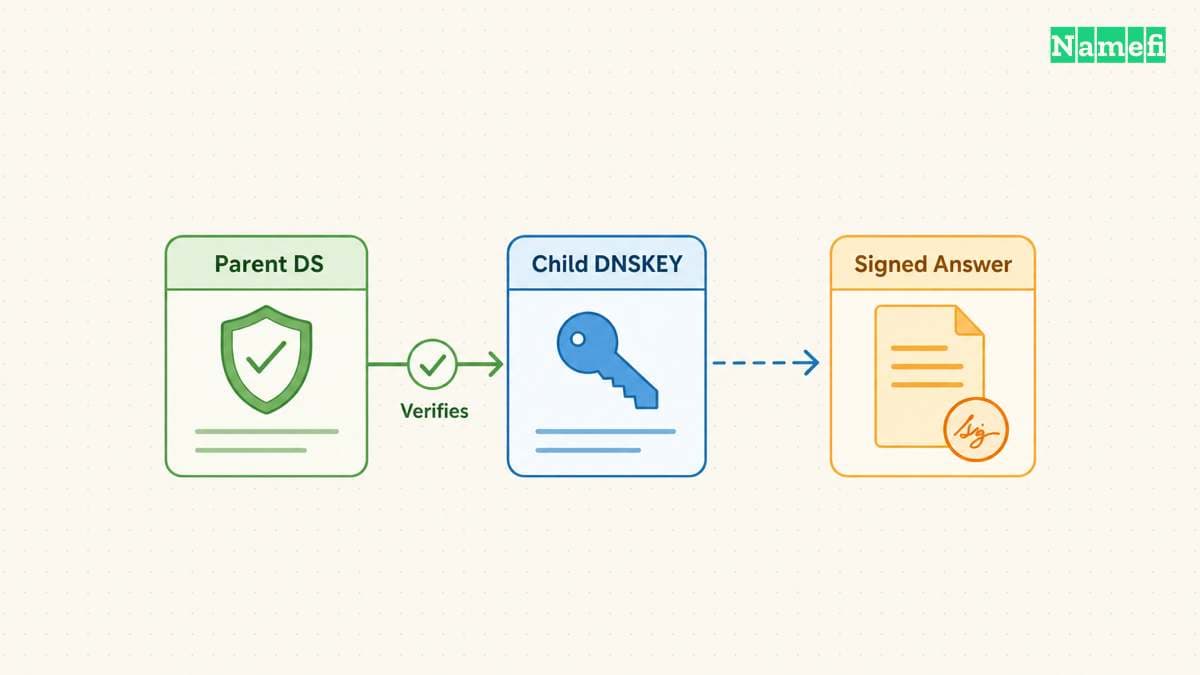
DNSSEC adds authentication and integrity checks to DNS data. A validating resolver follows authenticated key relationships and verifies signatures. RFC 4033, sections 3–4 explains both the protection and the limits. Query confidentiality and denial-of-service protection fall outside that protection.
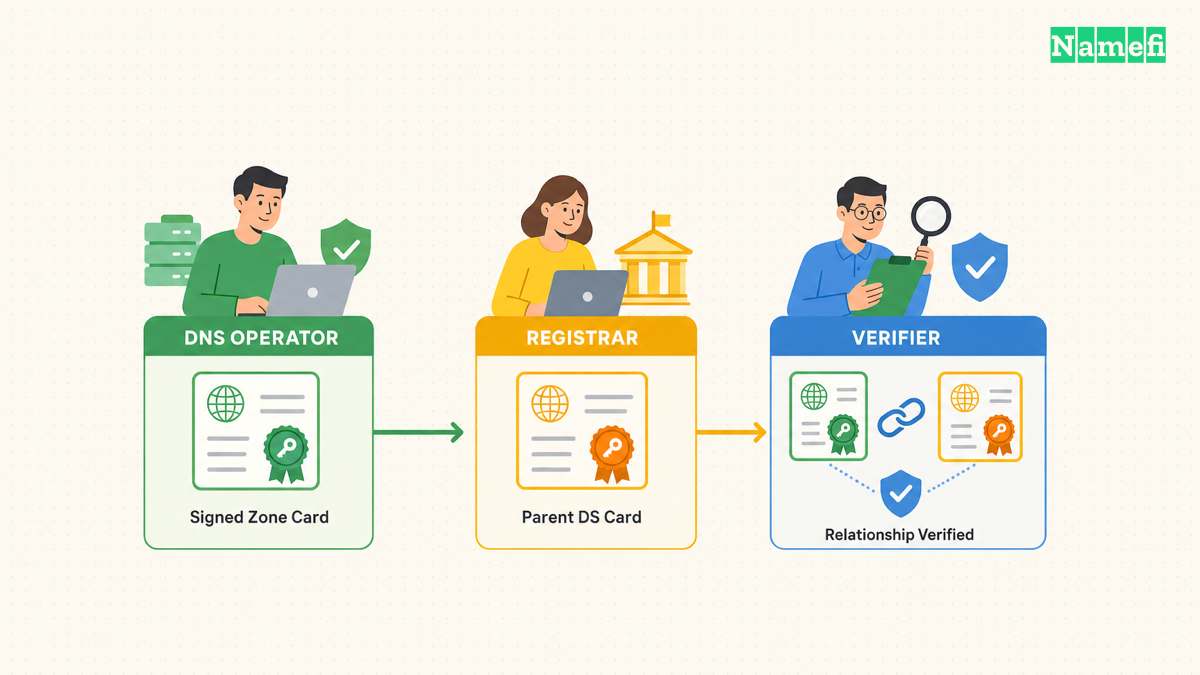
Separate the domain owner, registrar, and authoritative DNS operator in the operating record. One company may perform several roles, but the configuration still has distinct parts. The owner needs to know which account controls each part before an incident occurs.
A DNS operator publishes DNSKEY records and signatures for a signed zone. The parent zone publishes the DS record that identifies a child key. For example.com, the DS belongs on the .com side of the delegation. RFC 4034, section 5 defines that placement and relationship.
That distinction explains a common setup mistake. Adding a DS-looking record inside the child zone does not replace the parent DS publication. Use the registrar's supported DNSSEC process for a registered domain. A delegated subdomain instead requires coordination with the administrator of the parent zone.
| Component | Operational question |
|---|---|
| Signed zone | Which operator signs the data? |
| DNSKEY | Which public key does the zone publish? |
| Parent DS | Which key does the parent authenticate? |
| Validation | Does the complete relationship work? |
A domain can publish correct-looking address records while validation fails. Check the trust relationship separately from the website destination. A website hosting migration can leave DNS signing unchanged, while a DNS hosting migration can replace the signer entirely.
Do not treat DNSSEC as permission to weaken account controls. An authorized account can still publish an unwanted address through the provider's normal change process. Protect registrar access, DNS credentials, recovery contacts, and change approvals alongside the signed zone.
Likewise, preserve HTTPS for websites. DNSSEC and a website certificate answer different questions. A successful DNSSEC check does not prove that the destination serves the intended application. Verify the hostname, certificate, and application after DNS configuration changes.
A complete deployment verifies signing and parent records
Before enabling DNSSEC, inventory the active nameservers and current parent DS state. Confirm that the registrar supports the DNS operator's procedure. Identify an authorized person who can make parent-side changes if the original administrator becomes unavailable.
Export the zone and save the essential configuration in a controlled location. Include the DNS operator, registrar account owner, delegation, DS values, and support contacts. Store private keys only according to the signing operator's security model. Do not copy secret material into an ordinary editorial or support document.
Read the operator's instructions before selecting an algorithm or copying a digest. Avoid using an old tutorial's numerical examples as live settings. Managed operators often generate the necessary values and specify how the registrar must receive those values. The owner should preserve the exact current output.
Enable signing through the DNS operator's supported procedure. Confirm that the authoritative service publishes the expected signed data. Then submit the correct DS through the registrar process when the operator requires manual submission. Some integrations automate parts of the process, so confirm the documented responsibility split.
Compare every displayed field rather than checking only the key tag. A copied value can contain an omitted character or a value from another domain. Record the source account, target domain, submission time, and resulting parent publication. A second person can independently check a high-impact domain before the change.
Test the complete chain with a validating diagnostic service or a validation-capable tool. Querying DNSKEY proves only that a server returned a key. Querying DS proves only that a server returned delegation data. The deployment requires compatible records and valid signatures across the relevant chain.
Check both authoritative and recursive observations. Authoritative results show what the operator currently publishes. Recursive observations show what users may receive through caches and validation. Keep timestamps so a later comparison can distinguish a stale response from a new configuration mistake.
Finish with application tests. Load the website, send and receive mail, and test important subdomains. Keep the saved pre-change configuration until the checks succeed. A successful dashboard message provides less evidence than a complete validation result and working services.
Provider changes require a coordinated DNSSEC transition
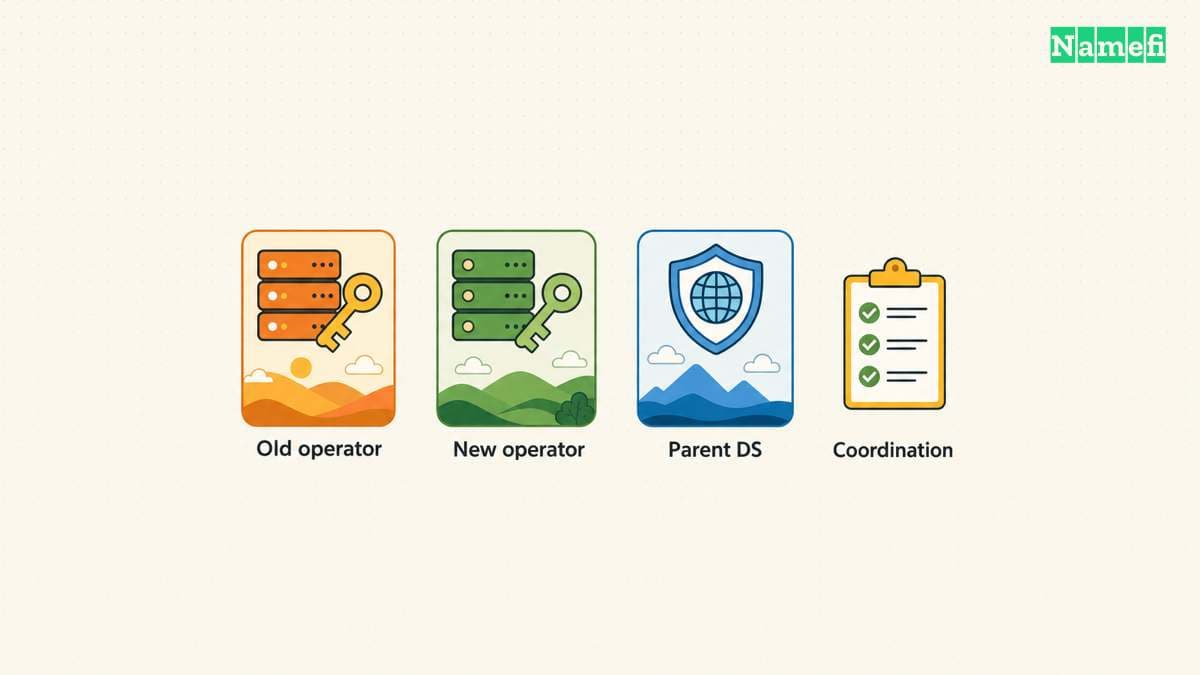
DNSSEC maintenance needs timing as well as correct values. A key rollover changes which key material remains available during a transition. A DNS operator migration can also change nameservers and the signer. RFC 6781 discusses coordinated and non-coordinated operator changes.
Ask the old and new operators which migration method both operators support. Do not assume that exporting ordinary DNS records also exports the signing arrangement. Compare the documented migration procedure before changing the parent delegation or retiring the old zone.
Some migrations preserve validation through coordinated signing arrangements. Other migrations require a planned interval without a parent DS relationship. The available method depends on operator capabilities and cooperation. A generic checklist cannot substitute for the specific transition sequence.
For example, Cloudflare's onboarding guidance tells incoming customers to disable the previous registrar-side DNSSEC configuration before changing nameservers. The guidance applies to that documented onboarding procedure. Do not generalize the instruction into “always disable DNSSEC for every migration.”
Build a transition worksheet with one row per action:
| Action | Evidence before the next action |
|---|---|
| Prepare new zone | Required records match the inventory |
| Coordinate trust changes | Operator procedure identifies the order |
| Update delegation | Parent shows intended nameservers |
| Complete new signing | Validation succeeds through the new service |
| Retire old service | Transition checks and waiting periods finish |
Assign an owner to each row. A hosting contractor may control the destination while another person controls the registrar. The worksheet should expose that dependency before the scheduled change begins. Keep contact methods outside the domain undergoing migration when feasible.
Account for existing cached records. A freshly changed parent record does not prove that every recursive resolver has discarded the old state. Use the relevant published TTLs and operator instructions when planning transition intervals. Avoid a universal waiting period copied from an unrelated migration.
After a managed key rollover, verify the same external outcomes used during initial deployment. Do not rotate keys manually merely because an old screenshot shows a different key. Confirm the operator's current maintenance state before intervening in an automated process.
Keep a record of completed changes and known dependencies. Record whether the registrar automates DS updates or expects manual action. A future registrar transfer can change that integration. Recheck responsibilities when accounts, providers, or administrators change.
A validation investigation identifies the failed relationship
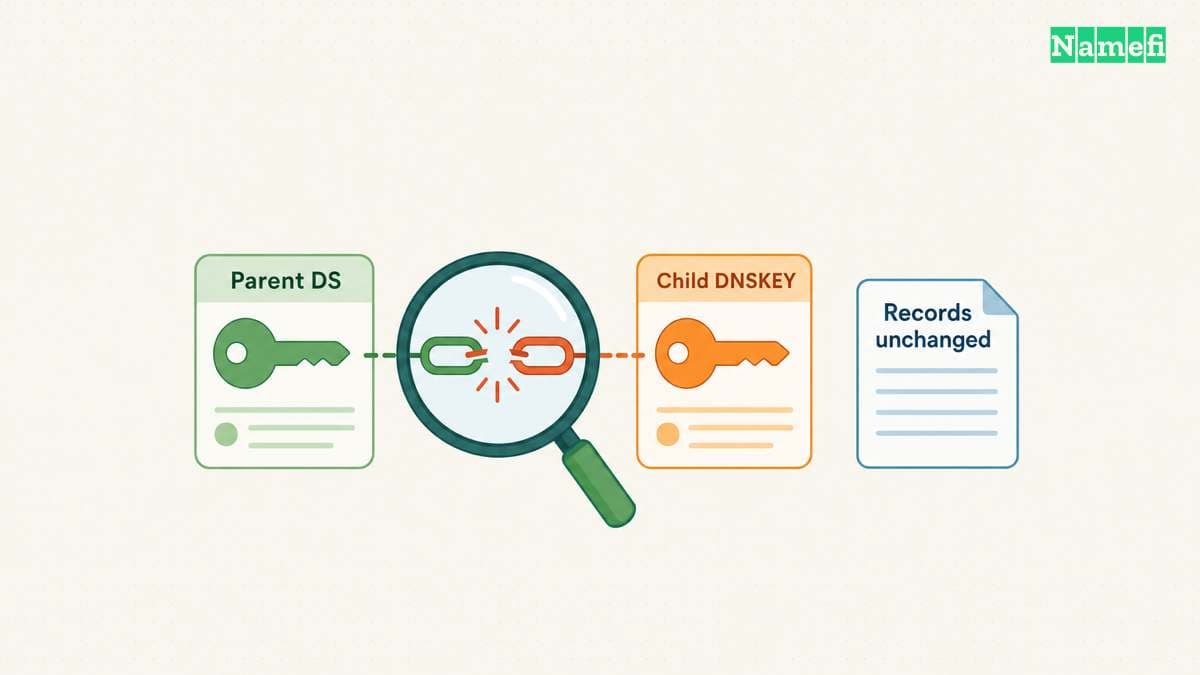
When users report resolution errors, start by identifying the failing hostname and record type. Determine whether the issue affects the apex, one subdomain, or the whole zone. Record the affected resolver and time rather than assuming every report describes the same cached state.
Compare ordinary resolution with a validation-aware diagnostic. A resolver error can have many causes, so do not declare DNSSEC responsible from one generic failure message. Gather the parent DS, child DNSKEY, signatures, delegation, and authoritative availability for the affected name.
Look for changes that occurred shortly before the failure. A nameserver migration, registrar transfer, key rollover, or accidental parent DS edit gives the investigation a concrete starting point. Compare the current configuration with the saved worksheet and the provider's change history.
Check signature timing and operator health with the DNS operator. RFC 4033, section 8 describes DNSSEC's timing dependencies. An address record can remain unchanged while the signature state becomes unsuitable for validation. Preserve diagnostic output before changing the configuration.
Prefer repairing the mismatched relationship through the responsible operator. Restore the correct signed zone or coordinate the proper parent DS update as the verified procedure requires. Avoid deleting unrelated website or mail records while investigating validation.
An emergency decision to remove a parent DS changes the security state. The decision also requires correct authority and cache-aware timing. Record the reason, authorized administrator, expected effect, and restoration plan. Do not present permanent removal as a completed DNSSEC repair.
Escalate with precise evidence. Give support the domain, failing name and type, timestamps, current nameservers, observed DS, and diagnostic result. Never include registrar passwords, private signing keys, or wallet recovery phrases. Useful evidence describes the public configuration and the failed relationship.
After recovery, repeat application checks and external validation. Confirm that the intended protection has returned if the recovery involved a temporary unsigned interval. Update the operating record with the cause and the preventive change. A repaired domain needs a maintained process, not only a green indicator.
For routine ownership, the practical standard is clear responsibility. The owner should know who signs, who updates the parent, who monitors validation, and who can recover. That responsibility makes DNSSEC useful through ordinary changes rather than fragile at the first migration.
These sources support the article
- IETF — RFC 4033, sections 3–4 and 8: protections, limits, and timing dependencies. Fetched 2026-10-21.
- IETF — RFC 4034, section 5: DS placement and DNSKEY relationship. Fetched 2026-10-21.
- IETF — RFC 6781, section 4.3.5: changing DNS operators. Fetched 2026-10-21.
- Cloudflare — DNSSEC, “Disable DNSSEC”: operator-specific onboarding guidance. Fetched 2026-10-21.
About the author(s)
Namefi is a collective of engineers, designers, and operators who obsess over building tools that make managing your onchain domain names effortless.