How to Find Expired Domains Worth Buying and Avoid the Junk
Evaluate expired domains by checking registration status, past use, naming fit, and purchase terms. Avoid unsupported promises about inherited rankings.

- domains
- guide
Find an expired domain through a listing or auction, then verify the registration status and purchase terms before paying. Choose a name that fits a real project. Do not treat age, backlinks, or a marketplace score as proof of future search traffic.
Google defines expired domain abuse as buying and repurposing an expired domain primarily to manipulate rankings with low-value content. Google explains that policy. A useful domain purchase needs a purpose beyond an assumed ranking advantage.
This guide concerns buying somebody else’s expired domain. If your own domain expired, use the owner recovery guide first.
The listing describes a sales route rather than guaranteed availability
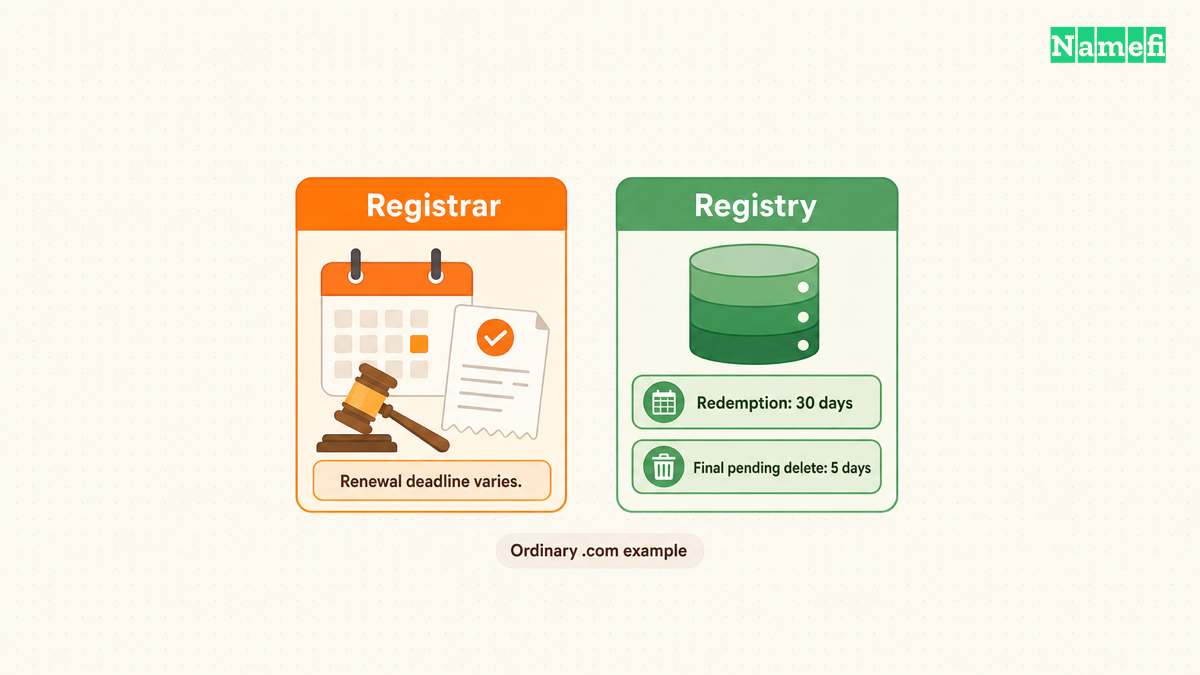
An expired registration can still have recovery options. ICANN says renewal options and fees vary by registrar and describes recovery during redemption. ICANN explains recovery eligibility.
Consequently, a domain on an expired list is not automatically available through ordinary registration. Read the seller’s description of the stage and delivery process. Ask whether the offer concerns an auction, a backorder attempt, or an already available name.
Use ICANN Lookup to inspect the registration record. Google documents how to find the registrar through the tool. Google explains registrar identification. The result provides context, while the sales platform’s terms explain the proposed transaction.
As editorial guidance, make a separate note for the acquisition route:
| Route | Question before paying |
|---|---|
| Expired auction | What happens if the former registrant recovers the domain? |
| Backorder | Is payment for an attempt, a successful acquisition, or another service? |
| Available registration | Does checkout confirm the exact name and registration term? |
| Marketplace resale | Who currently controls the domain and how does delivery work? |
Do not let the word “expired” replace those questions. The backorder guide explains why an acquisition attempt differs from ownership.
A useful shortlist starts with the intended project
Write the project’s audience, language, and intended use before opening a large list. Decide which naming qualities matter: clear spelling, relevant meaning, suitable extension, and reasonable renewal obligations.
Those criteria are editorial recommendations. A name that fits one buyer can be unsuitable for another. An unusual spelling might suit a deliberate brand while creating unnecessary support work for a local service business.
Reject names that require an explanation the project cannot sustain. Read each candidate aloud. Ask another person to type the name after hearing the name once. Treat that exercise as a usability check rather than a scientific benchmark.
Avoid collecting many cheap candidates before reviewing renewal costs. A low acquisition charge does not define the cost of keeping a portfolio. Set a total purchase budget and a separate annual renewal budget in the relevant currency.
For a specific candidate, record why the project needs that name. A clear reason makes later decisions easier when an auction becomes competitive.
Historical use can expose a mismatch
Review public historical captures where available. Compare the former subject with the intended project. Look for repeated changes in topic, confusing claims of affiliation, and content that would make the new site difficult to explain.
Historical captures are incomplete evidence. A missing capture does not prove that a site never existed, and an old homepage does not show every past URL. Label the research limits instead of calling an unseen history clean.
Inspect backlink samples rather than relying solely on a summary score. Consider why the linking page references the domain and whether the reference still makes sense. A tool’s estimate does not establish the value of the domain to the new project.
Google’s policy gives examples of unrelated, low-value repurposing, including commercial content on former charitable or educational sites. Google describes expired domain abuse. Use the policy to question a purchase thesis that depends on inheriting another organization’s reputation.
Do not claim that every expired-domain purchase violates search policy. The policy identifies a purpose and pattern of abuse. Evaluate the actual plan rather than applying a blanket label to all previously registered names.
A history review cannot settle every naming right
As due-diligence advice, check for existing organizations and products with the same or confusingly similar name. Review the jurisdictions and markets that matter to the project. Seek qualified advice for a material unresolved conflict.
A listing’s availability does not answer a separate naming-rights question. Avoid a purchase that depends on impersonating an existing organization or receiving misdirected customer communications.
Also avoid building a value estimate around old email accounts. New control of a domain does not authorize access to another party’s accounts or data. Prepare the new project’s email setup for legitimate new use.
A strong candidate survives a plain explanation: the name suits the project, the intended use is clear, and the research has identified the remaining uncertainties.
Purchase terms must describe successful delivery
Read the payment, cancellation, and delivery terms before bidding. Record the total charge, renewal term, currency, account destination, and any transfer restrictions. Keep screenshots or exported terms with a timestamp.
Set the maximum bid before the auction. Include required service charges and the first renewal in the budget. Do not raise the limit because a competitor appears or a platform displays an estimated value.
After successful delivery, confirm the domain appears in the intended account. Verify registration details, recovery settings, and renewal responsibility. Configure fresh DNS and the new application deliberately.
The finished research note should contain a naming rationale, historical findings, acquisition route, complete budget, and unresolved issues. Buy only when that note supports the project. A domain worth buying is a name with a defensible use and a workable transaction, rather than a collection of unverified metrics.
Sources and further reading
Google defines expired domain abuse
Google defines expired domain abuse. Supporting passage: “Expired domain abuse is where an expired domain name is purchased and repurposed primarily to manipulate search rankings by hosting content that provides little to no value to users.” Checked 2026-10-30.
ICANN explains expired registration recovery
ICANN explains expired registration recovery. Supporting passage: “Options and fees for renewing domain names, including expired ones, vary by registrar” Checked 2026-10-30.
Google explains registrar identification
Google explains registrar identification. Supporting passage: “Use the ICANN Lookup tool to find your domain registrar.” Checked 2026-10-30.
About the author(s)
Fenwei Bian is a software developer in her thirties who spends her working hours in pull requests and her weekends with her hands in soil or sawdust. Years of open source on GitHub taught her that names are interfaces: a good one is clear, honest about what it does, and kind to whoever has to use it next.
She gardens because it rewards patience and punishes wishful thinking, and she does woodwork because a joint either fits or it doesn't. Both habits show up in how she writes about naming — measure twice, check the source, and don't sand over a rough spot and hope no one notices.
For Namefi she writes about how domain markets actually move, the practical trade-offs of tokenizing and flipping names, and picking a domain you'll still be glad you own in twenty years.