
Domain Backorders and Drop-Catching, Explained
What domain backorders and drop-catching are, how services race to grab a name the instant it releases, and when a backorder is worth paying for.
- domains
- domain-investing
- domain-flipping
- explainer

A name you want is already taken. The current owner isn't selling, isn't answering, and as far as you can tell isn't even using it. So you do the only thing left: you wait for them to forget to renew it. The moment that registration lapses and the name falls back into the open pool, you want to be the one standing there to grab it.
That is the whole game behind backorders and drop-catching. Both are ways of betting on a domain you can't buy today, on the chance you can register it the instant it becomes free. They are not the same thing, the difference matters, and most of the time the honest answer to "should I pay for this?" is no. This explainer covers what each one is, how the race works at the moment a name releases, the main services that run it, and the narrow set of cases where a backorder is worth paying for. It's part of the domain flipping skill series, sitting next to our pillar on how to find domains to flip.
First, why a name "drops" at all
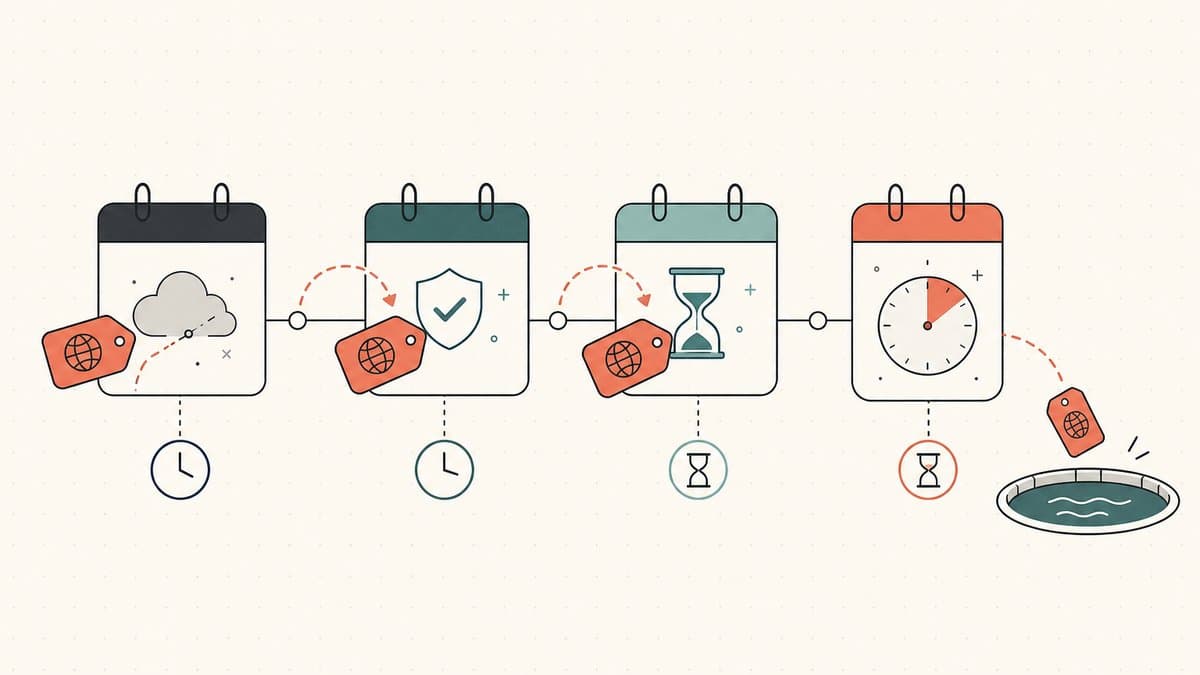
A domain isn't sold once and kept forever. It's registered for a term and has to be renewed, and when an owner stops paying, the name does not necessarily vanish instantly. The path after expiration depends on the TLD, registry, registrar, and whether the registrar routes the name through an expiry marketplace. We cover the full cycle in expired domains and the drop cycle; here's the part that matters for catching.
For gTLDs covered by ICANN's Expired Registration Recovery Policy, a registrar may delete a registration after it expires. Except for sponsored gTLD registries, the registry must then offer a 30-day Redemption Grace Period immediately after that deletion. During this period, the previous registrant can ask the deleting registrar to restore the name, and the registrar must disclose its restore fees. This ICANN policy is for gTLDs; country-code TLDs can have different registry-specific expiration and deletion rules.
If a covered gTLD registration is not restored, it can enter the final pending delete countdown. ICANN's EPP status guidance says a domain in pendingDelete after redemption is purged from the registry database after five calendar days and becomes available for registration. That public drop is the moment catchers wait for. Not every expired name reaches it: some registrars allocate eligible inventory through pre-release or expiry-auction partners before a registry deletion, and ccTLD processes vary.
Drop-catching: winning the millisecond

Drop-catching is the brute-force approach: you (or, realistically, a service acting for you) try to register the name the literal instant it's deleted. Wikipedia's definition is plain — drop catching, also known as domain sniping, is the practice of registering a domain name once registration has lapsed, immediately after expiry.
You cannot win this by hand. Good names are deleted on a predictable schedule, and a crowd of professional services is hammering the registry the same second you are. As the domain-speculation literature describes it, the business of registering the domain names as they are deleted by the registries is known as drop catching. It is a highly competitive business, and the contest is brutally fast: the time between a drop and a capture is often measured in seconds or fractions thereof.
This is why drop-catch services exist and win names you never could from a normal registrar checkout page. The serious catchers hold many registrar accreditations and run server farms aimed at the registry's deletion queue. Wikipedia describes the model simply: these services offer to dedicate their servers to securing a domain name upon its availability, usually at an auction price. That last clause is the part beginners miss. If a service catches a name more than one customer wanted, you don't get it for the registration fee — it goes to auction among the interested backorderers, and a contested catch on a desirable name can clear for hundreds or thousands of dollars. The mechanics of those bidding wars are their own skill, covered in how to win domain auctions.
Backorders: reserving your spot before the drop

A backorder is an acquisition request you place ahead of time. Instead of trying to register a name manually at the drop, you tell a service, "if this name enters your acquisition channel, try to get it for me." For a public pending-delete name, that request normally instructs the service's own drop-catching system; it does not create industry-wide priority over competing catchers. Payment authorization, minimum bids, and when a charge becomes due vary by platform.
Under the hood, a backorder is often fulfilled by the same drop-catching machinery, just pointed at your request. Dynadot, for example, says it tries to catch a pending-delete domain when it is released, gives no guarantee of success, and sends the name to a backorder auction if multiple customers requested it. NameJet similarly treats a backorder as reserved interest and an opening bid if an auction follows. In other words, you are buying or authorizing an attempt under one platform's rules—not a guaranteed domain and not priority over every other service.
There's a second model worth knowing, because it changes who you're competing against. Some registrars never let a name drop into the public pool at all. As the literature notes, certain registrars do not allow domains to drop in the normal fashion, instead introducing an intermediary (e.g., Snapnames and Namejet) that auction the domain prior to their deletion. When that happens, the name never reaches the registry deletion queue you'd be racing for, and the only way to get it is through that registrar's partner auction platform. Knowing whether a name will drop publicly or get diverted to a private expiry auction tells you which service to place your backorder with — and sometimes that you can't catch it at all, only outbid for it.
The services that race for you
Most flippers interact with drop-catching through a handful of platforms. They overlap and specialize by extension, and the right one depends on where a name is registered and which TLD it's in.
- DropCatch is the best-known pure drop-catch platform for
.comand other legacy gTLDs. You backorder a pending-delete name, the service throws its registrar fleet at the deletion, and if more than one user backordered the same name, it settles by auction. It's the default for catching public deletes at scale. - SnapNames and NameJet are the classic expiry-auction intermediaries — the Snapnames and Namejet named above. Their strength is names that never publicly drop because a partner registrar routes its expiring inventory to them first. If a name you want is at one of their partner registrars, this is where it surfaces.
- Dynadot is a full registrar that also runs backorder and expired-auction services, so you can reserve a catch at the same place you'd register normally. For the record, Wikipedia identifies it as an ICANN-accredited domain registrar and web host company founded by software engineer Todd Han in 2002.
- Park.io built its reputation catching newer and country-code extensions — the kind of names where a generalist catcher's coverage is thinner. If you're chasing a name on a less mainstream TLD, a specialist is often the only realistic shot.
The practical move is to figure out, before you authorize an order, how a specific name may become available. Is it heading for a public registry delete, where independent catchers compete, or is it listed through a registrar's pre-release or expiry-auction channel? For a public drop, requests at multiple independent services can improve the chance that one of them wins the registry race. First read each platform's payment, auction, and binding-order rules so you understand what a successful catch obligates you to pay. For exclusive or pre-release inventory, use the platform that actually controls that acquisition channel.
When a backorder is actually worth paying for
Backorders are cheap to place and easy to over-place, which is exactly the trap. Here's the honest filter.
Pay for a backorder when the name is genuinely scarce and you have a specific use. A clean one-word .com, a short brandable, or an exact-match name for a project you're actually building is worth a backorder fee and even a modest auction budget, because if it drops publicly it will be contested and you'll lose it without a catcher. This is also true for an aged name with real, verifiable history — existing backlinks or traffic that survive the handoff — which is a different sourcing channel from hand-registering brand-new names to flip.
Skip it when the name isn't really scarce. If a near-identical string is available to hand-register right now for the price of a normal registration, paying a backorder fee and risking an auction for the expiring version is usually a bad trade. The drop only matters when the specific name is the asset and no substitute will do.
Assume you might lose, and price accordingly. A backorder is an attempt, not a purchase. On a desirable name you can be outbid in the post-catch auction, or out-caught by a service with more firepower. Budget the fee as the cost of a lottery ticket with decent odds, not as a down payment on a name you already own.
Watch the trademark line. Catching an expired name doesn't launder its history. If the string is somebody's brand, the fact that it lapsed doesn't make it safe to grab and resell. The UDRP framework still applies, and an expired trademarked name is exactly the kind of thing that triggers a dispute, as we cover in what is UDRP. Catch generic and brandable names, not lapsed brands.
One more diligence note specific to caught names: an expired domain can carry baggage a fresh registration never would, like a spam history or a Google penalty. Before you bid hard, check its past in the WHOIS and archive record. A name's history transfers with it.
After the catch: actually owning it
Winning the catch is the start, not the finish. The name lands in an account at whatever registrar caught it, and turning that into a clean, sellable asset means getting real control of it — the auth code, the ability to do a cross-registrar transfer to your home registrar, and confidence that the WHOIS and DNS are yours. That handoff is where high-value names get nervous, because the standoff haunts every domain trade: nobody wants to move first.
This is the friction Namefi is built to reduce. Tokenized ownership makes control of a real ICANN domain easier to verify and transfer, with DNS continuity so a caught name keeps resolving cleanly through the handover. When you do resell it, the standard mechanics — listing, pricing, and a neutral escrow handoff — are covered in how to sell a domain name you own and domain escrow explained.
The short version
Drop-catching is the race to register a name when the registry releases it; a backorder is a request for a service to pursue a name through its available acquisition channel. For public deletes, no backorder gives universal priority over competing catchers. Pay or authorize one when the specific name is scarce and you have a real use for it, match the service to the path the name may take, and never treat an attempt as ownership until the name is actually secured in your account. Most of the time, the disciplined answer is to let it go — and that discipline is what separates a portfolio from a renewal bill.
Friendly Disclaimer (Read Me!)
We're not lawyers, accountants, financial advisors, or doctors, and nothing in this article is legal, financial, tax, accounting, medical, or any other flavor of professional advice. We write these posts to educate ourselves and as a convenience for our customers. Info here may be out of date, geography-specific, or just plain wrong. We make mistakes too.
For any important decision, please consult a real professional (seriously!). Or if that's not your vibe, ask a friend, ask Twitter, ask Reddit, ask an AI, or ask a psychic. In short: DYOR - Do Your Own Research. Let's learn and have fun.
Sources and further reading
- ICANN — Expired Registration Recovery Policy and EPP status-code guidance.
- Dynadot — How pending-delete backorder requests, failed catches, and multiple-request auctions work.
- NameJet — Inventory types, pending-delete timing, backorders, auctions, and payment states.
- Wikipedia — Domain drop catching and domain name speculation for historical terminology and industry context.
Contributors

Fenwei Bian is a software developer in her thirties who spends her working hours in pull requests and her weekends with her hands in soil or sawdust. Years of open source on GitHub taught her that names are interfaces: a good one is clear, honest about what it does, and kind to whoever has to use it next.
She gardens because it rewards patience and punishes wishful thinking, and she does woodwork because a joint either fits or it doesn't. Both habits show up in how she writes about naming — measure twice, check the source, and don't sand over a rough spot and hope no one notices.
For Namefi she writes about how domain markets actually move, the practical trade-offs of tokenizing and flipping names, and picking a domain you'll still be glad you own in twenty years.

Victor Zhou is a technology founder and standards editor focused on digital identity and trust. He founded Namefi, edits Ethereum Improvement Proposals, and previously led smart-contract architecture work at Google Labs.
His work sits at the intersection of naming, ownership, and the systems people use to establish identity online. That perspective makes him especially interested in the way names move between personal meaning, public recognition, and digital infrastructure.
For Namefi, Victor edits and writes about domains as durable digital identity: how names become ownable onchain assets, how tokenization changes custody and trust, and what naming can learn from the systems people use to establish identity online.
Related guides
- What Is Domain Parking? Parked Domains and MonetizationLearn what a parked domain is, why people park domains, and how parking, sale landing pages, and monetization differ.
- End-User Price vs Reseller Price: Why One Domain Has Two NumbersWhy a domain has a low wholesale/reseller price and a much higher end-user price, how big the spread is, and which number applies to your sale.
- Expired Domains and the Drop Cycle, ExplainedHow a domain expires and drops: grace period, the 30-day redemption window, 5-day pending delete, release — and where dropped names surface for flippers.
- Inbound vs Outbound Domain SalesInbound vs outbound domain sales: when each works, the effort-and-return tradeoff, and how to run both without your outreach reading as spam.