What Is a Domain Name? Examples, Structure, and URLs
Understand domain names, root, TLD, second-level domains, subdomains, registration boundaries, and the difference between a domain and a URL.


- faq
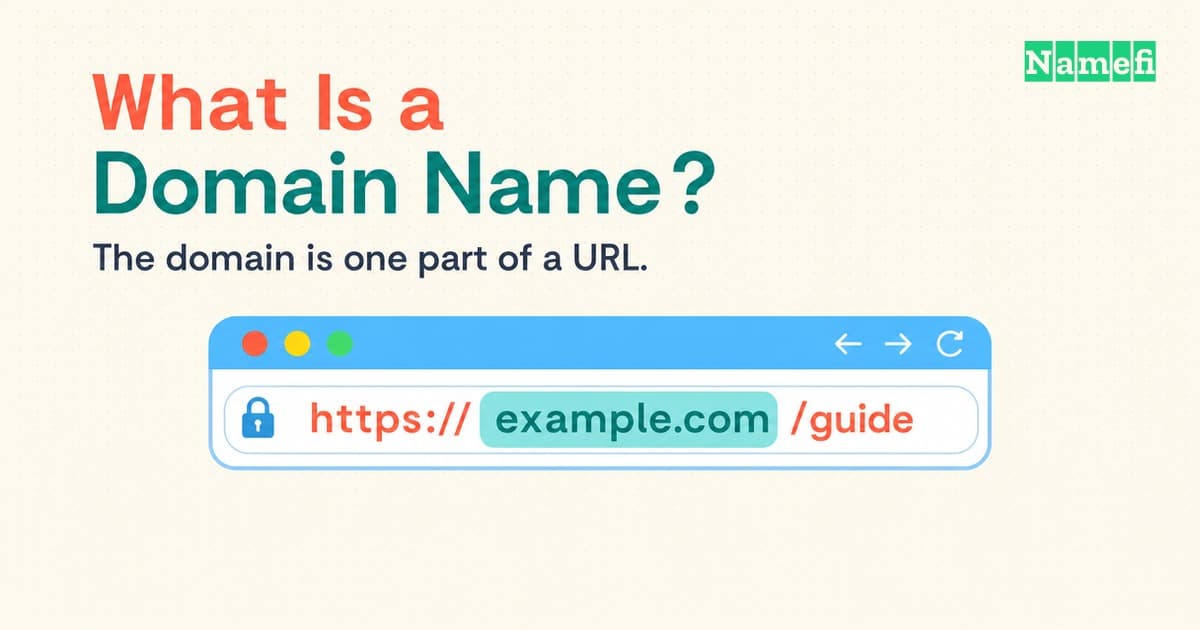
A domain name identifies a place in DNS
A domain name is a name such as example.com or namefi.io. People use domain names to reach websites and email services. A domain name does not include https:// or a page path.
The Domain Name System (DNS) associates names with records. Address records can supply IP addresses for a website. Other records support services such as email. Registration alone does not supply website hosting or a mailbox. RFC 1034 describes names, records, name servers, and resolvers.
Domain levels run from the root to more specific names
Read the following example from right to left: blog.example.com.. Each dot separates labels, and the final dot represents the root. Ordinary web addresses usually omit the final dot. RFC 1034, section 3.1, defines the hierarchy.
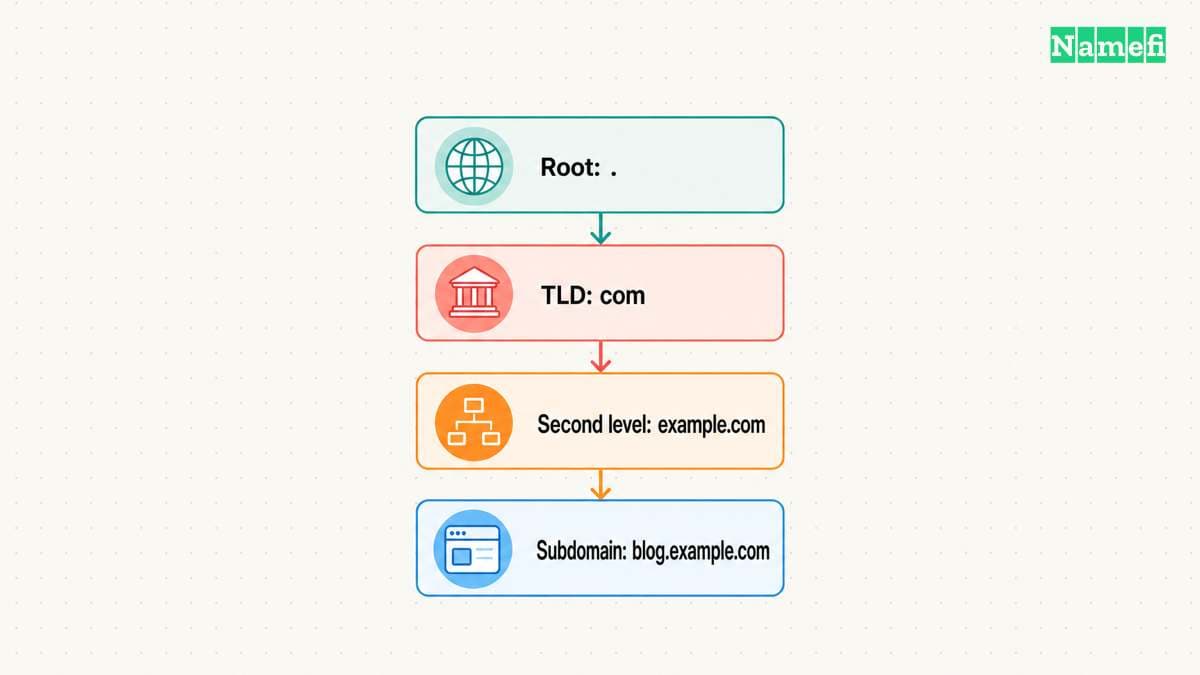
| Level | Complete name | Meaning |
|---|---|---|
| Root | . | The common starting point above all TLDs |
| Top level | com. | A domain directly below the root |
| Second level | example.com. | A domain directly below com. |
| Third level | blog.example.com. | A domain directly below example.com. |
The label example selects a child under com. The complete second-level domain name is example.com, rather than the label alone. A fourth level could be support.blog.example.com.
A subdomain describes a relationship to a parent domain. blog.example.com is a subdomain of example.com. More broadly, example.com is also below com. A subdomain need not identify a separate website. JPNIC explains domain hierarchy and DNS delegation.
TLD categories do not add another domain level
A top-level domain sits directly below the root. Generic TLDs include .com and .org. Country-code TLDs include .uk, .de, and .jp. The IANA root database lists TLD types and operators.
A country-code TLD is still a top-level domain. The word “country” describes the category, rather than a separate level. The TLD guide covers extension types and selection in more detail.
The registrable domain can sit below the second level
DNS depth and registration boundaries answer different questions. In example.com, the registrable domain spans two labels. In example.co.uk, uk is the TLD, co.uk is second level, and example.co.uk is third level. Nominet shows both .uk and .co.uk registration formats.
Do not assume that the last two labels always identify the registrable domain. Registration policy determines the boundary. A public suffix can contain several labels. RFC 9499 explains why the name alone cannot identify a public suffix.
A URL includes more than a domain name
Consider https://blog.example.com/guides/domains?lang=en:
| Component | Example | Purpose |
|---|---|---|
| Scheme | https | Selects the connection scheme |
| Hostname | blog.example.com | Identifies the host in this example |
| Registrable domain | example.com | Identifies the registration boundary in this example |
| Path | /guides/domains | Identifies a resource on the host |
| Query | lang=en | Supplies a parameter for the website |
The path and query do not change the DNS hierarchy. MDN describes URL components. For a site layout decision, compare subdomains and subdirectories.
Registries and registrars have different responsibilities
A registry operates a domain registry. A registrar handles registrations for customers. ICANN accredits registrars and maintains gTLD registry agreements. Country-code registries have their own arrangements.
For a gTLD registration, use an ICANN-accredited registrar or a reseller working through one. Check availability, eligibility, registration terms, and renewal costs before paying. Registration gives rights under the registration agreement. Keep the registration current and configure DNS for the required services.
A domain registration has one registrant at a time. The registrant can authorize another person or service to use the name. Registration does not reserve the same label under every TLD.
These sources explain domain names and their boundaries
Sources checked on 2026-10-21:
- IETF: RFC 1034, sections 2.4 and 3.1.
- IETF: RFC 9499, section 9.
- JPNIC: Domain name structure.
- IANA: Root zone database.
- Nominet: Domain lookup examples.
- MDN: What is a URL?.
- ICANN: Accredited registrars and registry listings.
Contributors
Fenwei Bian is a software developer in her thirties who spends her working hours in pull requests and her weekends with her hands in soil or sawdust. Years of open source on GitHub taught her that names are interfaces: a good one is clear, honest about what it does, and kind to whoever has to use it next.
She gardens because it rewards patience and punishes wishful thinking, and she does woodwork because a joint either fits or it doesn't. Both habits show up in how she writes about naming — measure twice, check the source, and don't sand over a rough spot and hope no one notices.
For Namefi she writes about how domain markets actually move, the practical trade-offs of tokenizing and flipping names, and picking a domain you'll still be glad you own in twenty years.
Victor Zhou is a technology founder and standards editor focused on digital identity and trust. He founded Namefi, edits Ethereum Improvement Proposals, and previously led smart-contract architecture work at Google Labs.
His work sits at the intersection of naming, ownership, and the systems people use to establish identity online. That perspective makes him especially interested in the way names move between personal meaning, public recognition, and digital infrastructure.
For Namefi, Victor edits and writes about domains as durable digital identity: how names become ownable onchain assets, how tokenization changes custody and trust, and what naming can learn from the systems people use to establish identity online.