Free Domain Offers Differ in Renewal Costs and Account Control
Compare free subdomains and first-year domain offers. Check eligibility, renewals, account control, cancellation, and transfer options before signing up.

- domains
- domain-basics
- guide
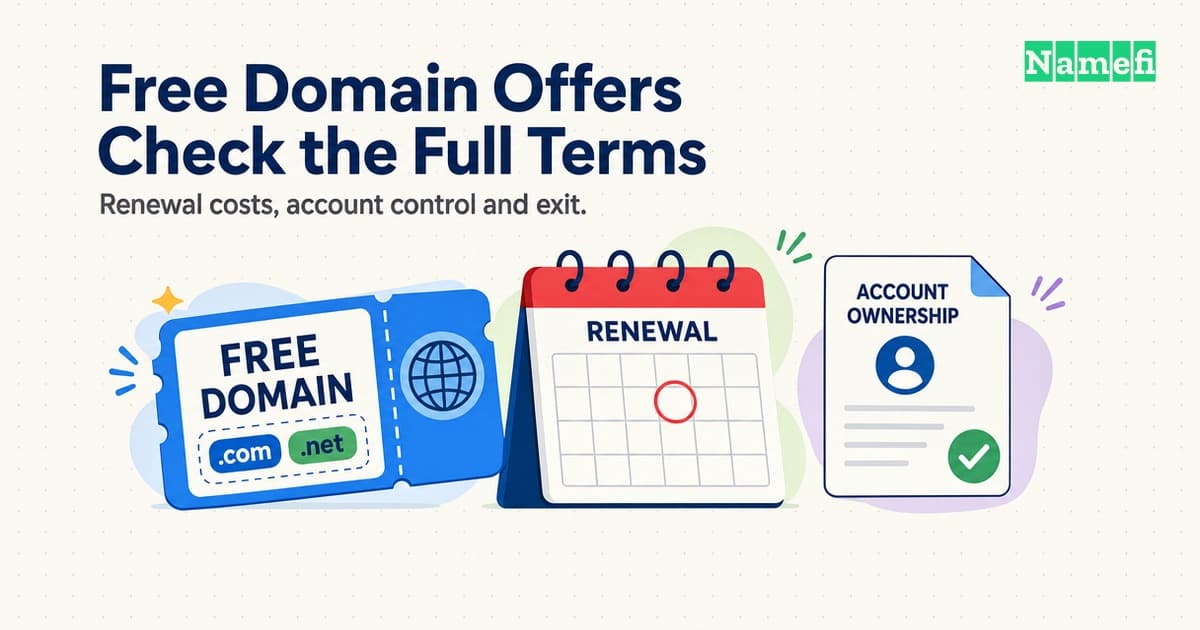
A free domain offer can remove an initial registration charge. The offer can also require a paid plan, limit eligible names, or provide a provider-controlled address instead.
The useful question is what the offer includes after checkout. Identify the address type, calculate later costs, and confirm who can manage the registration. Then test what happens when the website plan ends.
A genuine discount can suit a project. A discount becomes less useful when the project needs a different host or cannot afford renewal. This guide compares those decisions rather than ranking providers by an advertised zero.
The address determines what the offer provides
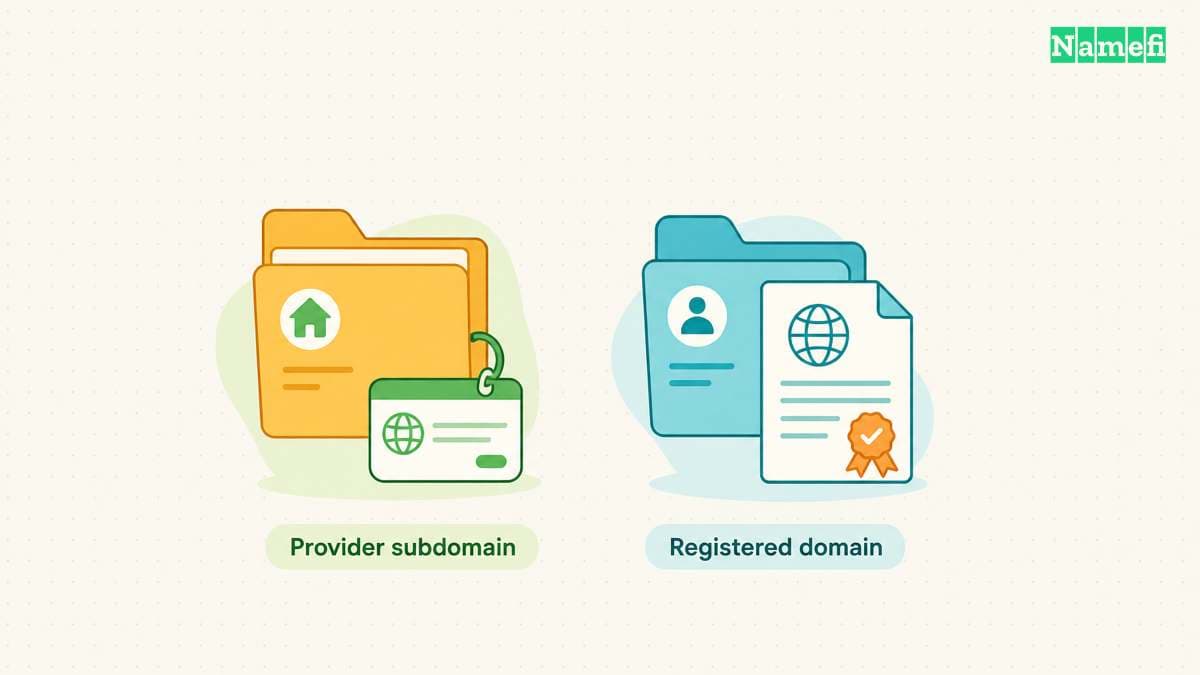
Start with the complete address. A subdomain under a provider's domain differs from a separate domain registration assigned to your account. Both can display a website, but the administrative arrangements differ.
GitHub Pages provides a clear example. GitHub documents default user and organization addresses under github.io, plus project addresses that add a repository path. GitHub also supports a separately configured custom domain. Public repositories can use Pages through GitHub Free. See GitHub's address and availability documentation.
A provider address does not give your project a separate registration for the provider's parent domain. A hypothetical address such as studio.example.com illustrates the relationship. The organization that administers example.com controls the parent domain. Your project needs the provider's permission and supported features to use the assigned address.
A custom registration creates a different question: who holds the registration and which registrar manages the registration? A zero registration charge does not answer either question. Ask for the registration agreement and identify the responsible account before accepting the offer.
| Offer | Initial benefit | Check first |
|---|---|---|
| Provider subdomain | Address under provider domain | Continued use and migration options |
| Bundled registration | Promotional registration period | Required plan and later renewal |
| Eligibility credit | Discount after qualification | Qualification and redemption deadline |
The table describes offer categories, not promises about every provider. A student credit, for example, requires the program's current eligibility terms. Do not assume that an offer for students covers alumni, businesses, or every country.
For a short demonstration, a provider address can meet the entire requirement. The project may need only a link that participants can open. A project that expects printed materials or long-term customer email has a different requirement. Record that requirement before comparing promotions.
Read our domain and hosting comparison if a checkout combines the address, website editor, hosting, and email. Write each service on a separate line. A service bundle can simplify administration, but a bundle does not erase the distinction between services.
The checkout terms determine the actual savings
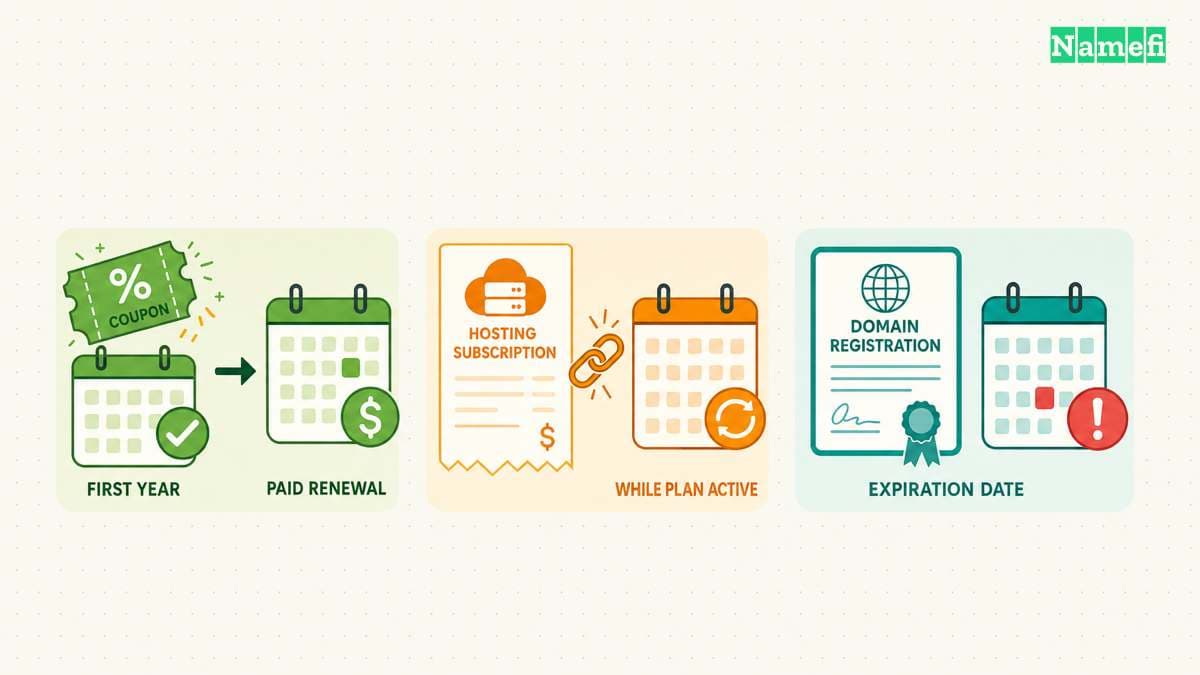
Read the promotion before choosing the billing period. A monthly price shown on a marketing page may describe an annual commitment. Record the amount due today and the length of the commitment from the checkout itself.
Wix offers a current example of a conditional registration promotion. Selected first-time yearly or multi-year site plans include a one-year domain voucher. Wix gives the voucher a two-month redemption window and requires payment details for subsequent renewal. The voucher excludes privacy protection. Check Wix's voucher terms and FAQs for the eligible extensions and purchase conditions.
WordPress.com uses different terms. A new annual plan includes a credit for a first registration year or an eligible incoming transfer. Monthly plans do not qualify, and the credit does not expire. The credit cannot renew a domain already registered at WordPress.com. See WordPress.com's free-domain credit rules.
The following comparison reflects the providers' published terms checked on October 21, 2026. The linked terms govern the exact purchase.
| Decision | Wix voucher | WordPress.com credit |
|---|---|---|
| Redemption deadline | Two months after plan purchase | Credit does not expire |
| Existing domain | Eligible transfer into Wix | Eligible transfer adds a registration year |
| Domain bought before plan | No retroactive voucher or refund | .com, .blog, .net, and .org can receive an upgrade credit |
| Later registration years | First year only | Standard renewal price after the first year |
Sources: Wix voucher FAQs and WordPress.com credit terms. The purchase-order difference matters: buying a domain before choosing the plan can change the discount.
These examples show why a generic free-domain checklist needs provider-specific answers. One promotion's deadline cannot stand in for another promotion's deadline. Save the terms that apply to the actual plan and purchase date.
Build a cost comparison over the period that the project expects to operate. Include the required website plan, subsequent domain renewals, and optional services that the project actually needs. Include taxes and currency differences when the checkout applies those charges. Compare equivalent services rather than a bundle against an unrelated registration price.
Use a simple worksheet without guessing future prices:
| Item | Bundled offer | Separate registration |
|---|---|---|
| Initial payment | Actual qualifying checkout | Actual selected checkout |
| Later domain renewal | Current renewal quote | Current renewal quote |
| Required website plan | Commitment and renewal quote | Host selected separately |
| Optional services | Only required additions | Same required additions |
A simple calculation can reveal the commitment. Suppose a fictional bundle costs $120 for one year and includes the domain's first year. Suppose equivalent separate hosting costs $80 and the registration costs $15. The separate total is $95, so the bundle costs $25 more despite the free domain. These figures illustrate arithmetic, not provider prices. Compare actual features and renewal quotes before choosing.
Current quotes support a planning scenario, not a guarantee of future charges. Record the quote date and currency beside the worksheet. Recheck the amounts before renewal or a new commitment.
The comparison also needs a cancellation scenario. Ask what the provider refunds if the website plan proves unsuitable. Ask whether keeping the domain reduces the plan refund. Ask whether a promotion requires a particular purchase order or a separate redemption step.
WordPress.com states that customers who cancel a qualifying plan can keep the domain for the remaining registration period. Keeping the domain can reduce an otherwise eligible refund by the registration cost. The provider specifies separate refund windows in the cancellation FAQ.
A hypothetical team might already prefer the qualifying website plan after testing the editor. The domain credit then reduces an expense associated with the chosen setup. Another team might purchase an unsuitable annual plan solely for the credit. The second team should compare the extra commitment with the registration saving before paying.
Do not choose a spelling or extension solely because a voucher covers the name. Read the proposed address aloud and ask another person to type the address. Check whether the exact name qualifies before approving payment. A promotional extension list does not establish availability for a particular registration.
A lifetime claim needs a defined renewal obligation
Treat “lifetime” as a term to investigate. Ask whose lifetime the contract means, which subscription must remain active, and who pays each domain renewal. Ask what happens after cancellation or a provider shutdown. Keep the answers with the registration agreement.
A long prepaid registration is also a different arrangement from perpetual registration. WordPress.com, for example, permits most domain registrations to extend to a maximum of ten years. See the multi-year renewal instructions. The account still has an expiration date after a multi-year payment.
For an offer that includes renewals while hosting continues, add the required hosting renewals to the cost worksheet. A continuing bundle benefit can be useful. The benefit still needs a cancellation plan and a named person responsible for keeping the registration active.
The account determines who can keep and move the domain
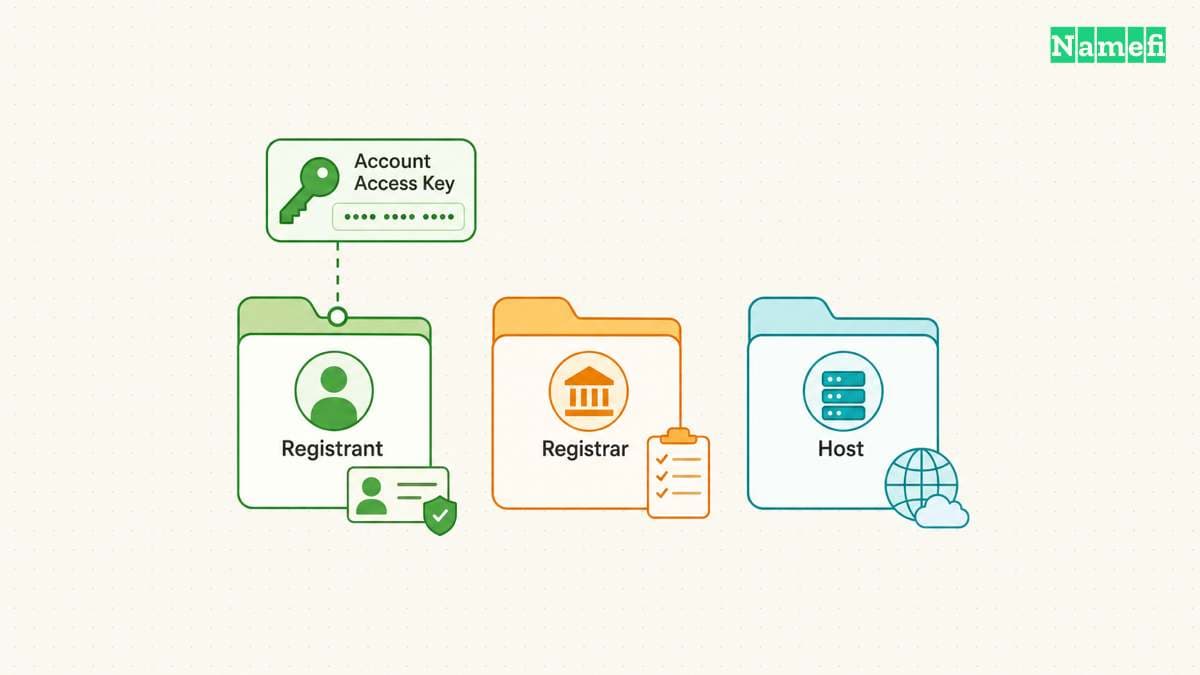
Separate website editing permission from registration control. A contractor may need access to page content without becoming the only person who can renew the domain. Decide who should hold the registrant role and who should operate the account.
Before launch, ask the provider to identify the domain-owning account and the registrar. Confirm the organization's contact details through the supported account process. Assign responsibility for renewal and recovery. Record the provider's support route where another authorized administrator can find the instructions.
WordPress.com explicitly says that only the account owning the domain can renew the domain. Website administrator access alone therefore does not settle renewal responsibility. See the renewal guide's account requirement.
Treat recovery as part of the purchase decision. Check available authentication options and recovery methods before placing a business address in the account. Store recovery information through the organization's approved process. Avoid making one departing contractor the only person who understands the account arrangement.
Ask about three separate operations: changing the website host, changing the registrar, and changing the registrant. The operations solve different problems. A website migration does not necessarily require a registrar transfer, and a registrar transfer does not rebuild a website.
ICANN's transfer FAQ identifies circumstances that can restrict transfers between covered registrars. A registrar may deny a transfer within 60 days of initial registration or a previous transfer. A change-of-registrant lock follows specific rules, including an optional advance opt-out where the registrar offers one. These rules do not arise merely because a promotion used the word free. Read ICANN's transfer FAQ, questions 3 and 8.
The same FAQ explains the authorization code for covered registrar transfers. Check the current registrar's supported process for obtaining the code. Keep the code private. Country-code domains and other naming arrangements require their own applicable transfer terms.
A transfer restriction should prompt a precise diagnosis. Ask the registrar for the reason, relevant dates, and available next steps. Do not respond by repeatedly changing contact details without understanding the consequences. Check whether the immediate project needs a hosting change instead.
Our registrar transfer guide covers the operational transfer process in more detail. For offer selection, the key question is whether the provider explains that process before purchase. An unclear support answer leaves an unresolved requirement even when the registration charge equals zero.
Control also includes configuration. Ask whether the plan supports the records and nameserver changes that the project expects to need. Request documentation for connecting an external email provider or another website host. Do not infer those capabilities from a domain search box.
A renewal and exit plan keeps the offer useful
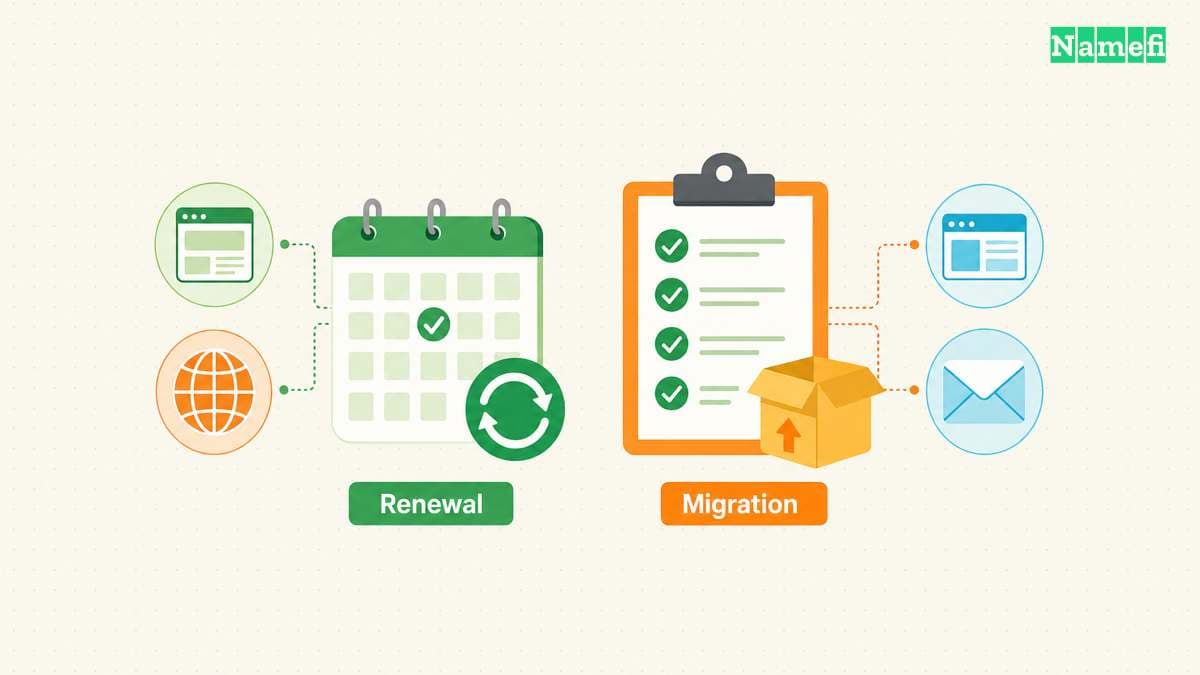
Create a small domain record immediately after purchase. Record the exact name, provider, registrar, owning account, expiration date, and current renewal settings. Record the website plan separately. Include the voucher redemption confirmation when the promotion requires redemption.
Check the receipt against the account display. Confirm that the account shows a completed domain registration rather than an unused credit or an uncompleted checkout. If the purchase looks incomplete, contact support before placing the address on customer materials.
Domain renewal deserves a separate reminder from website renewal. WordPress.com documents the distinction explicitly: a customer can cancel hosting while maintaining the domain through domain-only renewal. WordPress.com also provides independent automatic renewal controls. See the domain renewal instructions.
Set reminders early enough to review the renewal quote and resolve account access problems. Confirm that the payment method and renewal contact remain appropriate. Automatic renewal can reduce manual work, but an enabled setting does not replace an accountable person and a review process.
Before cancelling a plan, write the desired result in plain language. For example: keep example.com, move the website, and preserve email service. Ask support which subscriptions and settings that result requires. A precise request helps prevent cancellation of a service the project still needs.
Prepare the destination website before changing live configuration. Preserve the existing domain records and identify which records serve email or verification. Follow the destination provider's current instructions for the exact service. Do not replace the whole configuration merely because a setup screen shows one website record.
Test the website and email after any planned change. Check the public address, expected pages, incoming mail, and outgoing mail as applicable. Keep the previous service available during the planned transition when the contract permits that approach. Use the project's saved configuration to diagnose unexpected failures.
If an invoice surprises the team, identify the billed item before disabling renewal. The charge may concern the domain, website plan, email service, or an optional feature. Match the invoice to the purchase record. Then choose whether to renew, migrate, or discontinue that particular service.
A free domain offer earns a place in the project when the address, commitment, renewal, and control meet the project's requirements. Keep the offer when the full arrangement works. Choose another arrangement when the discount requires a compromise that the project cannot accept.
Sources and further reading
- GitHub — What is GitHub Pages?, “Who can use this feature?” and “Types of GitHub Pages sites.” Fetched 2026-10-21.
- Wix — About Your Free Domain Voucher, introduction, “Claiming the voucher,” and FAQs. Fetched 2026-10-21.
- WordPress.com — Register a free domain, “Receive a free domain credit” and cancellation FAQ. Fetched 2026-10-21.
- WordPress.com — Renew a domain name, automatic renewal, manual renewal, and account ownership instructions. Fetched 2026-10-21.
- ICANN — FAQs for Registrants: Transferring Your Domain Name, questions 3, 6, and 8. Fetched 2026-10-21.
About the author(s)
Namefi is a collective of engineers, designers, and operators who obsess over building tools that make managing your onchain domain names effortless.