Two Addresses, One Vote: The Websites of the HP-Compaq Proxy Fight
In 2002, both sides of the HP-Compaq proxy fight ran voting websites. Filings show what each address argued, and archives show where both names went.


- domains
- history
- branding
- campaign-domains
At 6:30 on the morning of March 19, 2002, Walter Hewlett was due on a telephone call with a small committee at Deutsche Bank's asset-management arm. Carly Fiorina, the chairman and chief executive of Hewlett-Packard, was due at 7:00. The committee had already decided to vote its HP shares against the purchase of Compaq Computer. After both sides spoke, it voted again. The second ballot was 4-1 in favor of the merger.
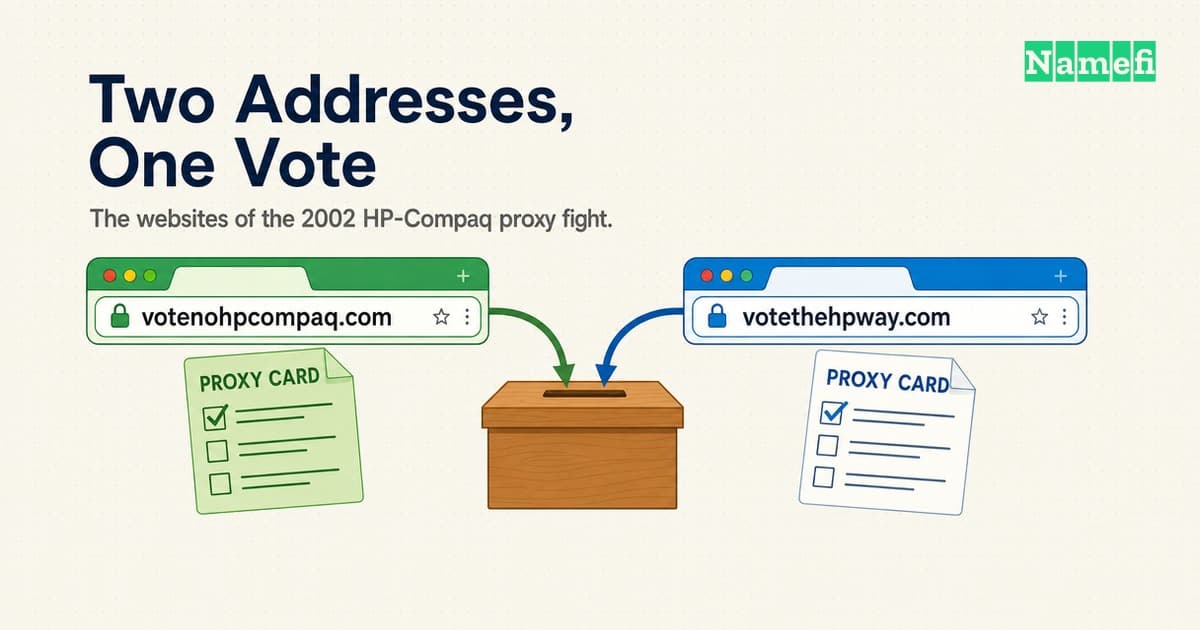
Most shareholders never heard that call. They had the mail, the newspapers and two web addresses. PBS NewsHour named both of them on March 19, reporting that the two camps had set up Web sites for their cause. One was votenohpcompaq.com. The other was votethehpway.com.
No source found for this article measures how many shareholders visited either site, or shows that either site moved a single share. The addresses matter for a smaller reason. Each one put an argument into a line a stockholder could type. Then the vote ended, and the names had to go somewhere.
A family dispute became a vote of shares
HP announced the Compaq deal on September 4, 2001. Walter Hewlett, a director since 1987 and the son of co-founder William R. Hewlett, joined the board's unanimous approval, according to eWeek. On November 6 he announced his opposition.
The fight that followed was fought in stockholder language. HP's proxy card was white. Hewlett's was green. His campaign counted more than 18% of the shares on its side, including the Hewlett trust and foundation and the David and Lucile Packard Foundation, which it said had reached its decision independently. Both camps took full-page newspaper advertisements and sent repeated mailings. At the meeting, one shareholder complained about the volume, and Fiorina answered, according to HP's own account, "I know all of us will be relieved when the mailman stops coming."
The websites sat inside that paper system. Both camps filed pieces of their web material with the Securities and Exchange Commission, so their ownership can be read today from documents instead of guessed from design.

Walter Hewlett's campaign put the deal in its address
The earliest capture of votenohpcompaq.com found in the Internet Archive dates from February 1, 2002. Its page holds almost nothing. The title is the hostname, and a single frame pulls in a page from another domain, transactioninfo.com/hpcom. The archive does not say who operated the second host.
What loaded inside the frame was a signed letter under the words "Vote No on HP Compaq." It said: "We oppose this transaction." It told stockholders to vote against the deal and return the green card, and it closed "Very truly yours, Walter B. Hewlett." The same page settled the ownership question in one line of legal text, naming "the Filing Persons' website at www.votenohpcompaq.com." The Filing Persons were Hewlett, Edwin E. van Bronkhorst and the William R. Hewlett Revocable Trust.
The site offered SEC filings, stockholder letters and a summary of the campaign's case. PBS noted an interview with Walter Hewlett, and the home page linked to one. Even a small addition went to the SEC. On February 25, the group filed a note describing a link "that will be added to each page of the website", with the text of a form to join the VoteNoHPCompaq mailing list.
Read as a name, votenohpcompaq.com is an instruction and a target, and it does not mention a family. That reading is this article's. The filings reviewed here give no account of how the name was chosen.
HP's address claimed the founders' tradition
HP's filings were just as direct about the other site. A newsletter filed in February describes HP's external web site, www.VotetheHPway.com, and says subscribers received it by e-mail through the site. The earliest captures of its pages found in the Internet Archive date from February 5, 2002.
A capture from later in February shows a visitor meeting a page of forward-looking-statement disclosures and a "continue" link before the pitch itself. That capture also carries a query tag, venue=nytimes. No filing explains the tag. It resembles a way to track visitors from a newspaper advertisement, but that is inference.
Past the disclaimer, HP made its business case. The site's argument promised annual cost savings of $2.5 billion and a 13% rise in earnings per share in the first year, figures HP presented as projections and qualified with references to its filings. A section titled "hear from the board" offered video on four subjects, the merger, change, the future and "the hp way," with transcripts from five directors.
That last subject carries the phrase in the address. In a transcript on the site, director George Keyworth said he had been mentored by David Packard, and that he believed Packard would look at the deal and "say let's go for it." Director Dick Hackborn recalled being told that the laser printer business was "not an HP way of business," then said that Hewlett and Packard "loved the business." HP's argument was that the tradition meant reinvention. Fiorina had said so to employees in November: "innovation and reinvention are fundamental to the HP Way."
The address does the same work in fewer letters. It leaves Compaq out and puts the company's tradition where a reader might expect the deal. Again, that reading is this article's. No filing reviewed here explains the choice.
Both sides fought over the same three words
Hewlett's campaign wanted the phrase too.
A February letter filed with the SEC quoted David Packard's own book, The HP Way: "More companies die of indigestion than starvation." The same letter carried a line the campaign repeated in later material: "A $25 BILLION MISTAKE IS NOT THE HP WAY." A Field Research poll of HP employees in the Corvallis, Oregon area, commissioned by David W. Packard and filed by the Hewlett group, listed "the merger runs counter to the HP way" among the reasons that opposed employees volunteered. Thirteen percent of them gave a reason in that category.
When Hewlett spoke at the special meeting in Cupertino, he said "the HP Way is not a relic of another time." The record of that sentence comes from HP, in a newsletter it filed with the SEC. The same newsletter reports thunderous applause and a standing ovation for him. The Associated Press wrote that Fiorina was booed.
One side had the phrase in its address, and the other had it in its advertising. Both claimed the tradition of two founders who were no longer alive to settle it.
The lawsuit reached back to a telephone call
The committee on that morning call became one of two subjects of a lawsuit in the Delaware Court of Chancery.
Chancellor William B. Chandler III's post-trial opinion sets out the chronology. On March 15, the Deutsche Bank committee decided to vote its HP shares against the merger. HP's proxy solicitor told Fiorina he had heard rumors of that vote. On the night of Sunday, March 17, she left a voicemail for chief financial officer Robert Wayman, later leaked to the San Jose Mercury News, saying HP might have to do "something extraordinary" to secure the vote. A senior Deutsche Bank investment officer agreed to a call on Tuesday morning, on the condition that both sides could present.
HP had agreed to pay Deutsche Bank $1 million, with another $1 million if the merger closed, for work on the proxy contest, and the bank was a co-arranger on HP's new credit facility. The opinion treats the credit negotiations as apparently unrelated to the merger.
Hewlett sued on March 28, alleging that the bank had been pressured into switching about 17 million shares and that HP had misstated the progress of integration. HP called the claims baseless. On April 8 the Chancellor refused to dismiss the case, noting that the alleged switch could have decided a thin vote. The complaint also suggested that Fiorina had delayed the meeting to wait for word from the bank. HP's newsletter gave a different reason, and at trial the court recorded a late start caused by long lines and heightened security.
On April 30, after a three-day trial, the Chancellor ruled for HP. The court had a recording of the call. Fiorina's closing words included "It is of great importance to our ongoing relationship," which the plaintiffs offered as the coercion. The Chancellor found otherwise, writing that the statement did not show an attempt to coerce the bank. One detail in that passage belongs to the story of persuasion: the committee's questions, he wrote, had in part been "prompted by concerns raised just minutes before by Walter Hewlett's presentation." He concluded that the plaintiffs had failed to prove either claim. Hewlett chose not to appeal.
The certified count confirmed a narrow result
HP announced the figures from the inspectors' final report on May 1, 2002, and repeated the figures in its quarterly report.
| Result | Shares |
|---|---|
| For | 838,401,376 |
| Against | 793,094,105 |
| Abstained | 13,950,651 |
The margin was 45,307,271 shares. That is about 51.4% to 48.6% of the shares voted for or against, the same split eWeek reported from the preliminary tally. Fiorina had called it "slim but sufficient." Hewlett had already lost his board seat at the April annual meeting. PLANSPONSOR reported that this was the first time in the company's 63-year history that no member of the founding families sat on the board. HP said it expected to close on May 3 and launch the combined company on May 7.
The winner's address stayed on company pages longer

The captures suggest that HP folded its address into the company. By May 28, 2002, votethehpway.com was showing "Welcome to the new HP." Later captures show it serving HP's regular pages, including the United States home page in February 2005.
Hewlett's address had no company to absorb it. Its last campaign capture is dated April 2, 2002. The next home-page capture, more than a year later, is a redirect. Both addresses then show unrelated pages.
| Capture | Address | What the archive shows |
|---|---|---|
| July 2003 | votenohpcompaq.com | Redirect to beepworld.de, a German free-homepage service |
| January 2006 | votethehpway.com | Redirect to a made-in-china.com product directory |
| July 2013 | votenohpcompaq.com | A Russian-language personal site |
| February 2015 | votenohpcompaq.com | A Japanese information site about hair loss |
| May 2019 | votenohpcompaq.com | A Japanese page whose title says that younger people need to vote |
| June 2022 | votethehpway.com | "Buy this domain." |
| May 2023 | votenohpcompaq.com | "The domain has expired and may be available at auction" |
The record is silent on the moments that matter most. No source found here says when either original registrant let go of a name, why, or who held it in any given year. The HP filings reviewed here do not discuss it. The archive shows pages, not owners. Current registry records through RDAP show only the present registrations: votethehpway.com since May 18, 2021, and votenohpcompaq.com since August 1, 2023, both at the registrar Spaceship. Those records name the registrar and not the registrant, so nothing in them connects the present holders to either campaign.
As of November 3, 2026, votenohpcompaq.com shows a parked page saying the domain may be for sale. Votethehpway.com is a WordPress site about post-merger integration, with articles on leadership, HR and customer experience. The home page does not mention Hewlett-Packard or Compaq. Integration was one of the two subjects that took the sides to trial in Delaware.
The filings still point to the old addresses
Hewlett's filing about "the website located on the Internet at www.votenohpcompaq.com" and HP's newsletter about its "external web site" are still in the SEC's archive. Filings do not expire. Domain registrations do. A reader who follows either address out of a 2002 document now reaches whatever the current holder has chosen to put there.
A contest ends, and the address loses its purpose. The gap that opens is the plain lesson of this story for anyone who prints a name in a document that will outlast the campaign: a domain carries an argument only as long as someone keeps renewing it. After that, the same letters belong to the next holder. At Namefi, that is the everyday question behind any name: who will hold it next year, and what will it say?
HP's merger went ahead on a margin of 45 million shares. The record cannot say what the addresses contributed to that result. The tally records how shares were voted, and the two names record what each side wanted those shares to mean.
Sources and further reading
- Court of Chancery of Delaware — Hewlett v. Hewlett-Packard Co., C.A. No. 19513-NC, redacted post-trial opinion, April 30, 2002, archived copy of the PDF linked by eWeek. Slip opinion pp. 7-8, 25-28, 41-43 (PDF pp. 8-9, 26-29, 42-44). Scanned image, read page by page. Supporting passage (p. 43): "plaintiffs have failed to prove that HP management improperly enticed or coerced Deutsche Bank" — fetched 2026-11-03
- Court of Chancery of Delaware — Hewlett v. Hewlett-Packard Co., opinion denying motion to dismiss, April 8, 2002 — fetched 2026-11-03
- Hewlett-Packard, Form 8-K Exhibit 99.1 — HP Announces Certified Vote Tally on Compaq Merger Proposal, May 1, 2002 — fetched 2026-11-03
- Hewlett-Packard, Form 10-Q — Quarter ended April 30, 2002, Part II, Item 4 — fetched 2026-11-03
- Hewlett-Packard, Rule 425 filing — VotetheHPway newsletter, February 25, 2002 — fetched 2026-11-03
- Hewlett-Packard, Rule 425 filing — Account of the special meeting, March 20, 2002 — fetched 2026-11-03
- Hewlett-Packard, Rule 425 filing — Fiorina message to employees, November 2001 — fetched 2026-11-03
- Walter B. Hewlett and others, Form DFAN14A — Website link and mailing-list form, February 25, 2002 — fetched 2026-11-03
- Walter B. Hewlett and others, Form DFAN14A — Letter quoting The HP Way, February 14, 2002 — fetched 2026-11-03
- Walter B. Hewlett and others, Form DFAN14A — Stockholder material, February 21, 2002 — fetched 2026-11-03
- Walter B. Hewlett and others, Form DFAN14A — Field Research employee polls, March 1, 2002 — fetched 2026-11-03
- Internet Archive — votenohpcompaq.com, February 1, 2002 and its framed page, April 2, 2002 — fetched 2026-11-03
- Internet Archive — votethehpway.com, February 17, 2002 and "why support this merger," April 5, 2002 — fetched 2026-11-03
- PBS NewsHour — Disputed Merger Deal, transcript, March 19, 2002 — fetched 2026-11-03
- The Associated Press via Southeast Missourian — H-P chief claims win in Compaq merger vote, March 19, 2002 — fetched 2026-11-03
- eWeek — Hewlett Sues HP Over Vote Solicitation Tactics, March 28, 2002, Judge Clears HP of Misconduct, April 30, 2002 and Hewlett Won't Appeal Ruling, May 1, 2002 — fetched 2026-11-03
- PLANSPONSOR — Hewlett Bounced From HP Board, April 29, 2002 — fetched 2026-11-03
- Verisign RDAP — votethehpway.com and votenohpcompaq.com, registration events — fetched 2026-11-03
Contributors
Aileen Wright is a student in her twenties living in New York City, where the distance between a museum wall and a library reading room is a short walk and a long afternoon. She came to name writing through art and history — the way a single portrait, coin, or manuscript margin can carry a name across centuries and change its meaning on the way.
Most weeks you can find her in Central Park with a paperback, or in the quiet of a public reading room chasing down where a name actually comes from rather than what a name-list says it means. She is also teaching herself to code, which has made her oddly precise about spelling, sorting, and the small details that decide whether a name ages well.
For Namefi she writes about the history and culture behind domain names, the stories brands carry as they rename, and the difference between a good story and a verified source.
Victor Zhou is a technology founder and standards editor focused on digital identity and trust. He founded Namefi, edits Ethereum Improvement Proposals, and previously led smart-contract architecture work at Google Labs.
His work sits at the intersection of naming, ownership, and the systems people use to establish identity online. That perspective makes him especially interested in the way names move between personal meaning, public recognition, and digital infrastructure.
For Namefi, Victor edits and writes about domains as durable digital identity: how names become ownable onchain assets, how tokenization changes custody and trust, and what naming can learn from the systems people use to establish identity online.