
Why a DAO Should Control the Main Domain
The main domain is a critical control point for an online movement. Here is how a DAO can govern it while preserving legal, registrar, DNS, security, and operational safeguards.
- governance
- dao
- web3
- namefi space

By the Namefi Team — June 2026
Most of the time, nobody asks who is in charge. The work gets done, the site stays up, the votes pass, and the question of ultimate authority stays politely unexamined. Then something breaks — a contested decision, a money dispute, a schism — and suddenly the only question that matters is the one nobody wanted to answer out loud: who actually speaks for this thing?
That is a constitutional-crisis moment. For an online movement, courts, charters, legal entities, governance votes, service providers, and technical access can all matter. The main domain is one especially visible control point because it shapes where users encounter the project.
The constitutional-crisis moment
A constitution is the document nobody needs to read in calm weather. You can run a country, a company, or a community for years without anyone consulting it. Its job is to sit there, boring and ignored, until the day the normal rules run out — a disputed election, a contested succession, a leader who won't step down — and everyone reaches for it at once to answer a single question: when we disagree about who decides, who decides?
The crisis is never really about the immediate fight. It is about legitimacy — who is authoritative, who is recognized, who gets to stand at the center of the stage and say "I speak for us" while everyone else accepts it. Countries answer this with constitutions, courts, and elections. The answer is rarely clean, but the machinery exists.
Movements that are not countries have no such machinery by default. They improvise it — and the improvisation usually fails at the worst possible moment.

Non-countries have constitutional crises too
You do not need a flag and a border to have a succession crisis. You just need enough people, enough value, and a moment where two parties each believe they are the legitimate voice.
Wikipedia — a volunteer encyclopedia, about as far from a nation-state as an institution gets — has had several. The first came early. In February 2002, the Spanish-language community, working off a perceived expectation that Wikipedia would soon start hosting advertisements, simply walked out. Led by Edgar Enyedy, they left Wikipedia on 26 February 2002, and created the new website Enciclopedia Libre. The encyclopedia's content was free to copy; what could not be copied was the question of which project was the real Spanish Wikipedia.
A decade later the fight inverted — community against foundation. In 2014, the Wikimedia Foundation built a new administrative power called "superprotect" and used it to force the installation of a new software feature on the German Wikipedia against the wishes of the Wikimedia community. This conflict was unprecedented: for the first time the Foundation that ran the servers was overriding the volunteers who wrote the encyclopedia, by technical force. The episode's lasting lesson was that the Wikimedia Foundation was unable to control the Wikimedia community with technical features — superprotect was eventually removed.
Then came 2019. When the Foundation's Trust & Safety team banned an established editor known as Fram from English Wikipedia, the community's objection was not really about Fram. It was jurisdictional. As one administrator put it, banning from en.wiki only seems like something ArbCom gets to do, not WMF — a flat assertion that the Foundation had reached past its authority into territory the community governed. The dispute consumed the project for months.
Three different fights, one recurring question: when the people who run the infrastructure and the people who are the community disagree about who has the final word, who wins? That is a constitutional crisis, flag or no flag.
The domain is where the crisis lands
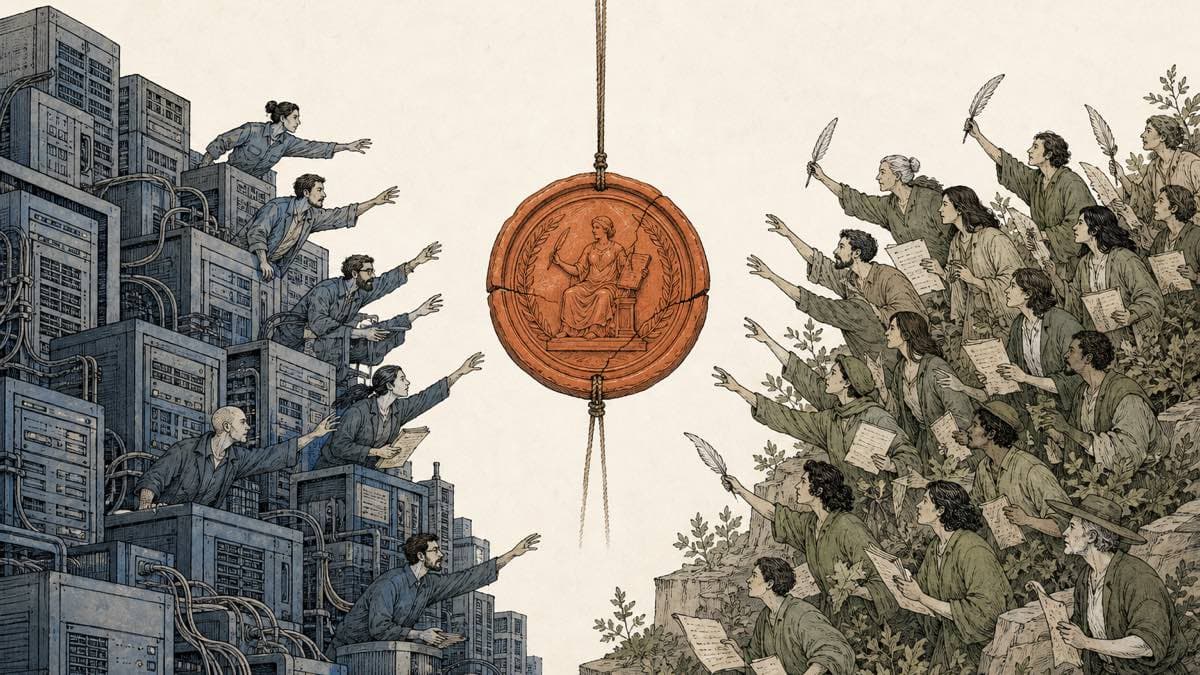
Here is the part that is easy to miss until you have lived through it: a DAO is not a building you can occupy or a town square you can stand in. Almost everything it does happens online — the proposals, the debate, the votes, the announcements. So practical power often turns on channels: Which account is the "official" one? Where does the community gather? Who can publish under the project's name? Control of those channels can strongly influence what users perceive as authoritative, even though it does not by itself settle legal rights or community legitimacy.
The main domain is a root asset for many of those channels. The .com, .org, or .eth that users remember can become the center of the project's public identity. Whoever controls it can redirect a website, change DNS-backed services, or present one fork as the continuation of the project. That leverage is powerful, but it is not automatic legitimacy: users, courts, counterparties, app stores, social platforms, wallets, and governance processes may recognize a different authority.
The domain is not just the website. DNS control can affect mail routing and domain-verification flows, and a domain mailbox is sometimes a recovery factor for social, forum, or vendor accounts. But domain control does not necessarily grant access to an existing mailbox or every linked account: independent passwords, hardware security keys, passkeys, MFA, recovery policies, provider locks, and platform intervention can block takeover. A DAO therefore needs an inventory of each control plane rather than assuming the domain is a universal master key.
This is what turns a principle into an operational requirement. A governance vote cannot redirect a site if the legal registrant, registrar account, DNS provider, hosting account, or authorized signers refuse or cannot execute it. Domain control is therefore one important execution layer, not the whole enforcement system. A robust design aligns governance authority with a legal contracting party, registrar and DNS access, payment and renewal responsibility, key custody, incident response, and the providers' own rules.

Crypto's version: which one is the real one?
Crypto has run this experiment in the open, with money attached.
In 2016, after the theft of funds from "The DAO," Ethereum executed a hard fork to reverse it. Not everyone agreed. The chain split, and [the altered history was named Ethereum (ETH) and the unaltered history was named Ethereum Classic (ETC)](https://en.wikipedia.org/wiki/Ethereum_Classic#:~:text=the%20altered%20history%20was%20named%20Ethereum). The Classic side's entire claim was a legitimacy claim — that it, not the larger fork, maintains the original, unaltered history of the Ethereum network. Both chains were technically real. Only one got to keep the name "Ethereum" in the world's mind, and it was the one the ecosystem's front doors — exchanges, wallets, the main site — pointed at.
The cautionary version is bitcoin.org, the canonical front door originally registered in Satoshi's era. By 2020 its actual control sat with a single pseudonymous owner, "Cobra," who removed the site's longtime maintainer in a unilateral ownership dispute. The maintainer's account was blunt: Cobra has removed my access and seized control of the site and accompanying code repositories. One anonymous person, holding the keys to a movement's most famous address, answerable to no one. That is the failure mode in its purest form: the most important domain in the room governed by whoever happened to control the registrar account.

Aave's identity crisis: does "Labs" speak for the DAO?
The clearest recent case is Aave, and it is almost too on-the-nose: a DAO arguing, in public, that it — not the company that builds the software — should control its own main domain and brand.
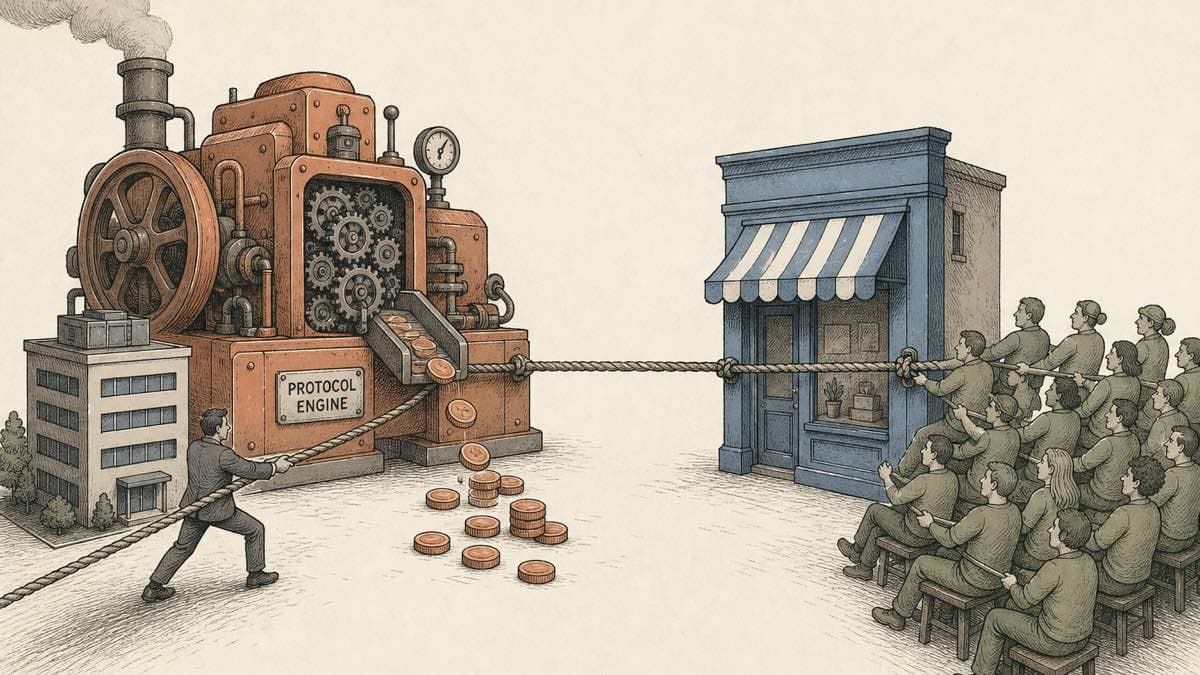
In late 2025 a governance proposal asked Aave tokenholders to take the protocol's brand, naming rights, web domains, and social accounts into the DAO, after a dispute over a deal that routed fees to Aave Labs rather than the DAO. Those assets were discussed together because they jointly shape public identity, not because domain control automatically grants social-account access. The argument was about who the front door really belongs to. As the proposal framed it, we should not have to fear that the implicit steward of the brand may at any point leverage that brand for their own benefit without the DAO's consent. The phrase that matters there is implicit steward — nobody had explicitly mapped the governance and operational authority over every brand asset.
And the assets included the website. Labs' own defense made the control explicit: it argued it needed the new revenue stream to cover the cost of running the protocol's website, which it controls. Commentators reached for a storefront metaphor: the DAO is the engine that ships upgrades and earns revenue, while the brand assets function as the storefront. The dispute exposed that governance authority, legal ownership, and operational control of the front door had not been mapped as one coherent system.
ENS's answer: write down who's authoritative
Aave shows the crisis arriving unannounced. ENS shows a movement trying to answer the question before the crisis — which is the entire point.
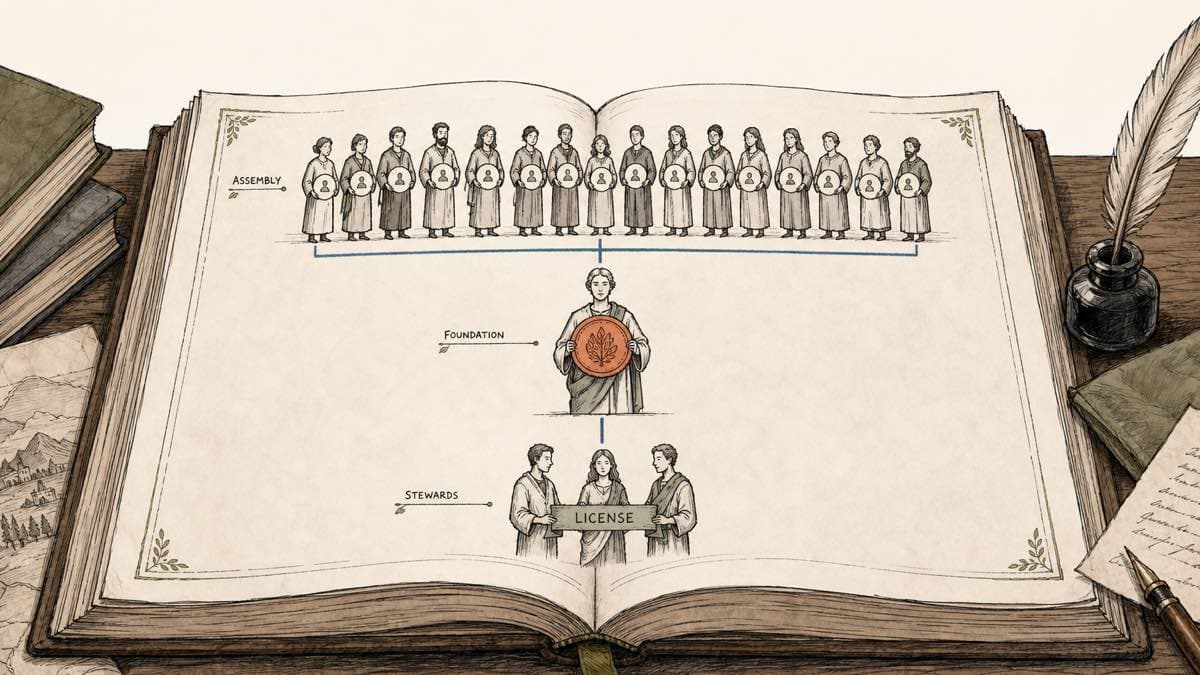
ENS already separates several roles. The ENS DAO governs the ENS protocol and treasury, while ENS Labs is a non-profit organization responsible for the core software development of ENS. A June 19, 2026 temp-check on the "next era" of ENS governance proposed a more explicit authority map. Under that proposal, protocol control such as smart contract upgrades, ENS pricing and fee structures, root key and registry control, and constitutional amendments remain exclusively with tokenholders — while a chartered Foundation holds trademarks and brand assets and licenses them to Labs. The same proposal argues that token voting is structurally poor at day-to-day operational management, which is why it delegates operations to accountable people and institutions rather than treating every asset as a direct token vote.
Read that carefully. The most contested asset in a crisis — the brand, the name, the identity everyone fights over — is placed under the chartered body answerable to tokenholders, and merely licensed to the company that does the day-to-day work. That is a movement deciding, in calm weather, who stands at the center of the stage, so that no one has to improvise it under fire.
Why the DAO, specifically
Granting that someone should hold the main domain on purpose rather than by accident — why the DAO, and not the founder, or the Labs company, or a trusted multisig of insiders?
Because DAO governance can make authority more explicit and auditable — if the operational, legal, and security design actually implements the vote. It is not automatically capture-resistant or survivable.
- Explicit. A documented token-holder or delegate vote can identify the body authorized to set policy, while a legal entity, board, or multisig executes within a written mandate. Token distribution, delegation, quorum, and conflicts still determine whose authority the vote represents.
- Verifiable. A multisig or governance contract can make signers, thresholds, timelocks, and token-control transactions visible on-chain. Registrar, DNS, hosting, billing, recovery, and legal records remain off-chain control planes that require separate audit.
- More resilient by design. A threshold wallet can reduce dependence on one founder, but only if signer diversity, key recovery, succession, emergency procedures, contract upgrades, and vendor access are designed and tested. A DAO can still suffer voter capture, signer collusion, lost keys, low participation, or governance attacks.
Leaving the main domain in one individual's personal account creates a clear succession and capture risk. Moving token control to a DAO-controlled threshold account can reduce that risk, but it can also move the failure point into governance contracts, signers, upgrades, delegates, or vendor accounts. The goal is an auditable allocation of authority with layered controls, not a claim that decentralization eliminates capture.
There is one practical complication: a DAO is not automatically a legal person that can sign a registrar agreement, provide required contact information, pay renewals, receive legal process, or satisfy provider checks. DAOs have long used foundations, companies, associations, trustees, multisigs, or designated registrants for those functions. Each wrapper introduces duties and intervention powers that governance should state explicitly.
Tokenized domains can add an on-chain control layer. A governance contract or DAO-controlled multisig may hold the NFT and authorize supported token transfers, while the domain itself still depends on registrar and registry records, DNS providers, renewals, registration and platform agreements, applicable policy, disputes, and court orders. Namefi's Terms of Service also reserve specified platform powers to award, freeze, mint, and burn domain NFTs and state that tokenization does not validate legal rights to a name. A DAO should therefore define who is the legal registrant, who may exercise each off-chain control, and how an on-chain vote becomes an authorized operational action.
What DAO control should mean in practice
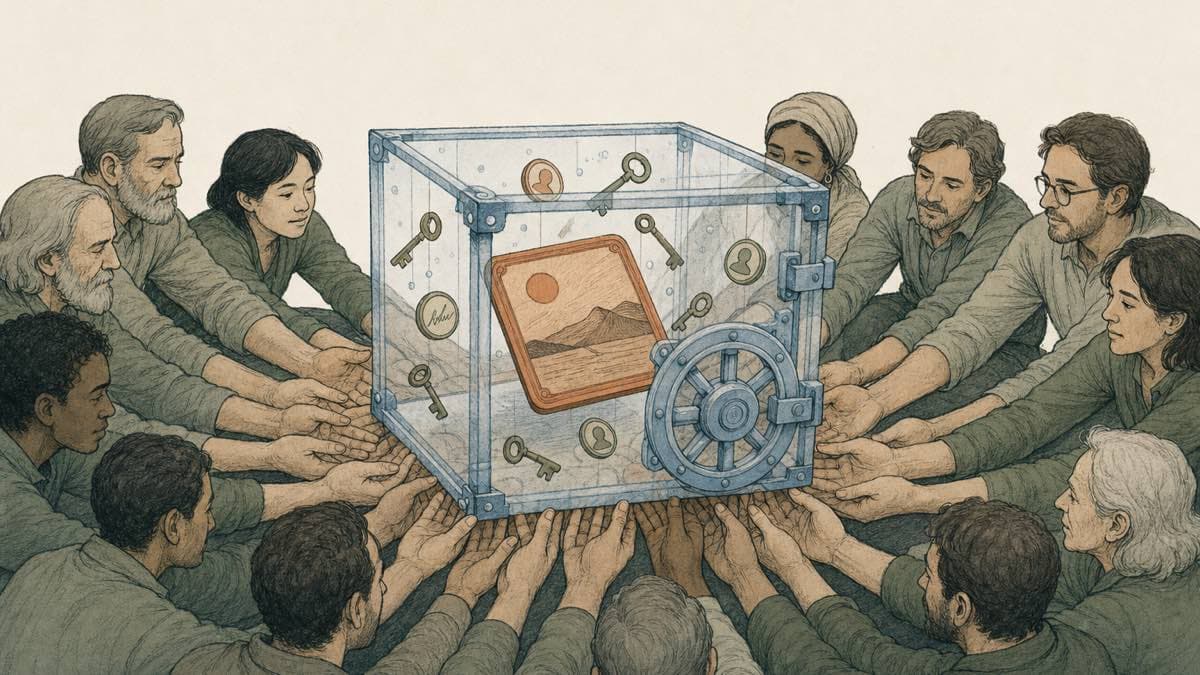
Treat the domain as a system of linked controls rather than one token or password:
- Name the legal registrant or contracting entity and document how it is accountable to governance.
- Inventory the NFT or multisig, registrar account, registry contacts, DNS provider, hosting, email, social accounts, billing method, recovery factors, and authorized representatives.
- Set signer thresholds, hardware-key requirements, timelocks, emergency powers, upgrade authority, succession, and recovery procedures; test them before a crisis.
- Separate routine operations from constitutional decisions. A DAO-wide vote may set policy or appoint accountable operators without asking tokenholders to approve every DNS record or renewal.
- Record how a passed proposal becomes a registrar, DNS, or platform action, including what happens if a provider, legal order, security incident, or agreement prevents execution.
This design is access-controlled by intent: only the named governance body and its authorized operators should be able to change the domain, while the public can verify the policy and relevant on-chain actions. Public transparency is not permission to operate the asset.
Decide before the crisis
The thing about a constitutional crisis is that it is a terrible time to write a constitution. Everyone is already fighting, every choice looks partisan, and whoever holds the asset when the music stops tends to keep it.
So decide now, while it is calm and boring and nobody is fighting about it: who controls the main domain? If the honest answer is "the founder's registrar account," or "the Labs company that happens to run the site," then the movement has an implicit steward and an unwritten constitution — and it will discover both at the worst possible moment.
Place the front door under a governance and operational structure that the movement has deliberately authorized. Make the mandate explicit, the on-chain controls auditable, the off-chain roles documented, and the system resilient to any one person's departure. DAO-governed token control can be part of that design, but only when legal registration, providers, keys, renewals, recovery, and execution authority are aligned with it.
Sources and further reading
- Wikipedia — Enciclopedia Libre Universal en Español (the 2002 Spanish Wikipedia fork)
- Wikipedia — Superprotect (the 2014 Foundation-vs-community override)
- Wikipedia — Wikipedia:Fram (the 2019 "Framgate" jurisdiction dispute)
- Wikipedia — Ethereum Classic (the 2016 "which chain is the real Ethereum" split)
- Decrypt — Bitcoin.org's Secret Owner Kicks Out the Site's Maintainer (the 2020
bitcoin.orgcontrol dispute) - DLNews — Aave DAO proposal to take control of brand from Aave Labs gains traction
- CoinDesk — The most important tokenholder-rights debate: Aave faces an identity crisis
- Aave Governance Forum — Temp Check: The Aave Interface Transparency Act
- ENS — Temp Check: Next era of ENS DAO — Empowering the ENS Foundation
- ENS Docs — The ENS DAO · ENS DAO Basics — ENS Labs
- Namefi — Terms of Service (registrar, ICANN, NFT-control, and legal-right limits)
Contributors

Aileen Wright is a student in her twenties living in New York City, where the distance between a museum wall and a library reading room is a short walk and a long afternoon. She came to name writing through art and history — the way a single portrait, coin, or manuscript margin can carry a name across centuries and change its meaning on the way.
Most weeks you can find her in Central Park with a paperback, or in the quiet of a public reading room chasing down where a name actually comes from rather than what a name-list says it means. She is also teaching herself to code, which has made her oddly precise about spelling, sorting, and the small details that decide whether a name ages well.
For Namefi she writes about the history and culture behind domain names, the stories brands carry as they rename, and the difference between a good story and a verified source.

Victor Zhou is a technology founder and standards editor focused on digital identity and trust. He founded Namefi, edits Ethereum Improvement Proposals, and previously led smart-contract architecture work at Google Labs.
His work sits at the intersection of naming, ownership, and the systems people use to establish identity online. That perspective makes him especially interested in the way names move between personal meaning, public recognition, and digital infrastructure.
For Namefi, Victor edits and writes about domains as durable digital identity: how names become ownable onchain assets, how tokenization changes custody and trust, and what naming can learn from the systems people use to establish identity online.
Related guides
- Can an AI Agent Own a Domain? WHOIS, Custody & TokensThe registrant must be a legal person, but custody can be delegated. WHOIS, API keys, and tokenized domains — the custody spectrum explained.
- Namefi MCP Server: Domain Tools for AI AgentsThe Namefi MCP server's current /v-next tool surface: search, registration, DNS, renewals, outbound workflows, OAuth and API-key authentication, plus separate x402 and MPP HTTP payment paths.
- Appraising ENS and Tokenized Domains: Reading Onchain CompsHow to appraise ENS and tokenized domains using onchain comps, floor-versus-premium reasoning, and ENS club factors — and why it differs from DNS.
- ENS vs DNS Domain Flipping: What's DifferentHow flipping ENS .eth names differs from flipping traditional DNS domains: ownership, liquidity, renewal, gas, and what each is good for.