
Appraising ENS and Tokenized Domains: Reading Onchain Comps
How to appraise ENS and tokenized domains using onchain comps, floor-versus-premium reasoning, and ENS club factors — and why it differs from DNS.
- domains
- domain-flipping
- web3
- analysis

Appraisal is the skill that decides whether a flip makes money. Sourcing tells you what's for sale and selling turns a name into a check, but the number in the middle — what a name is actually worth — is where the margin lives. That's true for a .com and it's true onchain, except the onchain world can provide something the DNS aftermarket usually cannot: a public, timestamped ownership trail and, when a marketplace protocol records the consideration, trade evidence you can audit. That is not the same as a complete sales tape — some transfers are not sales, and some payments or deal terms remain offchain. This is the appraisal chapter of the broader domain flipping playbook, focused on the two assets you trade in onchain domain flipping — ENS names and tokenized ICANN domains.
The method is the same one professional appraisers and real-estate agents use: comps. As Wikipedia defines them, comparables (or comps) is a real estate appraisal term referring to properties with characteristics that are similar to a subject property whose value is being sought. Domains have no ticker price, so you reason from what similar names recently sold for. The onchain twist is that a claimed sale can often be checked against protocol-specific marketplace and payment events instead of accepted on report alone — but only when those events expose the consideration.
Where the comps come from
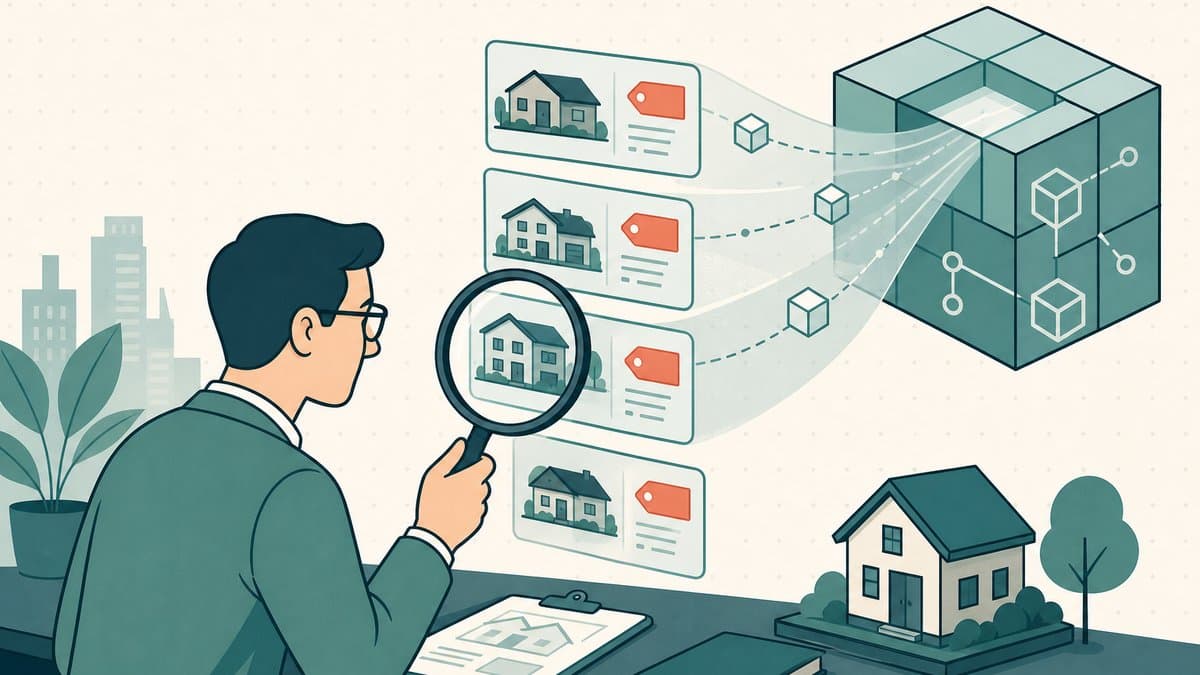
For traditional domains, the canonical comp database is NameBio, a searchable archive of historical domain sales you can filter by keyword, extension, price, and date. It is the closest the DNS aftermarket has to a public price feed: you search for names like the one you're appraising, look at what they actually closed at, and build a defensible range from the evidence rather than a gut feeling. Treat the headline numbers as estimates — reported sales skew toward the ones worth reporting, and a database of closed deals can't tell you about the names that never sold — but as a starting point it beats every automated appraisal tool, which is why our guide to how to value a domain name leans on comparable sales over algorithms.
Onchain, the comp evidence can be richer, and it is free to inspect. An ENS name or a tokenized domain is an NFT under the ERC-721 standard — which Ethereum's spec describes as a standard API for NFTs within smart contracts. Its Transfer event records an ownership change with only the sender, recipient, and token ID; it does not label the transfer as a sale or state a price. Sale reconstruction is marketplace-specific: Seaport's OrderFulfilled event, for example, records separate offer and consideration arrays. Supported marketplaces can use those records to assemble sale histories, listings, and floors, but wallet transfers, offchain payments, and complex bundles require extra verification and may not produce a clean comparable. The appraisal advantage is a stronger audit trail, not an automatic or complete sales tape.
Floor versus premium
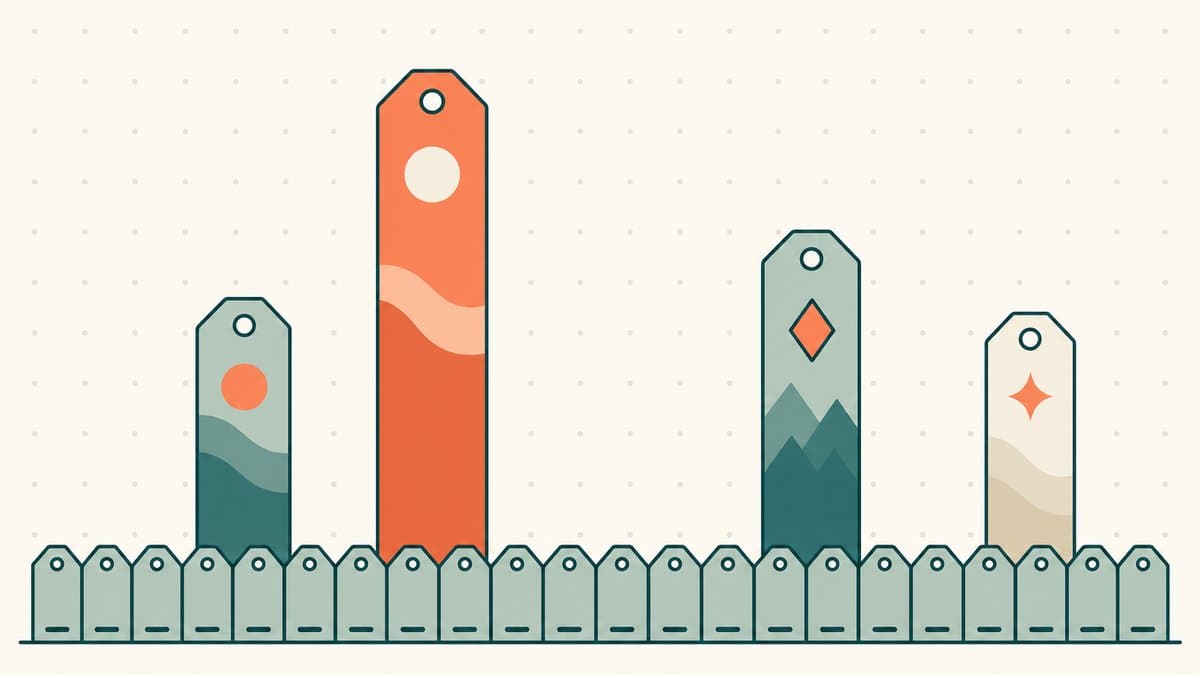
The single most useful frame for an onchain appraisal is floor versus premium, and it maps cleanly onto how these assets actually trade.
The floor is the cheapest available name in a recognizable category — the lowest ask in a marketplace collection. For a class of similar names (say, five-letter .eth names or random four-digit numbers), the floor is your baseline: it's roughly what a generic, undifferentiated member of that set is worth right now. Floors move with the market and with hype, so any floor you quote is a snapshot, not a constant.
The premium is everything a specific name commands above that floor — for being shorter, a real dictionary word, a recognized brand, or a low number. Most of an appraiser's work is justifying the premium: the floor you can read off a screen, but the gap between the floor and what crypto.eth would fetch is a judgment call you defend with comps. The discipline is to anchor on the floor first, then argue the premium up from comparable sales, rather than starting from a dream number and working down.
ENS makes this concrete because its own registration pricing is tiered by length. Per the ENS docs, a 5+ letter .eth will cost you 5 USD per year, while four- and three-character names cost more to register by design. That protocol-level scarcity signal — shorter names cost more to even hold — tells you where the premium concentrates before you look at a single sale.
ENS rarity and club factors
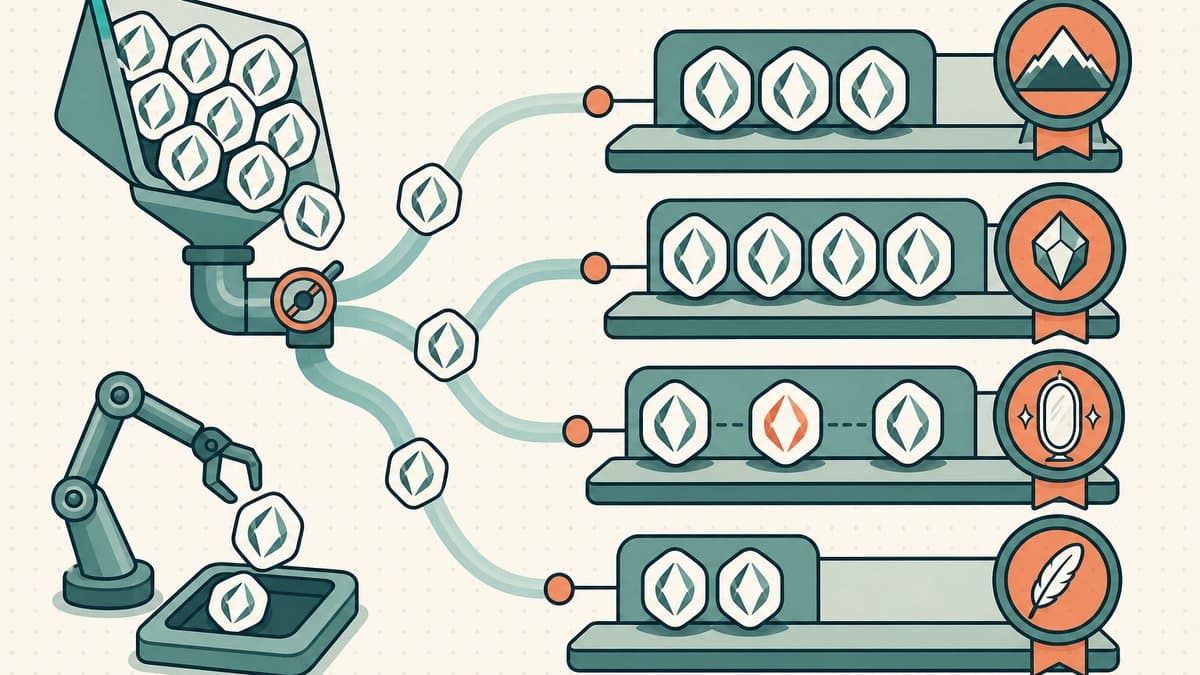
ENS has a quirk no DNS extension shares: organized rarity tiers. The "clubs" are sets of names defined purely by shape, and membership is a strong, legible driver of value.
The best-known are the numeric clubs. The 999 Club is the 1,000 three-digit names from 000.eth to 999.eth; the 10k Club is the 10,000 four-digit names from 0000.eth to 9999.eth. Because the supply of each is fixed and tiny, they trade like a collectible series with a visible floor and a thin premium tail. Numbers are also language-neutral and hard to mistype, which is part of why they became a speculative market of their own. The same logic extends to short letter strings, palindromes, and emoji names: the rarer and more legible the pattern, the thicker the premium over floor.
The ceiling sales show how far the premium tail runs. The biggest ENS sale on record is paradigm.eth, which The Block reports was purchased in October 2021 for 420 ETH (about $1.5 million at the time), and 000.eth — the lead member of the 999 Club — was purchased for 300 ETH ($315,000), making it the second-largest sale measured in both ether and dollars. Those are outliers and they're priced in ETH, so the dollar figure swings with the token — but they anchor the top of the curve. When you appraise a club name, you're locating it on a distribution whose floor and ceiling are both observable onchain. For where these names sit relative to other onchain assets, see premium Web3 TLDs and the broader ENS vs Unstoppable vs tokenized DNS comparison.
Appraising a tokenized ICANN domain is a DNS appraisal
Here's the line you must not blur. A tokenized ICANN domain is not an ENS name with a different label — it's a real .com, .xyz, or .io whose ownership is mirrored as a token, while the underlying name keeps resolving everywhere. As our explainer on what tokenized domains are puts it, these are real DNS domains that also have an onchain layer, not a parallel namespace. The practical consequence for appraisal: you value a tokenized .com the way you value any .com — with DNS comps from NameBio and the usual fundamentals of length, keyword demand, and extension strength — because the buyer is paying for a universally resolvable name, not a wallet handle.
So the comp set splits cleanly. To appraise acme.eth, you pull ENS sales and club floors, because its value is crypto-native identity. To appraise a tokenized acme.com, you pull .com comps, because its value is a real website address that happens to settle onchain. Conflating the two is the most common appraisal error in this space — a tokenized .com and an .eth of the same root word are different products with different buyers and very different comps. We walk the trading-side version of this distinction in ENS vs DNS domain flipping, and the mechanics of why tokenization changes the trade in how tokenization changes domain flipping.
How onchain appraisal differs from DNS appraisal
The inputs rhyme, but four things genuinely differ once a name is a token.
Comp evidence can be audited, not assumed. A NameBio entry is a sale someone chose to disclose; an onchain ownership change is a smart contract event anyone can read, and a marketplace sale can be checked when the protocol records its consideration. A bare ERC-721 Transfer is not enough. You still need to identify the sale protocol, payment asset, bundled items, offchain legs, and possible wash trading before treating the event as a comp.
There's a live floor. DNS names don't have a floor price; each is its own negotiation. A collection of onchain names does, and a moving floor changes the appraisal hour to hour in a way a .com valuation never does.
Settlement friction is structural; market liquidity is not. A marketplace contract can exchange payment and a token in an atomic transfer — all legs settle together or none do — reducing handoffs and potentially settlement time, cost, and risk, as the BIS explains in its overview of atomic settlement. That improves settlement mechanics, but it does not by itself make onchain domain liquidity higher: it does not create buyer demand, seller supply, or a deep two-sided market. Atomic execution can remove an escrow agent or transfer window from a sale as an NFT. The Federal Reserve Bank of New York describes market liquidity as multidimensional, measured through factors such as bid-ask spreads, market depth, and price impact; evaluate those separately from settlement mechanics. We cover the settlement workflow in how tokenized marketplaces replace escrow.
Crypto-denominated prices add a second variable. Most onchain comps are quoted in ETH. A name "worth 5 ETH" can swing thousands of dollars on token moves alone, so always note whether you're appraising in ETH or fiat — they tell different stories, and treating an ETH floor as a stable dollar number is how appraisals go wrong.
The throughline: onchain appraisal can give you a more auditable ownership trail and faster settlement, plus richer comp evidence when a marketplace records consideration, but the core craft is unchanged. Anchor on the floor, justify the premium with verified comparable sales, and price the right comp set for the right asset. A tokenized .com on a platform like Namefi is appraised as the real domain it is; an .eth is appraised as the onchain collectible it is. Get the comp set right and the rest is arithmetic.
Friendly Disclaimer (Read Me!)
We're not lawyers, accountants, financial advisors, or doctors, and nothing in this article is legal, financial, tax, accounting, medical, or any other flavor of professional advice. We write these posts to educate ourselves and as a convenience for our customers. Info here may be out of date, geography-specific, or just plain wrong. We make mistakes too.
For any important decision, please consult a real professional (seriously!). Or if that's not your vibe, ask a friend, ask Twitter, ask Reddit, ask an AI, or ask a psychic. In short: DOYR - Do Your Own Research. Let's learn and have fun.
Sources and further reading
- Wikipedia — Comparables (the comps method of appraisal by similar recent sales)
- NameBio — searchable database of historical domain name sales
- Ethereum Improvement Proposals — ERC-721: the
Transferevent records_from,_to, and_tokenId, not sale consideration - OpenSea Documentation — Seaport
OrderFulfilledevent with separate offer and consideration arrays - Bank for International Settlements — atomic settlement and its potential effects on settlement speed, cost, and risk
- Federal Reserve Bank of New York — market liquidity measures include bid-ask spreads, market depth, and price impact
- ENS Documentation — .eth registrar pricing by name length (5+ letter = $5/year)
- The Block — 000.eth sold for 300 ETH ($315,000); paradigm.eth for 420 ETH (~$1.5M, Oct 2021); ENS names as NFTs on OpenSea
Contributors

Fenwei Bian is a software developer in her thirties who spends her working hours in pull requests and her weekends with her hands in soil or sawdust. Years of open source on GitHub taught her that names are interfaces: a good one is clear, honest about what it does, and kind to whoever has to use it next.
She gardens because it rewards patience and punishes wishful thinking, and she does woodwork because a joint either fits or it doesn't. Both habits show up in how she writes about naming — measure twice, check the source, and don't sand over a rough spot and hope no one notices.
For Namefi she writes about how domain markets actually move, the practical trade-offs of tokenizing and flipping names, and picking a domain you'll still be glad you own in twenty years.

Victor Zhou is a technology founder and standards editor focused on digital identity and trust. He founded Namefi, edits Ethereum Improvement Proposals, and previously led smart-contract architecture work at Google Labs.
His work sits at the intersection of naming, ownership, and the systems people use to establish identity online. That perspective makes him especially interested in the way names move between personal meaning, public recognition, and digital infrastructure.
For Namefi, Victor edits and writes about domains as durable digital identity: how names become ownable onchain assets, how tokenization changes custody and trust, and what naming can learn from the systems people use to establish identity online.
Related guides
- How We Cut AI Buyer Discovery Cost by 85%: Start Lean, Escalate With EvidenceA practical method for cheaper buyer discovery using progressive model escalation, LLM-as-judge gates, and Laminar traces and evals.
- ENS vs DNS Domain Flipping: What's DifferentHow flipping ENS .eth names differs from flipping traditional DNS domains: ownership, liquidity, renewal, gas, and what each is good for.
- ENS vs Unstoppable vs Tokenized DNS DomainsENS vs Unstoppable Domains vs tokenized ICANN DNS, compared on browser resolvability, renewals, and who actually controls the name.
- How Tokenization Changes Domain FlippingHow bringing a domain on-chain can reshape flipping through verifiable token control, compatible marketplaces, and programmable settlement without removing registrar dependencies.