Nissan.com: Eight Years in Court Over One Man's Surname
Uzi Nissan used his surname for a Raleigh computer business, and Nissan Computer registered nissan.com in 1994. Court records show how Nissan Motor's suit ran from 1999 to 2008, and how his estate won an order returning the domains after his death.


- domains
- security
- domain-security
- case-study
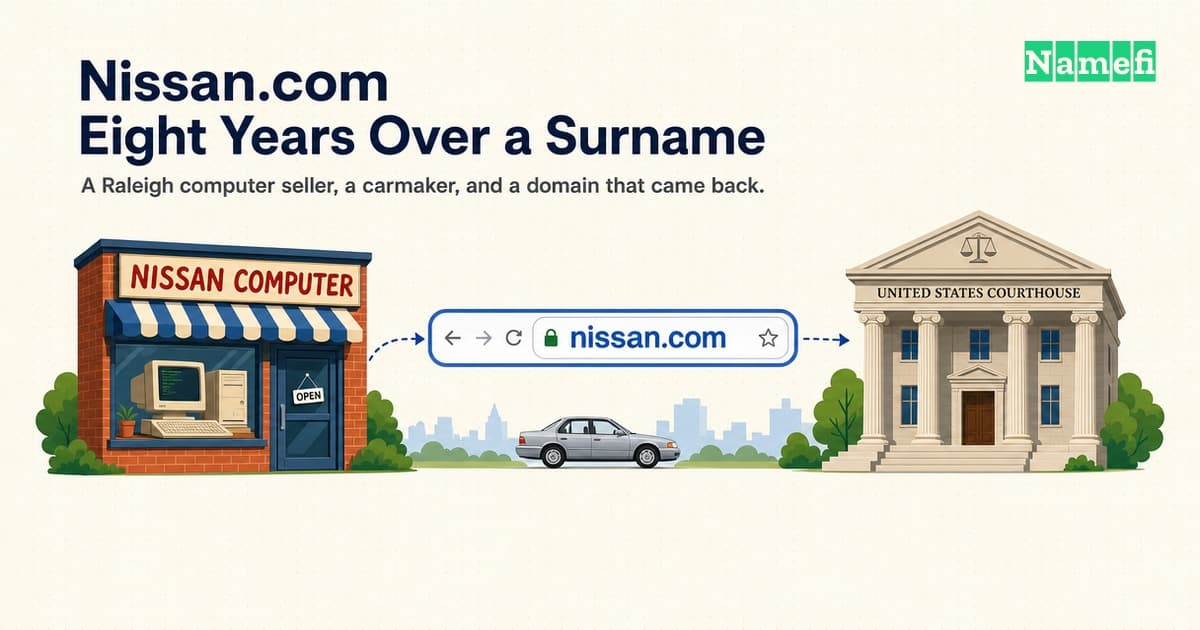
On Friday, December 10, 1999, Uzi Nissan sat through a third meeting with Merrill Davis, the corporate manager of eBusiness strategy at Nissan North America. Davis said the carmaker wanted nothing short of an outright sale of nissan.com. Mr. Nissan said no again. When Davis persisted, a federal judge later found, Mr. Nissan gave this answer: "OK, my price is $15 million, do you understand now that I don't want to sell?"
Nissan Motor filed suit that same day.
The case stayed open until February 2008. Retellings often end it with a small businessman beating a carmaker. The record is more exact. The final judgment says neither party prevailed. Nissan Motor left without the domain and without money. Mr. Nissan kept the domain and, by his own account, paid nearly $3 million to keep it. Fifteen years later, after his death, his estate went back to federal court and said the domain had been stolen from his account.
Uzi Nissan had used his name in business for 14 years before he registered nissan.com
Uzi Nissan came to the United States in 1976. In 1980 he opened a car repair business under his surname. He named an import and export business Nissan International in 1987. Nissan Computer followed in 1991, selling and servicing computers in Raleigh, North Carolina.
The name was old before any of these businesses existed. The court found that Nissan is a common Jewish surname, a common word in Hebrew and Arabic, a month in the Jewish calendar, and the Arabic word for April. For a Japanese speaker, it is also an easily recognized abbreviation of a generic company description.
Nissan Motor had registered the NISSAN mark in the United States in 1959. Its American cars, however, mostly carried the DATSUN mark until the 1980s. Dual badging began in 1983, and only in 1985 did the cars sell exclusively as Nissans. Salon later described a 1982 invoice that Mr. Nissan published on his website. A Datsun dealership had billed his repair shop for a car antenna, and the only "Nissan" on the paper was his own business.
Nissan Computer registered nissan.com in 1994 and nissan.net in 1996. Nissan Motor noticed. In July 1995, one of its trademark attorneys wrote to express concern. Mr. Nissan did not reply, and the company took no action for more than four years. That silence would matter.
Eight to ten weeks of car advertising gave Nissan Motor the infringement ruling it kept
In August 1999, Nissan Computer joined an advertising service that paid for each click. In late September, automobile-related advertisers began to appear on nissan.com. They never made up more than 5 of the 23 advertisers on the site, and none of them sold cars. That fall the network administrator also reduced the words "Computer Corporation" on the site and moved the logo onto an oval background that looked more like the carmaker's.
These facts cut against Nissan Computer, and the court said so. "It is true that Nissan Computer is not without fault," the 2007 findings read.
When Davis first came to Raleigh that October, Mr. Nissan showed him the site, banner advertisements included. He also told him that one-third of the product emails he received were meant for Nissan Motor. He proposed a permanent link to the carmaker's websites in return for a payment per click. Nissan Computer removed the automobile-related advertisements one business day after the suit. The court later called Mr. Nissan "forthright" about the advertising and said these facts suggested a lack of bad faith or willfulness. It still described the infringement as intentional.

The early rulings narrowed what Uzi Nissan could do with his site
The complaint alleged dilution, infringement, domain name piracy, and more. In March 2000, Judge Dean D. Pregerson of the Central District of California issued a preliminary injunction. It ordered a prominent disclaimer and barred automobile-related content. The same month, Nissan Computer posted a link to ncchelp.org, a site whose banner read "We Are Being Sued!!!"
He won one important point. In January 2002, the court granted summary judgment for Nissan Computer on the cybersquatting claim, the claim through which Nissan Motor had sought transfer of the domain. The court later wrote that there was no evidence that the company had registered the name to confuse consumers or to sell it to the carmaker.
The other rulings went the other way. The court held that the automobile-related advertising infringed the mark for the 8 to 10 weeks it ran. It also found dilution, and in late 2002 it entered a permanent injunction. That order barred commercial content, advertising, disparaging remarks, and links to sites with either on nissan.com and nissan.net. Mr. Nissan could still use the sites for personal purposes, but his companies could not earn from them or use them to criticize the company suing him.
Nissan Computer offered $75,000 in 2001, and Nissan Motor said no
One document in this long record does not appear in the retellings read for this article. In March 2001, Nissan Computer served a formal offer of judgment under Federal Rule of Civil Procedure 68. The offer proposed a permanent injunction with a caption, a disclaimer, and a ban on automobile-related content, much as the preliminary injunction had required. It added $75,000 for damages, attorneys' fees, and costs.
Rule 68 carries a penalty. A plaintiff who rejects such an offer and later does no better must pay the costs incurred after the offer.
As the court describes the offer, it did not include the domain. Nissan Motor rejected it, and the orders read for this article do not record the company's reasons. A public number from those years is much larger. Salon reported in 2002 that the carmaker was suing for $10 million, and Mr. Nissan's own site used the same figure. The court orders reviewed here mention damages but not that sum. The parties stipulated to damages in September 2002, but those orders do not state the amount.

The Ninth Circuit reopened the fight in 2004
Both sides appealed, and Nissan Motor asked the appeals court to order transfer of both domains in exchange for the fair value of Nissan Computer's investment. On August 6, 2004, a panel affirmed in part and reversed in part.
The panel upheld the infringement ruling for automobile-related use and agreed that other uses did not infringe. It left in place the trial court's refusal to order a transfer. It also held that barring links to negative commentary was a content-based restriction on non-commercial speech that conflicted with the First Amendment.
The ruling that reopened the case concerned a date. The trial court had measured the mark's fame as of 1994, when nissan.com appeared. The panel held that the first arguably offending use was the name "Nissan Computer" in 1991. It reversed the dilution judgment. The permanent injunction was vacated, and the claim went back for trial. The Supreme Court denied review in 2005.
Nissan Motor proved its fame and still lost the 2007 trial
The bench trial ran from March 27 to March 30, 2007, under a dilution statute that Congress had rewritten the previous October. On fame, the carmaker won without qualification. The company had spent about $900 million marketing the mark between 1985 and 1991 and sold almost 5 million vehicles carrying it. The judge called the mark "unquestionably famous" by the day Nissan Computer was incorporated. A survey found that 92.9% of respondents expected the car company or car information at the two domains.
Fame was not enough. The factor the judge called the heart of the inquiry asked whether the use had created any actual association. On that factor, Nissan Motor presented no evidence that visitors to nissan.com now linked the name with a second source. The court called the absence of a "simple and obvious survey" a significant omission.
The internet had also changed during the case. By 2007, the judge reasoned, most people used search engines, and Nissan Motor's own nissanusa.com came first in the results. A visitor who reached the plain computer site by mistake would know within "one hot second." The company's 4.5-year delay after the 1995 letter also counted against it, as did an agreement under which it shared the Nissan name with five other Japanese corporations.
In the end, three of the six statutory factors favored Nissan Motor and two were neutral, but the most important one cut strongly against it. The court then stated a limit. "[T]he rule cannot be that the owner of a famous mark will always be able to enjoin the commercial use of that mark as a domain name," the judge wrote, while noting that different facts could produce a different result. The court found no likely dilution. It also refused a permanent injunction on the old infringement, because that conduct had stopped nearly eight years earlier.
The final judgment named no winner
The ending came in paperwork. Nissan Motor asked for attorneys' fees. Judge Pregerson denied the request in February 2008 because it came five years late and because the case was not exceptional. "Nissan Motor cannot turn back the clock," he wrote.
Then he returned to the 2001 offer. The carmaker had obtained preliminary injunctions and a 2002 permanent injunction along the way, but the permanent injunction had been vacated and the 2007 trial did not produce another. "Nissan Motor ultimately takes nothing in damages, attorneys' fees, and costs." The rejected offer had been better. The judgment of February 5, 2008 declared no prevailing party, since each side had succeeded in some respect, and gave Nissan Computer its costs after the offer. Nissan Computer had billed $87,599.07. The next month, the clerk taxed $58,000 against the plaintiffs, an amount both parties stipulated to.
The court's explanation of "no prevailing party" shows what each side kept. Nissan Motor had won on infringement and on Nissan Computer's counterclaims, which included attempts to cancel the NISSAN mark. It had also stopped Nissan Computer from using the mark for automotive goods and services. Nissan Computer kept nissan.com for non-automotive commercial use.
The $58,000 covered litigation costs, not attorneys' fees. Mr. Nissan's cost figures come from his side, not from a court finding: $2.2 million in 2002, nearly $3 million in 2018, and at least $3 million in his estate's later complaint. Asked about the result a decade later, he refused the word victory. "I did not win the case. Nissan Motor lost."
His estate later said he went on using the sites for his business, advertising, and free speech advocacy. In 2020, Nissan North America said it had established NissanUSA.com as its U.S. homepage.
His estate said the domains were stolen after his death
Uzi Nissan died of Covid-19 on July 17, 2020. He was 68.
In June 2023, the Estate of Uzi Nissan sued in the Eastern District of Virginia, where the .com and .net registry operator Verisign has its principal place of business. The estate named nissan.com, nissan.net, and an unknown John Doe. Its verified complaint said a thief had entered his domain management account at the registrar GKG.NET and moved the domains to other accounts there. The estate said it received no transfer notices. It said GKG.NET did not dispute the unauthorized transfer but would not secure the domains' return. It also said someone claiming to hold the domains had impersonated family members in an effort to sell them. A footnote added that digest.com, another of his domains, had been stolen as well. These were allegations, and the complaint gave no date for the theft.
The search for a person failed. Subpoenas to the registrar and the web host yielded no identifying information. The estate amended its complaint in October 2023 to pursue only the domains, and it published notice in The Washington Times. Nobody answered. Under default rules, the magistrate judge wrote, a defendant in default concedes the complaint's factual allegations. He recommended judgment for the estate.
On April 16, 2024, Judge Patricia Tolliver Giles adopted that report. She ordered Verisign to move the domains to GoDaddy and ordered GoDaddy to list the estate as registrant. None of the court papers read for this article identifies who took them.

The estate won on its claim under the Anticybersquatting Consumer Protection Act, the statute on which Nissan Computer had defeated Nissan Motor two decades earlier. The two rulings answered different questions, and the second came without an opponent. Namefi's guide to cybersquatting and the ACPA explains how the law separates a bad-faith registration from a legitimate one.
The registry records for nissan.com and nissan.net now list GoDaddy as registrar, and both show a change on September 30, 2024. Those records do not name the registrant. A December 2025 industry account says the estate holds nissan.com. An October 2026 capture of nissan.com shows no cars and no computers. It shows a memorial to a father, brother, and friend, with the dates of his life at the top.
The records disagree on several details
News accounts of this case conflict with each other and with the court file. This article follows the court documents.
- Registration date. The Ninth Circuit says June 4, 1994. The 2007 findings say May 1994, and the registry record shows May 4, 1994.
- The December 1999 meeting. Mr. Nissan told Jalopnik that the lawsuit reached his fax machine while Davis was out of the room. The findings record the same-day filing but not the fax.
- Early history. Jalopnik places his arrival in 1980, and the estate's complaint dates Nissan International to 1980. The 2007 findings give 1976 and 1987.
- Infringement and dilution. Jalopnik says he won on infringement in 2007 and on dilution in 2002. The court file shows that he was liable for the 8 to 10 weeks of advertising, lost dilution in 2002, and won dilution in 2007.
- The Virginia filing date. Autoblog dates the civil action to October 17, 2023. The record shows the complaint on June 26, 2023, and the amended complaint on October 17.
- Limits on content. The 2000 preliminary injunction required a disclaimer and barred automobile-related content. The 2002 permanent injunction barred commercial content and negative commentary. That order was vacated after the 2004 appeal. The final orders left Nissan Computer free to use nissan.com for non-automotive commercial purposes.
- Preliminary injunctions. The 2007 findings say the preliminary injunction lasted about one year. The 2008 fee order refers to two preliminary injunctions in effect for several years. The orders read for this article do not give the second injunction's terms.
Sources and further reading
All sources fetched 2026-11-03. The scanned Central District of California PDFs were read through optical character recognition, and quoted passages were checked against the page images. Links open at the cited page in browsers that support PDF page anchors.
- U.S. District Court, C.D. Cal. — Docket, Nissan Motor Co. v. Nissan Computer Corp., No. 2:99-cv-12980
- U.S. District Court, C.D. Cal. — Findings of Fact and Conclusions of Law, ECF No. 811, September 21, 2007
- U.S. District Court, C.D. Cal. — Order on Request for Entry of Final Judgment, ECF No. 816, November 30, 2007
- U.S. District Court, C.D. Cal. — Order Denying Attorneys' Fees and Granting Costs Under Rule 68, ECF No. 828, February 4, 2008
- U.S. District Court, C.D. Cal. — Judgment, ECF No. 829, February 5, 2008
- U.S. District Court, C.D. Cal. — Bill of Costs, ECF No. 838, March 6, 2008
- U.S. Court of Appeals, Ninth Circuit — Nissan Motor Co. v. Nissan Computer Corp., 378 F.3d 1002 (2004), slip opinion hosted by Public Citizen — archive
- U.S. District Court, E.D. Va. — Verified Complaint, Estate of Uzi Nissan v. Nissan.com, No. 1:23-cv-821, June 26, 2023
- U.S. District Court, E.D. Va. — Report and Recommendation, Dkt. 23, January 31, 2024
- U.S. District Court, E.D. Va. — Order, Dkt. 24, April 16, 2024 — archive
- Verisign — RDAP record for nissan.com
- Verisign — RDAP record for nissan.net
- Strategic Revenue — The Domain Nissan Motor Couldn't Buy, Couldn't Win, and Still Doesn't Control
- Public Citizen — Nissan Motor Co. v. Nissan Computer Corp. case page
- Domain Name Wire — Judge orders Nissan.com transferred back to estate of Uzi Nissan — archive
- Domain Name Wire — Estate of Uzi Nissan says Nissan.com is stolen — archive
- The Drive — Lawsuit Claims 'Nissan.com' Has Been Stolen After Years of Legal Drama — archive
- The Drive — The Man Who Fought Nissan Over a Website—And Won—Has Died of COVID-19
- Autoblog — 'Nissan.com' site back in court, Nissan Motors not involved this time
- Jalopnik — Uzi Nissan Spent 8 Years Fighting The Car Company With His Name — archive
- Salon — Nissan vs. Nissan — archive
- Wired — Who Gets to Drive Nissan.com? — archive
- Nissan.com — Memorial page, archived October 28, 2026
Contributors
Aileen Wright is a student in her twenties living in New York City, where the distance between a museum wall and a library reading room is a short walk and a long afternoon. She came to name writing through art and history — the way a single portrait, coin, or manuscript margin can carry a name across centuries and change its meaning on the way.
Most weeks you can find her in Central Park with a paperback, or in the quiet of a public reading room chasing down where a name actually comes from rather than what a name-list says it means. She is also teaching herself to code, which has made her oddly precise about spelling, sorting, and the small details that decide whether a name ages well.
For Namefi she writes about the history and culture behind domain names, the stories brands carry as they rename, and the difference between a good story and a verified source.
Victor Zhou is a technology founder and standards editor focused on digital identity and trust. He founded Namefi, edits Ethereum Improvement Proposals, and previously led smart-contract architecture work at Google Labs.
His work sits at the intersection of naming, ownership, and the systems people use to establish identity online. That perspective makes him especially interested in the way names move between personal meaning, public recognition, and digital infrastructure.
For Namefi, Victor edits and writes about domains as durable digital identity: how names become ownable onchain assets, how tokenization changes custody and trust, and what naming can learn from the systems people use to establish identity online.