.com vs City TLDs (.nyc, .london): Best for Local Business?
Choose between .com, .nyc and .london for a local business: compare eligibility, city identity, search treatment and plans to expand.

- guide
Choose .com when your business needs a name that can follow you beyond one city. Choose .nyc or .london when the city is a lasting part of what customers are buying, you meet the registration policy, and the full address works better than your available .com alternatives. A good city domain can beat an awkward .com. You do not need to sacrifice your business name just to get those three letters.
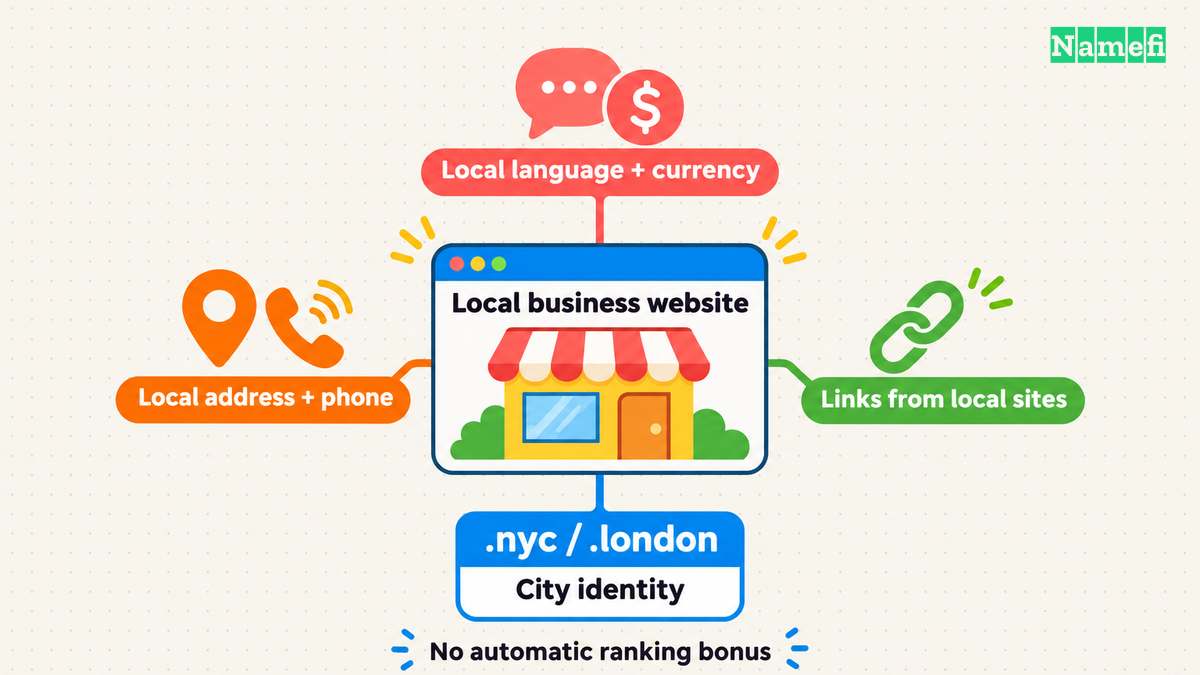
The important distinction is between a city identity and a search advantage. A city ending can put your location in the address. Google's guidance treats city TLDs as generic domains, rather than automatic local-ranking shortcuts. Google explains city-TLD treatment.
Compare the full addresses before choosing an extension
Here, city TLDs means extensions naming a particular city, such as .nyc and .london. Both are generic top-level domains, but each registry sets its own eligibility rules. Do not assume that qualifying for one city ending tells you anything about another.
| Decision factor | .com | .nyc | .london |
|---|---|---|---|
| What the ending communicates | No particular city | New York City | London |
| Best fit in this comparison | A business whose reach may change | A business with a durable NYC connection | A business with a durable London identity or offering |
| City eligibility to check | Neither of the city policies below applies | Demonstrable economic, cultural, historical, social or lawful NYC connection | London address, or good-faith declaration of affiliation with or interest in London |
| Registry manager in IANA | VeriSign Global Registry Services | The City of New York through its Department of Information Technology & Telecommunications | Dot London Domains Limited |
| Geographic flexibility of the name | Leaves the city unstated | Keeps NYC in every address | Keeps London in every address |
| Search purchase case | Buy for the name and business use | Buy for city identity, without assuming a ranking boost | Buy for city identity, without assuming a ranking boost |
The registry and policy sources below support the factual rows. The fit recommendations are editorial judgments, not measured claims about customer preference or conversion.
The city domains share a purpose but differ in policy
.nyc requires a substantive connection to New York City
IANA lists the City of New York as the registry manager and GoDaddy Registry as the administrative and technical contact. The delegation dates to March 20, 2014. That is the root-zone delegation date, not the date when retail registration opened. Read IANA's .nyc record.
The registry's current Nexus Policy, dated May 1, 2025, accepts an economic, cultural, historical, social or lawful connection to the city. A P.O. box alone does not qualify. Registrants must maintain compliance throughout the registration and cannot pass the domain to a third party that fails the policy. Read the current .nyc Nexus Policy.
That wording matters. Do not reduce the current rule to an absolute requirement that every registrant live in NYC. Equally, do not treat a vague fondness for New York as proof that your registration qualifies. Before building your website and email around .nyc, ask your registrar what evidence will support your particular connection.
The registry's own showcase features Original Barbershop at originalbarbershop.nyc and Makerspace NYC at makerspace.nyc. These are named examples of city-domain use, not evidence that the ending increased sales. See the .nyc showcase.
.london accepts an address or a declared affiliation or interest
IANA lists Dot London Domains Limited as the registry manager and dates delegation to March 22, 2014. Read IANA's .london record.
The Naming Policy provides two routes: a physical address in London, comprising the City of London and 32 boroughs, or a good-faith declaration of affiliation with or interest in London. The policy gives providing information, products, goods or services relevant to London or Londoners as examples. Read the London Nexus Requirement.
A business outside London can therefore have a route to registration. That does not make .london a sensible identity for every business. A supplier deliberately serving London has a clearer reason to choose the ending than a company that has no London offering.
The registry's customer showcase lists yogarise.london, risebakery.london and halfhitch.london. The useful lesson is the shape of the names: the city sits after the dot rather than lengthening the business name before it. See the named .Londoners.
.com gives you room to change your market
IANA identifies VeriSign Global Registry Services as the .com manager. Verisign's Domain Name Industry Brief reports 169.8 million .com registrations as of September 30, 2026. That is a domain-registration count, not a count of businesses, active websites or satisfied customers. Read the Q3 2026 report.
A local business can use .com without abandoning its local identity. Katz's Delicatessen uses katzsdelicatessen.com, where the business offers both Manhattan delivery and nationwide shipping. See Katz's own site. That combination illustrates a practical reason to leave the city out of the ending: the location can define the story without defining the delivery boundary.
Choose .com if a move, another branch or a broader customer base belongs in your actual plan. The advantage is flexibility in what the address says. The registration count does not prove that your customers will prefer .com, and it does not tell you whether your desired name is available.
Choose according to the business you intend to run
| Your situation | Recommended starting point | Trade-off to accept |
|---|---|---|
| A single-city business expects to remain local | Compare the exact .nyc or .london name against the best .com candidate | Your address will keep naming that city |
The clean city name beats a long or confusing .com variation | Choose the city name if eligible and affordable to maintain | Test how customers say and type the ending |
| You plan branches in other cities or a nationwide service | Prefer a usable .com | Explain local service areas in the site rather than the extension |
You already have an established .com and want a city campaign | Consider a city domain that redirects to the relevant page | You add a renewal and a redirect to maintain |
Your .nyc eligibility is uncertain | Resolve the policy question before buying | A successful checkout is not your evidence of a qualifying connection |
| You want a city domain mainly for promised Google rankings | Reject that purchase rationale | Choose by business fit instead |
For a hypothetical Brooklyn repair shop that intends to stay local, a clear business-name .nyc can be a better primary address than a .com padded with extra words. For a London company planning to serve several cities under one brand, a city-neutral name may be easier to keep. These are decision examples, not availability claims.
Our realtor TLD guide covers industry and defensive registrations. This comparison answers a narrower question: when should the city itself appear in your primary address?
Google's guidance does not promise a city-TLD ranking bonus
Google's city-TLD explanation specifically mentions .london and says region-looking endings receive generic treatment. Its current documentation says Google treats a root-zone TLD as generic unless ICANN classifies the ending as a country-code TLD. Read Google's current generic-domain guidance.
Neither .nyc nor .london needs an exception on Google's generic ccTLD list: IANA already classifies both as generic TLDs. Do not confuse a city name with a country-code geographic signal.
For audience targeting, Google's documentation names signals including local addresses and phone numbers, local language and currency, and links from local sites. See Google's audience signals. Give visitors useful information about where you operate whichever ending you choose.
If a seller's price depends on supposed search value, use our keyword-domain buying guide to separate the name from evidence about an existing website. A location in the address is not a substitute for that evidence.
Check the exact name and renewal terms before registering
Ask a prospective registrar for the registration and renewal quote for each shortlisted name, including currency, billing term, taxes and any premium status. Ask whether premium treatment continues at renewal. This article gives no retail price comparison because the decision needs quotes for your actual candidates.
Then say each full address aloud and ask someone to type it. Include the email address you intend to use. Choose the name that survives the test without repeated explanation, while still fitting your likely service area.
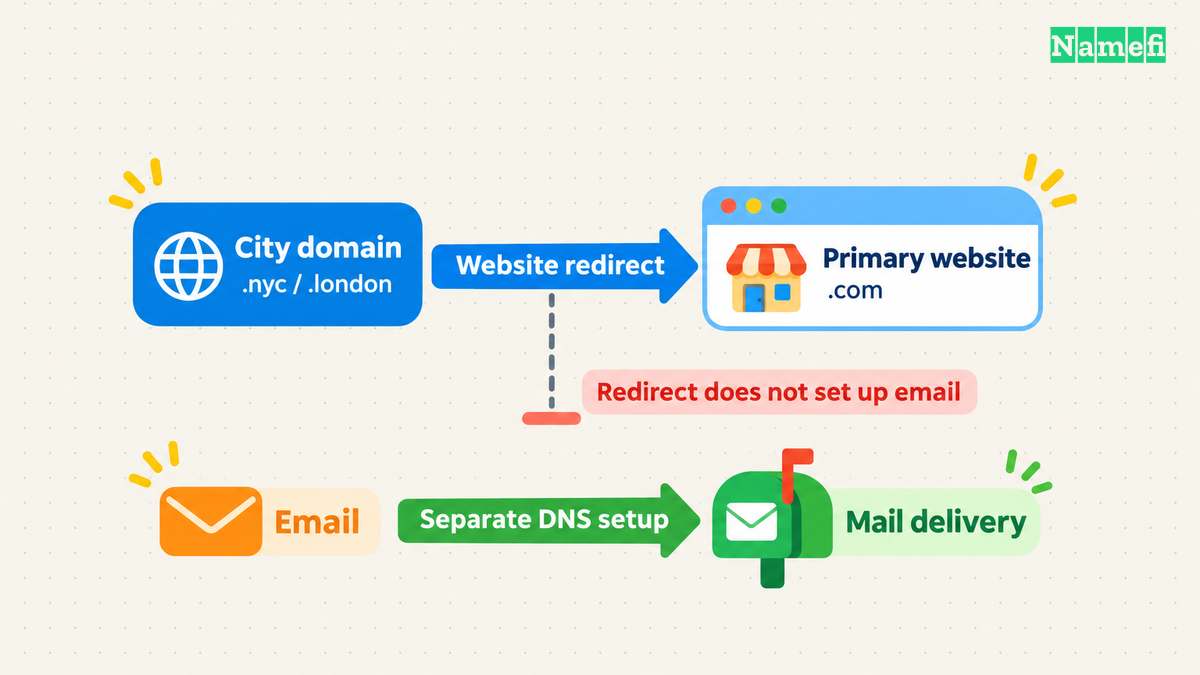
If you register both a .com and a city domain, choose one primary website and plan the other domain's redirect. Treat email separately: a website redirect does not configure mail delivery through DNS. Avoid adding domains unless you have a specific use and a sustainable renewal plan.
The deciding question is whether the city belongs permanently in your address. If the answer is yes, an eligible, clear .nyc or .london deserves serious consideration. If the city may change while the brand stays, start with .com.
Comparing more options? Start with our guide to .com vs every other TLD.
Sources and further reading
- IANA —
.comregistry record, registry manager; fetched 2026-11-06. - IANA —
.nycregistry record, manager, contacts and delegation date; fetched 2026-11-06. - IANA —
.londonregistry record, manager and delegation date; fetched 2026-11-06. .nycregistry — Nexus Policy, current connection and continuing-compliance requirements; fetched 2026-11-06..nycregistry — Customer showcase, named business examples; fetched 2026-11-06.- Dot London — Naming Policy, London Nexus Requirement; fetched 2026-11-06.
- Dot London — Meet the .Londoners, named domain examples; fetched 2026-11-06.
- Verisign / DNIB — Q3 2026 Domain Name Industry Brief, dated
.comregistration count; fetched 2026-11-06. - Katz's Delicatessen — Official website, local delivery and nationwide shipping; fetched 2026-11-06.
- Google Search Central — Handling of new top-level domains, city-TLD explanation from 2015; fetched 2026-11-06.
- Google Search Central — Managing multi-regional sites, current generic-TLD classification and audience signals; fetched 2026-11-06.
About the author(s)
Fenwei Bian is a software developer in her thirties who spends her working hours in pull requests and her weekends with her hands in soil or sawdust. Years of open source on GitHub taught her that names are interfaces: a good one is clear, honest about what it does, and kind to whoever has to use it next.
She gardens because it rewards patience and punishes wishful thinking, and she does woodwork because a joint either fits or it doesn't. Both habits show up in how she writes about naming — measure twice, check the source, and don't sand over a rough spot and hope no one notices.
For Namefi she writes about how domain markets actually move, the practical trade-offs of tokenizing and flipping names, and picking a domain you'll still be glad you own in twenty years.