.com vs .ai: Which Domain Should Your AI Startup Pick?
Choose .com or .ai for your AI startup with verified registry facts, registration terms, real company examples, and practical naming trade-offs.

- guide
Choose .com when the exact name fits your budget and you want a company identity that can extend beyond AI. Choose .ai when AI defines the product and the clean .ai is a better name than the .com you can actually obtain. Don't add awkward words or exhaust your launch budget just to finish with .com.
If both exact names are affordable, register both only if you have a use for the second address. Pick one primary domain. A second registration can reserve a future option, but it also creates another renewal obligation.
This comparison helps you choose between .com and .ai. For the broader technology alternative, read our .ai vs .io comparison. For a portfolio across more extensions, use the startup TLD guide.
The comparison starts with the full name
| Decision factor | .com | .ai |
|---|---|---|
| Registry identity | Generic TLD managed by VeriSign Global Registry Services | Anguilla's country-code TLD, managed by the Government of Anguilla, with Identity Digital's technical platform |
| IANA record creation date | January 1, 1985 | February 16, 1995 |
| Eligibility | Open worldwide, without location or industry requirements | Open registration; an AI business is not a prerequisite |
| Published registration-term example | Hostinger lists a one-year minimum | Enom lists registration and explicit renewal terms of two to ten years |
| Positioning to test | A company name without an industry label | A company name with an explicit AI association |
| Google geographic treatment | Generic TLD | On Google's list of ccTLDs treated as generic |
| Best reason to choose it | You want the exact name and room to broaden the business | You want the exact name and AI is central to the identity |
| Main compromise | An unavailable exact name can force a purchase or a naming change | AI positioning may become less useful if the business changes |
The registry, eligibility, term, and search facts have sources below. The positioning rows are editorial guidance, not measured claims about customer trust or conversion.
The registries have different histories and policy authorities
IANA lists VeriSign Global Registry Services as .com's manager. Its WHOIS record gives a creation date of January 1, 1985. That is the IANA record date, not the registration date of an individual website. Sources: IANA manager record and IANA creation record.
For .ai, IANA names the Government of Anguilla as manager and records February 16, 1995 as the creation date. Identity Digital announced that .ai moved exclusively onto its platform on January 15, 2025. Anguilla's delegation and Identity Digital's technical operation describe different responsibilities. Sources: IANA manager record, IANA creation record, and Identity Digital's migration announcement.
Neither extension requires your startup to work in a particular industry. Hostinger explicitly states that .com has no location or industry requirements. Enom describes .ai as unrestricted and open to anyone. These are registration providers' published eligibility statements, rather than an inference from IANA's delegation records. Sources: Hostinger eligibility and Enom eligibility.
Open eligibility does not mean unrestricted conduct. The .ai registry prohibits abusive use and says the Government of Anguilla may suspend or cancel registrations under its published rules. Read the registry FAQ before buying.
Published registration counts show scale, not your odds of finding a name
Verisign's October 22, 2026 report records 169.8 million .com registrations as of September 30, 2026. Identity Digital's January 15, 2025 migration announcement reports more than 600,000 .ai registrations at that time. These snapshots have different dates; the older .ai figure is not a current total or a basis for calculating market share. Sources: Verisign's quarterly report and Identity Digital's announcement.
Neither count tells you whether your desired name is available. Search the exact label in both extensions before debating which suffix is better in the abstract.
AI companies already use both extensions
AI model developers provide examples on both sides. OpenAI uses openai.com, Anthropic uses anthropic.com, and Mistral uses mistral.ai. The shared characteristic is their work on AI models; the domain choices differ. OpenAI includes “AI” in its name before the dot, while Mistral's extension supplies the letters.
Those examples establish that both endings can serve an AI company. They do not establish that an extension caused funding, customer adoption, or business success.
For your own name, read the whole address aloud. If the brand already includes “AI,” check whether adding .ai creates repetition you actually want. If the brand is an invented word, consider whether the extension helps explain the product. Our brandable vs keyword domain comparison covers that separate naming choice.
Your situation should determine the primary domain
AI-first teams should prefer the clearest available name
Model developers, agent builders, and AI application companies share a useful reason to consider .ai: AI describes the core offer. The details still differ. A model developer may want an AI identity across the company, while an established software business may need that identity for only one product.
Choose .ai if the exact label is clear, the renewal commitment fits, and you expect AI to remain central. Prefer a clean .ai to a .com padded with unrelated words just to make registration possible. Treat that as a judgment about these particular names, not a universal rule that shorter always wins.
.com is not the better choice when obtaining it would damage the name or consume money you need to launch. You can revisit an acquisition later, but don't assume the owner will eventually sell.
Teams selling a broader outcome should consider .com first
A scheduling service, accounting platform, and logistics business may all use AI without wanting AI to define the company. These teams share an outcome-led identity, but their audiences and sales channels differ. Test the domain with the customers who will use it.
If the exact .com is affordable, choose it when your promise is the service rather than the underlying AI. The extension leaves the industry description to your name and messaging. That flexibility matters if you expect to add services that don't depend on AI.
Existing brands should separate a product launch from a company move
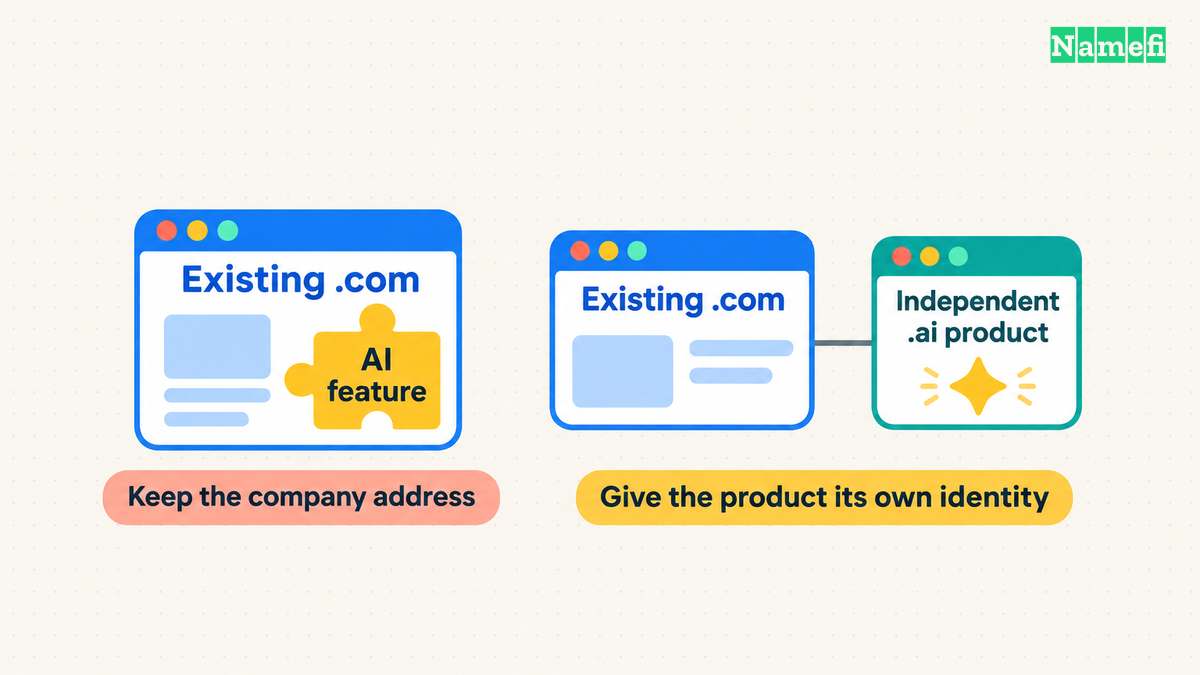
If your company already operates on a suitable .com, an AI feature alone is a weak reason to change the company domain. Start by asking whether the product needs a separate identity at all.
An independent product might justify its own .ai. A feature inside an existing platform might fit the current website better. Choose according to the product's role, rather than treating every AI launch as a domain migration.
Registration terms matter more than a promotional headline
Compare written quotes from the registrar for the exact names. Hostinger lists a one-year minimum for .com; Enom lists two-to-ten-year registration and explicit renewal terms for .ai. These provider examples, checked November 6, 2026, explain why you should compare the billed period as well as an advertised annual rate. Sources: Hostinger domain information and Enom registration terms.
Before paying, record:
- The total initial invoice, currency, taxes, and registration period.
- The renewal quote and the period that quote covers.
- Whether the name is available for a new registration or requires buying from an existing holder.
- Whether any special pricing continues at renewal.
A premium domain offered by its holder is a different purchase from an unregistered name. Don't compare one extension's ordinary registration quote with the other's acquisition price and call the difference a universal TLD cost.
This article deliberately gives no fixed retail price. For the next decision, our .ai registrar comparison identifies providers to investigate; request fresh quotes before relying on any historical pricing.
Google's generic treatment does not promise a ranking advantage
Google lists .ai among the country-code TLDs it treats as generic because users and website owners often see them as generic rather than country-targeted. Google also treats .com as generic. That is a geographic classification, not a statement that two actual websites will rank equally. Source: Google Search Central.
Don't buy .ai expecting an AI-search boost, or buy .com expecting a ranking advantage from the suffix. The cited guidance supplies neither promise. Make the registration decision on the name, intended audience, terms, and business identity.
One primary address gives the decision a clear finish
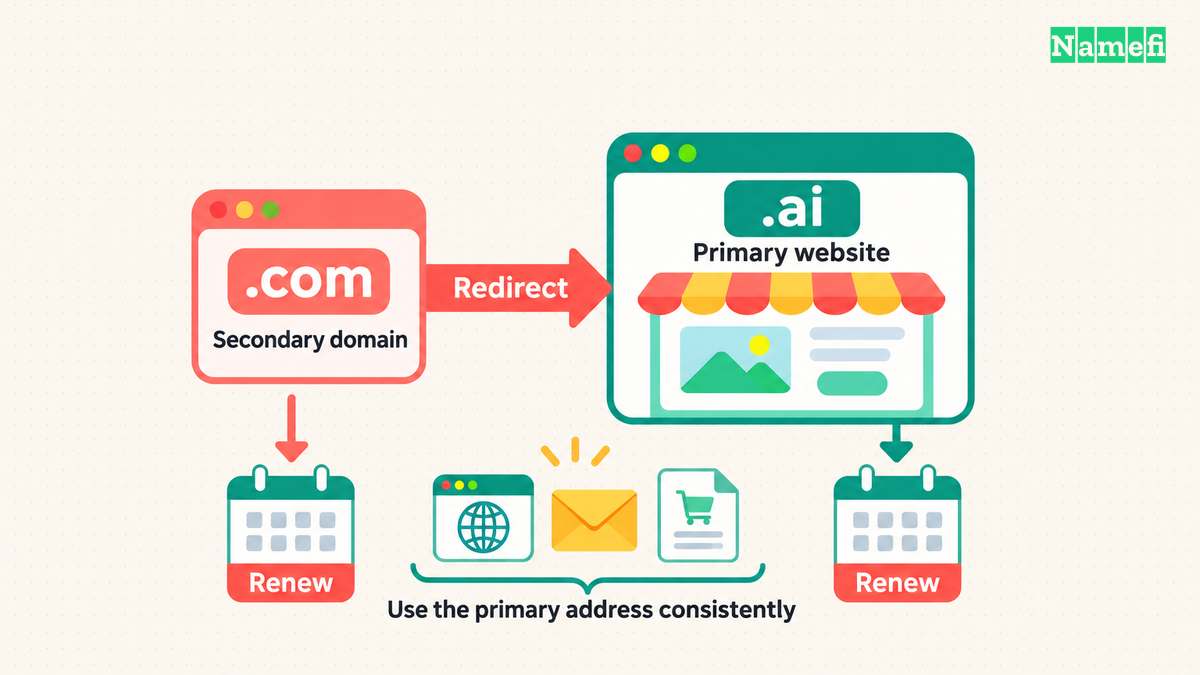
If you choose .ai, commit to using the complete address consistently in your website, email, and sales materials. Check what occupies the matching .com before launch. An active business with a similar name deserves closer investigation than an unrelated parked page.
If you buy both extensions, give the second a defined job, such as redirecting visitors to the primary website. Budget for both renewals. Don't buy both simply to postpone choosing the public address.
Once the name and extension are settled, search at Namefi and check the current availability, supported extension, and full checkout terms.
Comparing more options? Start with our guide to .com vs every other TLD.
Sources and further reading
- IANA — .com manager and creation record; fetched 2026-11-06.
- IANA — .ai manager and creation record; fetched 2026-11-06.
- Identity Digital — .ai migration, January 15, 2025, platform and historical count; fetched 2026-11-06.
- Verisign — Q3 2026 Domain Name Industry Brief release, September 30 registration count; fetched 2026-11-06.
- Hostinger — .com eligibility and terms; fetched 2026-11-06.
- Enom — .ai eligibility and terms; fetched 2026-11-06.
- .ai registry — Acceptable use and policy authority; fetched 2026-11-06.
- Google Search Central — Generic ccTLD treatment; fetched 2026-11-06.
- Company websites — OpenAI, Anthropic, and Mistral, named domain examples; fetched 2026-11-06.
- Namefi — Domain search; fetched 2026-11-06.
About the author(s)
Fenwei Bian is a software developer in her thirties who spends her working hours in pull requests and her weekends with her hands in soil or sawdust. Years of open source on GitHub taught her that names are interfaces: a good one is clear, honest about what it does, and kind to whoever has to use it next.
She gardens because it rewards patience and punishes wishful thinking, and she does woodwork because a joint either fits or it doesn't. Both habits show up in how she writes about naming — measure twice, check the source, and don't sand over a rough spot and hope no one notices.
For Namefi she writes about how domain markets actually move, the practical trade-offs of tokenizing and flipping names, and picking a domain you'll still be glad you own in twenty years.