.com vs Every Other TLD: How to Choose Your Domain
Choose .com or a fitting alternative with a practical decision path, verified registry facts, and 12 comparisons for your domain shortlist.

- guide
Choose .com for a broad business identity when the complete name is clear and the purchase fits your budget. Choose another ending when it gives you a better address, expresses a lasting purpose, or serves the market you actually operate in. A good .org, country domain, or descriptive name can be the first choice. Don't distort your name or spend essential launch funds just to get .com.
Start with the job: a company website, a local storefront, a community project, or a wallet identity. Then compare actual names you can obtain. This guide gives you that decision path and points to twelve detailed comparisons when a particular alternative deserves a closer look.
The comparison starts with the address's job
The groups below organize buying decisions, not one shared set of registry rules. Some overlap: .shop is both a newer generic ending and a retail-oriented choice. The recommendations describe naming fit, rather than measured effects on sales or customer trust.
| Choice or group | Shared reason to consider it | Where the members differ | Main trade-off against .com |
|---|---|---|---|
.com | A broad company or personal identity | Compare the exact spelling and purchase terms | The desired name may require an acquisition or a different name |
Established alternatives: .net, .org, .info | An established generic ending with a useful complete name | Technical identity, mission or community, and information respectively | Pick the purpose deliberately rather than treating every ending as a backup |
Tech choices: .ai, .io, .dev, .app | A name that introduces a technology product or audience | AI, broader tech, developers, or an application | A specific identity may stop fitting as the business changes |
Country domains: .us, .uk, .de | An address tied to a national market | Each registry sets different eligibility and registration structures | The country becomes part of the public identity |
City domains: .nyc, .london | A city that belongs in the business identity | NYC connection rules differ from London's affiliation rules | The address keeps naming the city if the business expands |
Retail choices: .shop, .store | A destination for buying goods | Wording, operator, and exact-name terms | Retail may describe only one part of the future business |
Creator choices: .me, .art, .studio | An address that expresses the creator's identity | Person, artistic field, or studio practice | The more specific description needs to remain accurate |
Broad newer choices: .site, .online | A general web presence with a workable name | Read the full address to assess wording and length | Test whether the audience remembers the ending |
Blockchain names: .eth, Solana naming | Identity in compatible wallets and applications | ENS and SNS have different systems and current registration rules | Application support becomes part of the purchase decision |
Blockchain names need a separate question from the public DNS choices. ENS describes .eth allocation through smart contracts and use through ENS-enabled applications. Don't buy a wallet identity assuming it supplies your business website and email. ENS explains its protocol and applications.
.com earns a place on the shortlist without winning every purchase
IANA names VeriSign Global Registry Services as .com's registry manager and gives its record a creation date of January 1, 1985. That's the TLD record date, not an individual website's registration date. Read IANA's record.
The Verisign-sponsored Domain Name Industry Brief reports 169.8 million .com registrations as of September 30, 2026, alongside 12.6 million .net registrations. These are registration totals, not active-website counts or evidence that your preferred name is unavailable. Read the Q3 2026 report.
For a consultancy, shop, or software company whose activities may broaden, .com leaves the subject unstated. That's a useful naming property. It doesn't justify any asking price, guarantee customer preference, or make a cumbersome spelling good.
Nor does .com require an incorporated company. ICANN's archival overview classifies .com, .net, and .org as unrestricted. Current registration agreements and applicable policies still matter. See ICANN's classification.
Your situation determines which comparison to read
Choose one group first, then one head-to-head comparison if needed. You don't need to investigate every ending before registering.
A business or public project should start with its purpose
- .com vs legacy TLDs: Read this when choosing among
.net,.org, and.info; the group shares established generic status, but technical, community, and information uses call for different judgments. - .com vs .net: Read this when the clean
.netis obtainable and the matching.comisn't; focus on whether the neighboring identity creates confusion. - .com vs .org: Read this when deciding whether the site primarily sells a service or brings people together around a mission.
- .com vs new TLDs: Read this when considering
.site,.online, or.shop; distinguish a general web address from a retail identity before comparing quotes.
For a volunteer association or open-source project, .org can beat an equally obtainable .com on fit. IANA lists Public Interest Registry as its manager, and PIR explicitly allows anyone to register: nonprofit status isn't a prerequisite or something the suffix certifies. IANA identifies PIR; PIR explains eligibility.
WordPress makes the distinction concrete. WordPress.org presents the open-source project, while WordPress.com describes a hosted version. Those are different destinations within one ecosystem, not evidence that one ending makes a site more successful.
A technology team should distinguish the company from the product
- .com vs tech TLDs: Read this to shortlist
.ai,.io,.dev, and.appby product and audience rather than treating them as interchangeable startup badges. - .com vs .ai: Read this when AI defines the offer and a clean
.aicompetes with a broader company address. - .com vs .io: Read this for a developer-facing or broader technology product, including the country-code continuity question.
The tech group shares a naming use, not a policy foundation. Google's registry pages supply a concrete distinction within the group: both .dev and .app require a working HTTPS certificate before browsers will load the site, and both allow general registration. Read the .dev requirements and .app requirements.
IANA names Charleston Road Registry Inc. as manager for .dev and .app. Google dates .dev's general-registration launch to February 28, 2019 and showcases MDN.dev; its .app page showcases Cash App at cash.app. Google's .dev history and .app examples show the different roles.
Choose a company address that can survive a product change. Choose a product-specific ending when the product identity is meant to last. If the shortlist has narrowed to the two technology-associated country codes, the existing .ai vs .io comparison covers that separate decision.
A local business should decide whether location belongs in every address
- .com vs country domains: Read this for a US, UK, or German market, with separate eligibility and namespace checks for
.us,.uk/.co.uk, and.de. - .com vs city TLDs: Read this when New York or London is central to the business, and compare the city policies before buying.
Location can justify choosing an alternative from day one. A Germany-focused service should seriously compare its clean .de candidate; a business planning several national markets should start with a usable .com.
Eligibility comes before branding. The .us nexus policy requires a qualifying individual, US entity, or foreign entity with a bona fide US presence, and continuing compliance. The current .nyc policy accepts a demonstrable economic, cultural, historical, social, or lawful city connection. The .london policy accepts a London address or a good-faith declaration of affiliation or interest. Don't transfer one ending's rules to another.
A seller, creator, or wallet user should choose for the actual destination
- .com vs ecommerce TLDs: Read this for
.shopand.storewhen choosing a main storefront or a separate merchandise address. - .com vs creator TLDs: Read this for
.me,.art, and.studio, distinguishing a personal identity, artistic field, and team practice. - .com vs Web3 domains: Read this when the real choice is a public website versus a wallet identity, including ENS and the current SNS migration.
For a personal portfolio, an art practice, or a dedicated store, the descriptive ending can be the point. Prefer .com when the address needs to represent a broader business. Compare the full words on a portfolio header, packaging, or invoice rather than choosing from extension popularity alone.
For Solana naming, old instructions can mislead a new buyer. SNS currently says existing names resolve as .sns, .sol resolution is paused, and new registrations use .sns. Check the current wallet support and migration rules before paying. Read the SNS migration FAQ.
Search treatment does not choose the domain for you
Google's published new-TLD explanation says its systems treat new generic endings like other generic endings and gives no keyword advantage or disadvantage to the TLD. That supports rejecting a built-in search bonus for .shop or .app; it doesn't predict equal results for two websites. Read Google's explanation.
Google's current geographic guidance treats country codes as a country signal, with named exceptions. Its generic ccTLD list includes .ai, .io, and .me, and Google says the list may change. The classification concerns geographic targeting, not a ranking guarantee or a change to registry eligibility. City endings also don't become country codes merely because they name a location. Read Google's geographic guidance and exceptions.
Choose for audience, purpose, and operating terms. A suffix alone doesn't establish customer trust, conversion, or a resale return. Our domain extensions list helps browse beyond these groups; how TLDs affect domain value addresses the separate valuation question.
The final shortlist needs a registration and renewal check
Reduce the decision to a few complete addresses, then use this order:
- Confirm eligibility and technical requirements. Read the chosen registry's policy, especially for location-linked names and mandatory HTTPS.
- Inspect neighboring identities. Check the matching
.comand relevant alternatives. If the name already identifies another business in your field, reconsider the name before buying another suffix. - Get exact-name quotes. Record registration, renewal, term, currency, applicable fees, and any premium renewal conditions. Keep an existing holder's acquisition price separate.
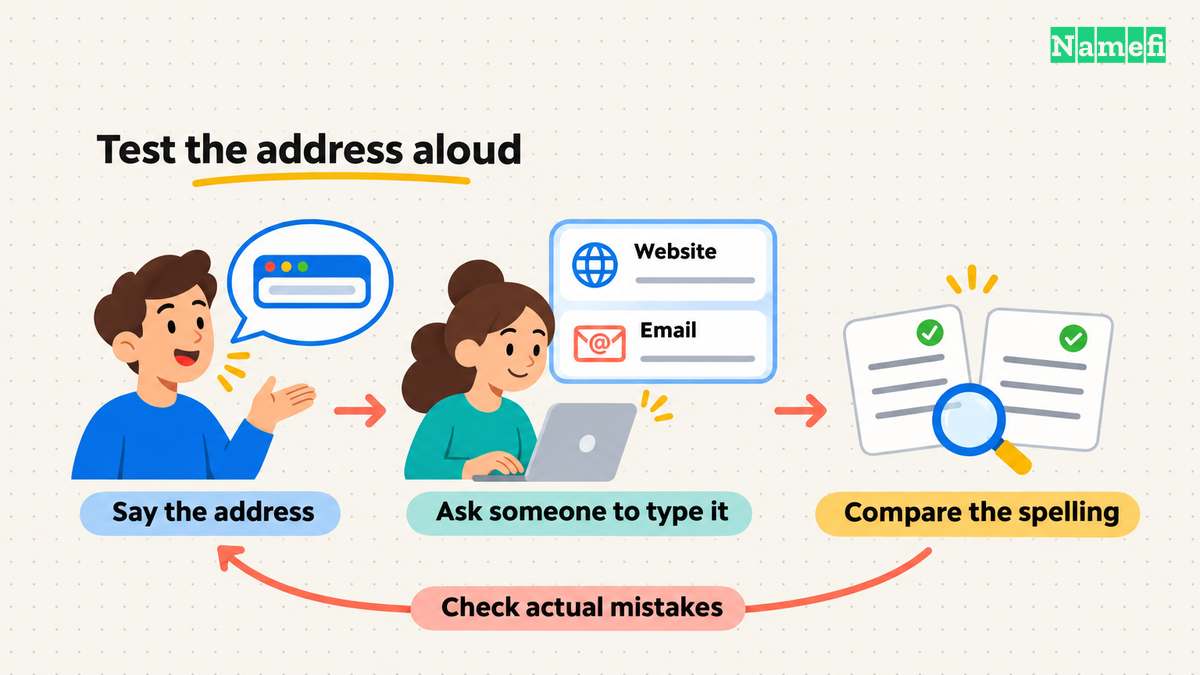
- Test the address in use. Ask an intended customer to type the domain after hearing it. Include the email address. Use observed mistakes rather than an invented traffic-loss percentage.
- Choose one primary address. Add another registration only for a defined purpose and a renewal commitment you can maintain. Don't depend on buying the matching
.comlater.
ICANN explains that registrars set their own prices and can offer introductory promotions. That's why this guide gives no universal price winner: compare the actual offers over the same planned holding period. Read ICANN's renewal-price explanation.
At Namefi or another registrar, confirm support and the exact-name terms before checkout. Take the clean .com when it fits. Take the fitting alternative when it serves the project better. If neither candidate works without a spelling lesson or an unjustified purchase, change the name before committing.
Sources and further reading
- IANA —
.comrecord, manager and creation date; fetched 2026-11-06. - Verisign / DNIB — Q3 2026 report, September registration counts; fetched 2026-11-06.
- ICANN — Archival unrestricted-TLD classification; fetched 2026-11-06.
- IANA —
.orgmanager; fetched 2026-11-06. - PIR —
.orgeligibility; fetched 2026-11-06. - WordPress — Open-source project and hosted service; fetched 2026-11-06.
- IANA —
.devmanager and.appmanager; fetched 2026-11-06. - Google Registry —
.devlaunch, eligibility, examples, and HTTPS and.appeligibility, examples, and HTTPS; fetched 2026-11-06. - Registry Services —
.usnexus requirements; fetched 2026-11-06. .nycregistry — Nexus Policy; fetched 2026-11-06.- Dot London — Naming Policy; fetched 2026-11-06.
- ENS — Protocol, smart-contract allocation, and compatible applications; fetched 2026-11-06.
- SNS — Migration FAQ; fetched 2026-11-06.
- Google Search Central — New-TLD search treatment and current geographic guidance; fetched 2026-11-06.
- ICANN — Renewal prices and introductory promotions; fetched 2026-11-06.
About the author(s)
Fenwei Bian is a software developer in her thirties who spends her working hours in pull requests and her weekends with her hands in soil or sawdust. Years of open source on GitHub taught her that names are interfaces: a good one is clear, honest about what it does, and kind to whoever has to use it next.
She gardens because it rewards patience and punishes wishful thinking, and she does woodwork because a joint either fits or it doesn't. Both habits show up in how she writes about naming — measure twice, check the source, and don't sand over a rough spot and hope no one notices.
For Namefi she writes about how domain markets actually move, the practical trade-offs of tokenizing and flipping names, and picking a domain you'll still be glad you own in twenty years.