.com vs Country Domains (.us, .uk, .de): Which Wins Locally?
Choose between .com, .us, .uk and .de with verified registry rules, local targeting guidance, registration counts and practical trade-offs.

- guide
Choose .de for a business built around Germany, .uk or .co.uk for a business built around the UK, and .com for one brand serving several countries. For a US business, start by comparing the exact .com and .us names, but choose .us only when you qualify and deliberately want the American association. A country domain can be the better primary address. You don't need to buy an awkward .com just to avoid using one.
That's a registration recommendation, not a promise about conversion or search rankings. The right answer depends on where you actually sell, which full name you can obtain, and the rules you can keep meeting.
The comparison starts with your intended market
The country domains in this comparison share a geographic identity: .us represents the United States, .uk the United Kingdom, and .de Germany. Each is a country-code top-level domain. Their registration rules differ substantially. .com is a generic top-level domain, rather than a country's namespace.
| Factor | .com | .us | .uk and .co.uk | .de |
|---|---|---|---|---|
| Best fit in this guide | One brand across countries | An explicitly US-focused identity | A UK-focused business | A Germany-focused business |
| Registry operator | VeriSign Global Registry Services | Registry Services, LLC | Nominet UK | DENIC eG |
| Historical starting point | IANA creation date: January 1, 1985 | IANA creation date: February 15, 1985 | .uk: July 24, 1985; direct registrations launched June 10, 2014 | IANA creation date: November 5, 1986 |
| Eligibility distinction | Check the registration terms for the exact name | Continuing US nexus required | Direct .uk allows any person; .co.uk has no applicant-status restriction | Applicants outside Germany may register |
| Decision to make before paying | Does the full name justify its acquisition cost? | Can you document eligibility and accept the privacy policy? | Which of the two addresses will you publish? | Can you handle any request for a German recipient for legal documents? |
IANA's records identify the operators and creation dates for .com, .us, .uk, and .de. Those are namespace dates, not the dates today's operators began managing them. Nominet separately documents the direct .uk launch. The eligibility details below come from registry policies, not IANA records.
Country domains share a local signal, but not one set of rules
.us requires a continuing connection to the United States
The registry's nexus policy sets three routes: a qualifying individual, a US entity or organization, or a foreign entity with a bona fide US presence. Individuals qualify through US citizenship, permanent residency, or a primary US domicile. For foreign entities, the policy describes lawful US activities or an office or other property in the country. Eligibility must continue after registration.
That makes .us a poor fallback for someone with no qualifying US connection. A registrar accepting payment doesn't settle the eligibility question.
Privacy also matters. The registry's FAQ prohibits proxy or privatized registrations. Check the disclosure implications before using a personal address for a side project.
For a real example, Zoom's current homepage links its sign-in service to zoom.us, while the public www.zoom.us homepage redirects to .com. The Zoom homepage shows both namespaces in use. That is evidence of a company's domain setup, not proof that either extension caused its success.
.uk and .co.uk share a registry but remain separate registrations
You can choose yourbrand.uk or yourbrand.co.uk. Direct .uk is shorter; .co.uk explicitly sits within the commercial part of the namespace. Nominet's current Rules of Registration allow any person to register directly under .uk and place no applicant-status restriction on .co.uk. The commercial-use charter for .co.uk states an intention rather than an enforced applicant qualification.
Registering one address doesn't automatically give you the other. Search both, decide which address goes on invoices and email, and consider the matching registration if the additional renewal obligation is worthwhile. Don't assume rules for .uk and .co.uk also apply to restricted namespaces such as .ltd.uk.
Sainsbury's supplies a concrete .co.uk example. Nominet itself uses nominet.uk for the registry pages cited here. Neither form is inherently the correct choice for every UK business.
The date matters: Nominet labels its replacement policy package as effective February 9, 2027. This article uses the rules applicable on November 6, 2026.
.de permits overseas applicants but carries a legal-service consideration
DENIC explicitly permits individuals and institutions outside Germany with legal capacity to register .de. You don't need to turn a German-market launch into a claim of German residency.
However, DENIC provides a process for rights holders to seek the appointment of a German recipient for legal documents when the domain holder lives abroad. Overseas eligibility doesn't mean you can ignore correspondence from the registry.
The retailer dm-drogerie markt runs its German storefront on dm.de. For a business whose product information, service area and customer support center on Germany, .de is a coherent primary address. That's a practical fit, not a measured claim that German shoppers always prefer it.
Registration counts show scale rather than a winner
These are published figures with different reporting dates and definitions. They aren't a same-day market-share table.
| Namespace | Primary-source figure | What the figure covers |
|---|---|---|
.com | 169.8 million names at the end of Q3 2026 | Verisign's domain base, including registered names outside the active zone and names on hold |
.us | “2M+” registered domains | Registry headline observed November 6, 2026; no specific snapshot date accompanies that headline |
.uk family | 10.4 million domains in Nominet's 2026 anniversary account | The managed .UK family, not direct .uk alone |
.de | More than 18 million registered domains on November 5, 2026 | DENIC's anniversary statement |
A larger namespace doesn't establish that your name is available, that visitors will trust your site, or that your pages will rank. For the broader namespace picture, see our ccTLD registration-volume overview. This comparison focuses on the purchase decision rather than repeating that market survey.
Google treats country targeting separately from a ranking promise
Google describes country-code domains as a strong country signal. Its exceptions list treats some ccTLDs as generic; .us, .uk and .de do not appear on that list. Don't extend the generic treatment of .ai and .io to every country domain. Our .ai versus .io comparison covers that different choice.
Google lists country domains as offering clear geotargeting, with costs and country restrictions among the trade-offs. A .com can also target a market through regional URLs, local content and other signals. Google recommends hreflang for identifying language or regional variants.
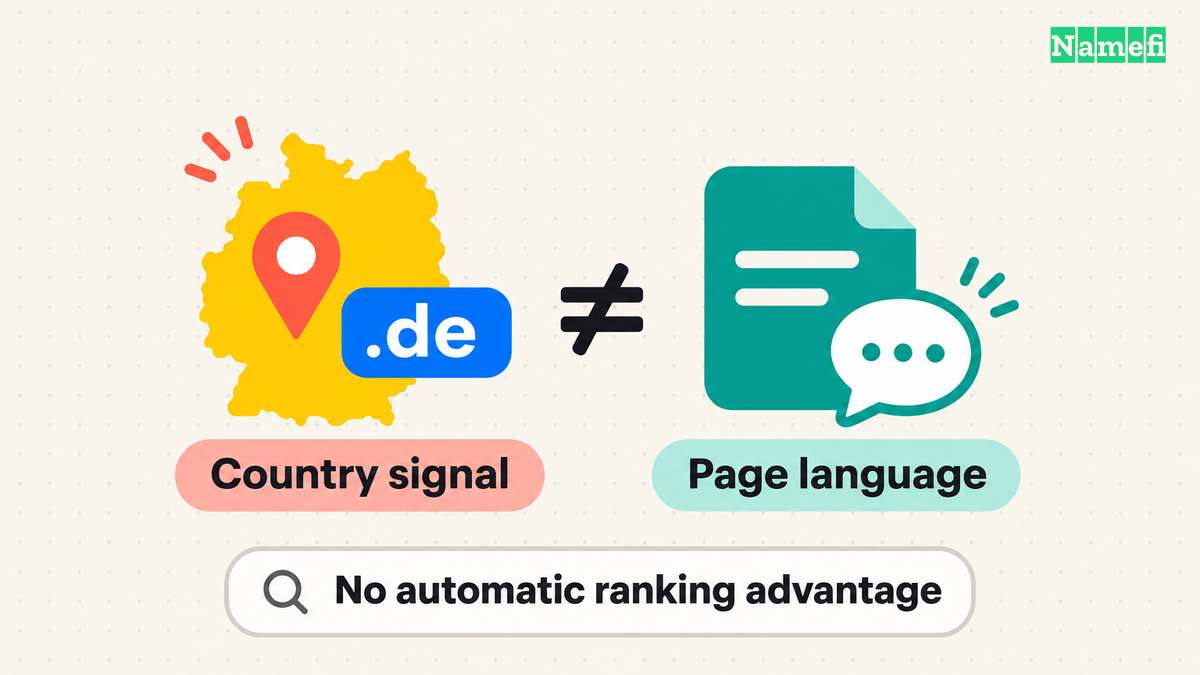
That guidance doesn't establish an automatic ranking advantage for either choice. Germany is a country, not a language: a .de address and a German-language page answer different targeting questions.
Your situation should determine the primary address
- You serve Germany and have no near-term foreign storefront. Choose a clear
.deahead of a cumbersome.com. Consider the matching.comseparately if expansion becomes concrete. - You serve the UK. Compare
.co.ukand direct.ukfirst. Choose one public address; owning both can support a redirect, but maintaining two independent copies needs a reason. - You serve the US. Prefer the clean
.comwhen it fits the name and budget. Choose.uswhen the American association is intentional, you meet nexus requirements, and the privacy terms work for you. - You sell internationally from launch. Prefer
.comas the shared address. Consider country domains for markets with genuinely separate operations, rather than buying a country domain for every possible future customer. - Your exact
.comis unavailable. Compare the actual alternatives. A short, accurate local name can be a better purchase than a long or confusing.com. If another registrant holds the.com, treat buying it as a separate acquisition decision.
Those are editorial recommendations. Test the whole address with actual customers: ask someone to read it aloud, spell it back, and explain which market they expect the business to serve. Don't substitute an extension popularity table for that exercise.
The trade-offs continue after registration
Budget for the names you'll maintain. Get a dated quote from your chosen registrar for registration, renewal, transfer and any required services. Compare equivalent terms. This guide doesn't quote prices because an extension alone doesn't determine the checkout amount. An existing owner's asking price is also different from a new-registration fee.
Choose a main address before setting up email. If you buy matching domains, document the primary website and sender domain. Redirect secondary web addresses intentionally, and decide separately whether secondary domains should receive email. Owning both doesn't configure either service for you.
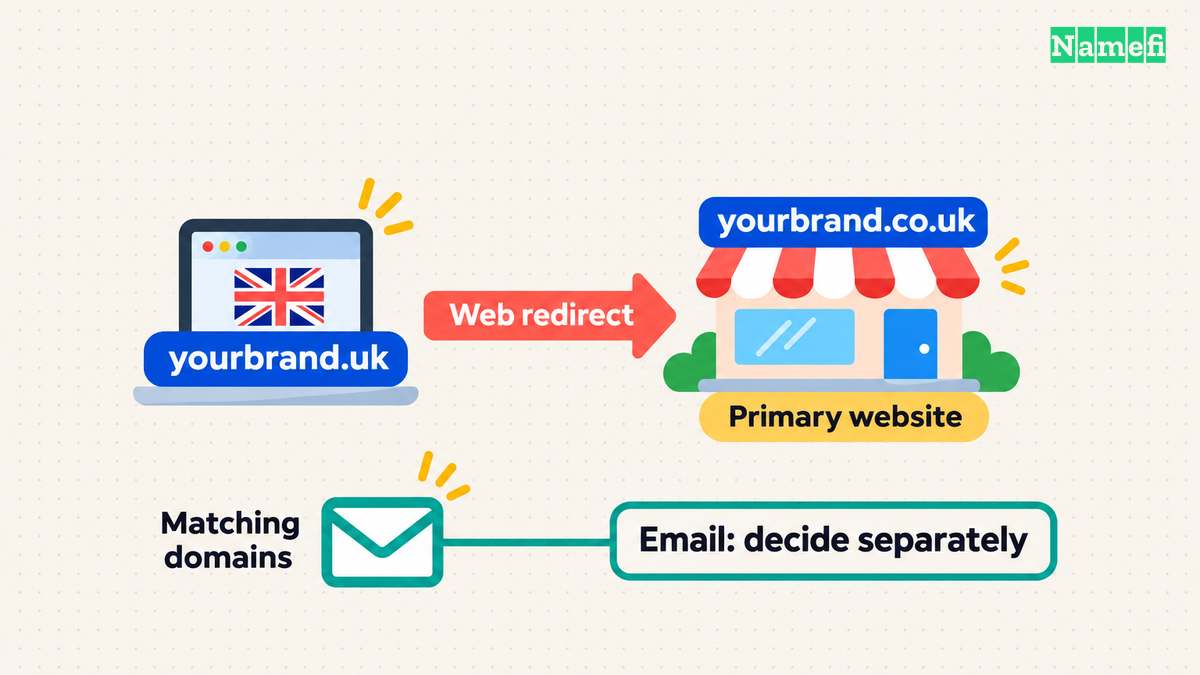
Buy defensive names selectively. A UK shop may have a clear reason to secure both .co.uk and .uk; a Germany-only service may prioritize .de and the matching .com. Our business TLD guide covers the wider defensive-registration decision. You don't need the whole list to launch.
Make the registration decision before choosing a provider
Write down the intended market, primary address, eligibility evidence and renewal quote. Then follow the domain registration guide. If you're considering Namefi, confirm support and current terms for the exact extension before checkout, especially when a country domain has eligibility requirements.
For a local business, the winning domain is the clear name you can legitimately register and consistently use. Sometimes that's .com. For a business committed to Germany or the UK, it can be the country domain from day one.
Comparing more options? Start with our guide to .com vs every other TLD.
Sources and further reading
- IANA —
.comWHOIS record, operator and creation date; fetched 2026-11-06. - IANA —
.usWHOIS record, operator and creation date; fetched 2026-11-06. - IANA —
.ukWHOIS record, operator and creation date; fetched 2026-11-06. - IANA —
.deWHOIS record, operator and creation date; fetched 2026-11-06. - Registry Services — US nexus policy, eligibility and continuing compliance; fetched 2026-11-06.
- Registry Services — FAQ and statistics, privacy policy and published count; fetched 2026-11-06.
- Nominet — Direct
.uklaunch announcement; fetched 2026-11-06. - Nominet — Rules of Registration and policy transition date; fetched 2026-11-06.
- Nominet — 30-year anniversary figures, managed namespace count; fetched 2026-11-06.
- DENIC — Applicant FAQ and authorised-recipient process; fetched 2026-11-06.
- DENIC — 40 years of
.de, November 5, 2026 registration count; fetched 2026-11-06. - Verisign — Q3 2026 earnings slides, slide 6 and domain-base definition; fetched 2026-11-06.
- Google Search Central — Managing multi-regional sites, country signals, generic exceptions and URL options; fetched 2026-11-06.
- Live examples — Zoom, Sainsbury's, and dm; fetched 2026-11-06.
About the author(s)
Fenwei Bian is a software developer in her thirties who spends her working hours in pull requests and her weekends with her hands in soil or sawdust. Years of open source on GitHub taught her that names are interfaces: a good one is clear, honest about what it does, and kind to whoever has to use it next.
She gardens because it rewards patience and punishes wishful thinking, and she does woodwork because a joint either fits or it doesn't. Both habits show up in how she writes about naming — measure twice, check the source, and don't sand over a rough spot and hope no one notices.
For Namefi she writes about how domain markets actually move, the practical trade-offs of tokenizing and flipping names, and picking a domain you'll still be glad you own in twenty years.