.com vs Ecommerce TLDs (.shop, .store): Best for Sellers?
Choose .com, .shop, or .store for your storefront. Compare registry facts, retail meaning, renewal checks, and when .com isn't worth the compromise.

- guide
Choose .com when the exact brand name fits your budget and the address will represent the whole business. Choose .shop or .store when the retail address is cleaner, the matching .com is impractical, or you want a distinct home for merchandise. A good retail name beats a .com padded with awkward words just to get the extension.
The ecommerce group shares a plain promise: this is somewhere to shop. The members differ in wording, operator, and registration terms. Neither gets a Google ranking bonus for putting a retail keyword after the dot: Google says keywords in a TLD confer no search advantage or disadvantage.
Compare the whole address before choosing the extension
| Factor | .com | .shop | .store |
|---|---|---|---|
| Best editorial fit | Main address for a business with several activities | Retail-first brand or shopping destination | Retail-first brand or dedicated merchandise store |
| Registry manager | VeriSign Global Registry Services | GMO Registry, Inc. | Radix Technologies Inc. |
| Historical milestone | Introduced in 1985 | Delegated May 23, 2016 | Delegated February 22, 2016 |
| Eligibility | Unrestricted generic extension | No requirement to operate a shop | Open to anyone |
| Meaning to test with customers | Broad business identity | “Shop” works as a noun or an invitation | “Store” names a retail destination |
| Main compromise | The desired name may require an acquisition or a different spelling | Retail wording may fit poorly if the business changes direction | Retail wording may fit poorly outside the selling part of the business |
| Cost decision | Check the exact name and renewal quote | Check the exact name and renewal quote | Check the exact name and renewal quote |
IANA identifies the current managers for .com, .shop and .store. The latter two records give the delegation dates above. Delegation marks entry into the root zone, not the opening of public registration.
For .com, the ICANN-commissioned economic study lists 1985 and unrestricted registration. For .shop, GMO's CEO explicitly says registrants need not be shops. Radix's current .store explanation says anyone can register. Open eligibility does not make an unavailable name available or remove registration terms.
This article chooses a primary address. For the broader question of which additional extensions to secure, use our ecommerce TLD portfolio guide. For the separate decision about who should manage a Shopify domain, read the Shopify buying guide.
The retail extensions share a purpose, not an operator
Treat .shop and .store as alternatives within one retail group, rather than interchangeable registrations. GMO runs .shop; Radix runs .store. Check both names independently. Availability or a quote on one tells you nothing about the other.
The useful wording distinction is small but concrete. “Shop” can read as an action, while “store” reads as a destination. Say the complete address in a product video, put it on a packaging mockup, and ask a prospective customer to type it back. Choose the version that survives that exercise, rather than assuming either word works equally well in every market.
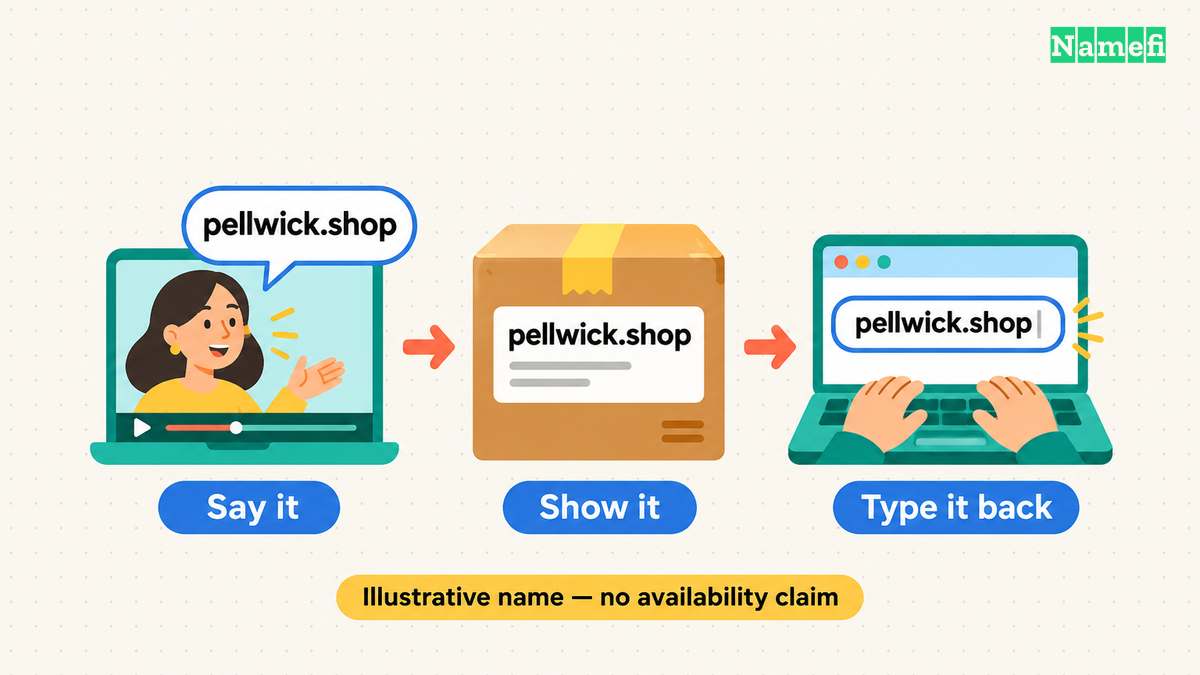
These are naming judgments, not measured conversion claims. Our brandable versus keyword domain comparison explores the words before the dot; here, the question is whether the complete name presents your retail business clearly.
The registries publish scale claims, but the metrics need careful reading. GMO's site reports more than 3.9 million registered .shop addresses, as displayed when fetched November 6, 2026. The page does not give a measurement date. Radix's homepage instead says over 1 million sellers worldwide use .store. Sellers are not a registration count, so those figures do not form a market-share comparison.
For a dated infrastructure benchmark, Verisign reported 179.1 million combined .com and .net registrations at the end of Q2 2026. That is explicitly a combined total, not a .com count. None of these figures measures shoppers' trust or predicts your store's sales.
Real stores show three workable uses
The live sites make the choices less abstract:
- A broad commerce identity: eBay operates on
ebay.com. The address does not spell out a particular product category. - A retail brand's main storefront: Doshi sells vegan bags, wallets, and accessories on
doshi.shop. GMO also publishes founder Paras Doshi's account of choosing.shopwhen the desired.comwas unavailable. - A dedicated merchandise destination: the Emirates Official Store sells aircraft models and accessories on
emirates.store. The retail word fits the specific purpose of the site.
These examples demonstrate actual use, not the cause of commercial success. Doshi's story is particularly useful for a new seller: a matching .com need not be a condition for launching. Emirates illustrates a different decision, separating merchandise from the broader brand's activities.
Choose by the job the address must do
Choose .com for the whole company when the exact name is practical. If the same identity must cover retail, wholesale inquiries, company information, and future services, a broad address leaves the naming brief open. Start with .com, but set an acquisition budget before approaching an existing holder.
Choose .shop or .store when .com forces a worse name. Compare the complete candidates. An invented example such as pellwick.shop can be a better editorial choice than buy-pellwick-products-online.com. Those are illustrations, not availability claims. If the retail version is clear, affordable on renewal, and suitable for the audience, use it confidently as the main address.
Keep an established address unless the new one solves a real problem. A retail extension alone is not a reason to change customer-facing URLs, packaging, or email. Write down the concrete benefit before planning a move. “The extension sounds newer” is a weak brief for that work.
Choose a retail extension for a separate merchandise operation. A creator, publisher, or service business can give selling its own address while keeping the broader identity elsewhere. Alternatively, consider a shop section under an existing domain before adding another registration to manage.
Choose between .shop and .store on the exact name and terms. If both match your brand, let the audience test and renewal quote decide. Do not pay extra merely because one registry's marketing sounds more persuasive.
Renewal terms matter more than an introductory offer
There is no universal price winner in this comparison. This article gives no price quote because a useful quote must identify the registrar, date, exact name, currency, term, and renewal conditions.
Before paying a registrar, record:
- The initial charge and registration period.
- The renewal charge and renewal period.
- Whether the name carries premium pricing, including at renewal.
- Any acquisition payment to an existing holder, separately from registration fees.
- Who controls the account and who handles renewal.
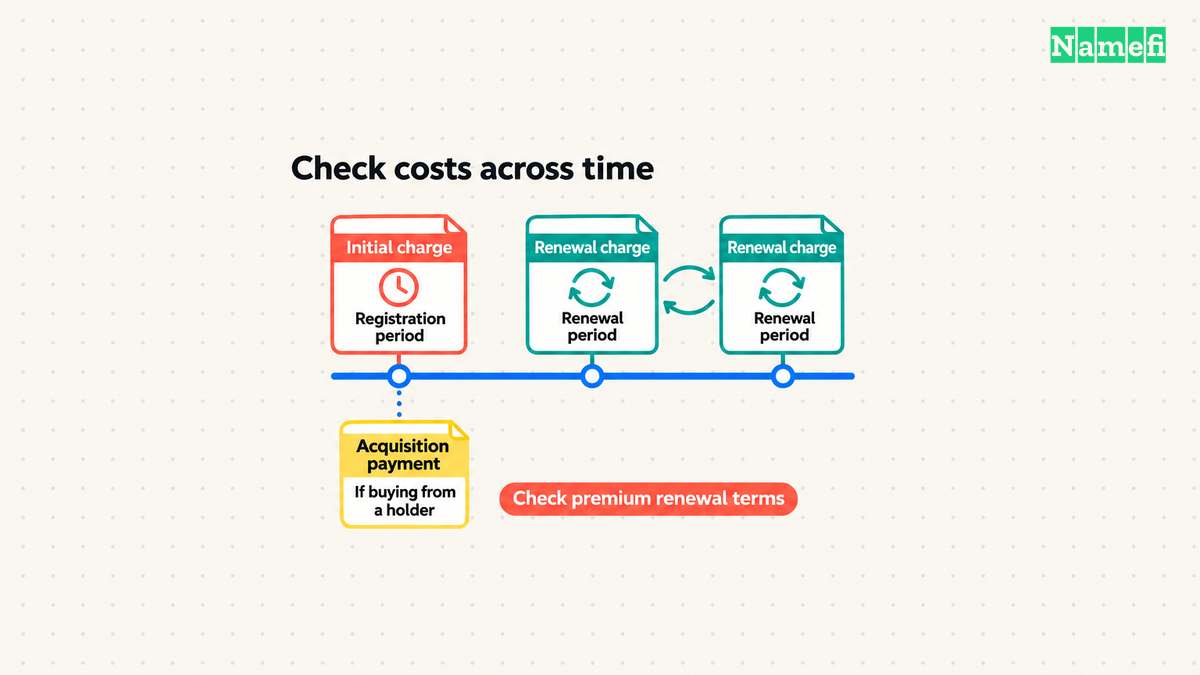
The .shop registry's FAQ explicitly distinguishes premium names and pricing. A short name is not automatically a standard-price registration. Compare the actual candidates instead of comparing a promotional retail-extension offer with an unrelated .com resale listing.
Near the purchase stage, read Namefi’s explanation of tokenized domains if that ownership model interests you. The extension decision still comes first: choose the name, then verify the provider's current support and terms for that exact registration.
The extension cannot promise rankings or customer trust
Google's guidance treats new generic extensions like other generic extensions, including .com. Its specific statement about TLD keywords rules out buying .shop or .store for a built-in keyword ranking boost. It also gives no basis for declaring .com the automatic ranking winner.
A clear retail meaning is useful naming material; it is not proof of a better checkout conversion rate. Equally, open registration is not verification that a merchant is legitimate. Judge the full storefront and test the name with the people who will buy from it.
The practical recommendation is straightforward: take the clean .com when it fits the whole business and the budget. Take the clean .shop or .store when retail is the point and .com would mean an awkward name or an unjustified acquisition. Choose one primary address and make that address consistent across packaging, profiles, and customer messages.
Comparing more options? Start with our guide to .com vs every other TLD.
Sources and further reading
- IANA —
.commanager; fetched 2026-11-06. - IANA —
.shopmanager and delegation; fetched 2026-11-06. - IANA —
.storemanager and delegation; fetched 2026-11-06. - ICANN — Economic framework, historical gTLD table; fetched 2026-11-06.
- Ascio — Interview with GMO Registry CEO Hiro Tsukahara, eligibility; fetched 2026-11-06.
- Radix —
.storeeligibility; fetched 2026-11-06. - GMO Registry —
.shopcount, founder account, and premium-name FAQ; fetched 2026-11-06. - Radix —
.storeseller claim; fetched 2026-11-06. - Verisign — Q2 2026 combined
.comand.netregistration base; fetched 2026-11-06. - Google Search Central — Handling of new top-level domains; fetched 2026-11-06.
- eBay — Live marketplace; fetched 2026-11-06.
- Doshi — Live storefront; fetched 2026-11-06.
- Emirates — Official Store; fetched 2026-11-06.
About the author(s)
Fenwei Bian is a software developer in her thirties who spends her working hours in pull requests and her weekends with her hands in soil or sawdust. Years of open source on GitHub taught her that names are interfaces: a good one is clear, honest about what it does, and kind to whoever has to use it next.
She gardens because it rewards patience and punishes wishful thinking, and she does woodwork because a joint either fits or it doesn't. Both habits show up in how she writes about naming — measure twice, check the source, and don't sand over a rough spot and hope no one notices.
For Namefi she writes about how domain markets actually move, the practical trade-offs of tokenizing and flipping names, and picking a domain you'll still be glad you own in twenty years.