.com vs .io: Which Domain Do Tech Startups Need?
Choose .com or .io for your tech startup with verified registry facts, search treatment, real examples, and advice on names, costs, and continuity.

- guide
Choose .com when the exact name fits your budget and your startup needs to reach beyond a technical audience. Choose .io when it gives a developer-facing product a clearer, shorter name without an awkward compromise. Being a tech startup does not make .io a requirement, and owning .com does not justify any acquisition price.
The decision is about the complete address you'll put on the website, in email, and in customer documentation. A clean .io can beat a cumbersome .com. An affordable exact-match .com can save you from building a naming strategy around an extension your customers don't recognize. Those are editorial buying recommendations, not measured conversion claims.
The comparison starts with two different registry categories
Both endings are ordinary DNS top-level domains, but they have different policy foundations. IANA classifies .com as generic and .io as country-code. The technology association does not turn .io into a generic registry delegation.
| Factor | .com | .io |
|---|---|---|
| Registry manager listed by IANA | VeriSign Global Registry Services | Internet Computer Bureau Limited |
| Origin | Generic namespace, originally intended for commercial businesses | Country-code namespace associated with the British Indian Ocean Territory |
| IANA creation date | January 1, 1985 | September 16, 1997 |
| Applicant eligibility | Unrestricted applicant category | Applicants for names directly under .io may reside in any legal jurisdiction |
| Google geographic treatment | Generic TLD | Listed among ccTLDs Google treats as generic |
| Strongest reason to choose it | A company address that needn't suggest a particular industry | A concise complete name that suits your technical audience |
| Main reason to reject it | The available spelling or acquisition terms compromise the business | Audience confusion, unacceptable renewal terms, or unwanted country-code continuity exposure |
The dates and managers come from IANA's .com WHOIS record and .io WHOIS record. ICANN describes .com's original commercial purpose. Verisign's registry submission to ICANN identifies .com as unrestricted. Availability, reserved names, and registration agreements still apply.
For .io, the registry's second-level allocation rule permits applicants worldwide. The same document requires British Indian Ocean Territory residency for third-level registrations, such as a name under com.io. Don't confuse that structure with yourbrand.io. Open applicant eligibility also doesn't waive the registry's contact-data and acceptable-use rules.
Real technology services use both endings for different purposes
Consider a group with a shared audience: software developers. GitHub's company site lives at github.com. Its publishing service uses github.io: GitHub's documentation explains that Pages sites can use that domain or a custom domain. These are different roles within one ecosystem, not competing votes for the best startup suffix. A Pages subdomain isn't a separately registered .io name.
Nor does .io mean a product must sell developer tools. Itch.io describes its marketplace as serving independent digital creators, with a focus on independent video games. Its audience includes creators and players, a different use from GitHub Pages' website publishing.
Use those examples to test a naming idea, not to borrow a company's success. A recognizable service on either ending does not prove that the extension caused adoption.
For scale, Verisign's October 22 presentation reports 169.8 million .com names at the end of Q3 2026, on slide 6. The count includes registered names beyond the active zone, including names not configured for use and names on hold. It is not a count of active businesses or websites. No current .io registration total appears in the primary sources checked for this article, so we don't substitute an estimate.
Your customers should decide the shortlist
Consumer products and business software share a need for clear customer communication
Start with .com for a consumer app, a broad marketplace, or software sold to nontechnical teams. The recommendation is to avoid making customers learn an extra naming convention before they can remember your address. Test that assumption with actual customers rather than treating familiarity as a guaranteed trust or sales advantage.
Members of this group still differ. A marketplace must communicate clearly to both buyers and sellers. Business software may need an address that finance, procurement, and support contacts can repeat accurately. A technical buyer inside an enterprise doesn't necessarily represent everyone who will handle your invoices or emails.
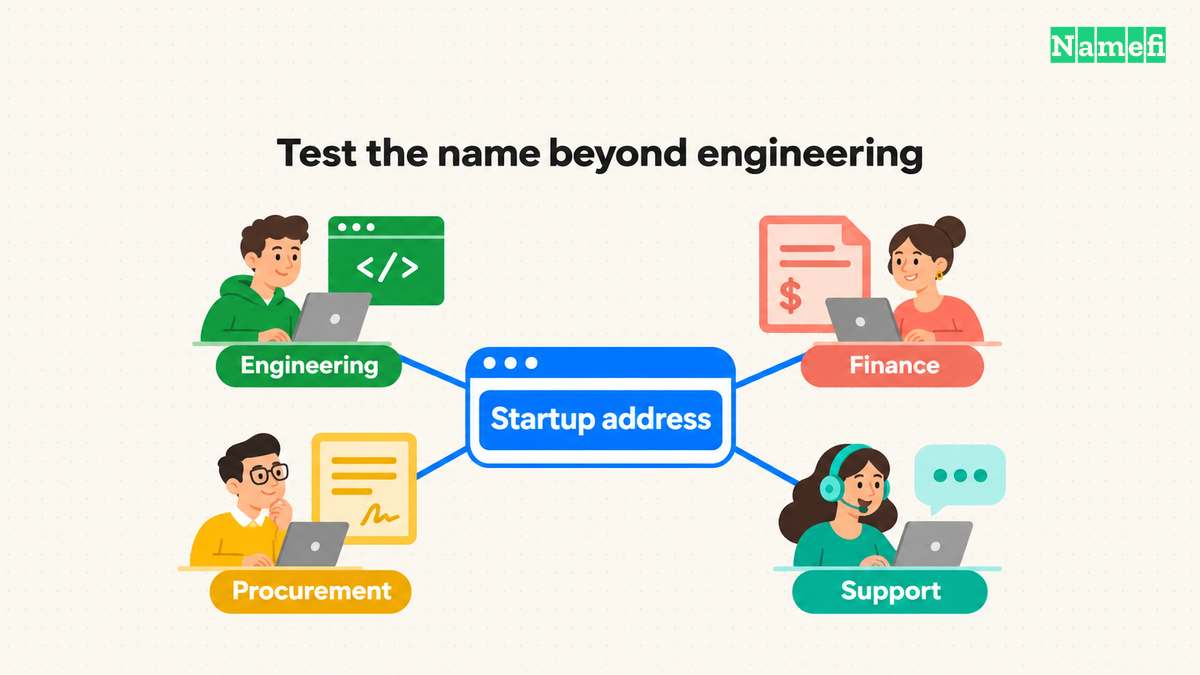
If the exact .com requires an acquisition your company cannot justify, compare a sensible modified .com with the exact .io. Don't add several filler words just to keep the suffix.
Developer tools, APIs, and infrastructure share a technical buying audience
Give .io a serious place on the shortlist when customers will encounter the name in documentation, repositories, SDK setup, and technical communities. The I/O association can support a computing identity, but treat that reading as a branding hypothesis to test.
The differences within this group matter. A developer tool may sell directly to individual engineers. An API business may also depend on partner introductions and enterprise contracts. Infrastructure software may eventually reach an audience far beyond the first technical adopters. Choose a name that works in those later conversations too.
.com is not the better choice when keeping it forces a spelling customers struggle to repeat, or an acquisition that displaces more urgent product work. Choose the clean .io if the recurring terms fit and the matching .com doesn't create an unacceptable identity collision. Choose another brand if either ending would leave customers confusing you with an established company.
For a broader extension shortlist, use our startup TLD guide. If artificial intelligence is central to the product, the separate .ai versus .io comparison addresses that choice rather than repeating it here.
Google treats both as generic for geographic targeting
Google's multi-regional site documentation includes .com among generic TLDs and .io among country-code extensions it treats as generic. Google also says the ccTLD list may change.
That answers a geographic-targeting question. It doesn't establish that .com ranks higher, that .io earns a technology boost, or that two sites will perform equally. Don't pay for a domain on the premise that this classification supplies an SEO advantage.
Compare the purchase and renewal obligations separately
An available registration and a purchase from an existing holder are different decisions. For each candidate, get the initial charge, term, renewal quote, and any premium renewal conditions from the chosen registrar. Keep an owner's asking price separate from recurring registration costs.
This comparison deliberately gives no universal price: the exact name, provider, term, currency, and date determine the quote. Our .io pricing guide explains the cost questions in more detail.
If both names fit the budget, consider registering both only with a purpose: a primary address, a redirect, or a documented future option. Keep one public identity. Owning both doesn't remove the need to check other businesses' names or monitor renewal dates.
The country-code distinction adds a continuity question for .io
As checked November 6, 2026, IANA lists .io as active and gives no retirement date. IANA's retirement guide ties country-code eligibility to ISO 3166-1 assignments. A loss of eligibility triggers a formal process, with a default five-year removal period and a possible approved extension of up to five additional years.
Those are conditional policy provisions, not a countdown already running for .io. The active delegation doesn't promise permanent continuation either. For a long-lived startup, decide whether accepting that additional dependency makes sense before embedding the domain in email, application callbacks, documentation, and integrations.
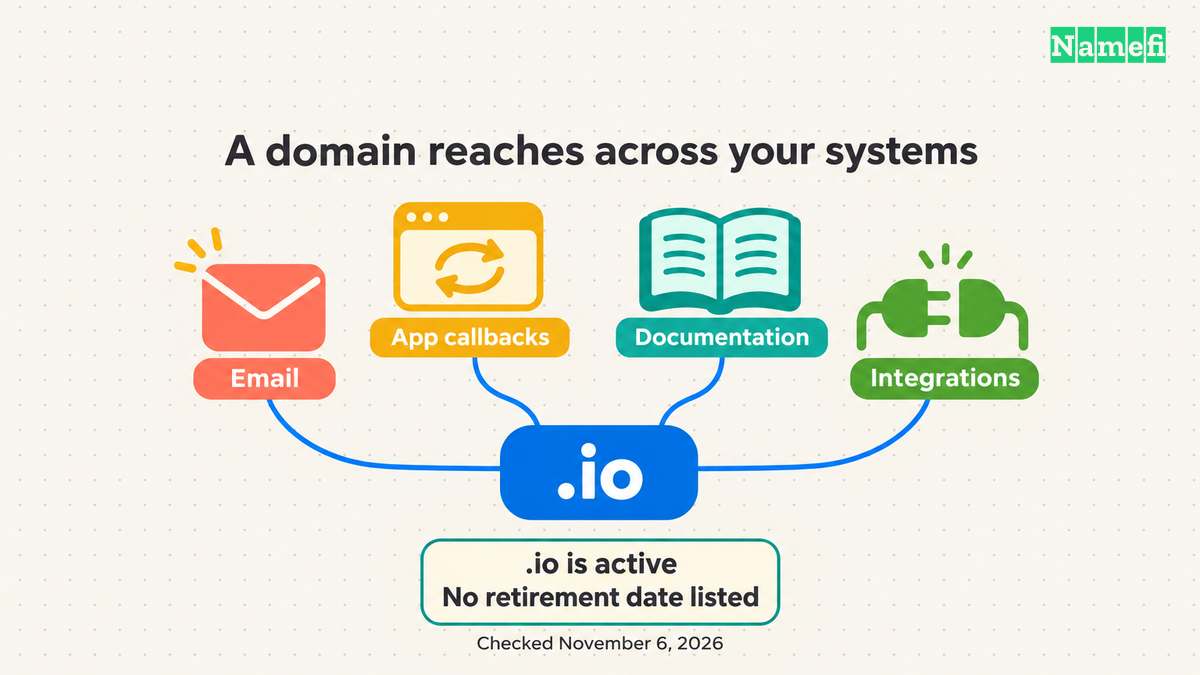
Choose .com if avoiding that country-code eligibility exposure matters more than the shorter .io spelling. Choose .io if the name is materially better for your product and the team accepts the continuity question. Neither decision excuses weak account security or missed renewals.
Register the name you can operate with confidence
Read each candidate aloud, ask someone in the target audience to type it, inspect the matching name on the other ending, and compare the actual purchase and renewal terms. Then make the call: an affordable, clear .com for broad reach; a clear .io when it better fits a technical product.
Once the shortlist is ready, Namefi's domain search provides a place to check candidate names. Review the live result and offered terms before purchasing. The extension decision should already make sense without a promise about resale, search rankings, or future acquisition of the other name.
Comparing more options? Start with our guide to .com vs every other TLD.
Sources and further reading
- IANA —
.comroot-zone record, classification and manager; fetched 2026-11-06. - IANA —
.ioroot-zone record, classification, manager, and active status; fetched 2026-11-06. - IANA —
.comWHOIS record, creation date; fetched 2026-11-06. - IANA —
.ioWHOIS record, creation date; fetched 2026-11-06. - ICANN — General questions,
.com's original purpose; fetched 2026-11-06. - Verisign, filed with ICANN — Registry service request, November 30, 2017, page 11, unrestricted
.comapplicant category; fetched 2026-11-06. - NIC.IO — Allocation rules, second-level and third-level eligibility, acceptable use, and contact requirements; fetched 2026-11-06.
- GitHub — Company website, developer platform example; fetched 2026-11-06.
- GitHub Docs — What is GitHub Pages?,
github.ioand custom-domain roles; fetched 2026-11-06. - Itch.io — About itch.io, creator marketplace example; fetched 2026-11-06.
- Verisign — Q3 2026 earnings presentation, slide 6, registration base and definition; fetched 2026-11-06.
- Google Search Central — Managing multi-regional and multilingual sites, generic geographic treatment and changeable ccTLD list; fetched 2026-11-06.
- IANA — ccTLD retirement guide, eligibility, notice, and transition periods; fetched 2026-11-06.
- Namefi — Domain search, candidate search interface; fetched 2026-11-06.
About the author(s)
Fenwei Bian is a software developer in her thirties who spends her working hours in pull requests and her weekends with her hands in soil or sawdust. Years of open source on GitHub taught her that names are interfaces: a good one is clear, honest about what it does, and kind to whoever has to use it next.
She gardens because it rewards patience and punishes wishful thinking, and she does woodwork because a joint either fits or it doesn't. Both habits show up in how she writes about naming — measure twice, check the source, and don't sand over a rough spot and hope no one notices.
For Namefi she writes about how domain markets actually move, the practical trade-offs of tokenizing and flipping names, and picking a domain you'll still be glad you own in twenty years.