.com vs New TLDs (.site, .online, .shop): Which to Buy?
Compare .com, .site, .online, and .shop by naming fit, renewal terms, and practical trade-offs before choosing a domain to register.

- guide
Buy .com when the complete name is clear, the cost fits your budget, and your audience can remember the address. Choose .site, .online, or .shop when the alternative gives you a better complete name at renewal terms you can sustain. Don't add awkward words or stretch your launch budget just to end in .com.
The distinction within the newer group matters: .site and .online suggest a general web presence, while .shop suggests a store. Those are naming interpretations to test with your audience, not promises about trust, sales, or search rankings.
Compare the complete addresses before choosing an ending
| Buying question | .com | .site | .online | .shop |
|---|---|---|---|---|
| What naming role would you test? | A broad brand address | A general website or project | A broad online identity | A retail or storefront identity |
| When would you shortlist it? | The desired name is obtainable without compromising spelling or budget | The full name reads clearly for a site, portfolio, or project | The name reads naturally with “online” | Shopping is central to the intended identity |
| What trade-off needs attention? | Don't accept an awkward name solely for the ending | Check whether listeners remember the ending | Read the full address aloud and assess its length | Consider whether a retail label fits future plans |
| What cost should you compare? | Exact-name acquisition or registration, plus renewal | Exact-name registration and renewal | Exact-name registration and renewal | Exact-name registration and renewal |
| Does the ending buy a Google ranking advantage? | No advantage established over the other generic endings here | No keyword bonus from the ending | No keyword bonus from the ending | No keyword bonus from the ending |
The naming rows are editorial guidance. Google's explanation of new generic TLDs supports the search row: Google says its systems generally treat new gTLDs like other gTLDs, and keywords in an ending confer neither a search advantage nor a disadvantage.
For a wider shortlist, use our domain extensions list. This comparison focuses on choosing a registration, rather than cataloguing every available ending.
The newer endings share a category, but they differ in meaning and management
All four endings are generic top-level domains. IANA classifies .com, .site, .online, and .shop that way. The newer choices aren't country-code endings repurposed for their letters.
They don't all share an operator. The same IANA records list VeriSign Global Registry Services for .com, Radix Technologies Inc. SEZC for .site and .online, and GMO Registry, Inc. for .shop. A shared category doesn't establish identical registration terms or retail prices.
For naming purposes, .site and .online leave the subject open. A portfolio, a community project, and a service business could each consider either ending. .shop makes a more specific suggestion: the address is a place to shop. That can be useful when you want the domain to explain the destination, but less useful if retail is only a small part of the business.
These associations depend on the reader understanding the words. Show the complete address to prospective customers before treating the association as a benefit.
Choose the ending that fits the situation
A broad business should compare clarity before paying extra for .com
If the same brand name is available on .com at acceptable terms, put it on the shortlist. Then ask people from the intended audience to hear the address once and type it back. The practical question is whether the full address works in referrals, invoices, and email signatures.
If the .com requires a confusing spelling, a string of filler words, or an acquisition you cannot justify, compare a clean .site or .online instead. The better purchase can be the name you can explain and afford today.
Don't build the plan around buying the matching .com later. Make sure the chosen address works as a lasting identity even if the other name never becomes available on acceptable terms.
A store should consider .shop when the retail meaning helps
Shortlist .shop if the business is a store and the complete address sounds natural. Compare the brand on .shop with the actual .com alternative, including any extra words needed to obtain that alternative.
The trade-off is scope. A store that expects to become a broader publishing, consulting, or software business should ask whether “shop” still describes the intended identity. .site and .online leave more room in that naming sense, but give less retail context.
Our e-commerce TLD guide explores other retail endings. You don't need a portfolio of retail domains to make this initial choice.
A portfolio or experimental project can choose .site or .online deliberately
For a personal site, project page, or early business experiment, prioritize a readable name and sustainable ongoing cost. .site and .online can belong on the first shortlist rather than serving only as fallbacks.
Compare how the brand and ending sound together. An ending that repeats the preceding word may feel clumsy. A longer address may be acceptable when visitors follow a link, yet inconvenient when someone needs to dictate an email address. Test the actual use case rather than declaring one ending universally easier to remember.
An established site should require a concrete reason to move
If an existing address works, don't change the ending merely because a promotion appears. Write down the problem the move would solve, then include the work of updating links, email, and customer communications in the decision.
Google's domain-move guidance in its new-TLD explanation says processing a domain change can take time. A new registration and a migration are different buying decisions.
Renewal terms matter more than the promotional headline
There is no price table here because an extension-wide price would hide the exact-name and registrar comparison you need. ICANN explains that registrars set their own prices and may offer introductory promotions. An initial registration charge can therefore be lower than renewal.
Ask the registrar for the following before checkout:
- The exact domain's initial charge, currency, registration term, and applicable fees.
- The renewal quote and the period covered by that quote.
- Whether the name has a premium designation, and whether a premium charge applies again at renewal.
- The distinction between paying an existing holder for a domain and paying the registrar to maintain the registration.
- The services included in the offer and the services charged separately.
Save the quote and its date. Compare costs over the same planned holding period using the actual terms offered. Don't assume .com is always more expensive, or that a newer ending is always the budget option.
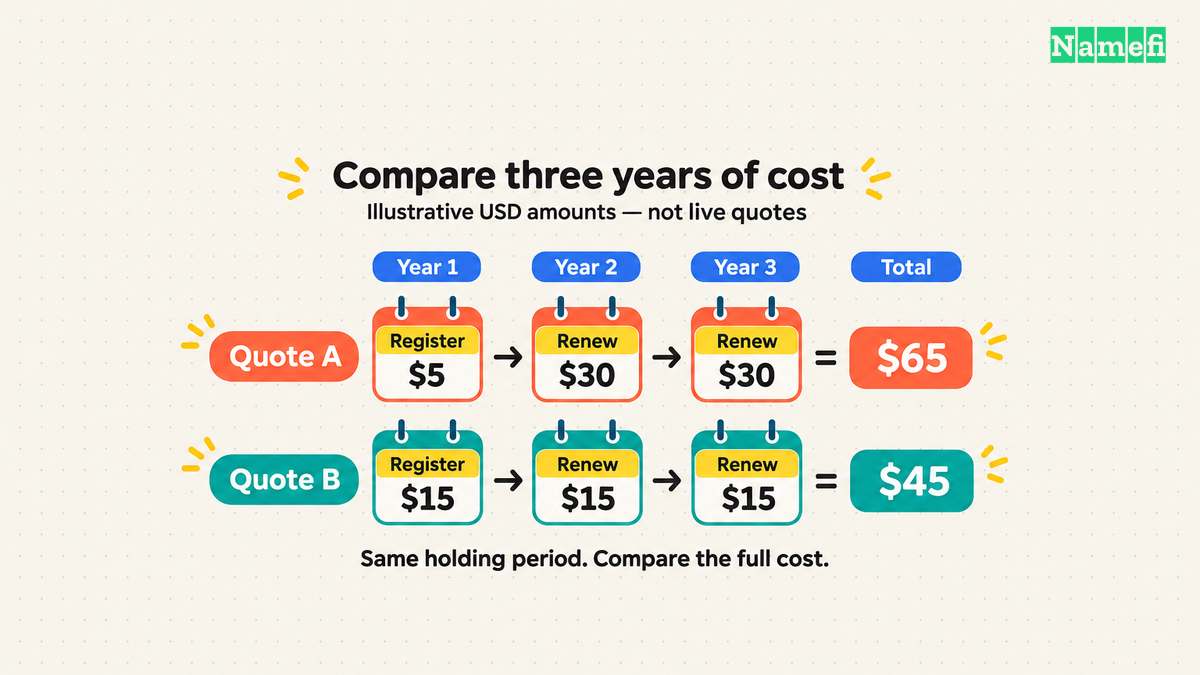
For registrar selection beyond the ending itself, follow our registrar buying guide.
Search treatment does not decide the naming question
Google's new-gTLD explanation supports rejecting a keyword bonus for .shop, .site, or .online. It doesn't promise identical results for different websites. Treat claims about better rankings, customer trust, or conversion rates as separate claims requiring evidence.
Google's current multi-regional documentation describes generic TLDs as unassociated with specific locations. The same documentation separately identifies country-code exceptions that Google treats generically. That exception list is not a ranking recommendation or a list of the best extensions to buy.
If the purchase pitch depends on keywords and search traffic, read keyword domains and SEO. If the shortlist instead includes country-code endings used by technology businesses, our .ai versus .io comparison covers that different decision.
Buy a name that works without a future upgrade
Before registering, read the complete address aloud, test the spelling with intended users, inspect the corresponding names on the other endings, and review the ongoing terms. If a matching name already belongs to another business, investigate possible confusion before choosing an alternative ending.
Choose .com when the full address earns the choice. Choose .site or .online when a broad web identity fits better. Choose .shop when the retail meaning helps. Reject any option that only makes sense with an unsupported SEO promise or an unaffordable future purchase.
When you're ready to compare a provider, Namefi's TLD pricing page separates registration, renewal, and transfer columns for supported non-premium TLDs. Confirm support and the exact-name quote before buying; the base-price page does not establish a premium domain's price.
Comparing more options? Start with our guide to .com vs every other TLD.
Sources and further reading
- IANA —
.comdelegation record, generic classification and manager; fetched 2026-11-06. - IANA —
.sitedelegation record, generic classification and manager; fetched 2026-11-06. - IANA —
.onlinedelegation record, generic classification and manager; fetched 2026-11-06. - IANA —
.shopdelegation record, generic classification and manager; fetched 2026-11-06. - Google Search Central — Google's handling of new top level domains, new-gTLD treatment and domain-move cautions. Published in 2015; fetched 2026-11-06.
- Google Search Central — Managing multi-regional and multilingual sites, generic geographic treatment and country-code exceptions; fetched 2026-11-06.
- ICANN — Domain name renewals and expiration FAQ, registrar pricing and introductory promotions; fetched 2026-11-06.
- Namefi — TLD pricing, page scope and registration, renewal, and transfer columns; fetched 2026-11-06. Individual price rows did not load in the fetched page, so this article quotes no Namefi prices.
About the author(s)
Fenwei Bian is a software developer in her thirties who spends her working hours in pull requests and her weekends with her hands in soil or sawdust. Years of open source on GitHub taught her that names are interfaces: a good one is clear, honest about what it does, and kind to whoever has to use it next.
She gardens because it rewards patience and punishes wishful thinking, and she does woodwork because a joint either fits or it doesn't. Both habits show up in how she writes about naming — measure twice, check the source, and don't sand over a rough spot and hope no one notices.
For Namefi she writes about how domain markets actually move, the practical trade-offs of tokenizing and flipping names, and picking a domain you'll still be glad you own in twenty years.