.com vs Web3 Domains (.eth, .sol): What Is the Difference?
Choose .com for a website, .eth for ENS identity, or a Solana name with care: compare resolution, registration, renewals, and current .sol changes.

- guide
Register .com if you need a public website and business email. Choose .eth if your main job is a readable identity in ENS-compatible wallets and apps. For Solana, check before buying: SNS says new registrations use .sns, while .sol resolution is paused. Read the current SNS notice.
The useful question isn't which ending looks more modern. It's where people need to use your name. A customer opening your shop and a wallet resolving a payment recipient need different things.
The comparison starts with what each name can do
| Decision point | .com: public DNS | .eth: ENS identity | .sol: Solana naming in transition |
|---|---|---|---|
| Naming system | Global Domain Name System | Ethereum Name Service | Solana Name Service, moving to a new registry |
| Registry or allocation authority | Verisign registry, with registrations through registrars | ENS registrar smart contracts | SNS; legacy SPL Name Service and new Solana Record Service registries |
| Best reason to register | Website, email, and a public address | Readable wallet identity and application records | Solana identity, subject to current migration support |
| Visitor or sender requirements | Standard DNS plus configured hosting or mail | ENS-aware wallet, app, or gateway | Compatible wallet or app; verify the active suffix |
| Ongoing obligation | Renew through your registrar | Renew the name under the applicable ENS version | Check SNS's current terms rather than borrowing ENS's model |
| Registration choice today | Search for an available name | Search through the official ENS app | New SNS registrations use .sns; new .sol eligibility differs |
Sources for the table: IANA's .com record, ENS's protocol documentation, and SNS's migration rules.
Here, Web3 names means blockchain naming systems that provide readable identities to compatible applications. .eth and .sol share that purpose. They don't share a blockchain, registration policy, renewal model, or guaranteed set of integrations.
.com gives a website a public DNS address
IANA identifies VeriSign Global Registry Services as the manager of .com. Verisign records the first .com registration, symbolics.com, on March 15, 1985. That's a first-registration date, not a claim about when today's registry operator took over. Verisign's anniversary record supplies the historical example.
You don't have to run a commercial company to register one. GoDaddy's .com documentation says anyone can register on a first-come, first-served basis. An available name still needs to meet the registrar's registration requirements.
Verisign reported 169.8 million .com names at the end of Q3 2026. The report's definition includes registered names that aren't configured for use and names on hold, so that isn't a count of active websites. See slide 6 and its definition.
For a shop, consultancy, or software product, the practical advantage is the public DNS address. You can configure hosting, HTTPS, and email around the same name. Registration alone doesn't supply those services: budget for setup as well as the domain.
.eth and .sol share an identity purpose but follow different rules
Neither .eth nor .sol appears as a delegated TLD in the IANA root-zone registry checked for this article. An application can recognize a blockchain name without making that ending part of public DNS. Don't assume that entering the name into any browser or ordinary email client will work.
.eth gives ENS-compatible apps a readable identity
ENS launched in May 2017. Its allocation rules live in registrar smart contracts, rather than a .com-style registry service. ENS maps names to cryptocurrency addresses, content hashes, and other records. That makes .eth useful when people need to find the same identity across supporting apps. ENS's launch history and record documentation explain the distinction.
Real uses extend beyond individual handles. ENS documents Uniswap's uni.eth subnames and Coinbase's base.eth namespace. Those are subnames beneath an organization's name, which can have different rules from registering your own second-level .eth. See the named examples.
For scale, ENS's March 18, 2026 article reported approximately 1.6 million domains and 30 million subnames. Preserve the distinction: the source doesn't describe those figures as one count of independently registered .eth names. Read ENS's figures.
Registration requires an available name, the protocol's registration process, and payment. The current docs direct new registrations to ENSv2 and distinguish renewals for migrated and unmigrated names. Use the official app rather than following an old contract tutorial. Read the ENSv2 transition notice.
.sol buyers need to check the SNS migration first
Bonfida launched Solana Name Service in May 2021, then announced its rebrand to SNS in July 2024. Those dates describe the service's history, not an ICANN delegation. Read the launch account and rebrand announcement.
SNS's January 5, 2026 update reported 455,000+ .sol registrations and named Jeremy Allaire's jdallaire.sol as an example. That's a historical snapshot before the migration, not confirmation that the address resolves today. See SNS's count and example.
As checked November 6, 2026, SNS says existing names have transitioned to .sns. New registrations don't qualify for matching new .sol names. Snapshot eligibility has exceptions. Activation targets Q4 2026–Q1 2027, subject to change. Check the migration FAQ before purchasing.
For a new Solana identity, evaluate the currently offered .sns name and your wallet's support. Don't buy based on an old “register your .sol” walkthrough.
Your situation should decide what you register
You're launching a public business. Choose .com if the complete name fits your brand and budget. Your website, customer email, and invoices need a dependable public address. A blockchain identity can follow when customers actually need one.
You only want an ENS wallet identity. Choose .eth. A .com isn't automatically the better purchase when you don't need a website or mailbox. Start with the wallet and apps you use, and confirm they read the records you plan to set.
Your community lives on Solana. Choose a name that the community's current tools resolve. During the SNS transition, the active suffix and migration status matter more than matching an older profile screenshot.
You need both a business address and a wallet identity. Holding a DNS name and a separate blockchain name can make sense. Treat the registrations separately: availability in one namespace doesn't reserve the matching label in another.
The exact .com is unavailable or beyond your budget. Don't buy .eth merely to disguise that problem. If you need a website, consider a different complete DNS name. If you need only a wallet identity, skip the .com acquisition. Our .ai versus .io comparison covers two other DNS choices.
Renewals, resolution, and control create the real trade-offs
Compare the actual invoice and renewal obligation. For .com, ask the registrar for registration and renewal quotes. For ENS, check your name's version and term. ENSv2 documents annual name-length pricing and multi-year discounts; the legacy page describes different terms. This article doesn't quote those fees as a universal “Web3 domain price.” Read the current ENSv2 pricing rules.
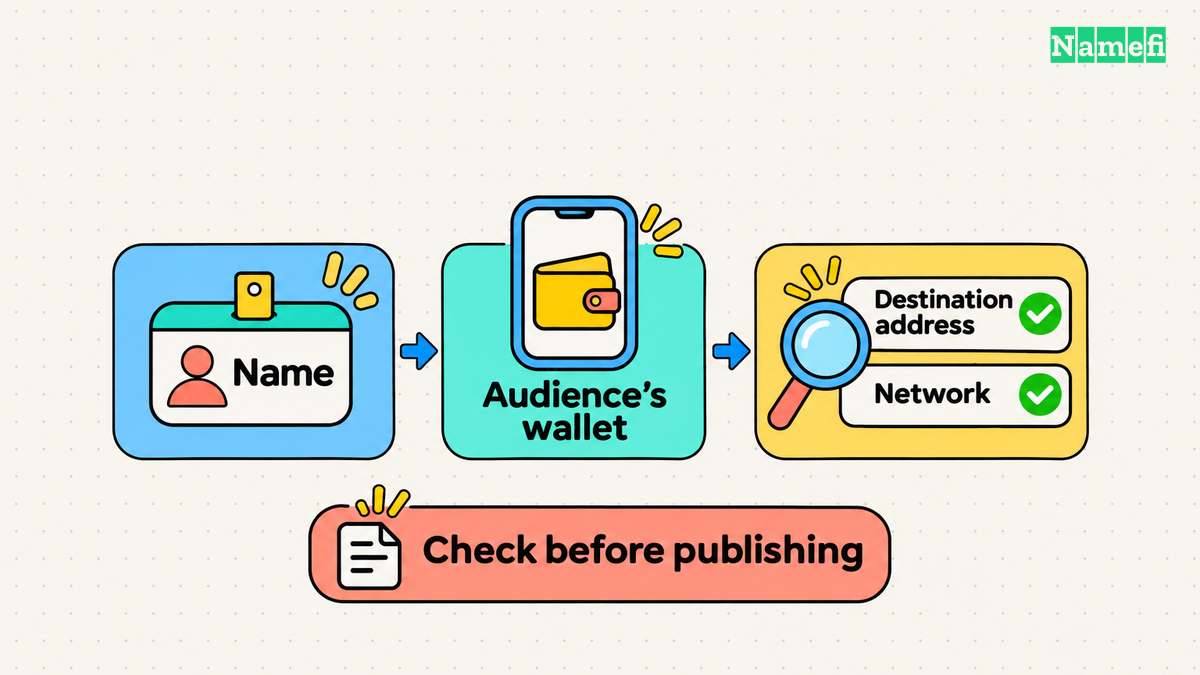
Test the recipient experience. Before publishing payment instructions, check resolution in the exact wallet your audience uses. Confirm the destination address and network. Before publishing a business URL, test the website and mail setup. A name that looks right in your own account isn't enough evidence that customers can use it.
Treat search visibility as a website requirement. Google requires a publicly accessible page, a successful HTTP response, and indexable content; meeting those requirements still doesn't guarantee indexing. A wallet name alone doesn't establish any of them. If you publish through a gateway, test the resulting web URL. This comparison makes no claim that .com receives a ranking bonus. Read Google's technical requirements.
Check what you control before paying. A second-level name, an organization-issued subname, and a marketplace listing aren't interchangeable. Verify the naming system, expiry, transfer permissions, and records rather than relying on an “NFT domain” label.
A .com can also participate in blockchain naming
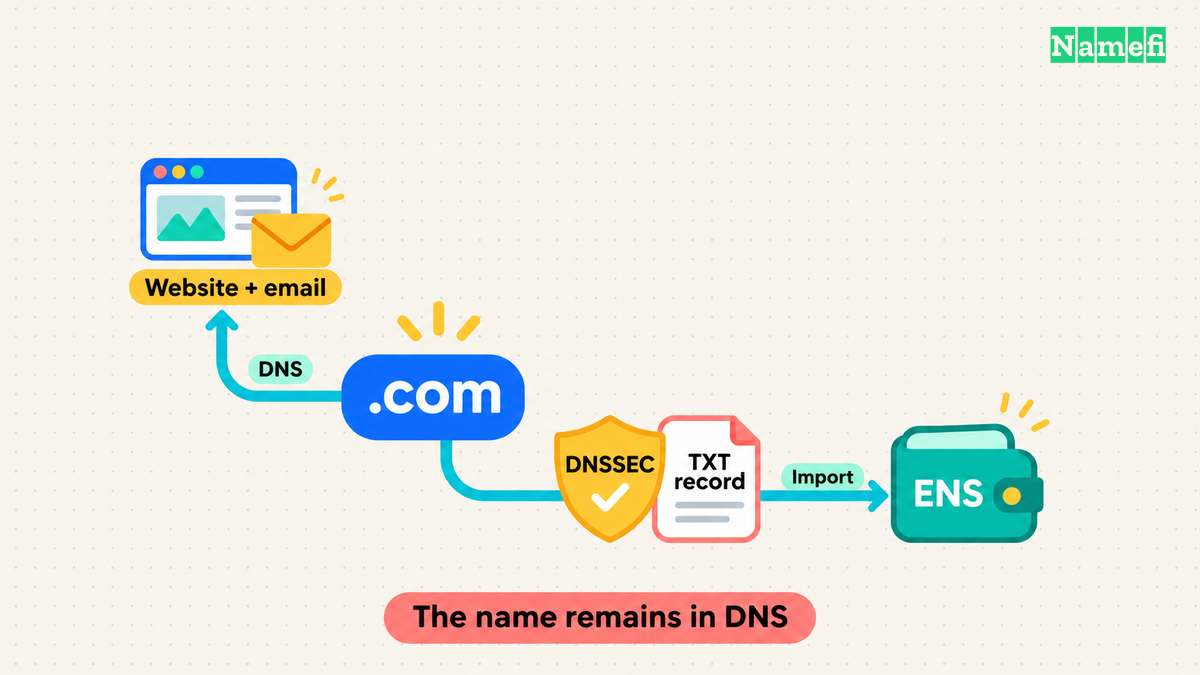
You don't necessarily need a separate ending to add blockchain functionality. ENS supports importing DNS names using DNSSEC and a TXT record. That lets a suitable .com participate in ENS while remaining a DNS name. Importing a DNS name isn't the same operation as tokenizing its registration. Read ENS's DNS-import requirements.
For the Namefi context, our tokenized domain versus Web3 domain guide explains that separate ownership question. Our ENS, Unstoppable, and tokenized DNS comparison examines the broader categories. The registration decision here stays practical: secure a public DNS address for your website, and choose a blockchain identity when your applications give that identity a job.
Comparing more options? Start with our guide to .com vs every other TLD.
Sources and further reading
- IANA —
.commanager and root-zone registry; fetched 2026-11-06. - Verisign — First
.comregistration; fetched 2026-11-06. - Verisign — Q3 2026 earnings slides, slide 6: domain base and definition; fetched 2026-11-06.
- GoDaddy —
.comregistration eligibility; fetched 2026-11-06. - ENS — Protocol and records; fetched 2026-11-06.
- ENS — Launch history and organizational subnames; fetched 2026-11-06.
- ENS — March 2026 domain and subname figures; fetched 2026-11-06.
- ENS — Legacy registrar and transition notice and ENSv2 registrar; fetched 2026-11-06.
- Bonfida — SNS launch history and SNS rebrand; fetched 2026-11-06.
- SNS — January 2026 registration count and named example; fetched 2026-11-06.
- SNS — Migration FAQ and registration eligibility; fetched 2026-11-06.
- Google Search Central — Technical requirements; fetched 2026-11-06.
- ENS — DNS-name imports; fetched 2026-11-06.
About the author(s)
Fenwei Bian is a software developer in her thirties who spends her working hours in pull requests and her weekends with her hands in soil or sawdust. Years of open source on GitHub taught her that names are interfaces: a good one is clear, honest about what it does, and kind to whoever has to use it next.
She gardens because it rewards patience and punishes wishful thinking, and she does woodwork because a joint either fits or it doesn't. Both habits show up in how she writes about naming — measure twice, check the source, and don't sand over a rough spot and hope no one notices.
For Namefi she writes about how domain markets actually move, the practical trade-offs of tokenizing and flipping names, and picking a domain you'll still be glad you own in twenty years.