
DNSpionage: The Campaign That Weaponized DNS Against Governments
In late 2018, Cisco Talos disclosed DNSpionage — a campaign later linked by researchers to Iranian interests that included malware and a separate DNS-redirection operation against government and company domains. In January 2019, CISA ordered federal agencies to audit and secure DNS infrastructure through Emergency Directive 19-01.
- domains
- security
- dns
- domain-security

Most domain disasters are about who owns a name. This one was about who controls it — and for a few months in late 2018, the answer for dozens of government domains across the Middle East was: not the governments.
DNSpionage included a malware operation and, in Talos's words, a separate DNS-redirection campaign. The redirection arm did not require defacing a home page or exploiting the victim's web application: compromised nameservers or administrative accounts could change the DNS records that told email, VPN, and web clients where to connect. Later reporting on the broader activity documented stolen credentials and valid TLS certificates being used to make some redirected services look legitimate.
Cisco Talos named it DNSpionage. It is one of the cleanest demonstrations on record that the Domain Name System is not just plumbing. It is national-security infrastructure.
DNS as a weapon of statecraft
To understand why DNSpionage rattled governments, you have to remember what DNS actually does.
Every time you send mail to a ministry, log into a corporate VPN, or load a webmail page, your device first asks DNS a question: what IP address is this name? Whatever DNS answers, you trust. Your mail client connects there. Your VPN authenticates there. Your browser hands over the session there. DNS is the address book of the entire internet, and almost nothing checks whether the address book has been edited.
That is the property DNSpionage exploited. If an attacker can change the record, the attacker can redirect clients toward infrastructure positioned to imitate or proxy a trusted service. The victim's own domain may still appear in the browser bar, so the change can be difficult to notice without DNS, certificate, and account monitoring.
This is espionage at the layer below the application. It is also, uncomfortably, the layer that most security programs treat as a solved problem.
The DNSpionage campaign (2018–2019)
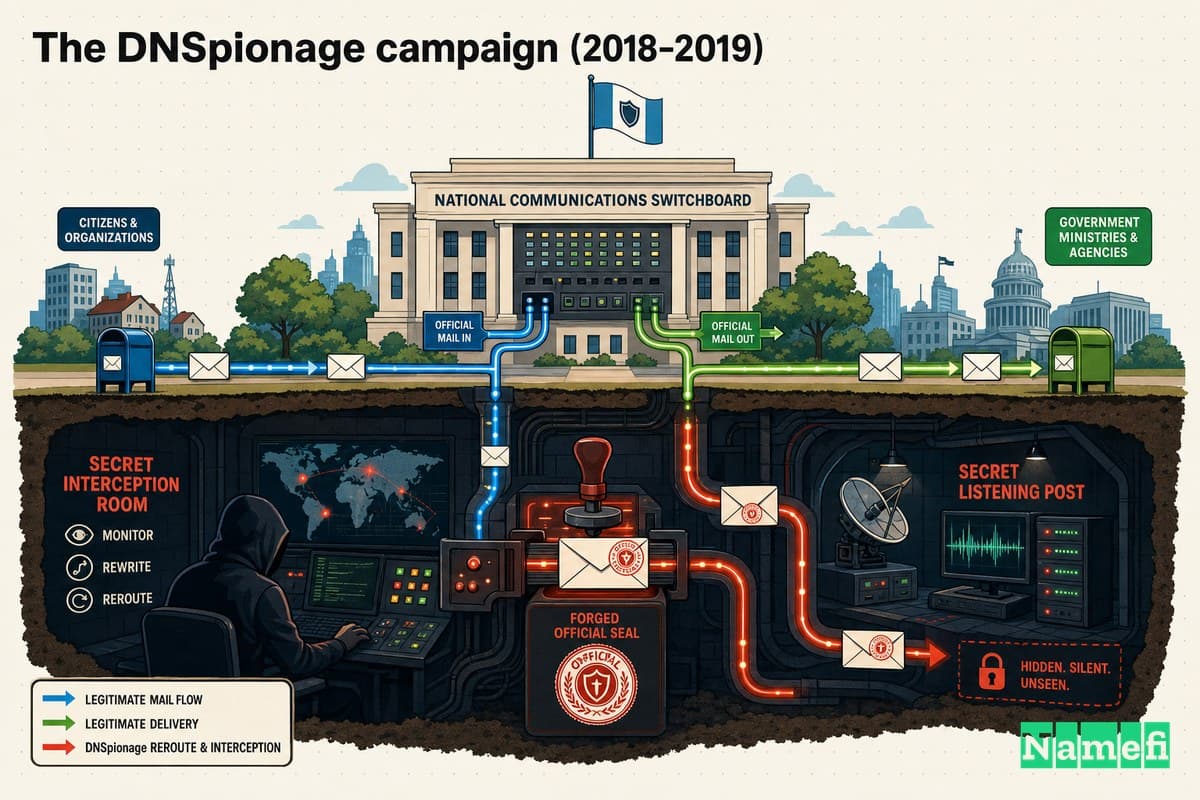
On November 27, 2018, Cisco Talos published its first report. The opening line was specific: "Cisco Talos recently discovered a new campaign targeting Lebanon and the United Arab Emirates (UAE) affecting .gov domains, as well as a private Lebanese airline company."
The campaign had two faces. One was a fairly ordinary malware operation: "This particular campaign utilizes two fake, malicious websites containing job postings that are used to compromise targets via malicious Microsoft Office documents with embedded macros." The bait sites impersonated real recruiters — "hr-wipro[.]com (with a redirection to wipro.com) and hr-suncor[.]com (with a redirection to suncor.com)" — and dropped a custom remote-access tool that, distinctively, could talk to its command server over DNS itself.
But the second face is the one that made history. In Talos's words: "In a separate campaign, the attackers used the same IP to redirect the DNS of legitimate .gov and private company domains." Real government nameservers were pointed at machines the attackers owned: "Multiple nameservers belonging to the public sector in Lebanon and UAE, as well as some companies in Lebanon, were apparently compromised, and hostnames under their control were pointed to attacker-controlled IP addresses."
The fake job sites were the part that looked like normal cybercrime. The DNS redirection was the part that looked like statecraft.
By the time independent researchers finished pulling the thread, the scope was much larger than two countries. Brian Krebs, working backward from the attacker IP addresses, found that "in the last few months of 2018 the hackers behind DNSpionage succeeded in compromising key components of DNS infrastructure for more than 50 Middle Eastern companies and government agencies."
Who was targeted, and the stakes
The victim list reads like a map of a region's nervous system: foreign ministries, civil aviation, telecom carriers, internet infrastructure, and a national finance ministry's webmail. These are not random marks. They are the places where a nation's secrets pass through wires.
Two months after Talos's first report, FireEye (now Mandiant) published its own analysis and made the attribution explicit but careful. As FireEye put it, "initial research suggests the actor or actors responsible have a nexus to Iran." Reporting on the FireEye findings, SecurityWeek noted the firm assessed with "moderate confidence" that Iran was behind the attacks, based on technical evidence and the fact that the campaign aligned with the interests of the Iranian government.
The stakes follow directly from the targets. Talos said it did not yet know whether the redirects it observed succeeded or their exact purpose. Later reporting on the broader Iran-linked DNS-hijacking activity described techniques capable of intercepting email and VPN credentials. Against ministries and national infrastructure, even attempted credential harvesting or traffic interception is an espionage risk, but the outcome for every Talos-observed target was not publicly established.
How it happened: DNS records + valid certs + fake job sites
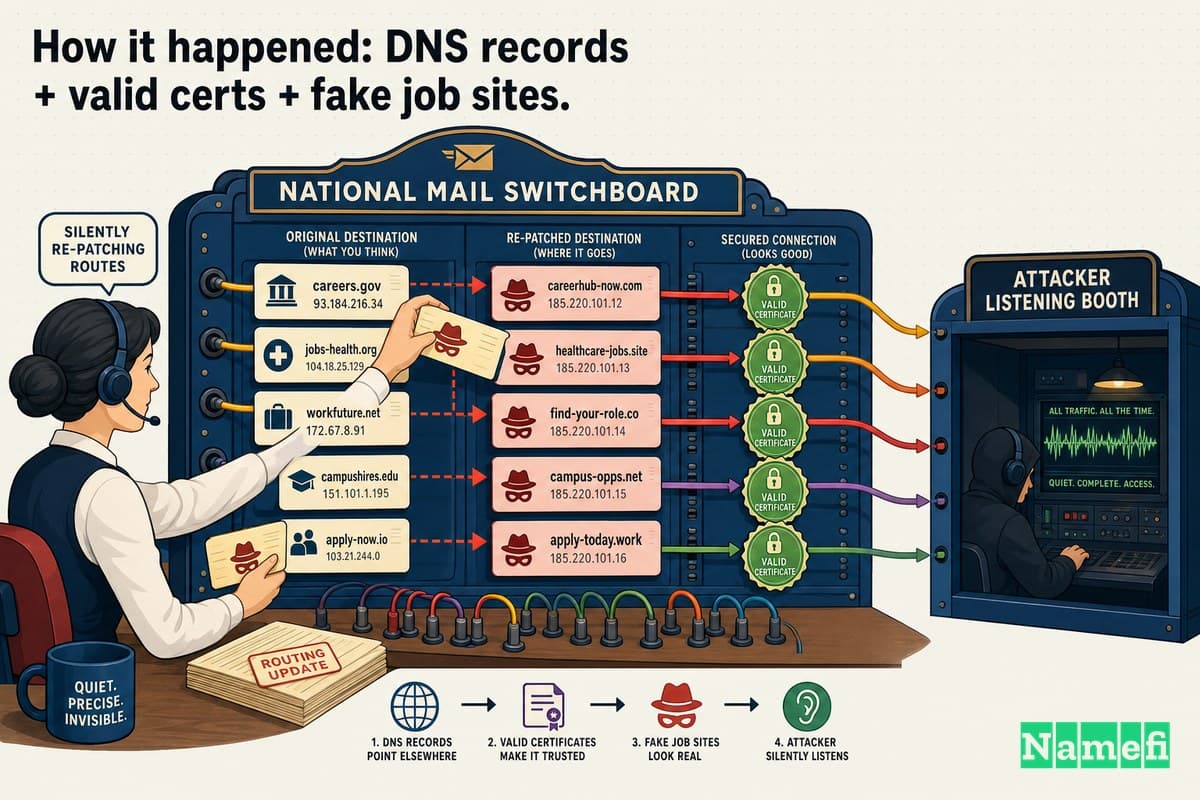
Here is the part worth slowing down for, because the technique is elegant in the worst way. There were three moves.
Move one: get the keys to the address book. The attackers did not crack DNS cryptography. FireEye described two administrative paths: "One method involves logging into a DNS provider's administration interface using compromised credentials and changing DNS A records in an effort to intercept email traffic. Another method involves changing DNS NS records after hacking into the victim's domain registrar account." Stolen registrar or DNS-host credentials can authorize high-impact routing changes even though they do not transfer the registrant's legal rights or an on-chain token.
Move two: reroute traffic toward attacker infrastructure. Pointing a government's mail server at an attacker IP may break service or trigger alarms, so the broader campaign reporting described proxy and man-in-the-middle techniques intended to keep services usable while harvesting credentials. FireEye described a variant in which "users were redirected to attacker-controlled infrastructure." That evidence establishes the technique across the broader activity, not successful interception for every domain in Talos's initial subset.
Move three: defeat the green padlock. Modern services use TLS, which should throw a certificate warning the moment traffic lands on the wrong server. The attackers closed that gap by minting their own legitimate certificates. Talos found that "during each DNS compromise, the actor carefully generated Let's Encrypt certificates for the redirected domains." Because they now controlled the DNS for the domain, they could prove control to a certificate authority — and automated domain validation handed them a valid cert. FireEye confirmed the same pattern across methods: "in both cases the attackers used Let's Encrypt certificates to avoid raising suspicion."
Krebs's later investigation of the broader activity reported that "these DNS hijacks also paved the way for the attackers to obtain SSL encryption certificates for the targeted domains (e.g. webmail.finance.gov.lb), which allowed them to decrypt the intercepted email and VPN credentials and view them in plain text." This supports the credential-interception risk and documented cases, while Talos's first report remained cautious about the outcome and purpose of its observed redirects.
For the DNS-redirection arm, the key weakness was administrative authority over records and delegation, not a zero-day in the victim's web application. That is distinct from the malware arm Talos documented under the same DNSpionage name.
The response: CISA Emergency Directive 19-01
Amid public reporting on DNS infrastructure tampering, on January 22, 2019 the US Cybersecurity and Infrastructure Security Agency issued Emergency Directive 19-01, "Mitigate DNS Infrastructure Tampering," binding federal civilian executive-branch agencies covered by the directive. The public record supports a response to the threat pattern; it does not establish that DNSpionage alone caused the directive.
The directive's diagnosis matched the research exactly. As quoted in contemporaneous reporting, CISA warned that "attackers have redirected and intercepted web and mail traffic, and could do so for other networked services," and that the actors had "compromised the accounts of administrators in charge of government DNS domains."
It then ordered four actions, on a 10-day clock — and they read like a direct rebuttal to each of the attacker's three moves:
- Audit your DNS records — verify that nothing has been tampered with on authoritative and secondary servers.
- Change DNS account passwords — rotate every credential that can edit DNS.
- Add multi-factor authentication to all DNS admin accounts — so a stolen password alone is no longer the master key.
- Monitor Certificate Transparency logs — watch for certificates issued for your domains that you never requested.
That fourth item is the tell. CISA was not only telling agencies to lock the door; it was telling them to watch the public certificate ledgers for evidence that someone had already used a copy of the key. DNSpionage had turned Certificate Transparency from a niche PKI feature into a frontline detection tool for nation-state DNS hijacking.
Krebs captured the unusualness of the moment plainly: "the U.S. Department of Homeland Security issued a rare emergency directive ordering all U.S. federal civilian agencies to secure the login credentials for their Internet domain records."
DNSpionage did not act alone in prompting it. A parallel, even more aggressive operation Talos called Sea Turtle — which Talos described as "the first known case of a domain name registry organization that was compromised for cyber espionage operations," hitting "approximately 40 different organizations across 13 different countries" — raised the stakes further. Talos was careful to keep the two distinct; in its April 2019 follow-up it noted that DNSpionage's behavior "will likely continue to distinguish this actor from more concerning campaigns like Sea Turtle." Together, the two campaigns made the same point from different angles: the DNS supply chain had become a theater of state conflict.
What this teaches about DNS as national-security infrastructure
DNSpionage is short on malware drama and long on uncomfortable lessons. A few worth keeping:
- The registrar and DNS accounts are crown jewels. Everything downstream of a domain — mail, web, VPN, single sign-on, certificate issuance — inherits the routing decisions of whoever can edit its DNS. CISA's Action One was to audit authoritative DNS records; credential rotation and MFA followed as Actions Two and Three.
- A valid certificate is not proof of legitimacy. The green padlock proves the traffic is encrypted to whoever controls the domain right now. If an attacker controls the DNS, automated domain validation will cheerfully issue them a real certificate. Trust in TLS is borrowed from trust in DNS — and DNS is softer than most people assume.
- DNS attacks are invisible by design. Because the proxy forwards real traffic, the victim's services keep working. There is no outage to investigate. The only external signal may be a certificate appearing in a public CT log — which is why monitoring those logs went from optional to mandatory overnight.
- Domain control is a national-security control. When the entity editing a foreign ministry's DNS is a hostile state, the distinction between "IT operations" and "counterintelligence" collapses. The address book of the internet is strategic terrain.
The through-line is a single question that almost no operational tool answers in real time: who actually controls this domain right now, and can I prove it hasn't quietly changed? DNSpionage worked because that question was so hard to answer that an entire region's governments couldn't.
The Namefi angle
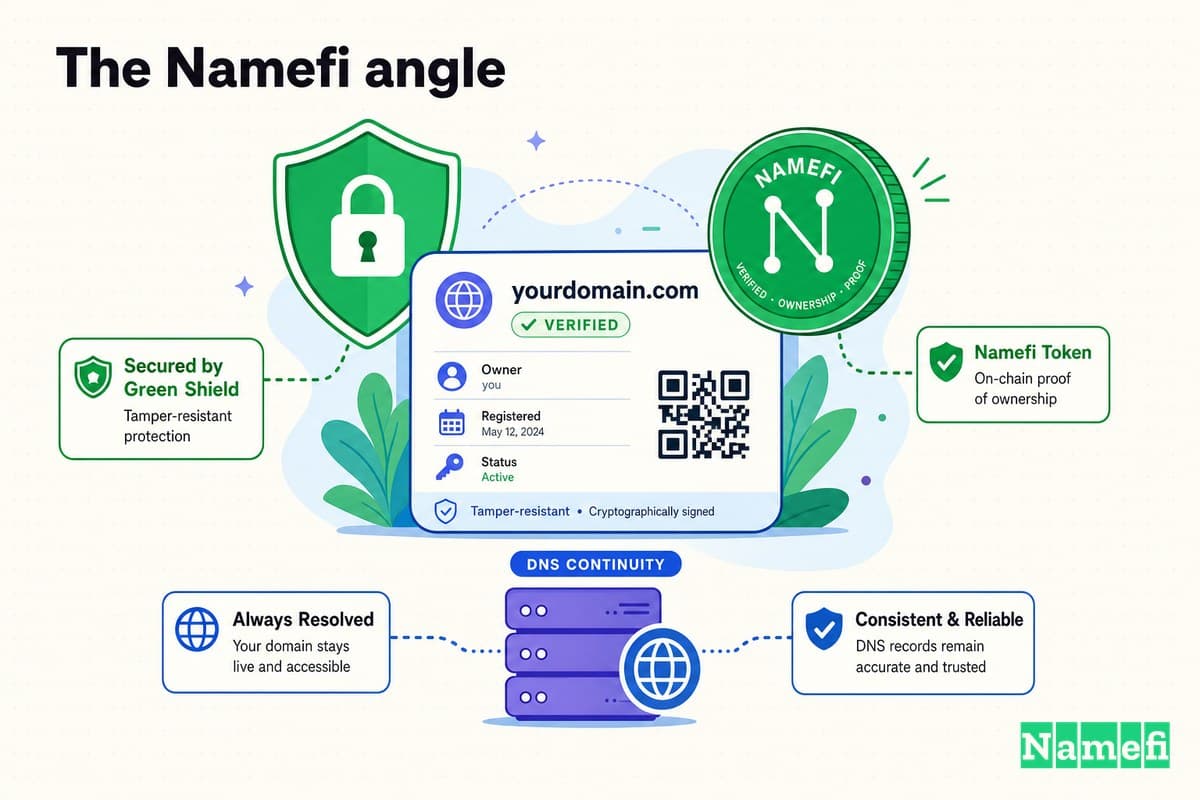
DNSpionage is, at its root, an administrative-control and monitoring problem. The attackers did not need to become lawful registrants. Compromised registrar or DNS-host credentials could authorize changes to A or NS records, and organizations needed independent record audits, certificate monitoring, MFA, and provider logs to detect or prevent them.
Namefi adds a publicly auditable token-control layer for supported domains. That layer can show which wallet controls the token and whether the token transferred. It does not make DNS-record or nameserver edits on-chain or tamper-evident: Namefi's DNS guide states that DNS resolution happens in the conventional DNS layer and that the on-chain ownership layer sits beside it. The controls relevant to DNSpionage therefore remain DNS-record auditing, MFA, registrar or registry locks where available, provider access logs, and Certificate Transparency monitoring.
The lesson of DNSpionage isn't that DNS is fragile in some exotic way. It is that several kinds of control coexist: registrant rights, registrar delegation, DNS-host administration, and any token layer. Each needs its own monitoring and security boundary; proving token ownership does not prove that current DNS records are legitimate.
Sources and further reading
- Cisco Talos — DNSpionage Campaign Targets Middle East (Nov 27, 2018)
- Cisco Talos — DNSpionage brings out the Karkoff (Apr 23, 2019)
- Krebs on Security — A Deep Dive on the Recent Widespread DNS Hijacking Attacks (Feb 18, 2019)
- The Register — Baddies linked to Iran fingered for DNS hijacking to read Middle Eastern regimes' emails (Jan 10, 2019)
- SecurityWeek — Iran-Linked DNS Hijacking Attacks Target Organizations Worldwide (Jan 10, 2019)
- BleepingComputer — DHS Issues Emergency Directive to Prevent DNS Hijacking Attacks (Jan 2019)
- Network World — Cisco Talos details exceptionally dangerous DNS hijacking attack (Apr 17, 2019)
- Network World — Cisco: DNSpionage attack adds new tools, morphs tactics
- CERT-IST — DNSpionage and DNS data hijacking
- CISA — Emergency Directive 19-01: Mitigate DNS Infrastructure Tampering (Jan 22, 2019)
- Namefi — DNS on Tokenized Domains (DNS resolution and on-chain token ownership as separate layers)
Contributors

Fenwei Bian is a software developer in her thirties who spends her working hours in pull requests and her weekends with her hands in soil or sawdust. Years of open source on GitHub taught her that names are interfaces: a good one is clear, honest about what it does, and kind to whoever has to use it next.
She gardens because it rewards patience and punishes wishful thinking, and she does woodwork because a joint either fits or it doesn't. Both habits show up in how she writes about naming — measure twice, check the source, and don't sand over a rough spot and hope no one notices.
For Namefi she writes about how domain markets actually move, the practical trade-offs of tokenizing and flipping names, and picking a domain you'll still be glad you own in twenty years.

Victor Zhou is a technology founder and standards editor focused on digital identity and trust. He founded Namefi, edits Ethereum Improvement Proposals, and previously led smart-contract architecture work at Google Labs.
His work sits at the intersection of naming, ownership, and the systems people use to establish identity online. That perspective makes him especially interested in the way names move between personal meaning, public recognition, and digital infrastructure.
For Namefi, Victor edits and writes about domains as durable digital identity: how names become ownable onchain assets, how tokenization changes custody and trust, and what naming can learn from the systems people use to establish identity online.
Related guides
- The $12 Minute: When Google Domains Accepted a Google.com OrderIn September 2015, Google Domains accepted a $12 order for google.com from former employee Sanmay Ved, then canceled it about a minute later. What the incident proves, what remains uncertain, and why the $6,006.13 bounty still matters for domain security.
- Domain Mayday EP03: The 2020 Twitter Bitcoin Account TakeoverOn July 15, 2020, attackers phoned their way into Twitter, hijacked the verified accounts of Obama, Biden, Musk, Gates, Apple and Uber, and ran a Bitcoin doubling scam — netting about $118,000. A deep-dive on how control of an online identity was stolen, and what it teaches about owning a name.
- Domain Mayday EP05: The 2024 Squarespace DeFi Domain Mass-HijackIn July 2024, a registrar migration from Google Domains to Squarespace turned weak default authentication into a mass attack surface. Attackers hijacked the domains of crypto and DeFi projects — Compound Finance, Celer Network, Pendle, Unstoppable Domains — and pointed them at wallet-drainer phishing sites. Here is how a "seamless" migration created hundreds of unlocked front doors, and what it teaches about registrar security and MFA.
- The BadgerDAO Front-End Attack: $120M Drained Through One Injected ScriptIn December 2021, attackers compromised BadgerDAO's Cloudflare account and injected one malicious script into its website front-end. The audited smart contracts were never touched — yet ~$120M walked out the door through wallet approvals users signed without knowing. A deep-dive on why the website is part of your security surface.