
The Dyn DNS Attack: When a Mirai Botnet Disrupted Major Internet Services
On October 21, 2016, a DDoS attack powered by the Mirai IoT botnet hit DNS provider Dyn in three waves, making Twitter, Netflix, Reddit, Spotify, GitHub, Airbnb, PayPal, and other services unreachable for many users — a Domain Mayday case study in DNS provider concentration.
- domains
- security
- dns
- domain-security

For a few hours on a Friday in October 2016, the internet forgot how to find itself.
Twitter, Netflix, Reddit, Spotify, GitHub, Airbnb, PayPal, and other services became unreachable for many users because DNS lookups failed. The contemporaneous reporting establishes the shared DNS disruption; it does not establish the health of every affected company's application servers or rule out every unrelated incident during the same window. What failed across this group was the lookup path that tells users where services are.
The attack didn't hit Twitter or Netflix. It hit a company most of their users had never heard of: Dyn, a New Hampshire firm that ran DNS — the internet's address book — for a large slice of the modern web. And the weapon wasn't a server farm or a nation-state arsenal. It was a swarm of hacked baby monitors, webcams, and home routers: ordinary household gadgets, quietly conscripted into an army called Mirai.
This is Domain Mayday EP08 — the day insecure smart-cameras took down the internet's phone book.
DNS: the internet's phone book, and Dyn's place in it
Every time you type a domain name, your computer has to translate it into a numeric IP address before it can connect to anything. That translation is the job of DNS, the Domain Name System. It is the lookup layer between the human-friendly name and the machine the name points to.
Dyn was one of the big managed providers of that lookup service. When a site outsourced its DNS to Dyn, Dyn's nameservers became the authoritative source for "where does this domain live?" The Register put the dependency plainly during the attack: by blasting Dyn offline, the public DNS resolvers run by Google and ISPs were unable to contact Dyn to lookup hostnames for netizens, preventing people from accessing sites using Dyn for DNS.
That is the quiet fragility at the center of this story. A website can be flawless — redundant servers, perfect uptime, world-class engineers — and still vanish from the internet if the one provider answering "where is it?" goes dark. As Carnegie Mellon's CyLab later summarized, the affected domains were critically dependent on Dyn, a third-party DNS. In other words, they relied solely on Dyn, so when Dyn went down, so did they.
October 21, 2016: the attack came in waves

The assault began on the morning of Friday, October 21, 2016, and it did not arrive as one blow. It came in distinct waves over the course of the day.
Wikipedia's record of the incident lists three consecutive distributed denial-of-service attacks against Dyn, beginning around 11:10 UTC. The mechanics were a textbook distributed denial-of-service: the DDoS attack was accomplished through numerous DNS lookup requests from tens of millions of IP addresses, drowning Dyn's nameservers in so much junk traffic that legitimate lookups couldn't get through.
The waves are what made it feel relentless. The Register, covering it live, described the moment Dyn seemed to recover — and then didn't: after two hours into the initial tidal wave of junk traffic, Dyn announced it had mitigated the assault and service was returning to normal. But the relief was short lived: just about an hour later, the attack resumed. What looked like the end was just the gap between rounds.
In raw volume, the attack was enormous for its era — among the largest DDoS events seen up to that point, with The Register characterizing the peak as more than 1TBps. (Dyn itself cautioned that a "retry storm" of legitimate traffic inflated some early estimates, a point we'll return to.)
Which sites went dark — and how it felt
When Dyn's nameservers couldn't answer, the failure rippled outward to everyone who depended on them. This wasn't an obscure corner of the web. It was the front page of the consumer internet.
The Register's live report named some of the casualties directly: an extraordinary, focused attack on Dyn that continued to disrupt internet services for hundreds of companies, including online giants Twitter, Amazon, AirBnB, Spotify and others. Wikipedia's list of affected services reads like a who's-who of the era's biggest sites: Airbnb, Amazon.com, CNN, GitHub, Netflix, PayPal, Reddit, Spotify, Twitter, and dozens more.
Brian Krebs, whose own site had been hit by the same malware weeks earlier, described the consumer experience as the attack began creating problems for Internet users reaching an array of sites, including Twitter, Amazon, Tumblr, Reddit, Spotify and Netflix. For ordinary users, there was no error that made sense. Sites simply wouldn't load — first along the US East Coast, then spreading as the later waves hit, reaching users across the US and into Europe.
How it happened: an army of insecure smart devices
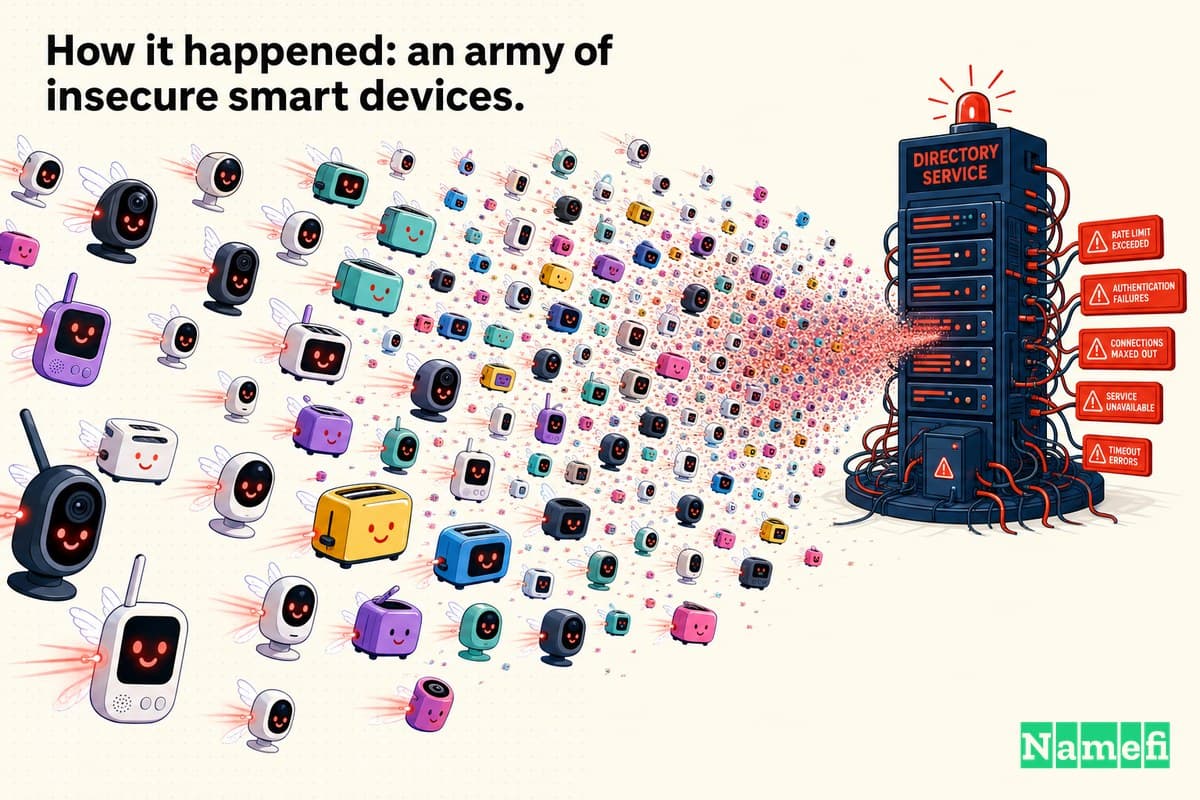
Here is the part that made the Dyn attack a turning point: the firepower didn't come from computers. It came from things.
Mirai is malware that hunts for Internet-of-Things devices — cameras, routers, DVRs — and hijacks them. It works by exploiting the laziest weakness in consumer hardware: the password the device shipped with. As The Register described it, Mirai spreads across the web, growing its ranks of obeying zombies, by logging into devices using their default, factory-set passwords via Telnet and SSH. Krebs put the mechanism just as bluntly: Mirai scours the Web for IoT devices protected by little more than factory-default usernames and passwords, and then enlists the devices in attacks.
The devices at the heart of the Dyn attack were largely cheap webcams and DVRs. Krebs traced the botnet to mainly compromised digital video recorders (DVRs) and IP cameras made by a Chinese hi-tech company called XiongMai Technologies — devices whose default credentials, in many cases, a user cannot feasibly change because the password was hardcoded into the firmware.
Two things turned Mirai from a nuisance into a catastrophe. First, the malware's author had, at the end September 2016, released the source code for it, effectively letting anyone build their own attack army. Second, the population of vulnerable devices was vast. Dyn confirmed the attack's signature: the company was able to confirm that a significant volume of attack traffic originated from Mirai-based botnets, and Wikipedia describes the botnet as a swarm of Internet-connected devices—such as printers, IP cameras, residential gateways and baby monitors—that had been infected with the Mirai malware.
The aftermath: counting the swarm — and the perpetrators
When the dust settled, even the basic question of how big was it turned out to be hard. Dyn's own post-incident analysis, via EVP Scott Hilton, estimated the botnet at up to 100,000 malicious endpoints — large, but smaller than the "tens of millions of IPs" some early figures suggested. The discrepancy came from a feedback loop: the malicious attacks were sourced from at least one botnet, with the retry storm providing a false indicator of a significantly larger set of endpoints than we now know it to be. In other words, the internet's own automatic "try again" behavior amplified the chaos.
The legal aftermath added a twist. The three young men behind Mirai — Paras Jha, Josiah White, and Dalton Norman — eventually pleaded guilty for their role in creating, operating and selling access to the "Mirai botnet". But by the time of the Dyn attack, Jha had already released the source code publicly — and prosecutors and reporters have been careful to note that the Dyn attackers were not necessarily the original trio. As CyberScoop reported, it's not yet clear, for example, who was behind most high profile Mirai-linked attack against internet performance management company Dyn. Once the weapon was open-source, anyone could pull the trigger.
For Dyn and its customers, the incident made DNS-provider concentration and failover a board-level reliability question. Later research examined how slowly major sites adopted multi-provider authoritative DNS despite the outage.
What this teaches about DNS provider concentration
The Dyn attack is remembered as an IoT-security story, and it is one. But its deeper lesson is about architecture: the danger of routing too much of the internet through one chokepoint.
Every site that went dark on October 21 had made the same reasonable-looking decision — outsource DNS to a single excellent provider. Individually, smart. Collectively, it meant that knocking out one company could blank out a meaningful fraction of the web at once. CyLab's verdict was that the lessons from the attack have only been acted upon by a handful of websites that were directly impacted, even years later.
The defensive answer is redundancy: spreading authoritative DNS across more than one provider so that no single outage is fatal. Two years after Dyn, The Register found this was still rare and still painful — Infoblox's Cricket Liu noted that it hasn't gotten any easier to use multiple authoritative DNS providers, for example (say Dyn plus Verisign or Neustar). Being able to use multiple providers would make a big difference. The takeaways for anyone who depends on a domain:
- A domain has more failure points than its registrar. The provider answering "where does this name point?" is just as load-bearing as the servers behind it.
- Single-provider DNS is a single point of failure. Excellent uptime in normal conditions says nothing about behavior under a 1 Tbps flood.
- Concentration is convenient and fragile. The same efficiency that makes one provider attractive makes its outage widely felt.
- Resilience depends on operational DNS control, not just ownership or hosting. When something breaks, you need tested authority, access, and procedures to reroute safely — ideally across more than one authoritative provider.
The Namefi angle
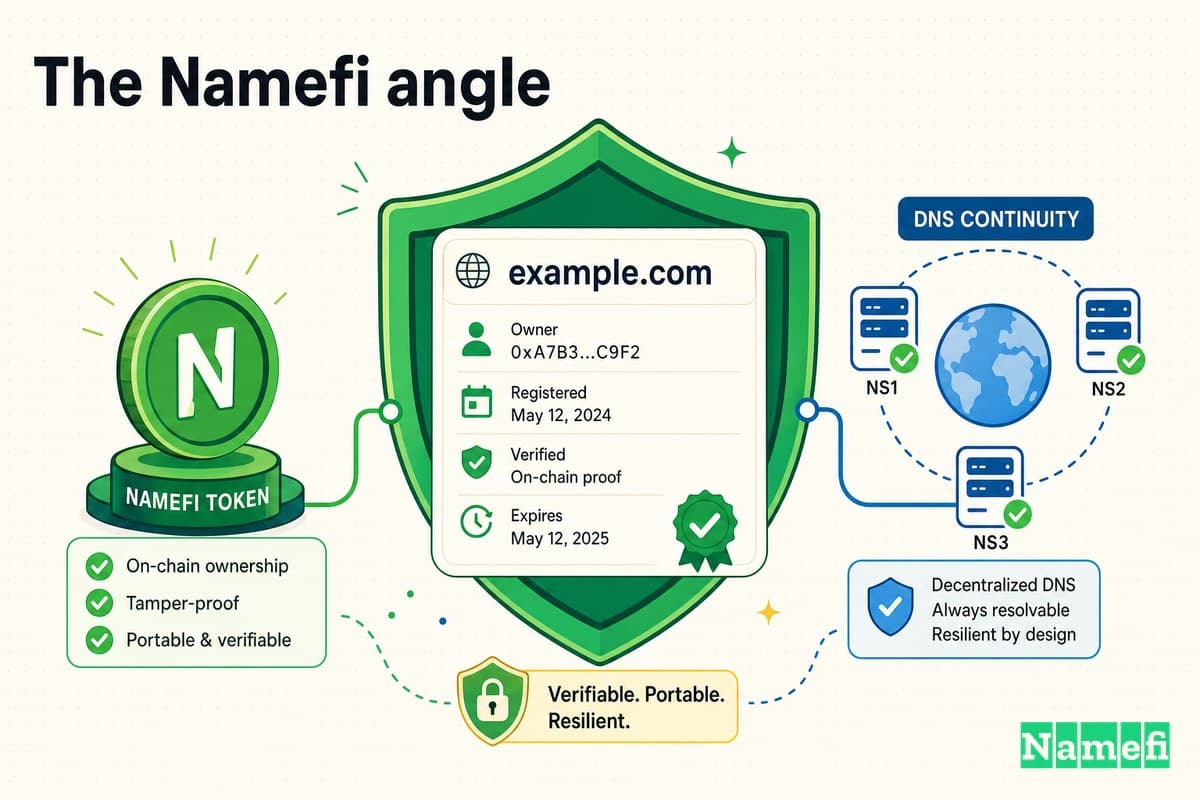
The Dyn attack did not need to steal a domain, forge a transfer, or hijack a registrar account. Registrant rights remained intact while a shared authoritative-DNS provider became unavailable. That is precisely why ownership and resolution resilience must be treated as separate properties.
For a Dyn-style availability event, the practical defenses are redundant authoritative DNS, tested failover, controlled access to delegation and zone data, monitoring, and a recovery plan. A different ownership representation does not absorb a DDoS attack or make a single nameserver provider redundant.
Namefi adds a verifiable token-control layer for supported domains while remaining compatible with conventional DNS. Its DNS guide explicitly separates the layers: nameservers and DNS resolution stay in layer 1, and on-chain token ownership sits alongside them. Tokenization therefore does not make a domain less dependent on its chosen DNS provider or record a DNS outage on-chain. It can make token transfers auditable; Dyn-style resilience still comes from the DNS architecture and operations above.
Sources and further reading
- Krebs on Security — Hacked Cameras, DVRs Powered Today's Massive Internet Outage
- Wikipedia — DDoS attacks on Dyn
- The Register — DNS devastation: Top websites whacked offline as Dyn dies again
- The Register — Today the web was broken by countless hacked devices: your 60-second summary
- The Register — Mirai, Mirai, pwn them all: who's the greatest botnet on the whole?
- The Register — In the two years since Dyn went dark, what have we learned? Not much, it appears
- BankInfoSecurity — Botnet Army of 'Up to 100,000' IoT Devices Disrupted Dyn
- Carnegie Mellon CyLab — Four years since the Mirai-Dyn attack… is the Internet safer?
- Namefi — DNS on Tokenized Domains (nameservers and resolution remain in the conventional DNS layer)
- CyberScoop — Three men plead guilty for roles in Mirai botnet empire
Contributors

Fenwei Bian is a software developer in her thirties who spends her working hours in pull requests and her weekends with her hands in soil or sawdust. Years of open source on GitHub taught her that names are interfaces: a good one is clear, honest about what it does, and kind to whoever has to use it next.
She gardens because it rewards patience and punishes wishful thinking, and she does woodwork because a joint either fits or it doesn't. Both habits show up in how she writes about naming — measure twice, check the source, and don't sand over a rough spot and hope no one notices.
For Namefi she writes about how domain markets actually move, the practical trade-offs of tokenizing and flipping names, and picking a domain you'll still be glad you own in twenty years.

Victor Zhou is a technology founder and standards editor focused on digital identity and trust. He founded Namefi, edits Ethereum Improvement Proposals, and previously led smart-contract architecture work at Google Labs.
His work sits at the intersection of naming, ownership, and the systems people use to establish identity online. That perspective makes him especially interested in the way names move between personal meaning, public recognition, and digital infrastructure.
For Namefi, Victor edits and writes about domains as durable digital identity: how names become ownable onchain assets, how tokenization changes custody and trust, and what naming can learn from the systems people use to establish identity online.
Related guides
- The $12 Minute: When Google Domains Accepted a Google.com OrderIn September 2015, Google Domains accepted a $12 order for google.com from former employee Sanmay Ved, then canceled it about a minute later. What the incident proves, what remains uncertain, and why the $6,006.13 bounty still matters for domain security.
- Domain Mayday EP03: The 2020 Twitter Bitcoin Account TakeoverOn July 15, 2020, attackers phoned their way into Twitter, hijacked the verified accounts of Obama, Biden, Musk, Gates, Apple and Uber, and ran a Bitcoin doubling scam — netting about $118,000. A deep-dive on how control of an online identity was stolen, and what it teaches about owning a name.
- Domain Mayday EP05: The 2024 Squarespace DeFi Domain Mass-HijackIn July 2024, a registrar migration from Google Domains to Squarespace turned weak default authentication into a mass attack surface. Attackers hijacked the domains of crypto and DeFi projects — Compound Finance, Celer Network, Pendle, Unstoppable Domains — and pointed them at wallet-drainer phishing sites. Here is how a "seamless" migration created hundreds of unlocked front doors, and what it teaches about registrar security and MFA.
- The BadgerDAO Front-End Attack: $120M Drained Through One Injected ScriptIn December 2021, attackers compromised BadgerDAO's Cloudflare account and injected one malicious script into its website front-end. The audited smart contracts were never touched — yet ~$120M walked out the door through wallet approvals users signed without knowing. A deep-dive on why the website is part of your security surface.