.com vs .org: Which Domain Fits Your Mission?
Choose .com or .org with clear guidance on eligibility, registry operators, costs, SEO, and the right domain for a business or public mission.

- guide
Choose .com for a business whose website primarily sells a product or service. Choose .org for a charity, association, or community project whose website primarily advances a shared mission. A public-interest project shouldn't pay extra for .com just because someone calls it the default.
Both extensions allow broad registration. .org does not require nonprofit status, and owning one does not certify a charity. The useful distinction is what the address says about the site visitors are about to use.
The comparison starts with purpose, not permission
Here is the practical difference between .com and .org. The audience-fit rows are editorial recommendations, not measured promises about trust or sales.
| Factor | .com | .org |
|---|---|---|
| Recommended primary use | A business, commercial product, or professional service | A public mission, membership organization, or community project |
| Registry operator | VeriSign Global Registry Services | Public Interest Registry (PIR) |
| IANA creation date | January 1, 1985 | January 1, 1985 |
| Eligibility | Open registration, not limited to incorporated companies | Open registration, not limited to nonprofits |
| Registration count | 169.8 million as of September 30, 2026 | Surpassed 12 million, announced June 8, 2026 |
| Concrete example | WordPress.com, a hosted WordPress service | WordPress.org, the open-source project |
| Main trade-off | A commercial identity may fit poorly when public participation defines the work | A mission-oriented identity may need explanation when the site primarily sells a commercial product |
| Budget check | Compare the exact name's registration, renewal, and acquisition terms | Make the same comparison; don't assume .org costs less |
IANA identifies both as generic top-level domains and lists their operators: .com and .org. IANA's WHOIS records give the creation date for .com and .org. Those are TLD record dates, not the registration dates of the example websites.
The counts come from the Verisign-sponsored Q3 2026 Domain Name Industry Brief and PIR's own milestone announcement. These are differently dated registration figures, not counts of active websites or available names. A larger namespace does not tell you whether your exact name is available.
Both extensions are open, but .org does not verify a nonprofit
ICANN's archival InterNIC FAQ describes .com and .org as open and unrestricted. Because that page carries an archive warning, the current registry statement matters especially for the common .org misconception: PIR explicitly says anyone can register and use .org domains.
You don't need a charity registration to start a volunteer group's .org website. A company can also register one. Conversely, a nonprofit needn't reject a suitable .com just because the organization accepts donations rather than selling subscriptions.
Open registration still means accepting the registration agreement and applicable policies. It doesn't mean every name is available or every use is permitted.
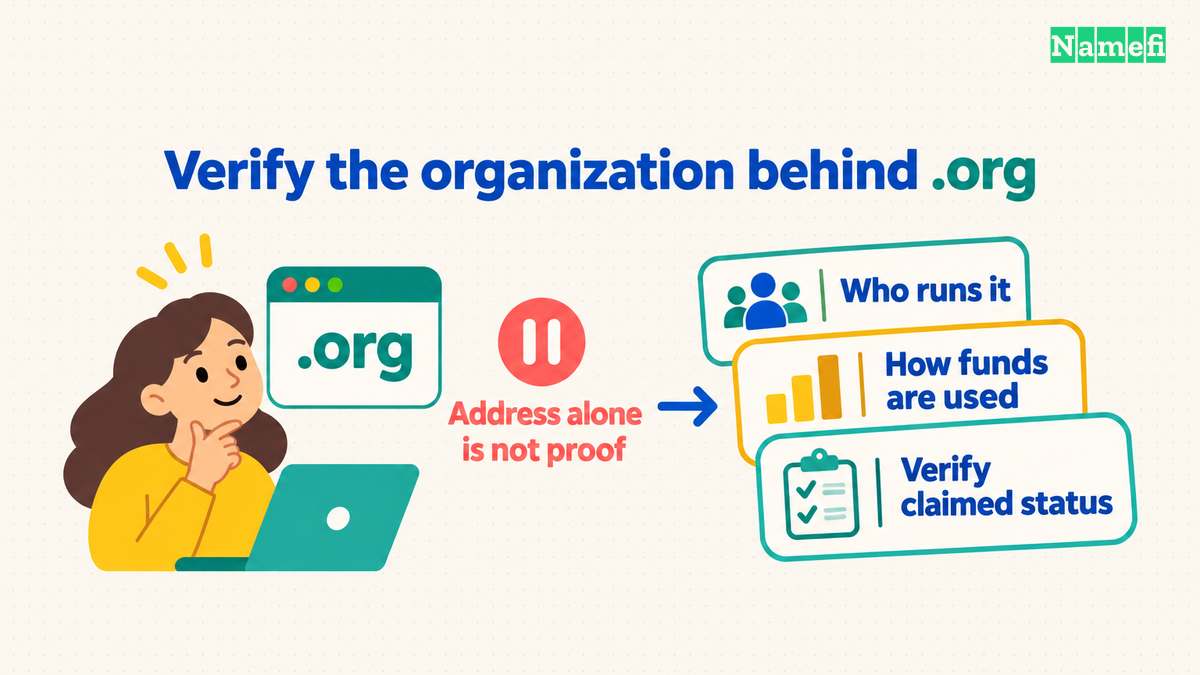
The important practical limit is what a donor should infer. A .org address alone cannot establish the holder's nonprofit status or justify a donation. Publish who runs the organization, how funds are used, and how visitors can verify any claimed status. Choose .org because the mission fits, then provide evidence of the organization behind the address.
Businesses and professional services usually fit .com
Retailers, consultancies, and subscription-software companies share a commercial task: customers visit to buy something. For that group, start with .com. A store needs clear product and checkout information; a consultancy needs evidence of expertise and a way to make contact; a software company needs pricing and product documentation. The extension supports that commercial identity without requiring a separate explanation of why a sales site uses .org.
That is a recommendation about communication, not a claim that .com converts better. Test the complete address with actual customers, particularly when the spelling or pronunciation needs explanation.
A company with a social mission still belongs in this group when the site's main job is selling its product. Selling reusable packaging doesn't automatically make .org the better fit. A separately governed education or volunteer initiative may have a different answer.
For broader choices beyond these two extensions, see which TLDs to secure for a business. If the product's technology is central to the name, the .ai versus .io comparison addresses a different decision.
Charities and member communities often fit .org better
Charities, professional associations, and neighborhood groups share a reason to bring people together beyond buying a product. Their websites may ask for donations, explain membership, or coordinate volunteers. Start with .org when that shared purpose defines the site.
The members of this group differ. A charity should explain its beneficiaries and funding. A professional association should explain membership and governance. An informal neighborhood group should make its organizers and contact details clear. None should expect the suffix to answer those questions.
A concrete example is the American Red Cross at redcross.org. Its about page describes a network of donors, volunteers, and employees working to prevent and relieve suffering. The address fits the work the organization asks visitors to support.
This is where .com is not the better choice: if your public identity revolves around participation, support, and a shared cause, a clear .org can fit better than a commercial-looking alternative. Don't lengthen or distort a good organizational name solely to obtain .com.
Open-source projects and hosted services can need different addresses
WordPress offers a useful paired example because the names share a software ecosystem while the sites serve different needs.
WordPress.org presents the open-source project and its contributor community. WordPress.com describes itself as a hosted version of that software. The pair illustrates a distinction between a shared project and a hosted service; it doesn't establish a rule that every software business needs both extensions.
If you maintain a community library and also sell managed hosting, choose an address for each actual audience. Separate websites can make sense when visitors genuinely need separate destinations. For a small project, one well-organized site may be easier to maintain than two partly duplicated sites.
Nor does .org establish community ownership. Our WordPress.org domain story examines the separate questions of domain control, project governance, and trademarks. This comparison focuses on the registration decision rather than retelling that history.
Neither suffix buys a Google ranking advantage
Google says its systems treat new generic TLDs like other generic TLDs, including .com and .org. The same answer says keywords in a TLD do not give an advantage or disadvantage in search.
That guidance provides no basis for choosing .com to outrank .org, or for buying .org to gain nonprofit-related rankings. It also doesn't promise identical results for two real websites. Choose the address for the organization and its audience, rather than treating the suffix as an SEO purchase.
Compare the exact names before paying for either
The registry operates the extension; the registrar is the provider through which you register the name. The table's operator names are not retail price quotes.
Before registering, compare:
- The complete address. Read the name aloud, including the suffix. Ask someone to write it down without seeing it.
- The registration and renewal terms. Record the quoted term, currency, renewal charge, and any required extras. An introductory offer doesn't establish the ongoing cost.
- The acquisition route. An available name and a name offered by an existing holder are different purchases. Get an actual quote rather than assuming the other extension will be cheaper.
- The matching address. Visit the other suffix before committing. If an existing organization uses the same name in your field, investigate confusion and trademark concerns before proceeding.
These are checks to perform on your shortlist, not claims about a standard price difference. This guide gives no retail prices because the useful comparison is the live quote for the names you can actually buy.
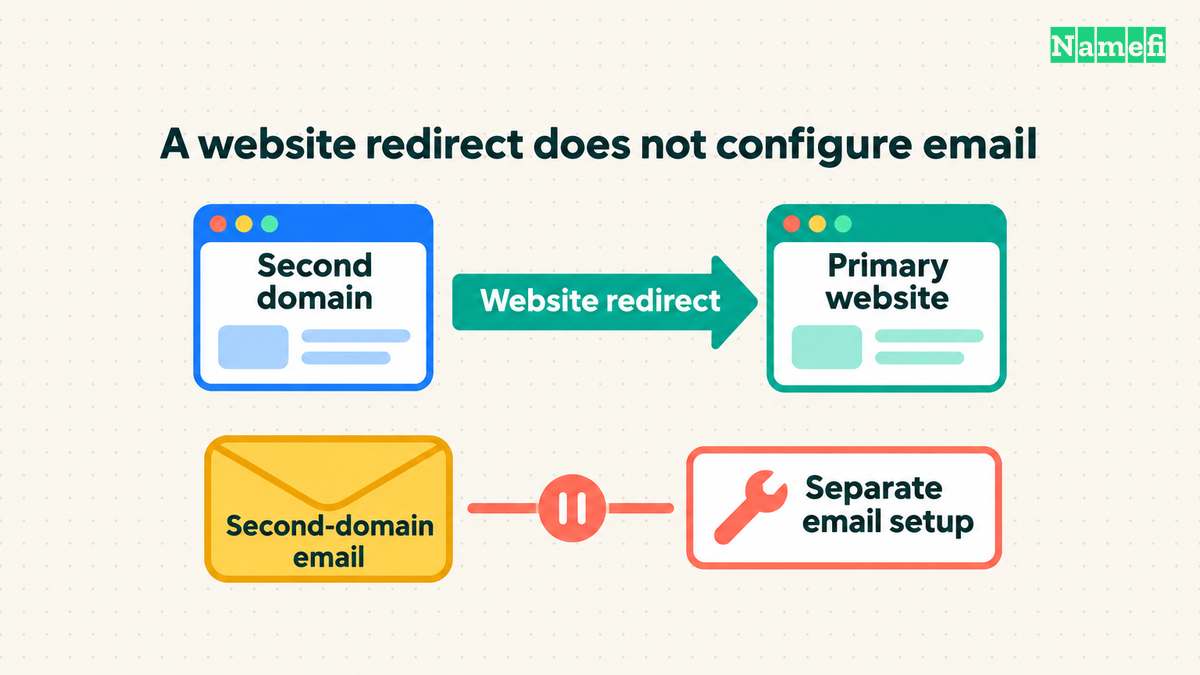
If both names fit your budget, consider registering the second for a redirect. Choose one primary website and publish that address consistently. A website redirect does not configure email for the second domain, so plan any alternate email addresses separately. Two registrations also mean two names to maintain.
Near the registration step, Namefi's domain search is one place to check a shortlist. Confirm the exact name and checkout terms before paying.
The final choice should match the site's main job
Choose .com when customers primarily come to buy a product, book a service, or evaluate a commercial offering. Choose .org when participants primarily come to support a cause, join an organization, or contribute to a shared project.
When neither option produces a clear, usable name, revisit the name itself. The best result isn't winning an argument about extensions. It's registering an address that fits the organization you intend to run.
Comparing more options? Start with our guide to .com vs every other TLD.
Sources and further reading
- IANA —
.comroot-zone record and WHOIS record, operator, classification, and creation date; fetched 2026-11-06. - IANA —
.orgroot-zone record and WHOIS record, operator, classification, and creation date; fetched 2026-11-06. - ICANN / InterNIC — Domain registration FAQ, archival open-registration statement; fetched 2026-11-06.
- Public Interest Registry — FAQ, current
.orgeligibility statement; fetched 2026-11-06. - Domain Name Industry Brief, sponsored by Verisign — Q3 2026 report, September 30
.comregistration count; fetched 2026-11-06. - Public Interest Registry — 12 Million .ORG Domains, June 8, 2026 milestone; fetched 2026-11-06.
- American Red Cross — About us, mission and participation example; fetched 2026-11-06.
- WordPress.org — About, open-source project example; fetched 2026-11-06.
- WordPress.com — About us, hosted-service example; fetched 2026-11-06.
- Google Search Central — Google's handling of new top level domains, generic-TLD search treatment; fetched 2026-11-06.
- Namefi — Domain search, search interface; fetched 2026-11-06.
About the author(s)
Fenwei Bian is a software developer in her thirties who spends her working hours in pull requests and her weekends with her hands in soil or sawdust. Years of open source on GitHub taught her that names are interfaces: a good one is clear, honest about what it does, and kind to whoever has to use it next.
She gardens because it rewards patience and punishes wishful thinking, and she does woodwork because a joint either fits or it doesn't. Both habits show up in how she writes about naming — measure twice, check the source, and don't sand over a rough spot and hope no one notices.
For Namefi she writes about how domain markets actually move, the practical trade-offs of tokenizing and flipping names, and picking a domain you'll still be glad you own in twenty years.