
From BufferApp.com to Buffer.com: The 624-Day, Bank-Statement-Open Domain Deal
How Buffer launched in 2010 on BufferApp.com because Buffer.com was taken, then spent 624 days acquiring the exact-match domain — even showing the seller its bank balance — and why a company famous for radical transparency stayed quiet on the one number everyone wanted: the price.
- domains
- branding
- startups
- domain-upgrades

Before it was the social-media tool you set and forget, Buffer answered to a longer name: BufferApp.com.
The "App" wasn't a branding choice. It was a workaround. When Joel Gascoigne shipped the first version of Buffer in late 2010, the clean exact-match domain — Buffer.com — was already taken, registered to someone else years before the company existed. So the product that wanted to be called "Buffer" launched, instead, at "Buffer, the app."
The first name was even stranger than that. By Buffer's own account, we originally started out with bfffr.com, when Joel launched Buffer in late 2010 — a vowel-free oddity in the fashion of that era's startups. Nobody could say it. Joel went on to change it to bufferapp.com, to make things more clear — and, in the same breath, to worry less about not having the exact domain of your startup's name.
That last phrase is the whole story in miniature. BufferApp.com was a way to stop worrying about a domain the company didn't own — until the day not owning it became the bigger problem.
This is the story of how Buffer eventually got Buffer.com: a 624-day pursuit, conducted by a company so committed to transparency that it showed the seller its own bank balance — and then, in a twist that surprised everyone, declined to disclose the one number the internet most wanted.
2010: the app in the name that did real work
Buffer began small and concrete. Per Wikipedia, Buffer began its development in October 2010 in Birmingham, United Kingdom by co-founder Joel Gascoigne, and on November 30, 2010, the initial version of Buffer was launched. The product did one narrow thing: it let you queue social posts to go out on a schedule instead of all at once. Joel later confirmed the date himself, writing simply: I launched Buffer on November 30th, 2010.
Soon after, Joel was joined by co-founder Leo Widrich, and in July 2011, the cofounders decided to move the startup venture from the United Kingdom to San Francisco. The team that would become famous for blogging its salaries and its revenue was, at the start, two expats and a scheduling tool living at a domain with an extra word on the end.
For that first stage, BufferApp.com was perfectly fine. "App" told you what it was. It let the company ship under its real name without waiting on a domain it couldn't get. The modifier was an on-ramp, not a failure — exactly the kind of reasonable workaround a young startup makes when the bare word is already spoken for.
The problem: the world kept knocking on the wrong door
The trouble with launching at BufferApp.com is that the world doesn't memorize your domain. It guesses. And it guesses the clean one.
As Buffer grew, the guessing turned into a liability. In the company's own retelling, more and more people thought that buffer.com was our domain — a confusion that would become more of an ongoing occurrence as Buffer grew bigger. Every new user, every press mention, every word-of-mouth recommendation pointed a fraction of people at Buffer.com — a domain Buffer did not control.
That is the hidden tax of a modifier domain. BufferApp.com worked perfectly for everyone who typed it exactly. But the bigger the brand grew, the more the bare word — the one the company didn't own — became the name people assumed and reached for first. The modifier wasn't slowing Buffer down at launch. It was quietly leaking attention at scale.
The fix wasn't a rebrand. The product was already called Buffer. It just needed its address to match its name.
The pursuit: 624 days to one word
Buying Buffer.com was not a transaction. It was a campaign.
The domain had deep roots: Buffer's account says it was registered to the seller's company in 1997, before Buffer existed and before Joel had built anything. The article labels that company “Company corp.,” but Buffer's privacy disclaimer says this is a placeholder: it redacted the real company name and replaced all individual names with “Bob.” The domain had therefore sat with the anonymized prior owner for the better part of two decades. Getting it loose took patience measured not in weeks but in years.
Buffer logged the timeline precisely. Time elapsed between first contact and effective domain transfer: 624 days (June 5th 2013 – Feb 19th 2015). Almost two years from the first email to the moment the domain finally moved. The strategic call — of course a product called Buffer should live at Buffer.com — was obvious from day one. Everything hard about the deal was the mechanics: finding the right person, building enough trust to make a deal, agreeing on a price with no public comparables, and moving the asset cleanly.
And the buyer wasn't flush with cash. Buffer was a profitable but lean startup, and committing to this purchase meant spending a large portion of our available cash on a single intangible asset. As the team put it, it was quite a new discussion to explore purchasing an asset—even a virtual one—for a large portion of our available cash. For a company this size, a domain wasn't a line item. It was a bet.
The deal also forced an internal first: Buffer had never bought anything like this before. In 2015 it still felt strange to spend serious money on a string of characters with no physical form. A domain isn't inventory, isn't equipment, isn't a hire — it's pure intangible. And yet, for a company whose entire existence was online, Buffer.com was a very important component of our identity.
Why dropping "App" mattered
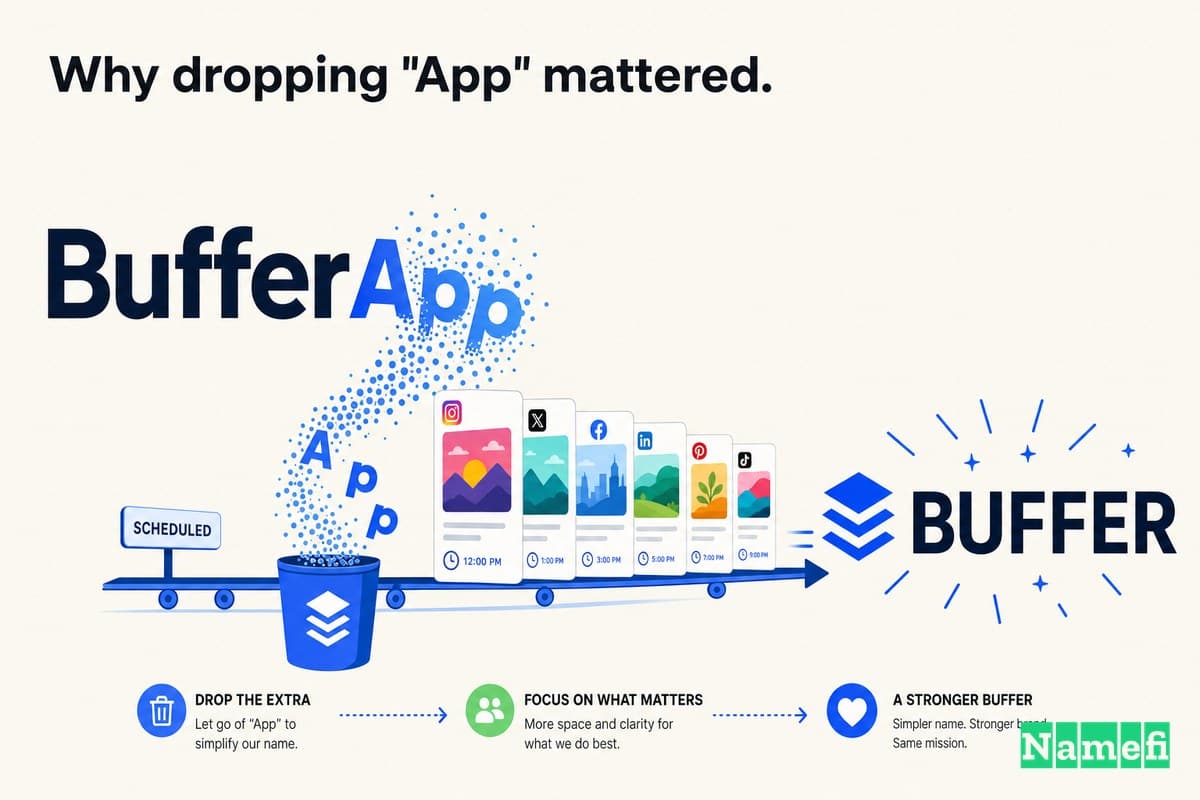
The distance between BufferApp.com and Buffer.com is three letters. Strategically, it is the distance between a thing you download and the brand itself.
BufferApp.com names a piece of software — an app, one of many, something you install. Buffer.com names the company, the verb, the category. One points at a product; the other simply is the brand. As Buffer grew from a single scheduling tool into a broader publishing-and-analytics platform, "App" became a ceiling baked into the address.
| Before | After |
|---|---|
| BufferApp.com | Buffer.com |
| Names a downloadable "app" | Names the brand itself |
| Carries a workaround modifier | Carries nothing but the word |
| Signals "the bare name was taken" | Signals "this is the canonical home" |
| Leaks guessers to a domain you don't own | Captures everyone who guesses the clean name |
This is the recurring pattern across domain upgrades: early names qualify; great names own. A modifier like "App," "HQ," "Cab," or "Get" is a sensible way to launch when the clean word is held by someone else. It becomes drag the moment the company is big enough that the bare word should be the destination — because that's exactly when the most people start typing it.
For Buffer, the signal was unmistakable: customers were already treating Buffer.com as the front door. The upgrade just made the front door actually lead inside.
There's a second, quieter reason the modifier mattered. "App" dates a company. In 2010, slapping "App" on everything was a sign you were current; a decade later, it reads like a fossil from a particular moment in startup history — the same way "2.0" or "i-" anything eventually did. A domain is the one piece of branding you can least afford to have feel old, because it's stamped on every email and every link forever. Buffer.com is timeless in a way BufferApp.com could never be.
The transparency backstory: showing the seller your bank account
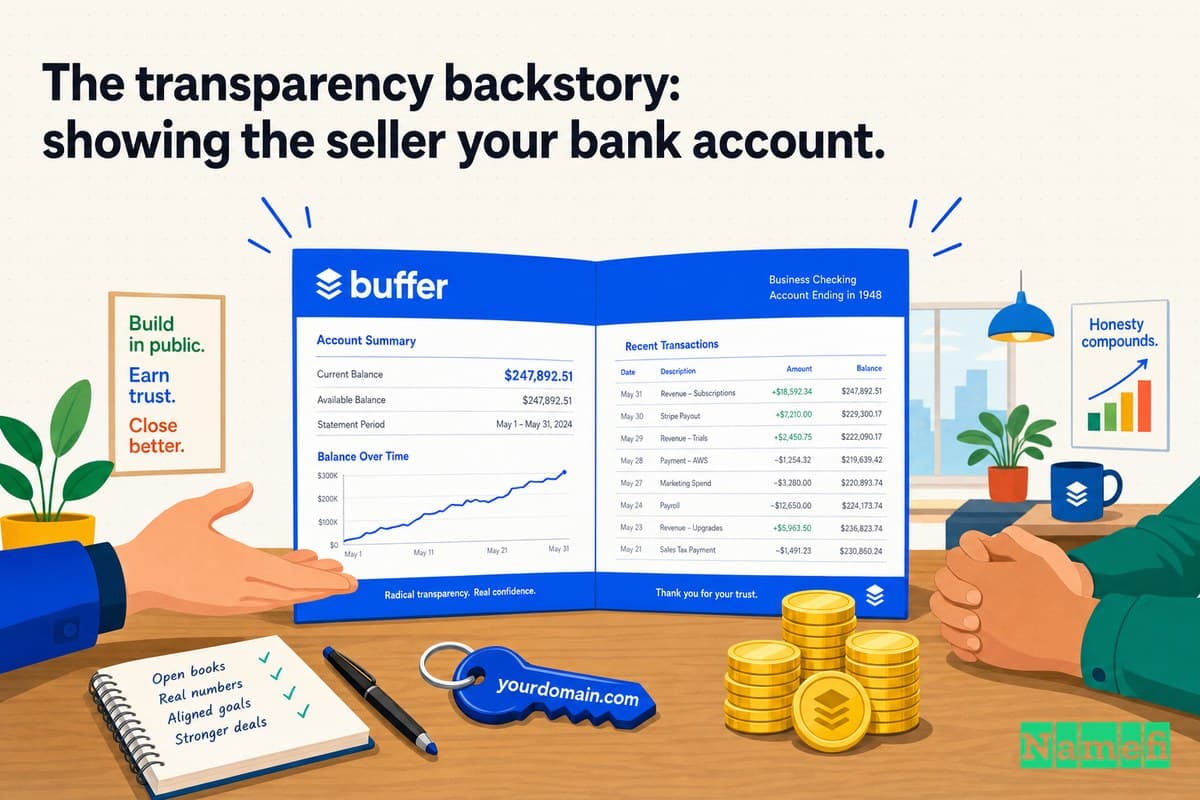
Here is where Buffer's story stops resembling every other domain deal.
Buffer is famous for radical transparency. Since 2013, the company has published its team's salaries and finances openly — its public transparency dashboard states plainly that they believe in the power of transparency to build trust, hold us accountable to a high standard, and push our industry forward, and notes that since 2013, we've been open with Buffer's finances and our team's salaries, among many other metrics. Most companies negotiate a domain purchase from behind a wall of anonymity — burner emails, brokers, undisclosed buyers — precisely so the seller can't gauge how much they can afford.
Buffer did the opposite. The team decided that even in a high-stakes acquisition, it would stay true to its values. In their words: So instead of obscuring any of our intentions, we were as transparent as possible—to a point where we later on even showed the owners our bank account to help them understand why our offer to buy the domain at our stated price was the stated price. They literally printed and shared their balance sheet: On Thursday, we printed our balance sheet; we had $844,386 in the bank that day.
Think about how unusual that is. The standard playbook is to hide your wallet so the seller can't price to it. Buffer opened the wallet on purpose — and went in knowing the cost. From the start, the team acknowledged that the transparent approach would likely mean we would be paying a higher amount for the domain than we could have gotten away with through other strategies. They chose to (probably) pay more in exchange for staying who they said they were. When the deal closed, Buffer thanked the anonymous seller using its stated pseudonym: We're happy to announce that we now own buffer.com, and are very thankful to Bob for being such a great partner in this transaction!
The money looked different then — and the one number Buffer kept
There is a delicious irony at the center of this case. The company that openly blogs CEO pay, revenue, and individual salaries by name — the patron saint of "share everything" — did not share the price it paid for Buffer.com.
Buffer was upfront about the omission, explaining that the previous owner also wasn't comfortable in sharing the price of this transaction. Transparency, in other words, has a limit at someone else's privacy. Buffer would open its own books to the seller; it would not open the seller's deal to the world.
That silence created a vacuum, and the domain press rushed to fill it. The widely cited "$600,000" figure traces not to Buffer but to an outside analyst: Inc42 published a story about how BufferApp.com purchased the domain name Buffer.com for $600,000, an estimate the author reverse-engineered from Buffer's public finances. The Domains, picking up the report, was careful to note that BufferApp.com did not mention the price it paid for Buffer.com in their blog post. So treat the $600,000 as an educated guess, not a disclosed fact — which is itself the most Buffer thing about the whole affair.
But a domain purchase should be judged at the moment of uncertainty, not from the far end of the story. Whatever the exact figure, it was a large portion of our available cash against a balance of $844,386. For a profitable-but-small startup, spending a meaningful slice of the bank account on a single word was a real allocation decision — runway and headcount traded for an address. It only looks easy in hindsight, after Buffer became a household name in social tooling.
Why dropping "App" mattered — the timing
The order of operations is what makes this case instructive.
Notice the sequence. The name was settled first — "Buffer," chosen when the tool was a brand-new experiment in 2010. The product launched on a placeholder: bfffr.com, then quickly bufferapp.com, to make things more clear. Only later, once the confusion had become an ongoing occurrence as Buffer grew bigger, did the company pursue and finally secure the exact match — on February 19th, 2015, 624 days after first contact.
The dependency runs in one direction. Buffer didn't need Buffer.com to launch. It needed Buffer.com once the brand had outgrown the modifier — once enough of the world was already typing the clean word. The upgrade wasn't about vanity; it was about stopping the leak of every user who guessed Buffer.com and found someone else. Timing the purchase to that moment — when the bare word had become the name people assumed — is what turned a nice-to-have into a worth-it.
The domain became part of the operating system
Premium domains matter for one unglamorous reason: repetition.
A company's core domain shows up in every place the marketing team can't directly control — in email addresses, press links, browser bars, search results, app listings, and every spoken recommendation. Each repetition either adds friction or removes it. BufferApp.com asked everyone to remember the extra word, and quietly sent the forgetful to a domain Buffer didn't own. Buffer.com asked for nothing and captured everyone.
That's the deeper point of the whole 624-day chase. The acquisition didn't change what the product did. It changed where every future mention of the name landed. Once Buffer.com was the address, the company stopped fighting its own audience's instincts. The most common guess — the bare word — finally led home. Multiply that across years of growth, and a domain that cost a large slice of the bank account stops looking like an expense and starts looking like infrastructure.
What founders should learn from Case 19
The easy takeaway — "always own your exact-match .com before launch" — is the wrong one, because Buffer literally couldn't; the domain had been registered since 1997. The more useful lessons are about modifiers, timing, and how you negotiate:
- A modifier is a fine on-ramp. "App" let Buffer launch under its real name while Buffer.com sat in someone else's portfolio. Shipping on BufferApp.com wasn't a failure; it was a reasonable way to start without waiting on a domain that might never come free.
- Watch for the moment the modifier starts leaking. The signal wasn't ego — it was that more and more people thought that buffer.com was our domain. When the world is already guessing the clean name, the upgrade pays for itself.
- Budget the pursuit in years, not weeks. Buffer's deal took 624 days. Exact-match domains held by long-time owners don't move on your timeline. Start early, stay patient, and treat it as a relationship, not a transaction.
- Decide what your negotiating values are — and live with the cost. Buffer chose to be transparent to the point of showing its bank account, knowing it would likely mean we would be paying a higher amount. That's a defensible choice — but a deliberate one, with a price.
The domain upgrade didn't make Buffer win. Product, timing, content marketing, and a culture of openness mattered far more. But Buffer.com made the win easier to reach — and ended the slow leak of everyone who guessed the obvious name.
The Namefi angle
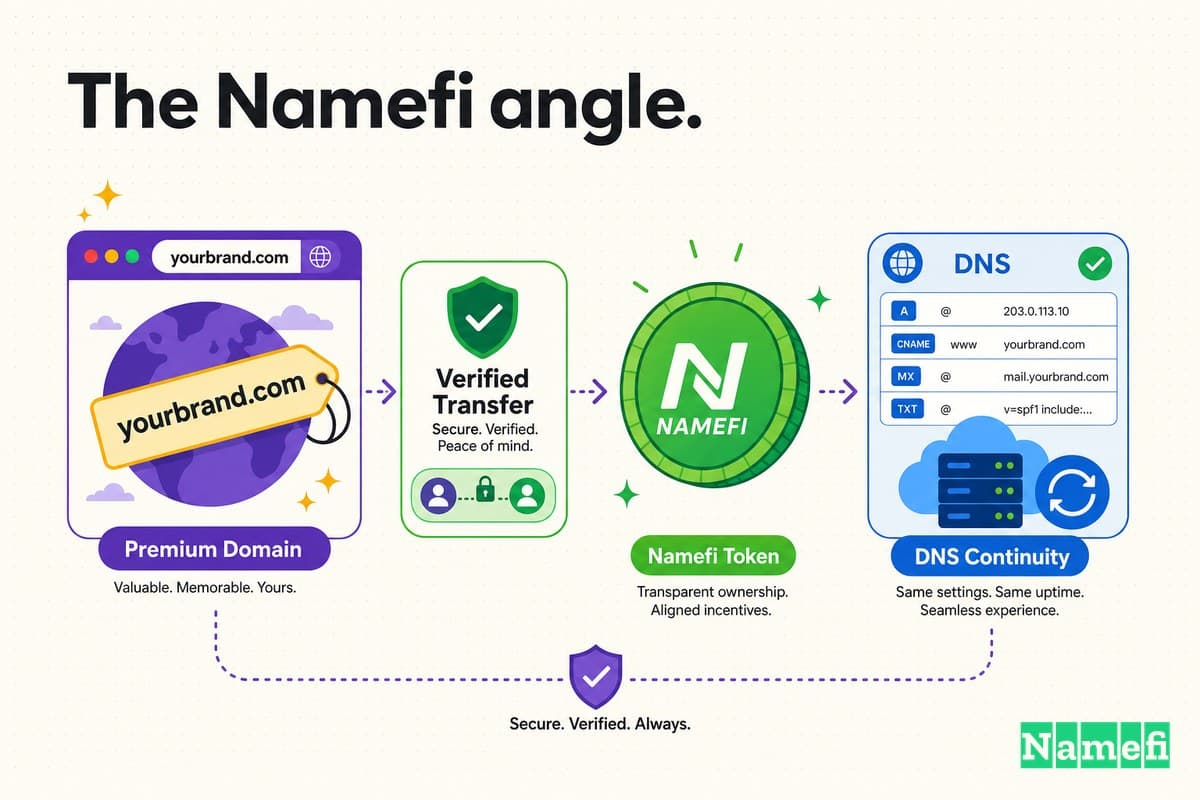
Underneath the transparency theater, Buffer's story is a transfer problem.
The strategic decision was never in doubt — of course a product called Buffer should live at Buffer.com. The hard part was everything around the asset: finding the long-time owner of a domain registered in 1997, building enough trust to make a deal, agreeing on a price with no public comparables, and moving control cleanly without breaking the live product. That work took 624 days — and even a company that prints its own balance sheet ended up unable to disclose the price, because the friction-heavy, trust-dependent nature of domain deals leaves so much of the value opaque.
Namefi is built around the idea that domains should behave like internet-native assets. Tokenized ownership can make domain control easier to verify, transfer, and integrate into modern workflows while staying compatible with DNS — turning the slow, trust-heavy part of a deal like this (confirming who owns what, agreeing on terms, and moving the asset safely) into something closer to a clean, auditable transaction. A world where ownership and transfer are provable on-chain is a world where a 624-day pursuit doesn't have to depend on burner emails, printed bank statements, and two years of patience.
Buffer.com looks obvious now because Buffer became big. But the lesson lands at the very beginning: when a name is going to carry the business, the domain isn't decoration. It's the difference between leaking your audience to a stranger's address and owning the one word everybody already types.
Sources and further reading
- Buffer — We Have Acquired Buffer.com: Here's How and Why We Did It
- Buffer — We Have Acquired Buffer.com (the 624-day timeline)
- Buffer — We Have Acquired Buffer.com (showing the bank account)
- Buffer — Transparency dashboard
- Buffer — Reflecting on 10 Years of Building Buffer
- Wikipedia — Buffer (application)
- The Domains — Report: BufferApp Buys Buffer.com For $600,000 & It Took Almost 2 Years
- Inc42 — Buffer Domain Bought At $600,000 And I Know The Reasons!
Contributors

Fenwei Bian is a software developer in her thirties who spends her working hours in pull requests and her weekends with her hands in soil or sawdust. Years of open source on GitHub taught her that names are interfaces: a good one is clear, honest about what it does, and kind to whoever has to use it next.
She gardens because it rewards patience and punishes wishful thinking, and she does woodwork because a joint either fits or it doesn't. Both habits show up in how she writes about naming — measure twice, check the source, and don't sand over a rough spot and hope no one notices.
For Namefi she writes about how domain markets actually move, the practical trade-offs of tokenizing and flipping names, and picking a domain you'll still be glad you own in twenty years.

Victor Zhou is a technology founder and standards editor focused on digital identity and trust. He founded Namefi, edits Ethereum Improvement Proposals, and previously led smart-contract architecture work at Google Labs.
His work sits at the intersection of naming, ownership, and the systems people use to establish identity online. That perspective makes him especially interested in the way names move between personal meaning, public recognition, and digital infrastructure.
For Namefi, Victor edits and writes about domains as durable digital identity: how names become ownable onchain assets, how tokenization changes custody and trust, and what naming can learn from the systems people use to establish identity online.
Related guides
- From Box.net to Box.com: The ~$1M Upgrade That Dropped the ".net" and Bought the Exact MatchHow Box launched in 2005 on Box.net because Box.com was taken, pivoted from consumer storage to the enterprise, and in 2011 paid Digimedia close to $1 million for the exact-match Box.com — a .net-to-.com upgrade that landed right as the company became simply "Box."
- Who Owns Trip.com? Ctrip, Trip.com Group, and the RebrandUnderstand how Trip.com relates to Ctrip and Trip.com Group, and trace the acquisition and company-name changes behind the travel brand.
- From del.icio.us to Delicious.com: The Cleverest Domain Hack on the Web — and Why Yahoo Untangled ItHow the pioneering social-bookmarking site launched in 2003 as the famous domain hack "del.icio.us," why those dots became a permanent tax on every mention, and how Yahoo moved it to the cleaner Delicious.com in 2008.
- From DiscordApp.com to Discord.com: How Dropping "App" Closed a Door Phishers LovedHow Discord launched in 2015 on DiscordApp.com because Discord.com was taken, quietly bought the bare word, and in 2020 made discord.com its primary home — partly for brand cleanliness, partly because the "discordapp.com" vs "discord.com" split was a gift to phishers and malware crews.