
From Box.net to Box.com: The ~$1M Upgrade That Dropped the ".net" and Bought the Exact Match
How Box launched in 2005 on Box.net because Box.com was taken, pivoted from consumer storage to the enterprise, and in 2011 paid Digimedia close to $1 million for the exact-match Box.com — a .net-to-.com upgrade that landed right as the company became simply "Box."
- domains
- branding
- startups
- domain-upgrades

Before Box was an enterprise software company worth billions, it lived at a slightly less authoritative address: Box.net.
The name was a workaround, not a choice. When the idea for Box.com started in 2003 with Aaron Levie, a business student at the University of Southern California, the clean exact-match — Box.com — was already taken. So the company that would become Box, Inc. (formerly Box.net) did what countless startups do when the .com is gone: it reached for the next-best TLD, launched on Box.net, and shipped.
Why "Box.net"? Because Box.com belonged to someone else — specifically, to the premium-domain holding company Digimedia, run by a former watermelon farmer. The exact match everyone assumed the company owned was sitting in a domain investor's portfolio, out of reach until Box had the cash and the reason to go get it.
For its earliest era, .net worked fine. In 2005, Levie dropped out of school to work on Box full-time with long-time friend and cofounder Dylan Smith, and Levie and Smith were joined by cofounders Jeff Queisser and Sam Ghods. The business model was simple consumer storage: People would pay us $2.99 a month, we'd give them 1GB of storage, as Levie later described it. The descriptive, available domain held that early product just fine.
Then, in 2011, Box finally bought Box.com. As Domain Name Wire reported, file sharing service Box.net bought the Box.com domain name from Scott Day at Digimedia — and the company bought the domain for between $900,000 and $999,000.
This is the story of how a startup launched on a .net workaround, spent its first six years growing into a real brand, and paid close to a million dollars to finally drop the ".net" — right as it stopped being "Box.net" and became, simply, Box.
2005: the .net workaround that shipped a product
In the beginning, ".net" was a constraint, not a strategy.
The product idea came from a real problem Levie watched up close. By the public histories, in 2004, with his major still undecided, Levie accepted an internship at Paramount Pictures in Los Angeles. It was during his time at Paramount that Levie saw firsthand how difficult it was for the studio to share large files. The fix was online file storage and sharing — a "box" that lived on the internet. The name was perfect. The .com was not available.
So Box launched on Box.net. For an audience of early adopters paying a few dollars a month for a gigabyte, the TLD barely mattered:
- The brand word was still "Box" — short, memorable, ownable.
- The product matched the name: a box for your files, online.
- The cost to explain was low, which mattered when the company had no brand equity and almost no money.
Money was, in fact, the founding constraint. To get the service online, Levie and Smith used $15,000 in online poker winnings that Smith had been saving to rent server space. The first real check came from a now-famous early backer: the founders relied on their own money as well as support from friends and family members until Mark Cuban invested $350,000 in seed funding in 2005. A company funded by poker winnings and a single angel check was not about to spend its runway prying a premium .com out of a domain investor's portfolio. Box.net was the address you could afford.
And critically, the company couldn't have the clean version anyway. Box.com wasn't sitting unused by accident — it was a curated asset in one of the best-known premium-domain portfolios on the internet. Box.net wasn't a branding flourish; it was the best available address while Box.com waited behind a price tag the young startup couldn't yet justify.
2011: buying the domain it had wanted all along
By 2011, Box had a problem only success creates: the better address was right there, and the company had finally outgrown the .net.
Box had pivoted hard from cheap consumer storage to the enterprise. By the time of the upgrade, TechCrunch described Box as a cloud storage platform for the enterprise that comes with collaboration, social and mobile functionality, and reported that Box, which has 7 million users and stores 300 million documents, had been adopted by 100,000 businesses, including 77% of the Fortune 500. A company selling to most of the Fortune 500 was no longer well-served by a domain that read like a hobbyist file host.
So it bought the exact match. The seller was a specialist: Watermelon farmer Scott Day founded Digimedia. He got into the domain business with the purchase of Watermelons.com. Years later, a domain guide summarized the deal in one line: in 2011, the owners of the Internet company Box paid close to $1 million to upgrade from Box.net to Box.com.
Close to a million dollars was not a vanity URL. It was the price of finally owning the exact address that matched the brand users already typed.
"Really cool guys" and a seller who didn't have to sell: the negotiation
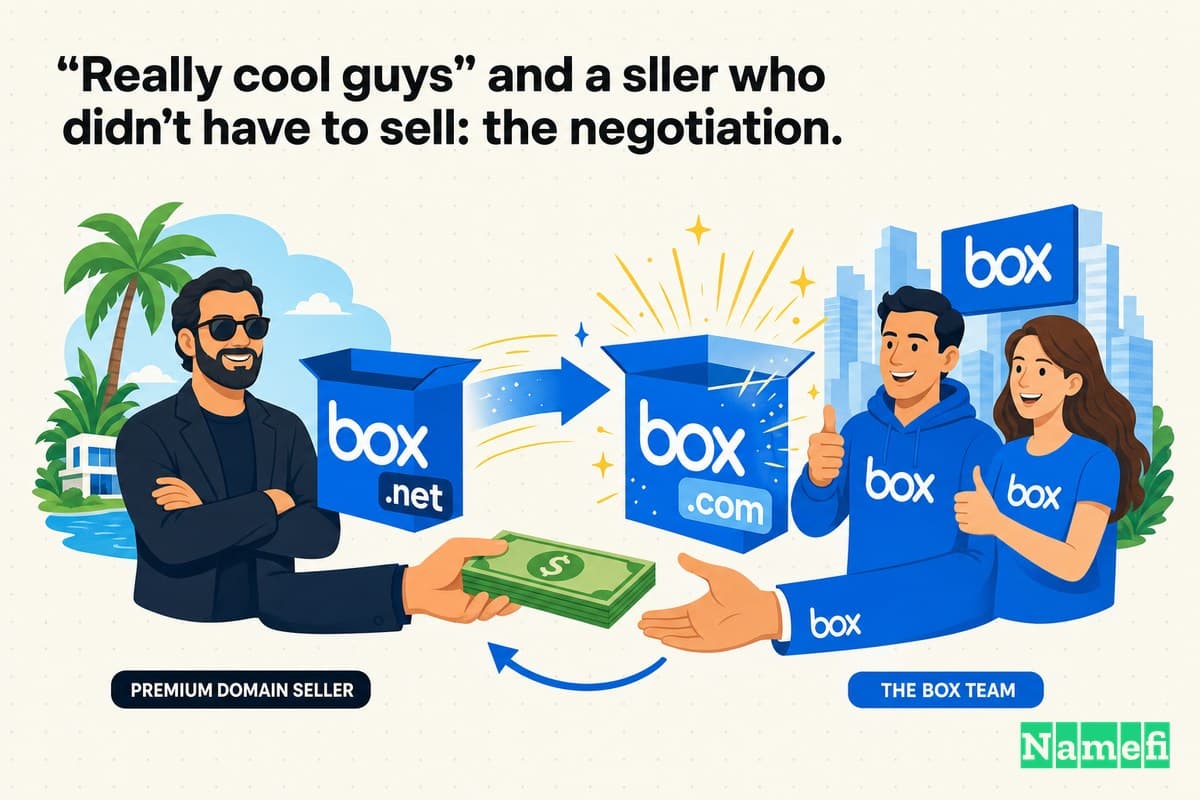
The reason buying Box.com took six years is the same reason most premium-domain deals are slow: the owner didn't have to sell.
Digimedia is not a squatter sitting on a typo. It is a professional portfolio that has held and sold some of the most generic, valuable one-word domains on the internet. Selling Box.com was a transaction on its terms, not a desperate flip. The pricing reflected that — between $900,000 and $999,000 for a single common English word as a .com.
What's notable is how cordial the deal was, given the leverage sitting with the seller. CNET writer Rafe Needleman discussed the domain name with Box CEO Aaron Levie, and the takeaway was almost warm: about the negotiations with Digimedia, Levie said the Digimedia guys were 'really cool'. There was no champagne-and-lawsuit saga here — just a well-capitalized buyer who knew exactly what it wanted and a professional seller who knew exactly what it had.
And Box wanted it badly enough to stretch. By the same reporting, Levie was prepared to spend more for the domain if he had to. That's the tell that this wasn't a cosmetic purchase. A founder who has already raised serious enterprise funding, and who is willing to pay above a near-seven-figure ask, has decided the exact-match .com is infrastructure — not decoration.
The difference from a typical squatter story is the absence of drama, and that's the point. When the seller is a legitimate portfolio and the buyer is a real company with real money, the "negotiation" is mostly about price discovery for an asset with no public comparables. The friction isn't hostility — it's valuation.
The money looked different then
It's tempting to call ~$1 million a bargain in hindsight. Box went public on the New York Stock Exchange and became a multibillion-dollar enterprise software company; Box.com is now one of its quietest, most permanent assets. Against that, a million dollars looks like a rounding error.
But it should be judged at the moment it was spent.
In 2011, Box was a fast-growing but still-private company in the middle of an expensive land grab for the enterprise. It was a company that had been bootstrapped on poker winnings and a $350,000 angel check just six years earlier. Around the time of the domain deal, Box just raised another $50 million in growth capital — money raised to fund sales teams, infrastructure, and enterprise features, not URLs.
In that context, spending close to $1 million on a domain name — not engineers, not data centers, not enterprise sales reps — was a real capital-allocation decision. It only makes sense if you treat the exact-match .com as infrastructure: the address every CIO, every press mention, every integration partner, and every Fortune 500 procurement form would land on. Box was betting that a company asking large enterprises to trust it with their files should not be living at a .net.
Why moving from .net to .com mattered
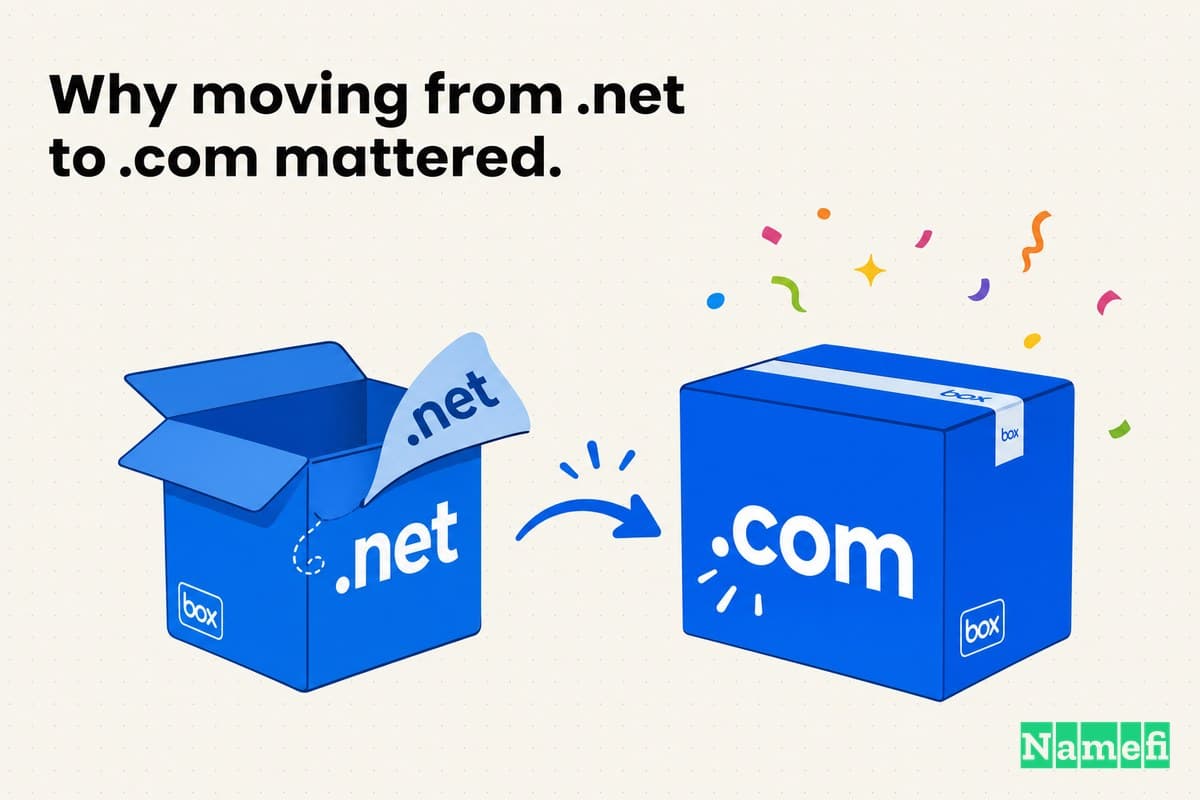
The gap between Box.net and Box.com is three characters. Strategically, it's the difference between "the version that was available" and "the one everybody assumes is real."
Box.net signals a fallback — the address you take when the .com is gone. Box.com signals the default, the canonical, the one a user types without thinking. For a consumer toy, that gap is survivable. For a company selling trust and permanence to the Fortune 500, it's a quiet, constant tax.
| Before | After |
|---|---|
| Box.net | Box.com |
| Reads like the fallback TLD | Reads like the canonical address |
| The version you take when .com is gone | The version everyone assumes is real |
| Subtle "are these the official guys?" friction | Default trust for enterprise buyers |
| Easy to mistype as Box.com — and land elsewhere | The address users already guess resolves to you |
This is the same pattern that shows up across domain upgrades: early addresses settle, great addresses own. A different TLD — .net, .io, .co — or a descriptive modifier is a perfectly reasonable on-ramp when the exact-match .com is taken or unaffordable. The upgrade pays off once the brand is strong enough, and the company well-capitalized enough, to claim the canonical version of its own name.
For Box, the .net was never the aspiration. It was the address the company could afford in 2005, kept only because Box.com sat behind a price tag a poker-funded startup couldn't justify.
The domain caught up to the company
The timing is the tell. The domain and the corporate identity moved together.
Box spent its first six years as a company whose product, brand, and ambition all said "Box" while its address said "Box.net" — a mismatch that grew more awkward the more enterprise customers it signed. The 2011 upgrade resolved it: the company secured Box.com, and in the same era it formally became Box, Inc. (formerly Box.net) — the identity dropping the ".net" exactly as the domain made that possible.
Imagine the alternative: a company pitching 77% of the Fortune 500 on trusting it with their documents, while its canonical web address remains Box.net and Box.com points somewhere else. The brand can't fully consolidate around "Box" until it owns Box.com. The slow, externally-owned, expensive piece — the domain — had to be secured before the clean, single-word identity could lock into place.
That's why the upgrade wasn't cosmetic. It was the moment the product name, the company name, and the address finally became the same three letters, on the TLD everyone expected.
The domain became part of the operating system
Premium domains aren't about prestige. They're about repetition — and, for an enterprise vendor, about trust.
A company's core domain shows up in places the marketing team never directly controls:
- In every employee email address and signature sent to a customer.
- In security reviews, procurement forms, and vendor onboarding.
- In press headlines, analyst reports, and integration directories.
- In search results and browser bars.
- In every spoken recommendation from one admin to another.
Every one of those repetitions either adds friction or removes it. Box.net made each mention carry a faint question — is the .net the real one, or is there a Box.com I should be using? — and made it trivially easy to mistype the address as Box.com and land on a parking page the company didn't own. Box.com made each mention canonical and self-correcting: the address people already guessed now resolved to the real company.
Multiply that across 7 million users, 100,000 businesses, and most of the Fortune 500 — buyers for whom "does this vendor even own its own .com?" is a real, if unspoken, trust signal — and close to $1 million stops looking like a luxury. It looks like a permanent reduction in drag, plus the removal of an enterprise-grade credibility gap.
What founders should learn from Case 17
The easy takeaway — "buy your exact-match .com on day one" — is the wrong one. Box couldn't; the .com was a curated premium asset and the company was funded by poker winnings. The more useful lessons are about staging:
- A different TLD is fine to launch on. Box.net carried a consumer product, an enterprise pivot, millions of users, and $50 million in growth capital. A .net, .io, or .co — or a descriptive modifier — isn't a failure. It's a reasonable on-ramp when the .com is taken or unaffordable.
- Watch for the moment the TLD starts costing you. Box's signal wasn't aesthetic. It was selling to the Fortune 500 from a .net — the moment the gap between "the address we have" and "the address buyers trust" became a credibility tax.
- Treat the exact-match .com as infrastructure, and budget for it. Deciding to upgrade was easy. Close to $1 million — with the founder prepared to spend more if he had to — was the actual cost, paid out of growth capital.
- Buy from professional sellers expecting professional prices. There was no squatter to litigate here — just Digimedia, a legitimate portfolio holding a one-word .com. The negotiation was cordial; the price was the friction.
The domain upgrade didn't make Box win. Product, the enterprise pivot, timing, and execution mattered far more. But Box.com let the company's name, product, and address finally agree — and removed the quiet "why is an enterprise vendor on a .net?" question from every customer interaction.
The Namefi angle
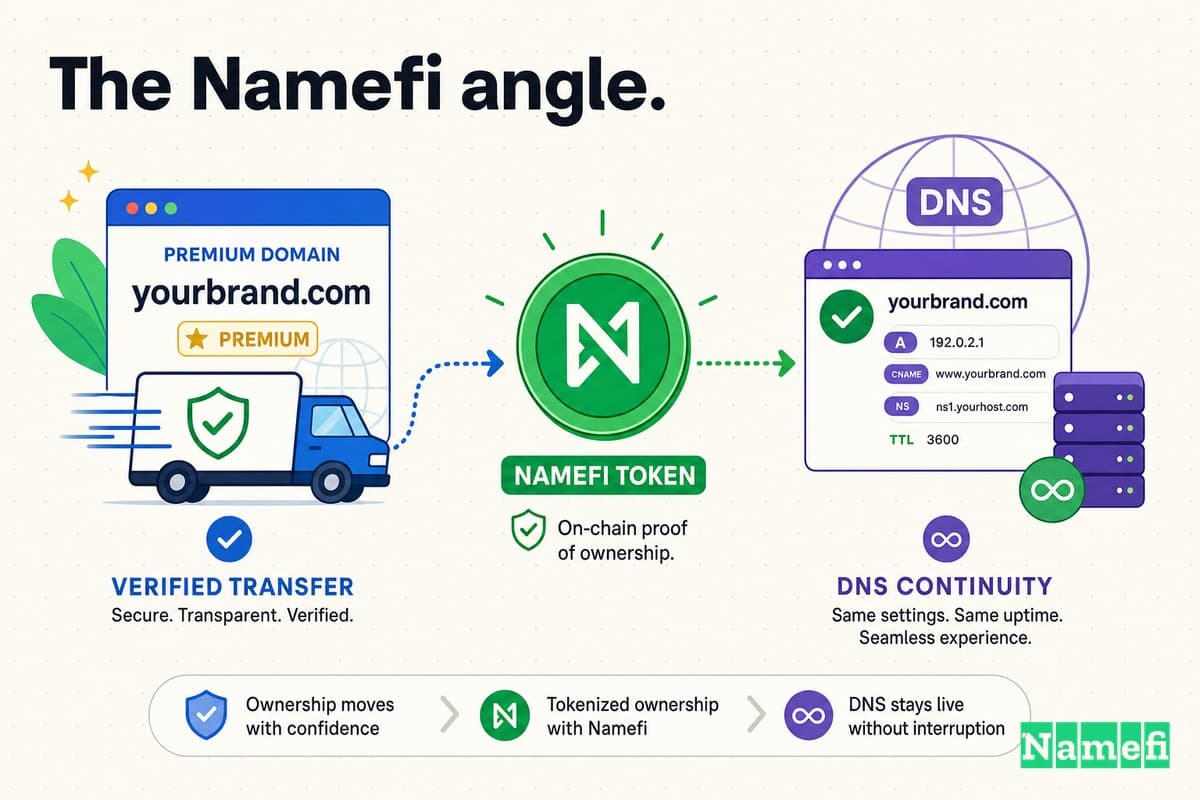
Box's story is, at its core, a transfer-and-valuation problem.
The strategic decision was never really in doubt — of course a company called Box should own Box.com. The hard part was everything around the asset: identifying that the .com sat inside a premium portfolio, agreeing on a price for a one-word domain with no public comparables, being prepared to pay even more than the near-seven-figure ask, and moving control cleanly without disrupting a live service used by 100,000 businesses. Years passed not because the decision was hard, but because the execution — pricing and transferring a premium asset — was.
Namefi is built around the idea that domains should behave like internet-native assets. Tokenized ownership can make domain control easier to verify, transfer, and integrate into modern workflows while staying compatible with DNS — turning the messiest parts of a deal like this (proving who really controls a premium domain, agreeing on value, and moving it safely) into something closer to a clean, auditable transaction.
Box.com looks inevitable now because Box became enormous. But the lesson lands long before that scale: when a name is going to carry the business — especially a business asking large enterprises to trust it — the exact-match .com isn't decoration. It's the part of the brand worth close to a million dollars, and a willingness to pay more, to finally get right.
Sources and further reading
- Wikipedia — Box, Inc.
- Wikipedia — Box, Inc. (alt title)
- Domain Name Wire — "Really cool" guys at Digimedia sold Box.com for about $1 million
- James Names — Who Is Digimedia? (Box.net to Box.com upgrade)
- TechCrunch — Cloud Storage Company Box.net Launches Cross-Platform Sync; Salesforce Chatter Integration And More
- TechCrunch — Box.net Acquires Increo Solutions
- Nira — How Box Conquered the Enterprise and Became a $1.7 Billion Company in a Decade
- Wikipedia — Aaron Levie
- Wikipedia — Rafe Needleman
- Digimedia — DIGIMEDIA Premium Domain Names
Contributors

Fenwei Bian is a software developer in her thirties who spends her working hours in pull requests and her weekends with her hands in soil or sawdust. Years of open source on GitHub taught her that names are interfaces: a good one is clear, honest about what it does, and kind to whoever has to use it next.
She gardens because it rewards patience and punishes wishful thinking, and she does woodwork because a joint either fits or it doesn't. Both habits show up in how she writes about naming — measure twice, check the source, and don't sand over a rough spot and hope no one notices.
For Namefi she writes about how domain markets actually move, the practical trade-offs of tokenizing and flipping names, and picking a domain you'll still be glad you own in twenty years.

Victor Zhou is a technology founder and standards editor focused on digital identity and trust. He founded Namefi, edits Ethereum Improvement Proposals, and previously led smart-contract architecture work at Google Labs.
His work sits at the intersection of naming, ownership, and the systems people use to establish identity online. That perspective makes him especially interested in the way names move between personal meaning, public recognition, and digital infrastructure.
For Namefi, Victor edits and writes about domains as durable digital identity: how names become ownable onchain assets, how tokenization changes custody and trust, and what naming can learn from the systems people use to establish identity online.
Related guides
- From BufferApp.com to Buffer.com: The 624-Day, Bank-Statement-Open Domain DealHow Buffer launched in 2010 on BufferApp.com because Buffer.com was taken, then spent 624 days acquiring the exact-match domain — even showing the seller its bank balance — and why a company famous for radical transparency stayed quiet on the one number everyone wanted: the price.
- Who Owns Trip.com? Ctrip, Trip.com Group, and the RebrandUnderstand how Trip.com relates to Ctrip and Trip.com Group, and trace the acquisition and company-name changes behind the travel brand.
- From del.icio.us to Delicious.com: The Cleverest Domain Hack on the Web — and Why Yahoo Untangled ItHow the pioneering social-bookmarking site launched in 2003 as the famous domain hack "del.icio.us," why those dots became a permanent tax on every mention, and how Yahoo moved it to the cleaner Delicious.com in 2008.
- From DiscordApp.com to Discord.com: How Dropping "App" Closed a Door Phishers LovedHow Discord launched in 2015 on DiscordApp.com because Discord.com was taken, quietly bought the bare word, and in 2020 made discord.com its primary home — partly for brand cleanliness, partly because the "discordapp.com" vs "discord.com" split was a gift to phishers and malware crews.