
Who Owns Trip.com? Ctrip, Trip.com Group, and the Rebrand
Understand how Trip.com relates to Ctrip and Trip.com Group, and trace the acquisition and company-name changes behind the travel brand.
- domains
- branding
- startups
- domain-upgrades

Trip.com is part of Trip.com Group Limited, the publicly traded travel group formerly called Ctrip.com International, Ltd. As checked September 15, 2026, the group's investor FAQ lists Trip.com and Ctrip as separate brands in the same family, alongside Qunar and Skyscanner.
| Name | What it refers to |
|---|---|
| Trip.com | The group's travel-booking brand for global consumers |
| Ctrip | A travel-booking brand serving mainland China |
| Trip.com Group Limited | The listed parent company, incorporated in the Cayman Islands and headquartered in Shanghai |
| Trip.com Travel Singapore Pte. Ltd. | A Singapore company listed among the group's significant subsidiaries |
The corporate FAQ and subsidiary disclosure distinguish the brand, parent, and operating entities. The parent has public shareholders; “who owns Trip.com?” is not the same question as who owns a particular block of its shares. A customer's contracting entity depends on the service terms, not simply the brand name or the parent's incorporation location.
The history below explains how acquiring the Trip.com business in 2017 led to the parent's 2019 name change. Ctrip continued as a brand; it did not disappear when the group adopted the new name.
For nearly twenty years, a company that would become one of the world's largest online travel platforms answered to a name that worked beautifully in one country and almost nowhere else: Ctrip.com.
The name was honest. When James Liang and three co-founders started the company in Shanghai in June 1999, "Ctrip" — the C nodding to China — described exactly what it was: a Chinese travel service for Chinese travelers. Wikipedia records that the company was founded as Ctrip.com by James Liang, Neil Shen, Min Fan, and Qi Ji in June 1999. It grew with extraordinary speed, and in 2003 it was listed on the NASDAQ in a Merrill Lynch-led offering that raised US$75 million — one of the first wave of Chinese consumer-internet IPOs.
Inside China, Ctrip.com had become one of the country's best-known online travel brands. But the moment the company looked beyond its home market, the name became a wall. "Ctrip" reads cleanly to a Mandarin speaker. To a traveler in London or Seoul, it is an unfamiliar cluster of consonants that announces, before anything else, that this is a Chinese company — and one whose name they will struggle to spell, say, or remember.
So in 2017, China's travel giant did something that looked, at first, like a small thing. It acquired a travel startup built around a single, premium English word with a .com after it: Trip.com. Two years later, that domain wouldn't just be a product. It would be the name of the entire company.
1999–2017: the company that owned China and almost nothing else
By the mid-2010s, Ctrip had become, as multiple outlets later described it, the largest online travel agency in China. But almost all of that scale lived inside one border.
The numbers were stark. As the South China Morning Post reported, Ctrip plans to boost the proportion of total revenue it makes from overseas customers from 2 per cent to at least 20 per cent over the next five years, using its recently-acquired Trip.com brand. Two percent. A company that dominated the biggest travel market on earth was, internationally, a rounding error.
The ambition was already global even when the revenue wasn't. Liang framed the entire industry as a scale game: travel, he argued, will be a winner takes all game in the end. And the prize was explicit: taking a big slice of the global tourism market and beating competitors like Expedia is now a key focus for Ctrip.
But you cannot beat Expedia.com and Booking.com with a brand most of the world can't pronounce. The descriptive, China-anchored name that had been a perfect on-ramp at home was now a ceiling abroad. Ctrip.com was the right domain for the first eighteen years — and the wrong one for the company it was about to become.
2017: buying Trip.com from a startup called Gogobot
So Ctrip went and got a better name. It acquired one of the most coveted domains in the entire travel industry — Trip.com — by buying the company that happened to be sitting on it.
That company was Gogobot, a San Francisco travel-recommendation startup that had recently rebranded itself around the domain. ChinaTravelNews reported the deal plainly: Ctrip has recently completed its acquisition of US travel booking platform Trip.com (formerly Gogobot) that offers personalized travel recommendations. The price was never publicly disclosed.
The Trip.com name and domain were key strategic assets, but they were not the only assets Ctrip acquired. Contemporary reporting said Trip.com's technology would also flow into Skyscanner, while industry observers saw a complementary brand structure: Ctrip could use Skyscanner for metasearch and Trip.com for full-service OTA. The deal brought Ctrip a product, technology, a team, and a booking brand wearing a name Western travelers could actually use.
The domain's twenty-year odyssey before Ctrip
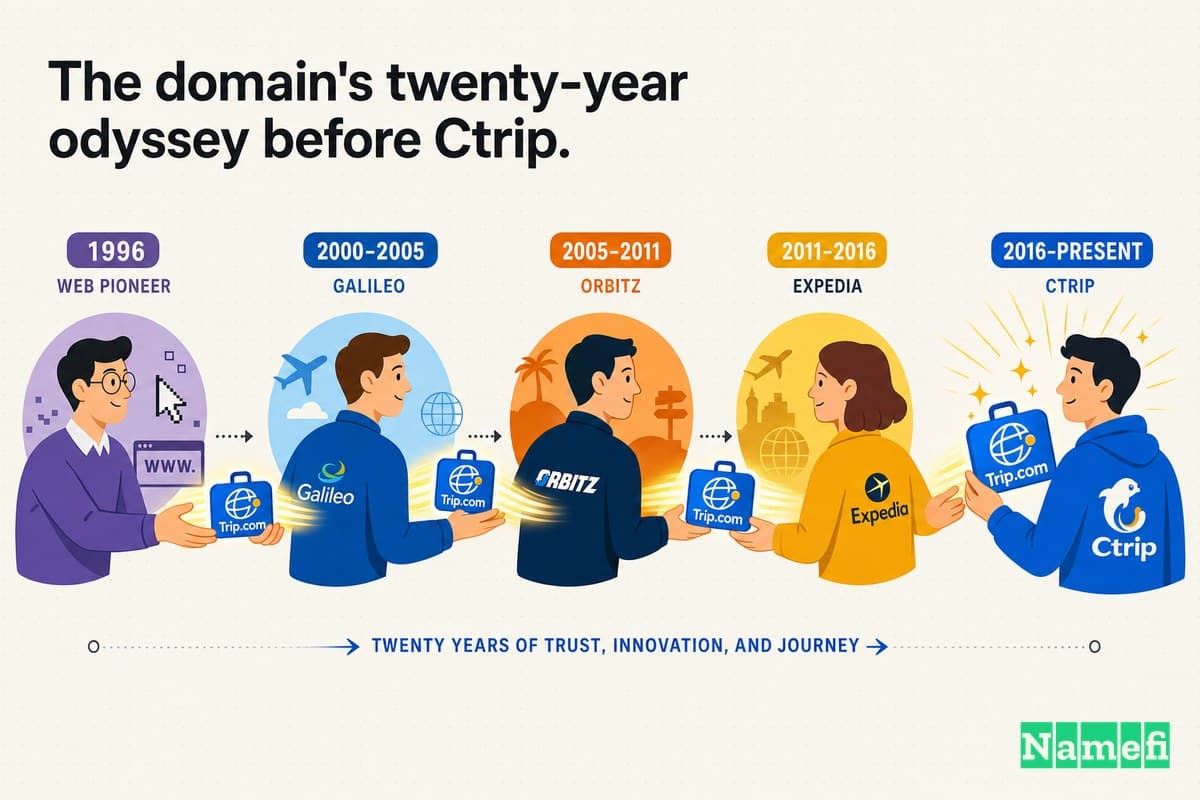
Here is what makes Trip.com such an extraordinary asset: by the time Ctrip bought it, the domain had already lived through almost a quarter century of travel-industry history. Skift traced its full odyssey, and the chain of custody reads like a map of the entire online-travel era.
The domain was first registered in 1996, by a man the original entrepreneur Antoine Toffa remembered only as "Mr. Trip" of Trip Software Systems. Toffa then purchased it from him in 1998 for $5,000, and built an early travel site on it. The big money came fast: travel-tech firm Galileo acquired the rest of the company in 2000 for $214.4 million in cash and stock.
Then the domain went through a long cycle of death and resurrection. After Cendant absorbed Galileo, it shut down Trip.com in 2003 — the brand's first death. In 2009, Orbitz Worldwide resuscitated the Trip.com brand as a metasearch site, before it lapsed again. Gogobot eventually bought the URL from Expedia for an undisclosed sum and rebranded to become Trip.com. And finally, Ctrip acquired Gogobot-turned Trip.com in 2017.
A domain that started as a $5,000 purchase in 1998 had, by 2000, been wrapped inside a $214.4 million acquisition. It had outlived three different corporate owners and two shutdowns. The word "Trip" plus ".com" was simply too valuable in travel to stay buried — and a Chinese company chasing the global market was exactly the kind of buyer with the motive to finally put it to permanent use.
The money looked different then
It is tempting to look at Trip.com today — the global brand of a major public travel company — and assume buying it was obvious. It wasn't.
Ctrip never disclosed what it paid Gogobot, and the deal was structured as an acquisition of a company, not a clean domain purchase, which muddies any single price tag. But the historical comparables tell the story of how a premium travel domain accretes value. The same string of letters changed hands for $5,000 in 1998 and was bundled into a $214.4 million transaction two years later. The price of "Trip.com" was never about the cost of registering a domain. It was about how badly the buyer needed the one word that made an entire category legible.
And in 2017, Ctrip needed it badly. It was a company with overwhelming scale at home and almost none abroad — 2% of revenue from overseas — making a bet that it could climb to 20% and challenge Expedia on the open field. Spending real money on a company whose name and domain are strategic assets only makes sense if you treat the address as part of the foundation everything else gets built on. Ctrip was about to ask the entire non-Chinese world to learn a new brand. The clearest way to make that brand stick was to make it a word travelers already knew: trip.
Why moving to Trip.com mattered
The gap between Ctrip.com and Trip.com is one letter. Strategically, it is the difference between a national champion and a global one.
Ctrip.com signals its origin before it signals its function — the "C" is a flag, and an unfamiliar one. Trip.com signals nothing but the thing you came to do. It is generic in the best possible way: a plain English noun that every traveler on earth already understands, owns the exact-match .com for, and can spell on the first try. One name asks the world to learn about a Chinese company. The other simply offers to help you take a trip.
| Before | After |
|---|---|
| Ctrip.com | Trip.com |
| Reads as "a Chinese travel site" | Reads as "the travel site" |
| Origin-first: the "C" flags the country | Function-first: the word is the category |
| Hard to spell, say, and remember abroad | An English noun everyone already knows |
| A national champion's name | A global category's name |
This is the same pattern that recurs across great domain upgrades: early names explain who you are, great names own what you do. Ctrip.com was a perfect name for winning China. Trip.com was the name for winning everywhere else — and the company couldn't have the second strategy without first owning the second domain.
A Chinese brand engineering its way out of being Chinese
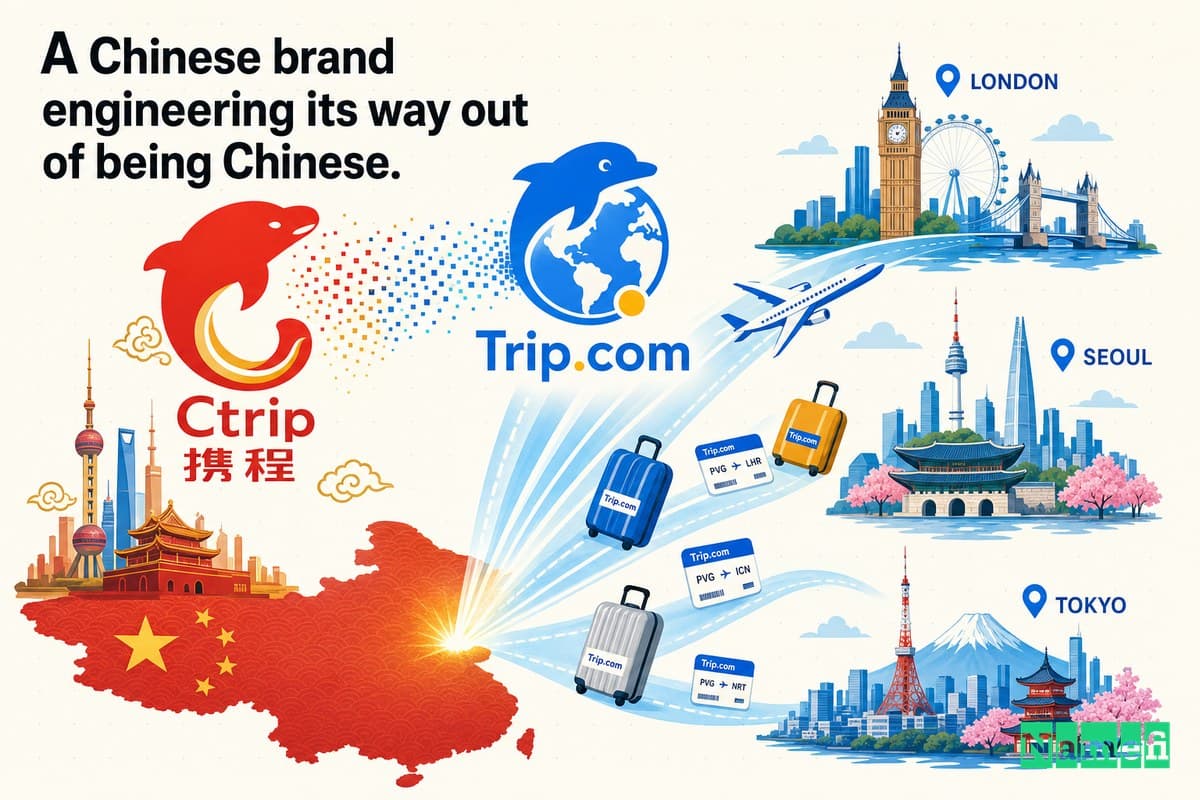
What makes this case unusual is how deliberately Ctrip set out to shed its own national identity. This was not an accidental rebrand. It was, in the company's own framing, surgery.
Reporting on the global relaunch, Marketing-Interactive described Liang's goal in his own words: he wanted to eliminate any reference to being Chinese-owned through what he called "an inside-out rebranding". The new Trip.com brand even sees the company removing its iconic dolphin from the logo, and changing the logo's colour and font — the visual identity rebuilt to match the new, geography-neutral name. The relaunched site was built to serve international travelers directly: Yicai Global reported that Trip.com will provide one-stop travel booking services in 13 languages through its website and mobile app.
The logic of why was always the same: scale. As Liang told the SCMP, a single market isn't enough to compete — the travel market is a global market. If you're just doing one market, you can't realise the economies of scale to compete. A name that broadcast "Chinese company" to every Western user was friction in exactly the markets where Ctrip wanted economies of scale. Trip.com erased that friction by design — a generic, ownerless-feeling English word that let a Shanghai company present itself to a traveler in London as, simply, a place to book a trip.
2019: the domain became the company
For two years, Trip.com was a brand the company owned. Then it became the name the company was.
In October 2019, during its 20th-anniversary celebration, the parent company put the rename to a shareholder vote — and it passed. Xinhua reported that China's largest online travel agency Ctrip has decided to change its official name, and that the company's shareholders have approved the change of the company name from "Ctrip.com International, Ltd." to "Trip.com Group Limited". Wikipedia records the same milestone: in October 2019, shareholders approved the company's proposal to change its name from "Ctrip.com International, Ltd." to "Trip.com Group Limited."
The reasoning was entirely about global legibility. Caixin Global reported that Liang said the new name "can be easily remembered by global users," reflecting the company's ambition to achieve the widespread brand recognition of international competitors like Expedia and Priceline. The stock ticker moved to match the new identity: as the same report noted, its ticker will be changed from "CTRP" to "TCOM."
Notice the sequence, because it is the whole lesson. The acquisition and launch of the Trip.com mobile app and website came first (2017). The corporate rename came last (2019). You cannot rename your entire publicly traded company "Trip.com Group" if you don't own Trip.com — and Ctrip had spent two years building the brand before it ever asked shareholders to vote. Crucially, the rename didn't kill Ctrip: the Ctrip brand stayed alive for the Chinese market, while Trip.com became the spearhead abroad. The group simply chose the global-facing name for the parent.
The domain became part of the operating system
Premium domains are not about prestige. They are about repetition — and for a company going global, repetition in a language its customers actually speak.
A company's core domain shows up in places the marketing team never directly controls:
- In app-store listings across dozens of countries.
- In airline confirmation emails, hotel vouchers, and itineraries.
- In press headlines and analyst reports in every market it enters.
- In search results, browser bars, and word-of-mouth recommendations between travelers.
- In the stock ticker, the investor decks, and the corporate name itself.
Every one of those repetitions either adds friction or removes it. Ctrip.com made each international mention slightly harder to spell, slightly more foreign, slightly more "a Chinese site." Trip.com made each mention an ordinary English word a traveler in any of those 13 languages could absorb without thinking. Multiply that across hundreds of millions of users and every market Ctrip wanted to enter, and a premium domain stops looking like a vanity purchase and starts looking like a permanent reduction in the drag on global growth.
What founders should learn from Case 5
The easy takeaway — "buy a generic .com" — misses the real structure. The useful lessons are about when a descriptive name becomes a wall, and in what order to dismantle it:
- A local, descriptive name is a feature at the start. "Ctrip" — the C for China — was the right name for winning China. It signaled exactly who the company was to exactly the audience it needed. A geography-coded or descriptive name is a reasonable on-ramp, not a mistake.
- Watch for the moment the name stops describing you and starts limiting you. For Ctrip the signal was structural: 2% of revenue abroad, a name foreign customers couldn't spell, and a stated ambition to reach 20% and beat Expedia. When your name only works in one market and you want all of them, the name is the ceiling.
- Buy the domain before you bet the company on it. Ctrip acquired Trip.com and launched the consumer website and app in 2017, then renamed the public company in 2019. The slow, expensive, externally-owned asset — the domain — has to be secured first. The corporate identity can follow.
- A generic word can do work a clever one can't. Trip.com wins precisely because it is not distinctive in origin — it's the plain noun for the entire category, owned outright at the exact-match
.com. For a global play, ownable generic beats memorable-but-foreign.
The domain upgrade did not make Trip.com Group win. Liang's strategy, two decades of operating muscle, the Skyscanner acquisition, and sheer scale mattered far more. But Trip.com made the company's reinvention as a global brand — rather than a Chinese one — actually nameable. And that name had to be bought years before anyone outside China could use it.
The Namefi angle
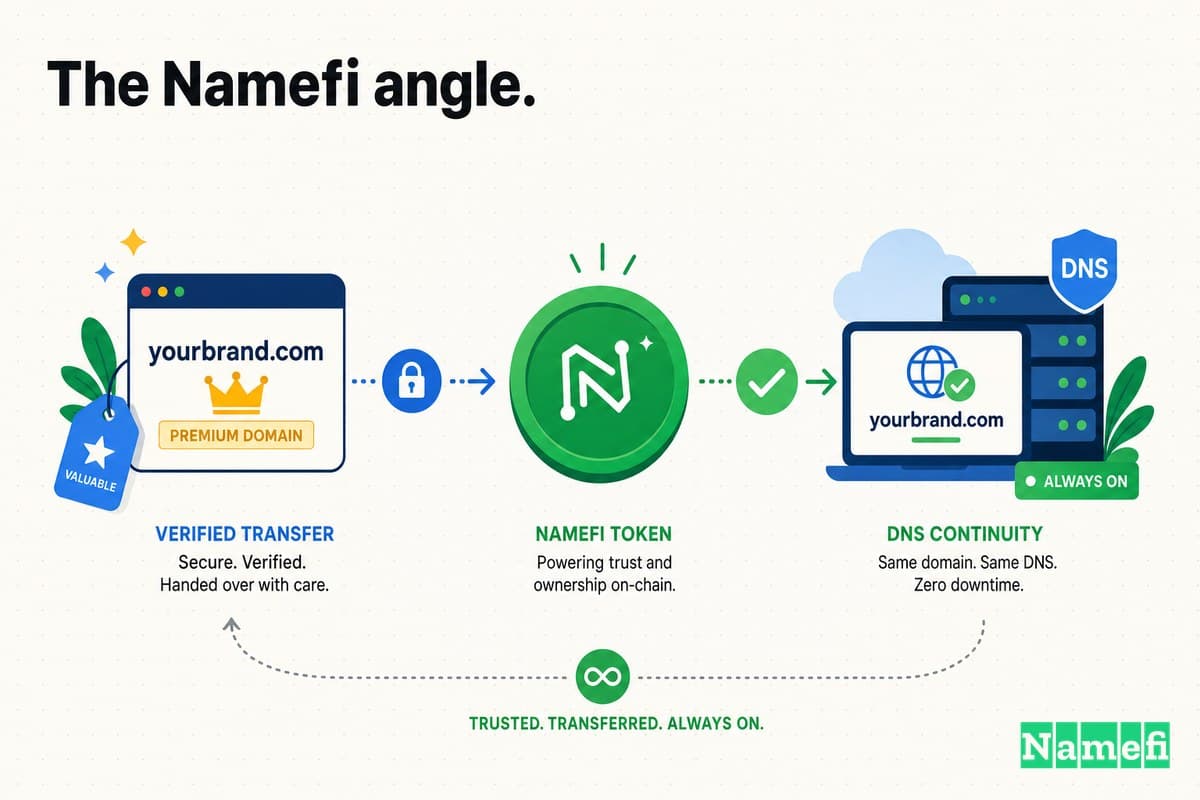
Strip away the branding drama and this case is, at its core, a transfer-and-provenance problem.
The strategic decision was never really in doubt — of course a company chasing the global travel market should own Trip.com. The hard part was everything around the asset. Trip.com had passed through the hands of at least half a dozen owners across two decades — a $5,000 buyer in 1998, a $214.4 million acquisition in 2000, Cendant, Orbitz, Expedia, Gogobot. Some transfers occurred inside corporate deals; others were direct asset purchases. Each handoff still required the parties to establish ownership and move control safely. A domain with that much history carries that much friction.
Namefi is built around the idea that domains should behave like internet-native assets. Tokenized ownership can make domain control easier to verify, transfer, and integrate into modern workflows while staying compatible with DNS — turning the messiest part of a deal like this (establishing clean provenance across a long chain of owners, agreeing on value, and moving control without disrupting a live, revenue-generating site) into something closer to a clean, auditable transaction. A domain that has changed hands six times in twenty-five years is exactly the kind of asset whose history should be legible at a glance, not reconstructed from old press releases.
Trip.com looks inevitable now because Trip.com Group became enormous. But the lesson lands long before that scale: when a name is going to carry a company across borders, the domain isn't decoration. It's the load-bearing piece — and for a brand that wanted the whole world, it was the part worth chasing for two years before the rename ever happened.
Sources and further reading
-
Trip.com Group — Investor FAQs, brand portfolio, incorporation, listing, and name-change questions — fetched 2026-09-15.
-
Trip.com Group — List of Significant Consolidated Entities, Exhibit 8.1, “Significant Subsidiaries” — fetched 2026-09-15.
-
South China Morning Post — Exclusive: China travel giant Ctrip wants to go global with Trip.com brand
-
ChinaTravelNews — Ctrip to further global expansion by acquiring US travel site Trip.com
-
Skift (via Yahoo Finance) — Trip.com's Nearly Quarter Century Odyssey as a Can't Lose Travel Domain
-
Marketing-Interactive — Ctrip launches global rebrand to Trip.com
-
Yicai Global — Ctrip Goes Through 'Inside-Out Rebranding,' Unveils New Global Site
-
Caixin Global — Ctrip Formalizes Name Change as It Eyes Global Expansion
-
Trip.com Group / SEC — Supplemental and Updated Disclosures, including the 2017 Trip.com app and website launch
-
TechCrunch — CTrip Group snaps up travel search startup Trip.com
-
Wikipedia — Trip.com Group
Contributors

Fenwei Bian is a software developer in her thirties who spends her working hours in pull requests and her weekends with her hands in soil or sawdust. Years of open source on GitHub taught her that names are interfaces: a good one is clear, honest about what it does, and kind to whoever has to use it next.
She gardens because it rewards patience and punishes wishful thinking, and she does woodwork because a joint either fits or it doesn't. Both habits show up in how she writes about naming — measure twice, check the source, and don't sand over a rough spot and hope no one notices.
For Namefi she writes about how domain markets actually move, the practical trade-offs of tokenizing and flipping names, and picking a domain you'll still be glad you own in twenty years.

Victor Zhou is a technology founder and standards editor focused on digital identity and trust. He founded Namefi, edits Ethereum Improvement Proposals, and previously led smart-contract architecture work at Google Labs.
His work sits at the intersection of naming, ownership, and the systems people use to establish identity online. That perspective makes him especially interested in the way names move between personal meaning, public recognition, and digital infrastructure.
For Namefi, Victor edits and writes about domains as durable digital identity: how names become ownable onchain assets, how tokenization changes custody and trust, and what naming can learn from the systems people use to establish identity online.
Related guides
- From Box.net to Box.com: The ~$1M Upgrade That Dropped the ".net" and Bought the Exact MatchHow Box launched in 2005 on Box.net because Box.com was taken, pivoted from consumer storage to the enterprise, and in 2011 paid Digimedia close to $1 million for the exact-match Box.com — a .net-to-.com upgrade that landed right as the company became simply "Box."
- From BufferApp.com to Buffer.com: The 624-Day, Bank-Statement-Open Domain DealHow Buffer launched in 2010 on BufferApp.com because Buffer.com was taken, then spent 624 days acquiring the exact-match domain — even showing the seller its bank balance — and why a company famous for radical transparency stayed quiet on the one number everyone wanted: the price.
- From del.icio.us to Delicious.com: The Cleverest Domain Hack on the Web — and Why Yahoo Untangled ItHow the pioneering social-bookmarking site launched in 2003 as the famous domain hack "del.icio.us," why those dots became a permanent tax on every mention, and how Yahoo moved it to the cleaner Delicious.com in 2008.
- From DiscordApp.com to Discord.com: How Dropping "App" Closed a Door Phishers LovedHow Discord launched in 2015 on DiscordApp.com because Discord.com was taken, quietly bought the bare word, and in 2020 made discord.com its primary home — partly for brand cleanliness, partly because the "discordapp.com" vs "discord.com" split was a gift to phishers and malware crews.