
From del.icio.us to Delicious.com: The Cleverest Domain Hack on the Web — and Why Yahoo Untangled It
How the pioneering social-bookmarking site launched in 2003 as the famous domain hack "del.icio.us," why those dots became a permanent tax on every mention, and how Yahoo moved it to the cleaner Delicious.com in 2008.
- domains
- branding
- startups
- domain-upgrades

For about five years, one of the most influential sites of the Web 2.0 era lived at an address you almost couldn't say out loud: del.icio.us.
The name was clever. It was, in fact, the single most famous example of a domain hack — a trick where the domain itself spells a word by borrowing a country-code suffix. Joshua Schachter registered icio.us on the .us ccTLD, put del in front of it as a subdomain, and the whole string read as "delicious." As one early explainer walking through the construction put it, del is actually a subdomain of icio.us, and that subdomain-plus-ccTLD assembly was, in its words, an ingenious way to register a domain name.
For a side project run by an engineer for fun, that cleverness was the point. The dots were a wink. They said: this is a hacker's tool, built by someone who thinks the way the web's plumbing works is itself a place to be creative.
But a wink does not scale. Every dot in del.icio.us was a place a new user could get lost — a comma where a period went, a missing letter, an extra one. And the site underneath those dots was not staying a side project. It coined a category, attracted hundreds of thousands of users, and got bought by Yahoo. By 2008, under Yahoo's ownership, the cleverest domain on the web was traded in for the boring, correct one: Delicious.com.
This is the story of when a domain hack stops being charming and starts being a tax — and what it costs to fix it after millions of people have already learned to mistype your name.
2003: a side project named after a country code
In the beginning, the dots were free.
Schachter didn't set out to build a company. He built a tool for himself. When he topped 20,000 links in 2001, he wrote a single-user program to manage his own bookmark sprawl, then rewrote it as something other people could use. As Computerworld later recounted, he rewrote it from scratch as a multiuser system and launched it on the Web for others to use. He called it del.icio.us. Per Wikipedia, in September 2003, Schachter released the first version of Delicious.
He did it in his spare time. According to Computerworld, Schachter ran it in his spare time, while working full time as a quantitative analyst at Morgan Stanley — the kind of after-hours origin where nobody is doing trademark clearance or thinking about how the name will read in a TV chyron. The tagging idea that made the site famous wasn't even native to it; per Wikipedia, it was a system he developed for organizing links suggested to Memepool.
And the product worked. With no marketing budget, it spread on cleverness and word of mouth. Computerworld reported that with no formal marketing, today del.icio.us has about 200,000 registered users, and Wikipedia credits the service with more than just users: the service coined the term social bookmarking.
So here is the setup. A company that named an entire category was wearing a domain designed for a one-person hobby. The name was a hacker's joke that had accidentally become a brand.
The cleverest domain on the web — and the most mistyped
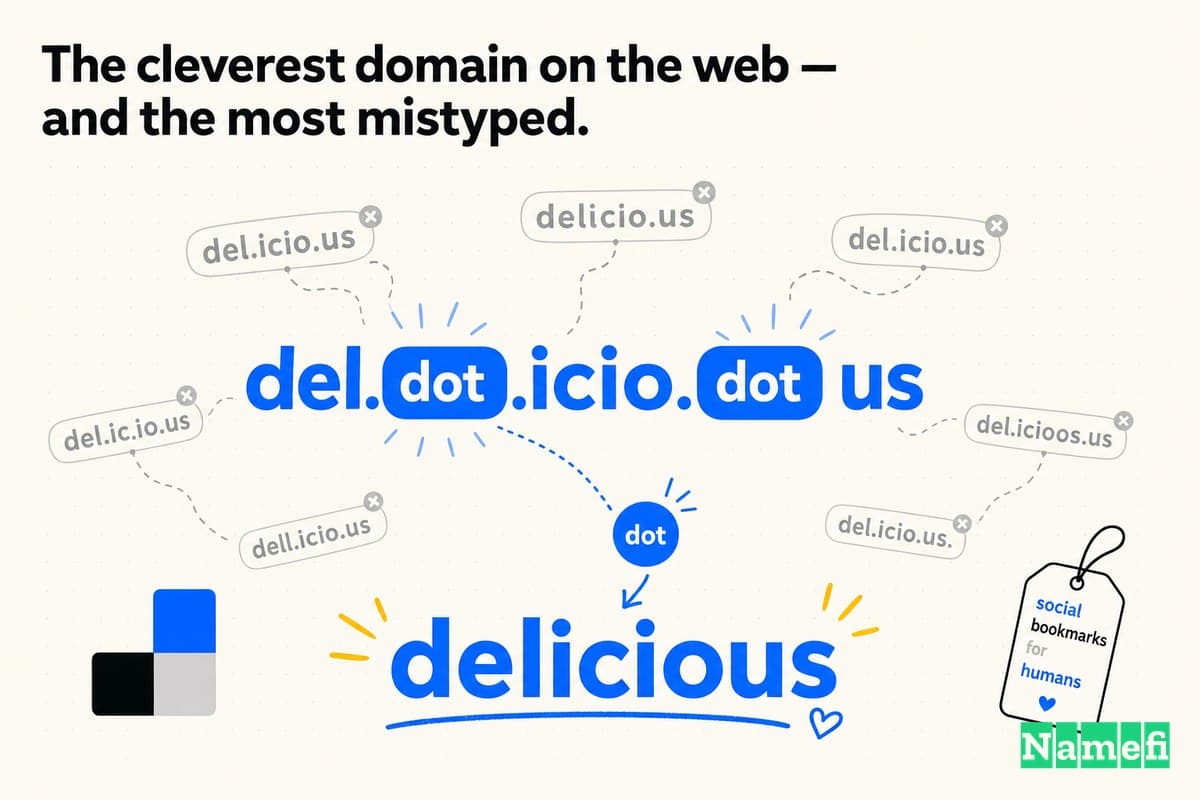
del.icio.us is, even now, the textbook example of a domain hack. Wikipedia states it plainly: the "del.icio[.us]" domain name was a well-known example of a domain hack, an unconventional combination of letters to form a word or phrase.
The trick was genuinely elegant. As the construction walkthrough explained, icio was the selected domain name and .us was the registered country code level top level domain (ccTLD) which combined to form icio.us, with del stacked on top as a subdomain. The address didn't point at a word. The address was a word. For an audience of engineers, that was catnip.
The problem is that the rest of the world doesn't read DNS for fun. Those two dots turned the brand into a spelling test, and most people failed it. When the team finally explained the 2008 move, they listed the damage: we've seen a zillion different confusions and misspellings of "del.icio.us" over the years (for example, "de.licio.us", "del.icio.us.com", and "del.licio.us"). Every misplaced dot was a user who didn't arrive, a link shared that didn't resolve, a recommendation that died in the gap between hearing the name and typing it.
Schachter knew. He'd known almost from the start. As Domain Name Wire noted, way back in 2004 he talked about the naming mistake, quoting him directly: I somewhat regret using the domain name, because it's almost impossible to discuss or verify without sounding silly.
That line is the whole tension of a domain hack in one sentence. Almost impossible to discuss or verify without sounding silly. A name that lives on a screen can be clever and crooked at the same time. A name that has to survive being said aloud — on a phone call, across a bar, in a podcast, to a colleague — has to be sayable. The dots that made del.icio.us a great inside joke made it a terrible thing to recommend.
2005: Yahoo buys the hobby
The hobby became an acquisition.
On December 9, 2005, Yahoo! acquired Delicious for an undisclosed sum — a price Wikipedia notes was according to Business 2.0 ... $30 million. Delicious was, at that moment, a crown jewel of Web 2.0. TechCrunch later described the era affectionately: once upon a time (maybe around 2004), the social bookmarking service Delicious was the hottest thing on the web, a site that hit all the right buzzwords of the time (collaborative tagging, folksonomy, AJAX).
Yahoo now owned a category-defining product. It also owned that product's biggest legibility problem. A scrappy side project can wear a domain hack as a badge. A mainstream consumer property owned by a public company that wants everyone to use it cannot — every dot is friction standing between Yahoo and the mass-market growth that justified the purchase price.
So the question Yahoo inherited wasn't whether del.icio.us was clever. Everyone agreed it was clever. The question was whether clever was worth the millions of users who couldn't spell it.
2008: trading the wink for the word
In the summer of 2008, Yahoo made the call. A redesigned Delicious launched and the brand quietly migrated to the address it should have had all along. Per Wikipedia, the new design went live on July 31, 2008.
Domain Name Wire captured the switch precisely: social bookmarking site Delicious has flipped the switch on its brand, encouraging users to visit the easy-to-remember Delicious.com instead of the often typod del.icio.us. Note the framing: easy-to-remember versus often typod. Five years and one acquisition later, the official reason for the move was exactly the problem Schachter had named in 2004 — the dots cost more than they were worth.
The why-we-switched explanation was unsentimental. As Domain Name Wire reported the team's own words, the whole point of moving to delicious.com was that it will make it easier for people to find the site and share it with their friends. Find it. Share it. Those are the two verbs a domain hack quietly breaks, and they're the two verbs a growth-stage product lives and dies by.
This is the rare upgrade where the company moved toward the plain .com and away from the clever string — the opposite direction of the usual descriptive-to-exact-match path. But it's the same underlying move: shedding a name that explained the founder's wit in favor of a name the whole market could use without thinking.
The money looked different then
It is easy, from here, to say Schachter should have just bought delicious.com in 2003 and skipped the dots. That reads the decision from the wrong end.
In 2003, del.icio.us was not a brand decision. It was a hobby decision. Schachter wasn't allocating a marketing budget; he was registering a domain for a tool he ran nights and weekends while keeping a day job at Morgan Stanley. The hack wasn't a strategic misfire — it was a small creative pleasure, the kind of thing you do because it's just for you.
Domain Name Wire made exactly this allowance, and it's the fair read: since the Delicious site started as a hobby, founder Joshua Schachter can be forgiven for not using a good domain name.
The trap isn't choosing a domain hack when you're small. The trap is keeping it when you're not. The cost of the dots was near-zero for a side project with a few thousand technical users who thought the hack was great. The cost climbed every time the audience widened — past the early adopters, past 200,000 registered users, past a Yahoo acquisition, toward the mainstream Yahoo wanted. The bill for del.icio.us wasn't paid in 2003. It came due in 2008, denominated in every user who couldn't find a site they'd been told to try.
Why moving to Delicious.com mattered
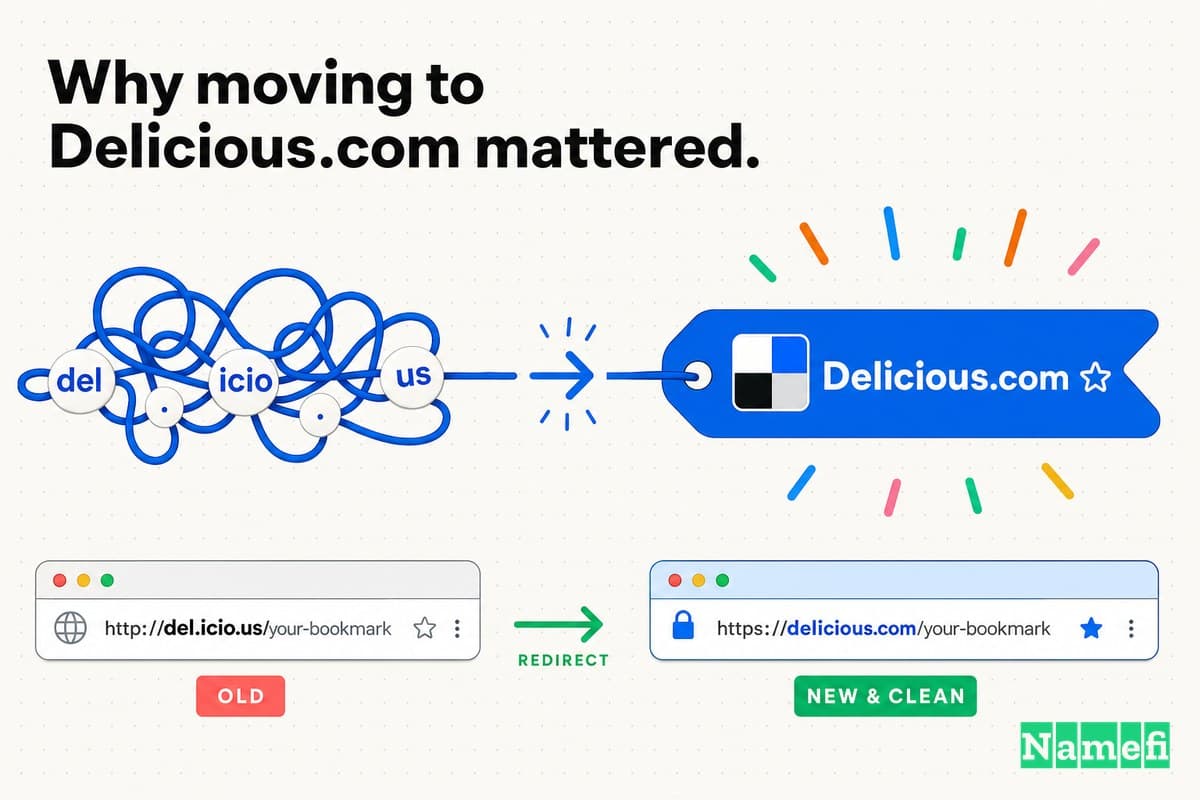
The gap between del.icio.us and Delicious.com looks like punctuation. Strategically, it's the difference between a name that performs cleverness and a name that delivers users.
del.icio.us is a puzzle: two dots, a borrowed country code, a string you have to decode before you can type it. Delicious.com is just a word. One asks the listener to remember an unusual structure. The other asks them to remember a word they already know how to spell.
| Before | After |
|---|---|
| del.icio.us | Delicious.com |
| A domain hack (the .us ccTLD spelling a word) | A plain, exact-match .com word |
| Clever to read on screen | Easy to say out loud and share |
| Two dots = two places to mistype | One word, one spelling |
| "de.licio.us", "del.licio.us", "del.icio.us.com" | delicious.com |
| Signals a hacker's side project | Signals a mainstream consumer product |
This is the same lesson as every domain upgrade, just arriving from the opposite side. Most companies move from a descriptive name (UberCab, TeslaMotors) to a clean exact-match word. Delicious moved from a too-clever name to the clean exact-match word. The destination is identical: a domain that disappears into the brand instead of demanding attention. A great domain is the one users don't have to think about. del.icio.us made them think about the domain every single time.
And the move carried a warning for everyone watching. Domain Name Wire put the broader lesson bluntly: sadly, a number of web 2.0 entrepreneurs saw the success of del.icio.us and thought it would be cool to create domain hacks themselves, resulting in poorly chosen domain names that sent plenty of traffic to the wrong place. The hack that made Delicious famous also made it a cautionary template — copied by founders who saw the cleverness and missed the cost.
The timing: when "clever" became "expensive"
The interesting question isn't why Delicious moved. It's when.
The complaint was constant from the beginning — Schachter named it in 2004, the year after launch. But the move didn't happen until 2008, after the user base had ballooned and Yahoo had paid a reported $30 million for the company. The dots didn't get worse over those years. The stakes did.
When you have a few thousand technical users, a hard-to-type domain is a quirk they forgive. When you're a Yahoo property chasing mainstream adoption, the same domain is a leak in the top of the funnel — every "del-dot-what?" is a user who never makes it in. The tax rate on the dots never changed. The size of the thing being taxed grew until the bill was impossible to ignore. By 2008 the math was obvious in a way it simply wasn't in 2003: the cost of switching once was smaller than the cost of being mistyped forever.
The domain became part of the operating system
Premium domains aren't about prestige. They're about repetition — and a domain hack breaks at exactly the points where repetition happens.
A site's core address shows up in places no marketing team controls:
- In word-of-mouth: "you should try del-icio-us... no, it's spelled with dots."
- In the browser bar, where one wrong dot lands on nothing.
- In links shared between friends, where a typo silently fails.
- In press, podcasts, and conversation, where a name has to survive being said.
- In every new user's first thirty seconds, where finding the site is step one.
Every one of those moments either adds friction or removes it. del.icio.us added friction at all of them: the name was unsayable without explanation, unshareable without care, and unfindable for anyone who got a dot wrong. Delicious.com removed friction at all of them: you say a word, you type a word, you're there. Multiply that delta across hundreds of thousands of users and every recommendation they made to a friend, and the cleverness of the hack stops looking like an asset and starts looking like a toll booth the company built in front of its own door.
The domain didn't make Delicious popular — tagging, timing, and a genuinely useful product did that. But every recommendation passed through the name, and for five years the name leaked.
What founders should learn from Case 18
The easy takeaway — "never use a domain hack" — is too blunt. The more useful lessons are about who you're naming for and when the joke stops paying for itself:
- A clever name is fine for a hobby.
del.icio.uswas a delightful choice for a nights-and-weekends tool with a technical audience. Domain Name Wire was right that the hobby origin earns forgiveness. If your whole audience is people who'd appreciate the hack, the hack is a feature. - Audit the name the moment the audience widens. The signal to upgrade isn't aesthetic; it's demographic. The instant your users stop being people who read DNS for fun, a domain hack flips from charming to costly. Schachter felt it by 2004. The fix didn't come until 2008.
- A name has to survive being said out loud. The clearest test of a domain isn't how it looks — it's whether someone can hear it and type it correctly the first time. If recommending your site requires spelling instructions, the name is taxing your growth.
- Switch before the bill compounds. The cost of moving once is fixed. The cost of being mistyped scales with every new user. Delicious paid the switching cost late, after years of leaked traffic. The earlier you trade the wink for the word, the less you've already lost.
The move to Delicious.com didn't save the company — Yahoo's later neglect did far more to determine its fate than punctuation ever could. But it made the brand findable, and findability is the one thing a clever domain hack quietly steals.
The Namefi angle
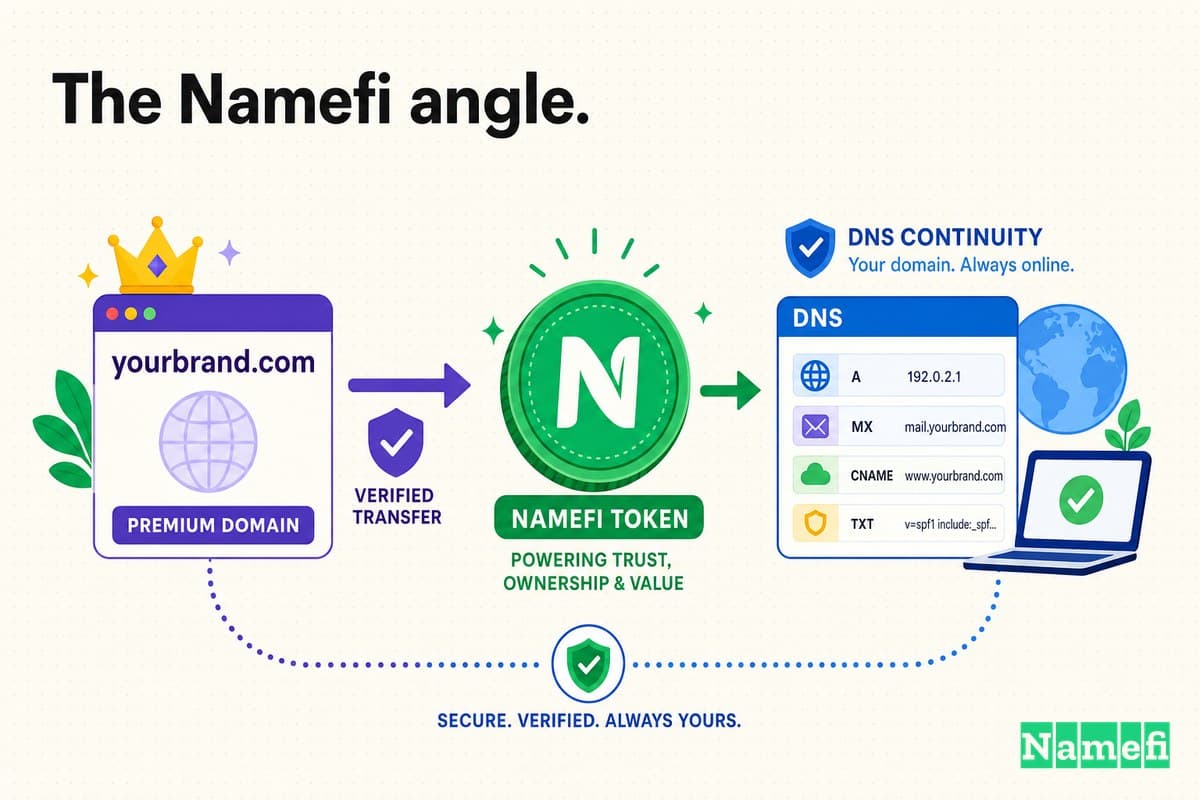
This case is, underneath the cleverness, a question of which asset actually carries the business.
Delicious had two names: the witty one its founder loved and the plain one its users needed. For five years it ran on the witty one and quietly paid for the gap — in mistypes, in failed shares, in the friction of a name almost impossible to discuss or verify without sounding silly. Closing that gap meant treating the right domain not as decoration but as core infrastructure: securing it, moving the brand onto it cleanly, and keeping the service live through the switch.
Namefi is built around the idea that domains should behave like internet-native assets. Tokenized ownership can make domain control easier to verify, transfer, and integrate into modern workflows while staying compatible with DNS — turning the messy parts of an upgrade like this (proving who holds what, moving a name safely, keeping the site resolving the whole time) into something closer to a clean, auditable transaction. The cleverness of a domain hack is fun. The boring reliability of a name your users can find, share, and trust is what the business actually runs on.
Delicious.com looks obvious in hindsight. It always does. But the lesson lands long before hindsight: a name that performs cleverness is naming for the founder. A name your whole market can spell is naming for the business. When the audience outgrows the joke, the domain isn't decoration — it's the part of the brand worth switching to get right.
Sources and further reading
- Wikipedia — Delicious (website)
- Wikipedia — Joshua Schachter
- Computerworld — Del.icio.us: Social bookmarking phenomenon
- Domain Name Wire — Del.icio.us Rebrands as Delicious.com: A Lesson for Entrepreneurs
- QuickOnlineTips — Decoding the Domain Name del.icio.us
- TechCrunch — Delicious, Former Web 2.0 Darling, Is Now Managed By New Alliance
Contributors

Fenwei Bian is a software developer in her thirties who spends her working hours in pull requests and her weekends with her hands in soil or sawdust. Years of open source on GitHub taught her that names are interfaces: a good one is clear, honest about what it does, and kind to whoever has to use it next.
She gardens because it rewards patience and punishes wishful thinking, and she does woodwork because a joint either fits or it doesn't. Both habits show up in how she writes about naming — measure twice, check the source, and don't sand over a rough spot and hope no one notices.
For Namefi she writes about how domain markets actually move, the practical trade-offs of tokenizing and flipping names, and picking a domain you'll still be glad you own in twenty years.

Victor Zhou is a technology founder and standards editor focused on digital identity and trust. He founded Namefi, edits Ethereum Improvement Proposals, and previously led smart-contract architecture work at Google Labs.
His work sits at the intersection of naming, ownership, and the systems people use to establish identity online. That perspective makes him especially interested in the way names move between personal meaning, public recognition, and digital infrastructure.
For Namefi, Victor edits and writes about domains as durable digital identity: how names become ownable onchain assets, how tokenization changes custody and trust, and what naming can learn from the systems people use to establish identity online.
Related guides
- From Box.net to Box.com: The ~$1M Upgrade That Dropped the ".net" and Bought the Exact MatchHow Box launched in 2005 on Box.net because Box.com was taken, pivoted from consumer storage to the enterprise, and in 2011 paid Digimedia close to $1 million for the exact-match Box.com — a .net-to-.com upgrade that landed right as the company became simply "Box."
- From BufferApp.com to Buffer.com: The 624-Day, Bank-Statement-Open Domain DealHow Buffer launched in 2010 on BufferApp.com because Buffer.com was taken, then spent 624 days acquiring the exact-match domain — even showing the seller its bank balance — and why a company famous for radical transparency stayed quiet on the one number everyone wanted: the price.
- Who Owns Trip.com? Ctrip, Trip.com Group, and the RebrandUnderstand how Trip.com relates to Ctrip and Trip.com Group, and trace the acquisition and company-name changes behind the travel brand.
- From DiscordApp.com to Discord.com: How Dropping "App" Closed a Door Phishers LovedHow Discord launched in 2015 on DiscordApp.com because Discord.com was taken, quietly bought the bare word, and in 2020 made discord.com its primary home — partly for brand cleanliness, partly because the "discordapp.com" vs "discord.com" split was a gift to phishers and malware crews.