
How to Name Your Project: A Founder's Field Guide
A practical, research-backed guide for founders naming a project, product, or company: clear it legally, make it easy to say, generate strong candidates, check it across cultures, and run the searches that matter before you commit.
- branding
- startups
- guide
- naming
- domains

Naming is the first product decision most founders get wrong.
It feels like a side quest you do once and forget. In reality the name is the single asset that shows up everywhere for the life of the project: the domain, the logo, the app icon, the GitHub org, every invoice, every "what are you working on?" at a party, every time someone tries to type it from memory a week after hearing it once. You will say it and write it tens of thousands of times. A good name compounds. A bad one taxes every one of those moments.
This guide is a field manual for picking that name. It blends what the research actually shows about how people process names with the legal and technical checks you have to clear before you can own one — and it ends with the only rule that overrides all the others.
A Name Has Two Jobs
Strip away the romance and a name has to do exactly two things:
- Be ownable — legally defensible and technically available, so it can actually become yours.
- Be easy to market — easy to say, spell, remember, and pass along, so the name does your marketing for you, and so other people can spread it without effort.
Most naming advice optimizes only the second. Founders who skip the first ship a beautiful name, build a brand on it, and then get a cease-and-desist or discover the .com is held by someone who wants five figures for it. Do the constraints first. They are cheaper to check than to fix.
Part 1 — Clear the Name (Legal & Technical Constraints)
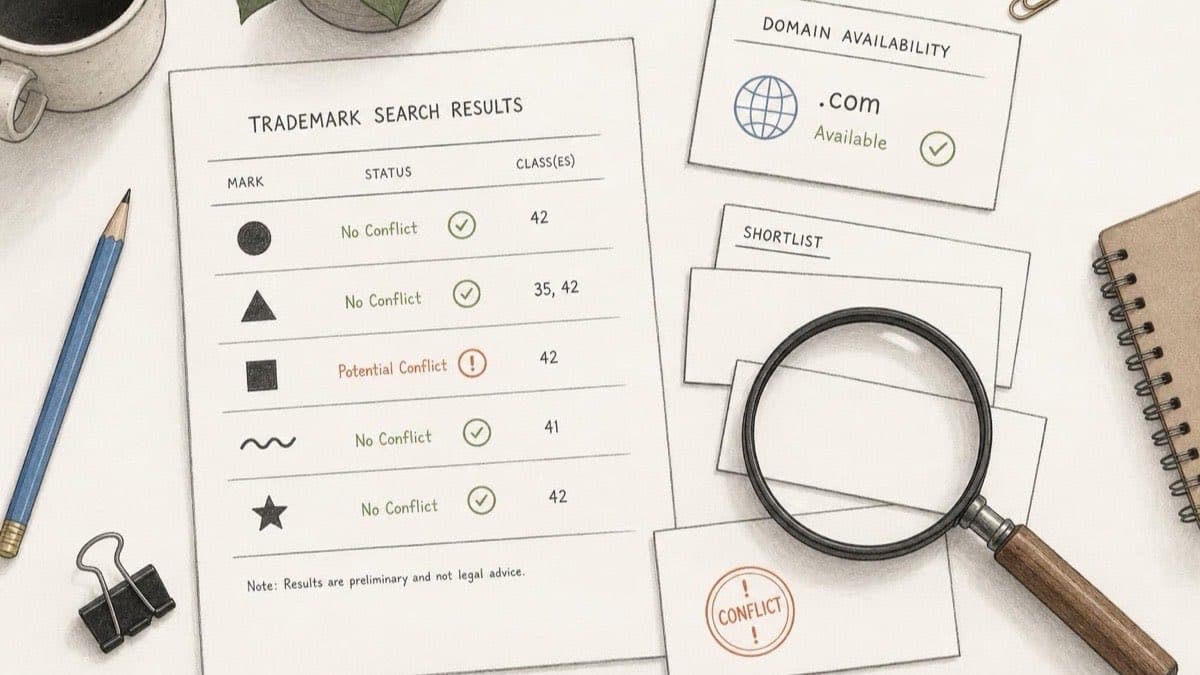
Be unique inside your category
The legal test that matters is not "is this name taken somewhere on Earth." It is likelihood of confusion: would an ordinary buyer, seeing your mark in your category, plausibly think it comes from someone else. U.S. examiners and courts weigh a set of factors — most importantly the similarity of the marks in sound, appearance, and meaning, and the relatedness of the goods or services — known as the DuPont factors. Two identical names can coexist in unrelated categories (Dove soap and Dove chocolate); two similar names in the same category are a problem even if they are not identical.
So the question to ask about any candidate is narrow and specific: is anything close to this already operating in my lane?
Run the searches that actually matter
Before you fall in love, spend twenty minutes here:
- Plain web search. If page one is already crowded with a company doing something adjacent, stop. You will fight them for attention forever.
- Trademark databases. Search the USPTO trademark search system for the U.S., the EUIPO database for the EU, and WIPO's Global Brand Database for an international sweep. You are not doing a lawyer's clearance — you are catching the obvious collisions for free.
- Domains. The
.comstill anchors credibility for most ventures. On Namefi you can check availability, see how long a.comhas been registered (a name held continuously since 2009 is a very different signal than one registered last month), and see how many TLDs the name is already registered across. A name taken on 30 extensions is contested territory; a name free almost everywhere is open road. Treat that spread as a quick "how crowded is this word" gauge. - Handles. Check the GitHub org, plus X, Reddit, LinkedIn, and whichever platform your users actually live on. Consistent handles across the web ("handle uniformity") are worth a surprising amount for an early project — and they are first-come, first-served.
If a candidate clears the category, the trademark sweep, a usable domain, and the handles, it has earned the right to be judged on craft.
Part 2 — Make It Easy to Say (What the Research Shows)
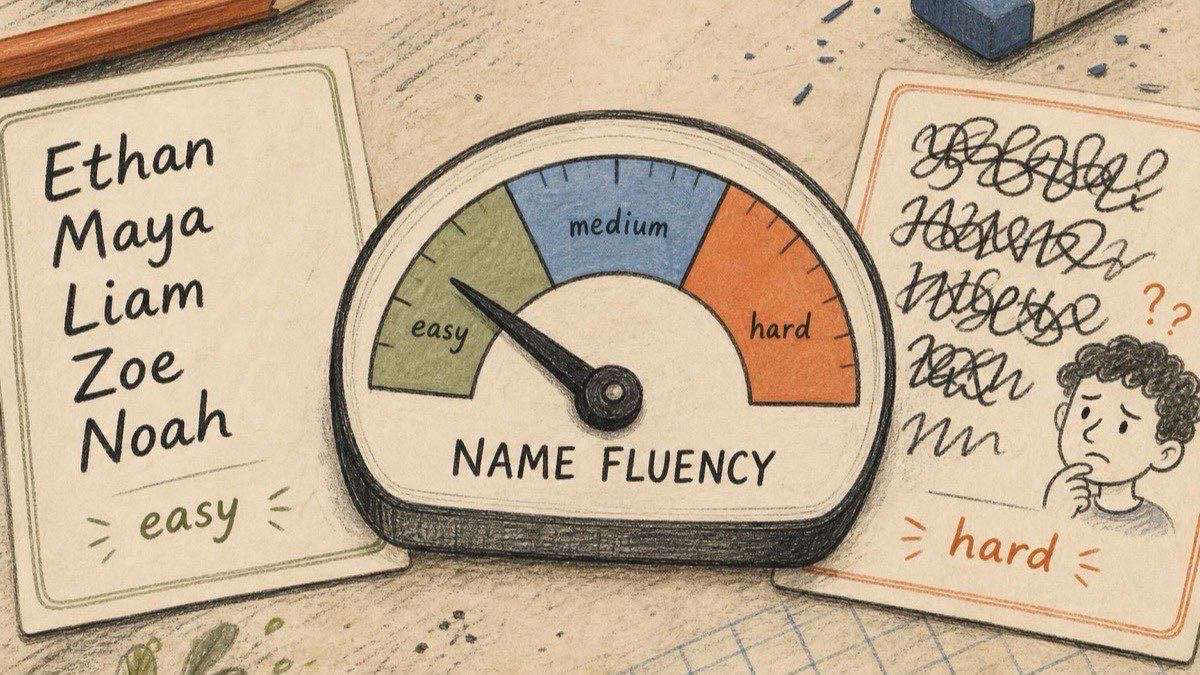
Here the science is unusually clear, and it all points the same direction: the brain rewards ease.
Psychologists call it processing fluency — we unconsciously prefer things that are easy to perceive and pronounce, and we transfer that good feeling onto the thing itself. The effect is strong enough to move money. In a study published in the Proceedings of the National Academy of Sciences, Adam Alter and Daniel Oppenheimer found that newly listed companies with easier-to-pronounce names and ticker symbols outperformed harder-to-pronounce ones in their first days of trading — a name like "BAL" beating a name like "BDL" for no reason other than fluency.
It is not just stocks. In "The Name-Pronunciation Effect" (Laham, Koval & Alter, 2012), people with easier-to-pronounce names were judged more positively — and, in real-world data, were favored for political office and rose faster up law-firm hierarchies. Ease of pronunciation quietly bends judgment in your favor.
And the sounds themselves carry meaning. In "A Sound Idea" (Yorkston & Menon, 2004), consumers judged a fictitious ice cream brand named with a soft, round vowel ("Frosh") as creamier and smoother than the same product named "Frish." We infer attributes from phonetics automatically, before we even think about it. Sharp, high vowels (i) read small, fast, light; broad, round vowels (o, a) read large, smooth, heavy. Pick sounds that match the feeling you want.
Even the mouth movement of a name registers. Across seven experiments, Topolinski and colleagues found people preferred names whose consonants travel front-to-back through the mouth (an inward, "swallowing" motion) over back-to-front ones — lifting liking and willingness-to-pay by roughly 4–13%. You won't engineer that consciously, but when two finalists feel equally good, say each one slowly and notice which your mouth prefers.
The practical translation of all this research is a short checklist. A strong name is:
- Easy to understand — it hints at what you do, or carries a culture that fits the category.
- Easy to remember — distinctive enough to stick after one exposure.
- Easy to spell — the listener can write it without asking "how do you spell that?"
- Easy to pronounce — no hesitation, no two-camps-on-the-team debate.
- Short — short names are easier on every one of the above. Brevity is the prerequisite, not a separate rule.
Three tests you can run today
- The Radio Test. Say the name once, out loud, as if over a noisy phone line. Can the listener get it without seeing it spelled?
- The Starbucks Test. Imagine giving the name to a busy barista in a loud café. Do they write it down right, first try?
- The Hallway Test. Write the name on paper, show five people for three seconds, take it away. A minute later ask: what was it, and what do you think it does? If they can't reproduce it, it isn't sticky yet.
Part 3 — Generate Strong Candidates
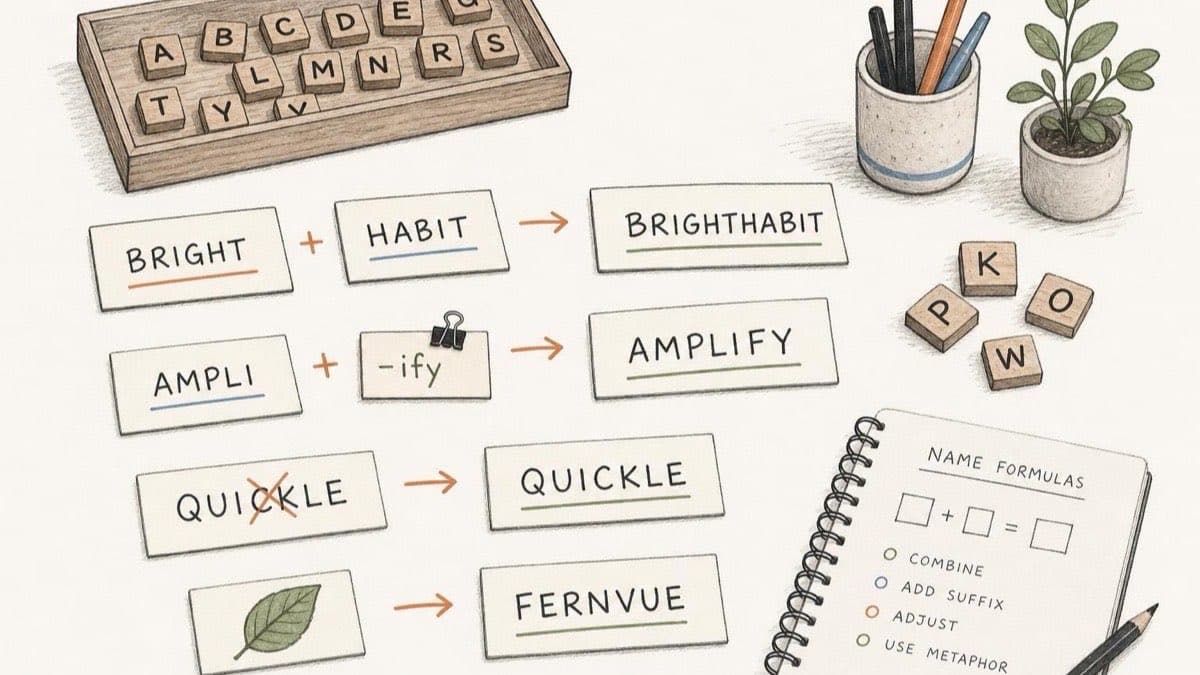
Naming is not waiting for lightning. It is a generative process with known formulas. Brainstorm wide using these, then filter through Parts 1 and 2:
- Compounds — fuse two real words: Face + book, Micro + soft, Snow + flake.
- Prefixes & suffixes — bolt on
-ly,-ify,-io,-ai,-hq: Spotify, Shopify, Calendly. - Misspellings — bend a familiar word so the domain is ownable: Flickr, Tumblr, Lyft, and Google itself (from "googol").
- Metaphors — borrow a concrete thing whose qualities you want: Apple, Amazon, Nike, Stripe.
- Founder & tribute names — your own name, or a nod to a person, place, or myth that means something to the project. Convention carries credibility in some categories (law, finance, fashion).
- AI generators — tools like Namelix and Looka are good for breaking a blank-page stall; treat their output as raw ore, not finished metal.
Run the generator until you have 15–20 candidates you don't hate. The goal of brainstorming is volume; judgment comes after.
Part 4 — Prefer a Name You Can Picture

Here is an underrated tiebreaker: does the name evoke a concrete image?
Concrete nouns are easier to remember than abstractions — that is one of the most replicated findings in memory research — and they hand your designer a logo on day one. Apple has an apple. Amazon has a river (and, conveniently, an arrow). Shopify has a bag. Twitter had a bird. An evocable image gives the name a second channel into memory (you can recall the picture even when the word slips) and a ready-made visual identity.
This is where Part 2's sound symbolism and this section's imagery meet: a name that sounds like what it is and looks like something is doing double duty. If two finalists are otherwise tied, pick the one you can sketch.
Part 5 — Run the Travel Test (Culture & Negative Associations)
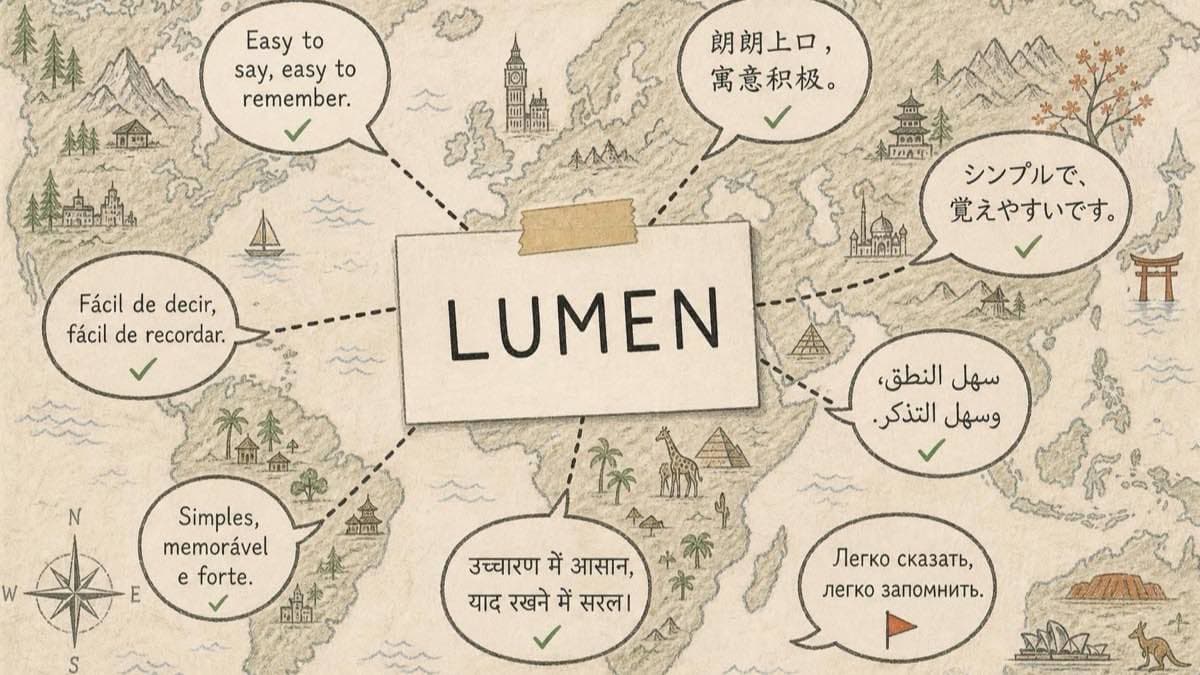
If there's any chance your project crosses a border — and on the internet there always is — your name needs to survive other languages.
The discipline is simple: say each finalist out loud to native speakers of the languages your users speak, and ask if it means anything awkward, rude, or unfortunate. This is the Localization Test, and it catches problems no English-only ear will hear.
A caution about the famous cautionary tales, though: the most-repeated one is fake. The story that the Chevrolet Nova flopped in Latin America because "no va" means "doesn't go" is an urban legend — nova and no va are stressed and pronounced differently, and the car actually sold fine. Don't build your naming philosophy on myths.
The real cases are less famous but instructive. Mitsubishi sold its Pajero SUV as the Montero in Spanish-speaking markets because "pajero" is crude slang in Spanish. The lesson stands: check before you launch, not after you've printed the boxes. A two-minute conversation with a native speaker is the cheapest insurance you will ever buy.
Part 6 — The Pre-Launch Search Sweep
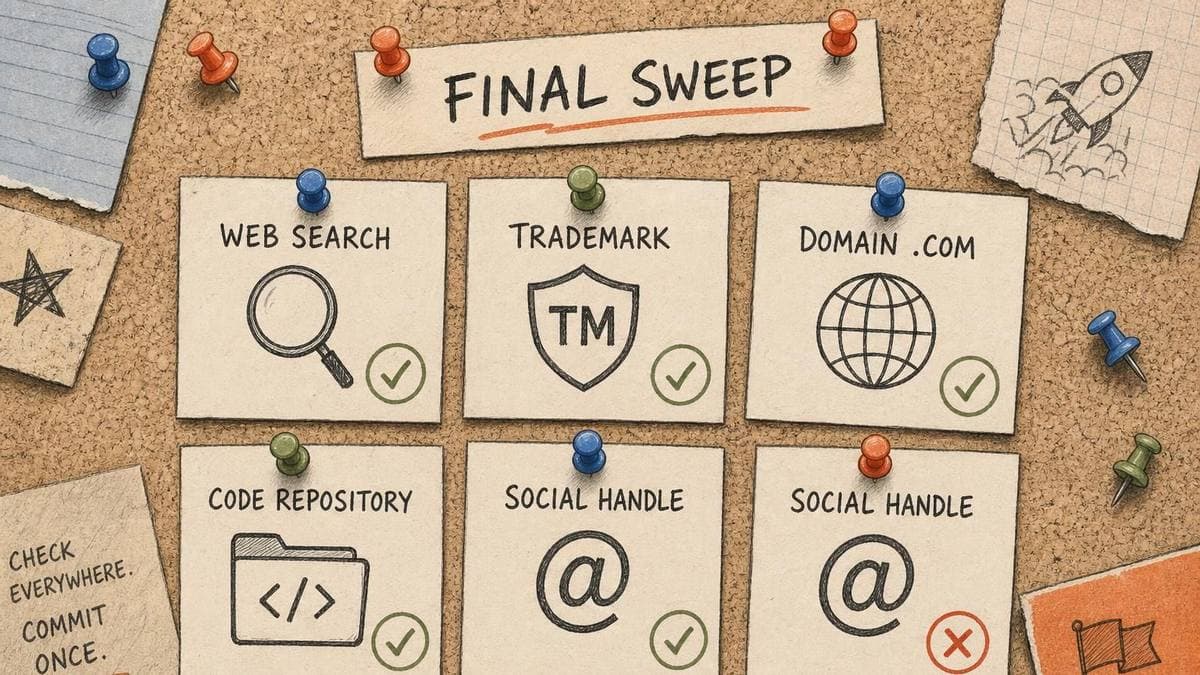
Once you have a finalist, do one consolidated pass before you commit a single dollar to a logo. Search, in this order:
- Web search — is the first page clear of competitors?
- Trademark — USPTO, EUIPO, and WIPO Global Brand Database for your category.
- Domain — is the
.comavailable or acquirable? On Namefi, check the.comregistration age and the count of TLDs already registered to gauge how contested the name is. - GitHub — is the org/handle free? (Critical for anything developer-facing.)
- Social handles — X, Reddit, LinkedIn, Instagram, YouTube — whatever matters to your audience, ideally all matching.
- App stores, if you'll ship an app.
Any single red flag isn't necessarily fatal, but the pattern tells you how much friction the name will carry. A name that's clear everywhere is a gift. A name that's contested on five of six is a warning.
The Rule That Breaks All the Rules
Every rule here is breakable, and the best names often break one. Google is a misspelled math term that fails "easy to spell." Häagen-Dazs is invented faux-Danish that means nothing. Xerox starts with a hard-to-place X. They worked because their founders believed in them and willed them into familiarity.
So the final rule is the one that overrides the rest: you, the founder, have to love it. You will defend this name in pitch meetings, repeat it ten thousand times, and live with it on your worst days. If a name clears the constraints, reads easily, survives the travel test — and makes you sit up a little when you say it — that's the one. Conviction is what turns a string of letters into a brand.
Run the checks. Then trust the one you can't stop saying.
How Namefi Helps
Naming and owning are two halves of the same decision. Namefi is built for the "can I actually own this?" half: check .com and alternative-TLD availability, see how long a name has been registered and how many extensions it spans (your contested-vs-open signal), explore brandable names, and — when you find the one — secure and even tokenize ownership so the asset behind your brand is verifiably yours. Pick a name you love; make sure it's a name you can hold.
Sources and further reading
All links below are publicly accessible (no login or paywall). For the academic papers we link the open-access full text rather than a gated journal page.
- USPTO — About Trademark Infringement (likelihood of confusion & DuPont factors) · Nolo — Likelihood of Confusion, explained
- Trademark search tools — USPTO · EUIPO · WIPO Global Brand Database · TMview (global)
- Alter, A. L., & Oppenheimer, D. M. (2006). Predicting short-term stock fluctuations by using processing fluency (open-access full text). PNAS, 103(24).
- Oppenheimer, D. M. (2008). The secret life of fluency (PDF). Trends in Cognitive Sciences, 12(6).
- Laham, S. M., Koval, P., & Alter, A. L. (2012). The name-pronunciation effect: Why people like Mr. Smith more than Mr. Colquhoun (full-text PDF). Journal of Experimental Social Psychology, 48(3). Plain-English NYU Stern summary.
- Yorkston, E., & Menon, G. (2004). A Sound Idea: Phonetic Effects of Brand Names on Consumer Judgments (full-text PDF). Journal of Consumer Research, 31(1).
- Topolinski, S., Zürn, M., & Schneider, I. K. (2015). What's in and what's out in branding? A novel articulation effect for brand names (open access). Frontiers in Psychology, 6.
- Snopes — Did the Chevrolet Nova Fail to Sell in Spanish-Speaking Countries? (debunking the myth)
- Wikipedia — Mitsubishi Pajero / Montero naming (a real localization rename)
Contributors

Fenwei Bian is a software developer in her thirties who spends her working hours in pull requests and her weekends with her hands in soil or sawdust. Years of open source on GitHub taught her that names are interfaces: a good one is clear, honest about what it does, and kind to whoever has to use it next.
She gardens because it rewards patience and punishes wishful thinking, and she does woodwork because a joint either fits or it doesn't. Both habits show up in how she writes about naming — measure twice, check the source, and don't sand over a rough spot and hope no one notices.
For Namefi she writes about how domain markets actually move, the practical trade-offs of tokenizing and flipping names, and picking a domain you'll still be glad you own in twenty years.

Victor Zhou is a technology founder and standards editor focused on digital identity and trust. He founded Namefi, edits Ethereum Improvement Proposals, and previously led smart-contract architecture work at Google Labs.
His work sits at the intersection of naming, ownership, and the systems people use to establish identity online. That perspective makes him especially interested in the way names move between personal meaning, public recognition, and digital infrastructure.
For Namefi, Victor edits and writes about domains as durable digital identity: how names become ownable onchain assets, how tokenization changes custody and trust, and what naming can learn from the systems people use to establish identity online.
Related guides
- From Box.net to Box.com: The ~$1M Upgrade That Dropped the ".net" and Bought the Exact MatchHow Box launched in 2005 on Box.net because Box.com was taken, pivoted from consumer storage to the enterprise, and in 2011 paid Digimedia close to $1 million for the exact-match Box.com — a .net-to-.com upgrade that landed right as the company became simply "Box."
- From BufferApp.com to Buffer.com: The 624-Day, Bank-Statement-Open Domain DealHow Buffer launched in 2010 on BufferApp.com because Buffer.com was taken, then spent 624 days acquiring the exact-match domain — even showing the seller its bank balance — and why a company famous for radical transparency stayed quiet on the one number everyone wanted: the price.
- Who Owns Trip.com? Ctrip, Trip.com Group, and the RebrandUnderstand how Trip.com relates to Ctrip and Trip.com Group, and trace the acquisition and company-name changes behind the travel brand.
- From del.icio.us to Delicious.com: The Cleverest Domain Hack on the Web — and Why Yahoo Untangled ItHow the pioneering social-bookmarking site launched in 2003 as the famous domain hack "del.icio.us," why those dots became a permanent tax on every mention, and how Yahoo moved it to the cleaner Delicious.com in 2008.