.se Connects Your Domain to Sweden
Learn who can register a .se domain, which identity checks apply, how renewal works, and why Sweden’s domain suits a Swedish audience.
- tld
.se is Sweden’s country-code top-level domain. Internetstiftelsen, the Swedish Internet Foundation, runs the registry. IANA lists .se as an active country-code TLD.
A .se address fits a business, service or publication that serves Sweden. Foreign registrants can apply, but open eligibility does not remove identity checks or naming rules. The practical decision involves your audience, your registration details and your renewal plan.
.se identifies Sweden, while registrars handle registration
A country-code top-level domain identifies a country or territory in the domain name system. For .se, that country is Sweden. A registrar handles your order and support, while Internetstiftelsen maintains the central registry.
| Question | Answer |
|---|---|
| Which country uses .se? | Sweden |
| Who operates the registry? | Internetstiftelsen, the Swedish Internet Foundation |
| Can foreign registrants apply? | Yes, with acceptable identification and correct contact information |
| How long can registration last? | 12–120 months, subject to the registrar’s available options |
| Can names include Swedish letters? | Yes, including å, ä and ö |
| How do contested registrations proceed? | Through the .se alternative dispute resolution procedure or applicable court proceedings |
The operator’s registration guide directs applicants to authorized registrars. An ICANN accreditation alone does not establish that a registrar offers .se. Check the operator’s registrar directory for the service you need.
Foreign applicants must supply valid identification
The registration terms effective January 15, 2026 allow identifiable individuals and legal entities to apply. Section 4.1.1 expressly accepts foreign equivalent identification information for non-Swedish holders.
Applicants must supply their name, identification information, phone number and email address. Companies must also supply a contact person. Keep these details correct when circumstances change. The Swedish version of the registration terms prevails.
The operator’s verification guidance describes document checks, electronic identification, and email or phone verification. Registrars can combine methods. Ask your registrar which evidence it accepts from your country before ordering.
The registry can withhold DNS activation while a registrant corrects deficient information. A successful payment does not guarantee immediate use. Keep access to the contact email so verification requests reach the person responsible for the domain.
Naming rules permit Swedish letters and restrict some names
The operator’s current naming rules permit names with 1–63 characters. The accepted character set includes å, ä and ö, alongside letters, numbers and permitted hyphens.
Internationalized domain names support these characters. Check the complete character table before choosing a spelling. Test your chosen name with the website, email service and other tools you intend to use.
The registry maintains blocked and reserved names. An unavailable name therefore does not always belong to another registrant. A reserved name may require a specific entitlement. Names cannot begin or end with a hyphen, and additional technical restrictions apply.
Choose a name that customers can type and explain aloud. If an accented spelling matters to your brand, consider the unaccented spelling too. Check availability and rights for each name separately.
Renewal keeps your registration active
The operator’s domain lifecycle guide specifies registration periods of 12–120 months. Your registrar determines which options it sells. Compare the renewal price, taxes, included services and payment deadline before accepting a first-year offer.
The guide describes ten days with an expired status after expiry. If no renewal follows, the registry deactivates the domain for 60 days. During deactivation, the domain stops working, but the current holder can still renew it.
After deregistration, the registry holds the name in quarantine until its listed release date. Do not treat expiry as immediate availability for a new buyer. Do not use the recovery period as your normal renewal schedule.
Availability does not establish a right to a name
The operator allocates available names in application order without preliminary rights examination. A later dispute can still challenge a registration.
Internetstiftelsen’s .se dispute guidance describes a procedure that WIPO administers. The complainant must establish a qualifying right valid in Sweden, the holder’s bad-faith registration or use, and the holder’s lack of rights or justified interest.
Section 7.2 of the current registration terms gives the detailed test, including similarity to a protected name. Check the actual .se procedure when assessing a dispute. Do not assume that every domain extension uses identical dispute rules.
.se suits a Swedish audience and signals a country focus
A Swedish country domain can make sense for a local service or a Swedish version of an international site. A global project should consider whether that country association matches its intended audience.
Google’s international site guidance describes country-code domains as strong country signals. Google lists some country domains as generic exceptions, but .se does not appear in that list. This supports choosing .se for Sweden, rather than assuming the suffix guarantees better rankings.
Content, language and service availability must also match the audience. A .se address alone does not supply a Swedish translation or prove where a business operates.
Registrants should check security and public data separately
The registry supports DNSSEC. Its DNSSEC guide explains how signed DNS answers protect against manipulation. Ask your registrar or DNS provider how to enable and maintain the service.
Public lookup limits do not remove the duty to provide accurate registration details. The operator’s disclosure policy explains that search results hide some personal information. The operator requires a legal basis under GDPR to disclose registry data.
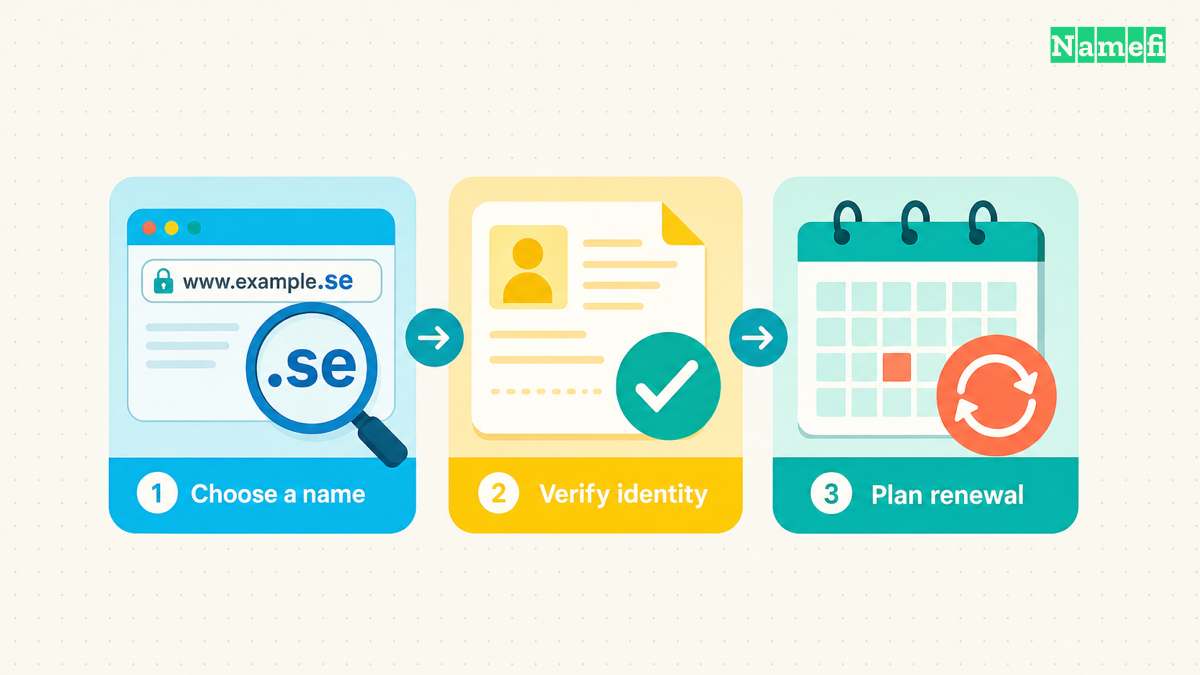
Applicants can follow a clear registration process
- Search the desired name through the registry or an authorized registrar.
- Check the naming rules and possible conflicts with existing rights.
- Compare renewal costs, verification requirements and included services.
- Supply correct holder details and complete the registrar’s identity checks.
- Configure your website and email, then schedule renewal before the registrar’s deadline.
When you compare providers, confirm current .se availability directly. Keep the holder identity and recovery contact under your control. Read the domain terminology guide if registry, registrar and DNS provider roles remain unclear.
These answers summarize common registration questions
Foreign people and companies can register .se domains
The registry accepts foreign equivalent identification information. Registrants must provide complete, correct contact details and meet identity verification requirements.
Registration periods range from 12 to 120 months
Ask your registrar which periods it offers. Check the renewal price and payment deadline before ordering.
Swedish letters can appear in .se domains
The registry supports å, ä and ö through internationalized domain names. Check the character table and test the spelling with your intended services.
These primary sources document the current rules
The author accessed all sources on October 21, 2026, Pacific time (October 22 UTC).
- IANA records the .se delegation.
- Internetstiftelsen explains registration and registrar changes.
- Internetstiftelsen lists authorized registrars.
- The January 2026 terms define holder obligations and dispute rules.
- Internetstiftelsen explains identity verification.
- Internetstiftelsen defines accepted characters and reserved names.
- Internetstiftelsen explains expiry and release.
- Internetstiftelsen explains .se dispute resolution.
- Google explains country targeting.
- Internetstiftelsen explains DNSSEC.
- Internetstiftelsen explains registry data disclosure.
Related keywords
- Sweden domain registration
- Internetstiftelsen registry
- .se identity verification
- .se renewal rules
- what is .se
- .se domain
- .se TLD