.com vs .net: Is the Backup Option Still Good?
Choose between .com and .net with verified registry facts, registration counts, real examples, and practical advice for your next domain.

- guide
Yes, .net is still a good domain. Choose .com when the same clear name is available on reasonable terms; choose .net when it gives you a better full address without creating confusion with someone else's business. Don't buy an awkward .com just to avoid a clean .net, and don't spend your launch budget acquiring a .com you can't justify.
The important question isn't whether .net is respectable enough. It's whether the specific .net you're considering can carry your business without constantly sending people toward the matching .com.
The comparison separates shared registry facts from naming trade-offs
Both are established generic top-level domains, rather than country-code extensions. The table combines sourced facts with practical recommendations; the recommendations aren't measurements of customer preference.
| Factor | .com | .net |
|---|---|---|
| Registry operator | VeriSign Global Registry Services | VeriSign Global Registry Services |
| IANA creation date | January 1, 1985 | January 1, 1985 |
| Original audience | Commercial businesses | Internet service providers |
| Registration eligibility | Open registration, subject to applicable terms | Open registration; no ISP qualification required |
| Registered domain base, September 30, 2026 | 169.8 million | 12.6 million |
| Naming recommendation | First choice when the exact name and total cost work | Strong option when the complete name works better |
| Main decision risk | Overpaying or weakening the name to secure the extension | Confusion with the matching .com |
| Cost comparison | Check the exact registration, renewal, and acquisition quote | Check the same items; don't assume .net costs less |
IANA's records name Verisign and give the same creation date for .com and .net. That date describes the TLD records, not the first registration by a customer or the start of Verisign's operation.
ICANN describes .com's commercial origins and .net's historical ISP role. Its archival overview identifies both as unrestricted, and its general FAQ explicitly describes .net use by organizations and individuals globally. The historical purpose isn't a requirement to run a network company. Open registration still means following your registrar's agreement and applicable policies.
Verisign's Q3 2026 Domain Name Industry Brief reports the individual registration counts above. Those are registered domains, not active websites, unique businesses, or a survey of which ending people trust. A smaller domain base also doesn't establish that your desired .net is available.
For the separate reference pages, see .com and .net. For the wider set of choices, use the domain extensions guide.
Choose .com when the full name and the budget both work
For a new shop, consultancy, or broadly marketed product, start by checking the exact-name .com. That's our practical default, not a claim that the extension guarantees sales or trust.
The strongest case is simple: the name is easy to spell, the domain is available, and the ongoing cost fits. There's little reason to add an extension decision to an otherwise straightforward purchase.
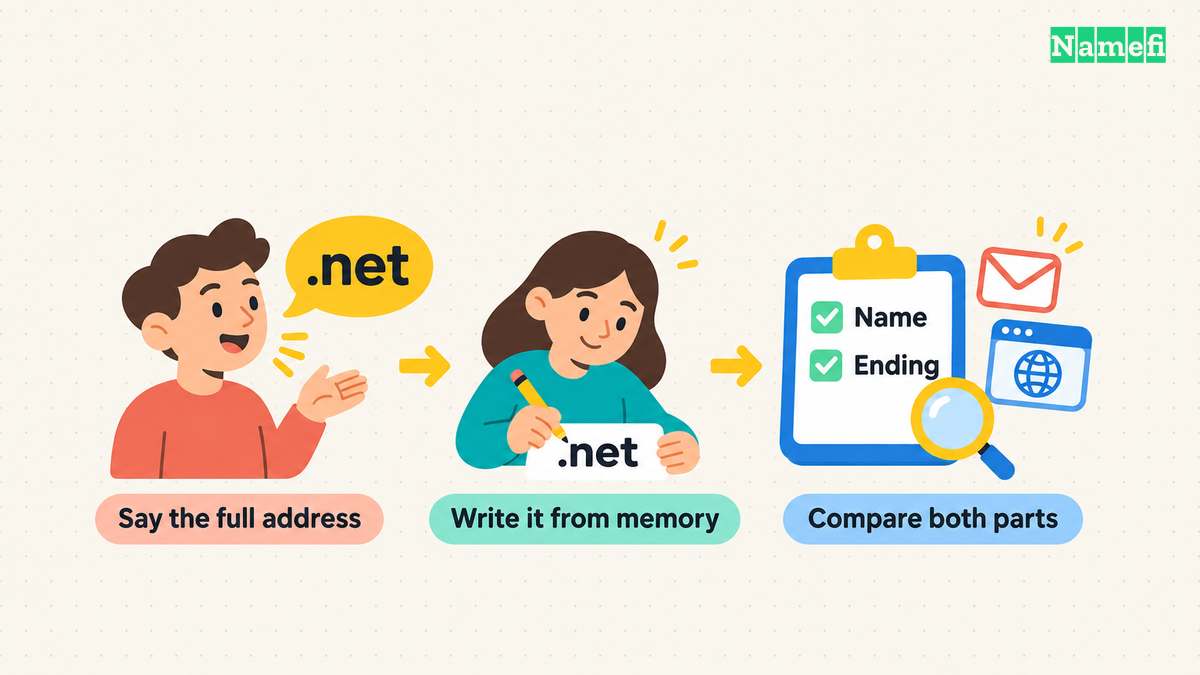
The weaker case is paying for the ending while compromising everything before it. A long string of modifiers, an unclear abbreviation, or a hard-to-explain spelling can make the complete address worse. Compare the actual candidates aloud and in an email address. Ask a few intended customers to write the address after hearing it once. Use the result to evaluate the name rather than treating .com as an automatic winner.
If you're deciding between a distinctive brand and a descriptive phrase, the separate brandable versus keyword domains comparison addresses that choice. This article compares extensions, not naming styles.
Choose .net when the name works on its own
.net makes sense when you can use a short, clear name, the matching .com doesn't create a direct business conflict, and you can consistently present the complete address.
Technology projects are a natural place to consider it because of the extension's network history, but the eligibility rules don't limit registration to technology businesses. PHP's official site at php.net provides a concrete example: the scripting-language project uses .net for its public website and documentation. A useful .net doesn't have to be a temporary address.
For comparison, Adobe's site at adobe.com presents its software products on .com. PHP and Adobe share a software audience, but they differ in purpose: a language project's documentation hub and a commercial vendor's product site. Neither example proves what a new business's customers will prefer.
The useful lesson is narrower: consider what your full address needs to do. A developer documentation site reached through package links has a different naming problem from a local service advertised on vans and radio. Test the address in the channels you'll actually use.
The matching .com can make .net the wrong choice
Before registering a .net, visit the matching .com and investigate who uses the name. An available ending doesn't settle whether the overall identity is sensible.
- The
.combelongs to a business in your market: choose a different name before paying. The same words with a different ending can create an avoidable identity problem. Get appropriate advice if trademark rights are uncertain. - The
.comis offered for sale: decide whether the.netis acceptable permanently. Don't build a plan around acquiring the.comlater at a price nobody has agreed to. - The
.comserves an unrelated organization: assess the full name, audience, and potential confusion. An unrelated use deserves a closer look, rather than an automatic rejection or approval. - You already control both: choose one public address and give the other a deliberate role. Don't make customers guess which site to use.
Treat mistaken visits and misaddressed email as risks to evaluate, not as losses with an invented percentage. Ask testers which ending they remembered. Check your planned email address as carefully as your homepage URL.
The existing Box.net-to-Box.com case study covers a specific company's domain upgrade. Read it as a case, rather than a rule that every .net needs a future .com purchase. A sound registration decision should work even if the matching .com never becomes yours.
Neither extension earns a Google ranking advantage from its letters
Google says keywords in a TLD provide no search advantage or disadvantage. That statement comes from its explanation of how new generic extensions compare with other gTLDs. It doesn't support a claim that .com outranks .net.
Google's current geographic guidance also explains that generic TLDs aren't associated with specific locations. Both choices belong to that generic category. Neither identifies your business as serving a particular country just by its ending.
Choose between them for the name, audience, and cost. Don't pay more for a claimed .com ranking bonus, and don't discard a suitable .net because someone calls the extension an SEO penalty. These sources establish neither promise.
Compare ownership costs before registering either domain
A registration quote and an existing owner's sale price answer different questions. First establish whether you're registering an available name or buying a registered domain from its owner.
For each candidate, record the initial payment, renewal quote, registration term, transfer conditions, and any services bundled into the checkout. Check the ongoing quote separately from a promotional first year. This article gives no universal price comparison because the relevant figure is the dated quote for your exact purchase.
At Namefi or another registrar, apply the same comparison. The registrar is your registration provider; the registry operator for both extensions remains Verisign.
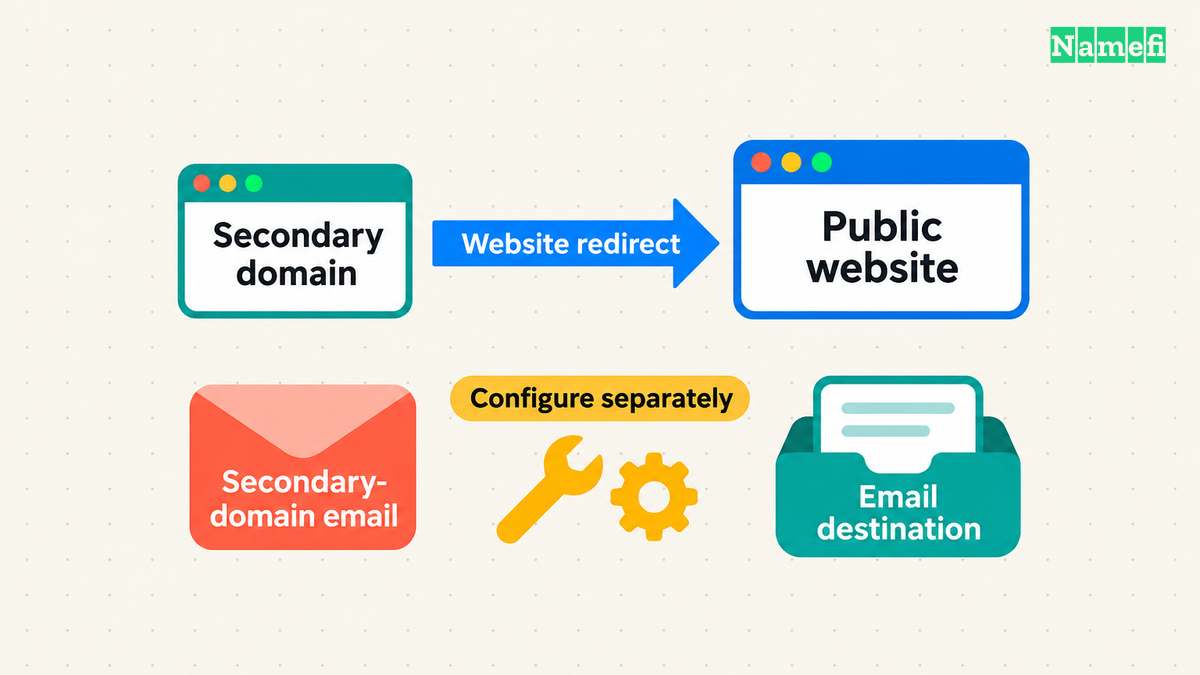
If you buy both endings, budget to renew both. A website redirect is one possible use for the secondary domain; our domain forwarding guide explains that setup. Treat email separately rather than assuming a web redirect handles it.
Your situation should decide the registration
| Your situation | Recommended next step |
|---|---|
| The same good name is available in both endings | Prefer .com if the quotes fit your budget |
The .com requires a strained spelling but the .net is clear | Test the .net and investigate the matching .com |
The exact .com acquisition would consume essential launch funds | Choose a sustainable .net or a different name |
The matching .com belongs to a direct competitor | Rework the name before registering |
An established project already uses .net successfully | Identify a concrete problem before planning a migration |
| You're choosing among technology-focused alternatives too | Read the separate .ai versus .io comparison |
The backup option is still good when it solves the actual naming problem. Pick .com when it gives you the right address at a sensible cost. Pick .net when it gives you the better complete name and you've checked the neighboring identity. If neither candidate passes those tests, keep searching with the domain name search guide.
Comparing more options? Start with our guide to .com vs every other TLD.
Sources and further reading
- IANA —
.comWHOIS record, registry organization and creation date; fetched 2026-11-06. - IANA —
.netWHOIS record, registry organization and creation date; fetched 2026-11-06. - ICANN — General Questions, original purposes and global
.netuse; fetched 2026-11-06. - ICANN Archives — Top-Level Domains, historical classification of unrestricted registration; fetched 2026-11-06.
- Verisign / DNIB — Q3 2026 report, individual
.comand.netregistration bases at September 30, 2026; fetched 2026-11-06. - PHP — Official website, example of a software project using
.net; fetched 2026-11-06. - Adobe — Official website, example of a software vendor using
.com; fetched 2026-11-06. - Google Search Central — Google's handling of new top level domains, statement about keywords in TLDs; fetched 2026-11-06.
- Google Search Central — Managing multi-regional and multilingual sites, geographic treatment of generic TLDs; fetched 2026-11-06.
About the author(s)
Fenwei Bian is a software developer in her thirties who spends her working hours in pull requests and her weekends with her hands in soil or sawdust. Years of open source on GitHub taught her that names are interfaces: a good one is clear, honest about what it does, and kind to whoever has to use it next.
She gardens because it rewards patience and punishes wishful thinking, and she does woodwork because a joint either fits or it doesn't. Both habits show up in how she writes about naming — measure twice, check the source, and don't sand over a rough spot and hope no one notices.
For Namefi she writes about how domain markets actually move, the practical trade-offs of tokenizing and flipping names, and picking a domain you'll still be glad you own in twenty years.