
What Is a Domain Hack? Examples and Extension Tradeoffs
See how domain hacks form words across the dot, explore examples, and learn what country-code rules can mean for choosing one.
- domains
- domain-investing
- branding
- domain-flipping

There is a kind of web address you don't read so much as decode. You see the letters, you see the dots, and then the whole string snaps into a single word that runs straight across the punctuation. The most famous one ever made was del.icio.us. Read it slowly and it falls apart into pieces; read it at speed and it just says "delicious."
That trick has a name. It's called a domain hack, and it's one of the oldest pieces of cleverness on the internet. This guide explains what a domain hack actually is, why brands and domain investors keep paying for them, the very real risks hiding behind the cleverest ones, and how to size up a domain hack as a flipper before you wire money for it.
What a domain hack is
A domain hack is a domain name where the extension itself becomes part of the word. Instead of the address pointing at a word, the address is the word, spelled across the dot. Wikipedia defines it precisely: a domain hack is a domain name that suggests a word, phrase, or name when concatenating two or more adjacent levels of that domain.
The mechanism is the top-level domain — the part after the final dot. Most famous domain hacks borrow a country code top-level domain (a ccTLD), the two-letter extension a country gets in the global DNS, and use it as if it were the last syllable of an English word. del.icio.us did exactly this: it took .us (the United States ccTLD), registered icio.us, stacked del in front as a subdomain, and the whole thing read as "delicious." We pulled that one apart in the del.icio.us case study, and it remains the textbook example.
It works because ccTLDs were never designed to be word endings — that's an accident of which two letters each country happened to get. (If you've never thought about where these extensions come from, our explainer on what a TLD is covers the ground.) A domain hack is what happens when someone notices that a country's two-letter code also spells a useful suffix and decides to build a brand on the coincidence.
Read the word across the dot
| Example | How the parts read together | Naming lesson |
|---|---|---|
del.icio.us | del + icio + us → “delicious” | A subdomain can participate, but extra dots need explaining aloud |
youtu.be | youtu + be → “YouTube” | The extension completes the recognizable name |
pistach.io | pistach + io → “pistachio” | A word ending can fit a country-code extension |
These illustrate spelling, not availability or permission to use an existing brand. Namecheap uses pistach.io as an example; for the extension's origin and rules, see the existing .io reference. A short address such as t.co is a shortener, but it does not form a word across the dot in the same way.
How it works: ccTLDs that double as English suffixes
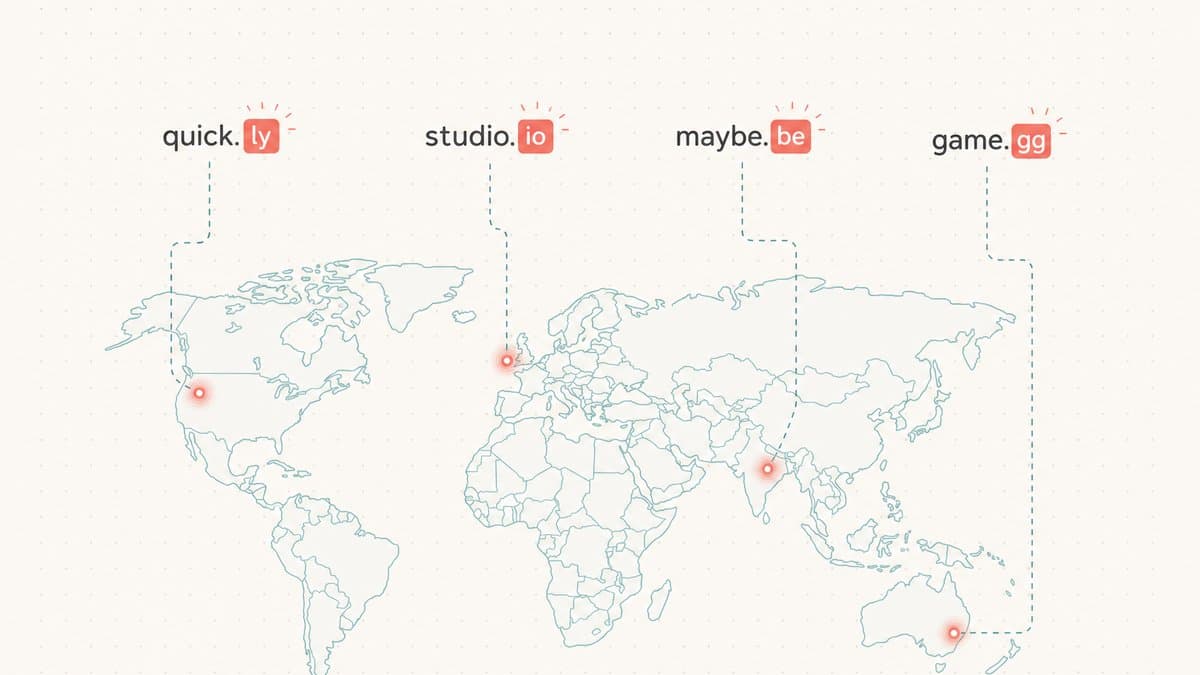
A handful of ccTLDs are gold for this because their two letters are common word endings or words in their own right. The catch — and we'll come back to it hard later — is that every one of these belongs to a real country with real rules. Here are the workhorses, with the famous addresses built on each:
.ly(Libya). This is the engine behind the link-shortener era..lyreads as the English adverb ending "-ly," and as Wikipedia notes, many popular URL shortening services are registered in the .ly domain, such as bit.ly. Bitly is the giant here; per Wikipedia, Bitly is a URL shortening service and a link management platform, and it took off when it became the default URL shortening service on the website on May 6, 2009 for Twitter..be(Belgium). YouTube's short links live here. As Wikipedia puts it, YouTube uses the domain hack youtu.be for their URL shortening service..gl(Greenland). Google's URL shortener,goo.gl, was built on Greenland's code. Google stopped accepting newly shortened URLs in 2018, but this was a product decision rather than a failure of the.glregistry. In an August 2025 update, Google said it would preserve actively usedgoo.gllinks and deactivate only links that had already shown an inactivity warning. IANA continues to list TELE Greenland A/S as the.glccTLD manager..co(Colombia). Twitter wraps every outbound link int.co. Per Wikipedia, t.co is a URL shortening service created by Twitter, running on the Internet country code top-level domain (ccTLD) assigned to Colombia..cois the rare ccTLD that reads as a generic word fragment ("co" for company, or just a shorter.com), which is part of why it sells so widely..am(Armenia). This is the one behind Instagram's old short name. Wikipedia confirms.amis the ccTLD for Armenia and that the mobile photo sharing service Instagram uses the Armenian domain name Instagr.am. We told that full story in the instagr.am case study..me(Montenegro). The personal-namespace extension. Wikipedia notes that most .me domain names were purchased as domain hacks in English, because "me" reads as the English pronoun..gg(Guernsey). The gaming favorite. Per Wikipedia, multiple video games, streamers and esports websites use Guernsey's domain (.gg) because "gg" is a common initialism for "good game.".sh(Saint Helena). A developer in-joke, because.shis also the file extension for Unix shell scripts. Wikipedia observes that since the .sh filename extension is also used by Unix shell scripts, this domain has been used for websites about command-line interface programs — thinkbrew.sh, Homebrew's home..tv(Tuvalu) and.fm(Federated States of Micronesia). The media pair..tvis, in Wikipedia's words, popular, and thus economically valuable, because TV also happens to be an abbreviation of the word television, and.fmdoes the same job for radio and audio brands.
And then there's the most successful "accidental suffix" of all: .io, the ccTLD for the British Indian Ocean Territory, which developers read as I/O. It's not strictly a word-spelling hack the way del.icio.us is, but it's the same coincidence at work — a country code that happens to mean something to the people typing it. We dig into why that extension commands such a premium in why .io domains are expensive and on the .io TLD page.
Why brands and flippers value them
Strip away the cleverness and a domain hack is competing on the same thing every great domain competes on: it's short, it's memorable, and it carries meaning in fewer characters than anyone else can. A good hack is a whole word in three or four syllables of address, with nothing wasted.
For the kind of product that lives inside other people's text — a link shortener, a share button, an invite link — that brevity is the entire product. Every character in a shortened URL is a character the user didn't have to read, and the dot-as-suffix trick buys you a word's worth of meaning for the price of two letters. That's why an entire generation of infrastructure tools — Bitly, YouTube's youtu.be, Discord's invite links on .gg — chose hacks rather than long .coms. The hack was the feature.
For everyone else, the appeal is brandability. A name that reads as a real word but resolves to an unusual extension is distinctive almost by definition, and distinctiveness is exactly what a crowded category lacks. That's also what makes hacks a live market in domain trading: the supply of clean, short, word-spelling combinations on a good ccTLD is genuinely finite, and demand from founders who want a name that doesn't sound like everyone else's is not. A strong hack on a popular extension is the kind of asset domainers track, the same way they track one-word .coms — and many of the same fundamentals from what makes a domain valuable apply directly.
The catch: a ccTLD is a locally governed namespace
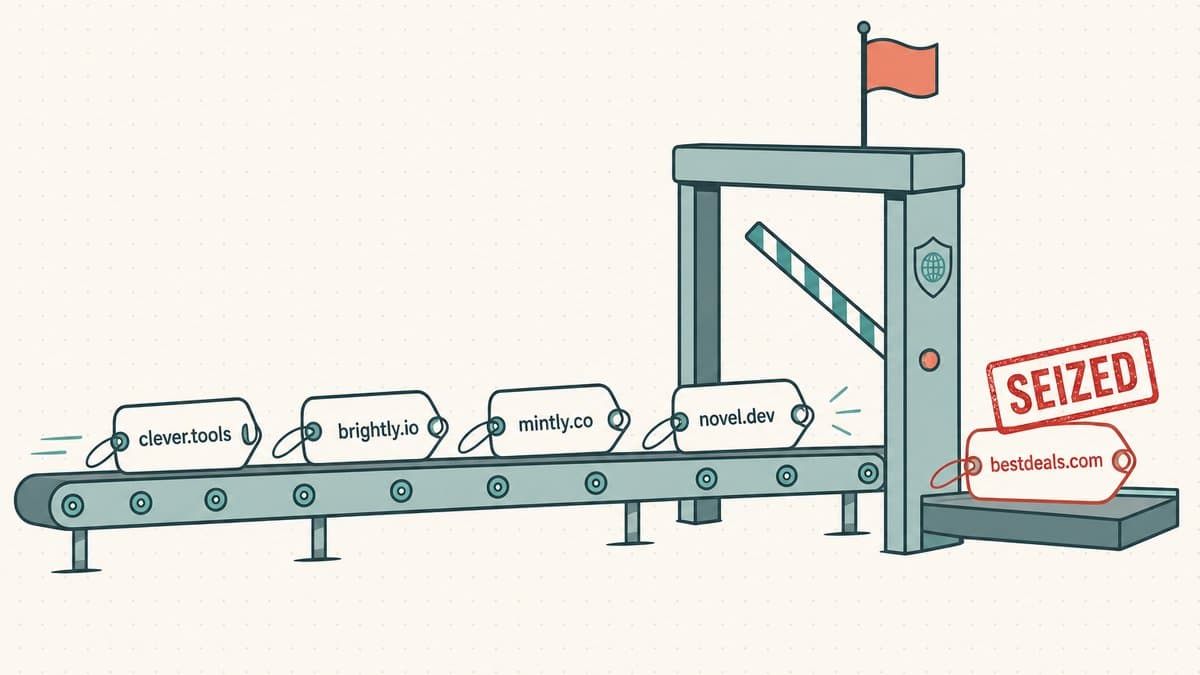
Here is the part most "10 clever domain hacks" listicles skip, and it's the part that separates a hobbyist from someone who can actually value one of these. When you register a domain hack, you depend on the policies and operation of its ccTLD manager. A .com operates under ICANN's gTLD contracts and consensus policies; a ccTLD's management is primarily a local matter, shaped by its manager in consultation with the local internet community and subject to applicable local law. Government involvement varies widely—from light participation to direct operation—so it is inaccurate to assume that every ccTLD is run by its national government.
The starkest example is .ly. It's the ccTLD for Libya, and Libyan law applies to what sits on it. In 2010 that stopped being theoretical. As Wikipedia records, in October 2010, the domain of "sex-positive" URL shortening service vb.ly ... was seized by the Libyan web authorities for not being compliant with the law of Libya, with the registry's explanation reported as blunt: pornography and adult material aren't allowed under Libyan Law ... Therefore, we removed the domain. The domain didn't expire and it wasn't sold. It was taken, because of what it pointed to, under rules that had nothing to do with the open internet and everything to do with one country's content law.
The second flavor of risk is the country or territory code's continued eligibility. As checked September 15, 2026, IANA's .io record still lists the ccTLD and does not display a retirement date. Under the retirement process, removal from ISO 3166-1 leads to a Notice of Removal and a default five-year transition, with a possible extension of up to five additional years. A political announcement alone is not that notice, and this policy does not predict the outcome for .io. We discuss the purchasing implications in why .io domains are expensive.
There's a third, separate risk, and goo.gl illustrates it: a service built on a domain can be deprecated even when the underlying registry and domain delegation remain healthy. Google stopped creating new short links in 2018 and later limited deactivation to previously flagged inactive links; IANA still lists the .gl manager. That is service-operator dependency, not evidence that the .gl registry walked away. The lesson for a flipper isn't "never touch a ccTLD." It is to evaluate both layers independently: the ccTLD manager's registration policies and stability, and the durability of the particular product or redirect service using the domain. This distinction is part of understanding how the TLD affects domain value.
How to spot and value a domain hack as a flipper
If you're buying or holding hacks rather than just admiring them, a few practical heuristics separate the assets from the curiosities:
- Does it spell a real word the market wants? The value is in the word, not the cleverness of the construction.
stud.io,rad.io, anddeliciousare words people already search for and pay for. A hack that spells an obscure word, or that needs a subdomain and three dots to land, is a puzzle, not a brand. - Can someone say it out loud and land on it? The fatal flaw of
del.icio.uswas never how it looked — it was that you couldn't tell someone the name without spelling out every dot. A hack that reads as one clean word when spoken (the extension disappears into the word) is worth far more than one that requires punctuation instructions. If recommending it needs a spelling lesson, discount it hard. - What's the registry's policy and stability? Before you value a
.ly,.io, or any ccTLD hack, learn whether the registry welcomes third-party registration, what content rules apply, and how the manager handles disputes and policy changes. Thevb.lycase shows why those rules can have practical consequences. Diligence can identify current restrictions, although it cannot eliminate the risk of later policy changes. A beautiful hack on a restrictive or uncertain ccTLD may deserve a discount relative to a comparable gTLD. - Is the extension already a proven hack market?
.io,.co,.me,.gg, and.lyhave established demand, liquidity, and a track record of brands paying for them. A novelty ccTLD with no buyers is a domain you'll hold forever. Liquidity is part of the price. - Is there a clean exact-match
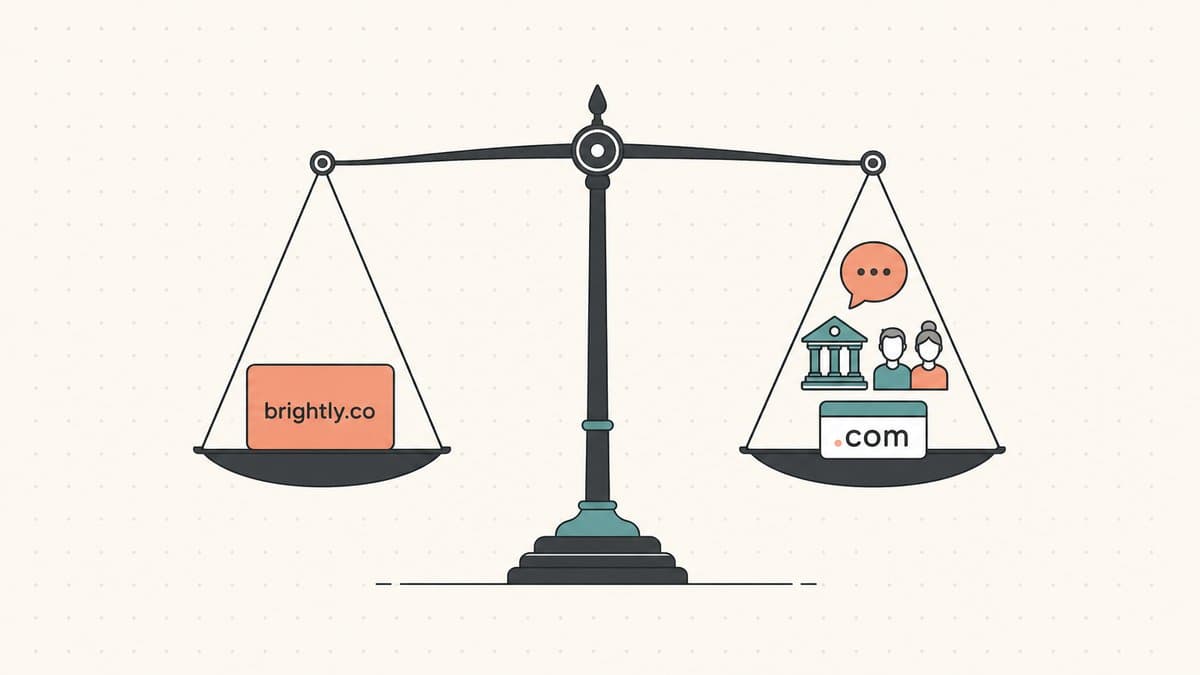
.comfallback for the same word? Often the most valuable position is owning both the hack and the matching.com. The hack wins the clever, in-product use; the.comwins the say-it-out-loud, mass-market use. A buyer who needs both will pay for the pair.
The short version: value the word, test it spoken, price in the country, and check that real buyers exist for that extension. A domain hack is a great asset when all four line up and a clever trap when they don't.
The Namefi angle
When a premium hack does change hands, the hard part isn't agreeing on a price — it's the transfer. Moving a valuable name means proving who holds it, handing it over without the site going dark, and trusting that the other side actually delivers. That's the same friction behind any high-value domain trade, and it's worse for a hack, where the name often is live infrastructure inside someone's product.
This is the gap Namefi is built to narrow: tokenized ownership can make the on-chain ownership record and token transfer easier to audit, and an atomic marketplace sale can reduce settlement risk. It does not automatically put registrar recovery, nameserver delegation, or an external DNS provider behind the same authorization boundary. A token transfer also does not by itself change DNS configuration, but continued resolution still depends on those separate systems remaining correctly configured and available. Clever is fun. An auditable transfer with each control plane secured is what lets you trade the asset underneath it.
Sources and further reading
-
Namecheap —
.iodomain examples, word-spelling examples. Fetched 2026-09-15. -
IANA —
.iodelegation record, current delegation. Fetched 2026-09-15. -
IANA — ccTLD retirement process, General Principles and Initial Process. Fetched 2026-09-15.
-
Wikipedia — Domain hack
-
Wikipedia — .ly (Libya, and the vb.ly seizure)
-
Wikipedia — Bitly
-
Wikipedia — .be (Belgium / youtu.be)
-
Wikipedia — .gl (Greenland / goo.gl)
-
Wikipedia — T.co (Twitter) · .co (Colombia)
-
Wikipedia — .am (Armenia / instagr.am)
-
Wikipedia — .me (Montenegro)
-
Wikipedia — .gg (Guernsey)
-
Wikipedia — .sh (Saint Helena)
-
Wikipedia — .tv (Tuvalu)
-
ICANN ccNSO — ccTLD management and the varying role of governments
-
IANA — ccTLD retirement process and
.gldelegation record -
Google Developers Blog —
goo.gldeprecation and the August 2025 preservation update
Contributors

Fenwei Bian is a software developer in her thirties who spends her working hours in pull requests and her weekends with her hands in soil or sawdust. Years of open source on GitHub taught her that names are interfaces: a good one is clear, honest about what it does, and kind to whoever has to use it next.
She gardens because it rewards patience and punishes wishful thinking, and she does woodwork because a joint either fits or it doesn't. Both habits show up in how she writes about naming — measure twice, check the source, and don't sand over a rough spot and hope no one notices.
For Namefi she writes about how domain markets actually move, the practical trade-offs of tokenizing and flipping names, and picking a domain you'll still be glad you own in twenty years.

Victor Zhou is a technology founder and standards editor focused on digital identity and trust. He founded Namefi, edits Ethereum Improvement Proposals, and previously led smart-contract architecture work at Google Labs.
His work sits at the intersection of naming, ownership, and the systems people use to establish identity online. That perspective makes him especially interested in the way names move between personal meaning, public recognition, and digital infrastructure.
For Namefi, Victor edits and writes about domains as durable digital identity: how names become ownable onchain assets, how tokenization changes custody and trust, and what naming can learn from the systems people use to establish identity online.
Related guides
- How We Cut AI Buyer Discovery Cost by 85%: Start Lean, Escalate With EvidenceA practical method for cheaper buyer discovery using progressive model escalation, LLM-as-judge gates, and Laminar traces and evals.
- Brandable vs Keyword Domains: Which Sell Better?Brandable invented names vs exact-match keyword domains: who buys each, which resells more reliably, and the trademark angle every flipper should know.
- Domain Appraisal Tools Compared: Estibot vs GoDaddy vs RealityHow automated domain appraisers like Estibot and GoDaddy actually work, where they systematically miss, and how to use them as a first filter.
- Domain Backorders and Drop-Catching, ExplainedWhat domain backorders and drop-catching are, how services race to grab a name the instant it releases, and when a backorder is worth paying for.