Complete Domain Name Terminology Guide - Essential Terms for Domain Investors
Learn domain terminology, including domain names, URLs, hostnames and the domain name space, plus essential domain investing terms.


- faq
- domains
Complete Domain Name Terminology Guide
Whether you're a beginner exploring domain investing or an experienced professional, understanding domain terminology is crucial for success. This comprehensive guide covers all essential terms used in the domain industry, organized by category for easy reference.
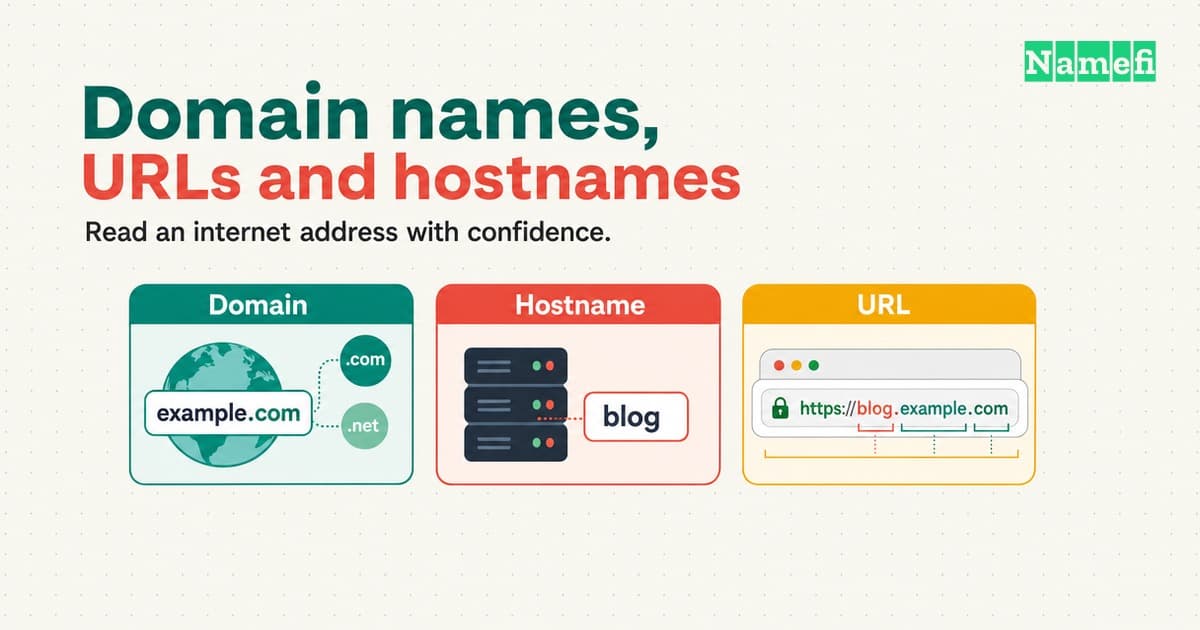
Domain names, hostnames and URLs describe different things
A domain name identifies a name in a naming hierarchy. A hostname identifies a host in context. A URL identifies a resource and describes access to that resource. For an HTTPS address, the hostname can be a domain name. The terms overlap, but the terms do not mean the same thing. RFC 9499 defines DNS names, while RFC 3986 separates URL components.
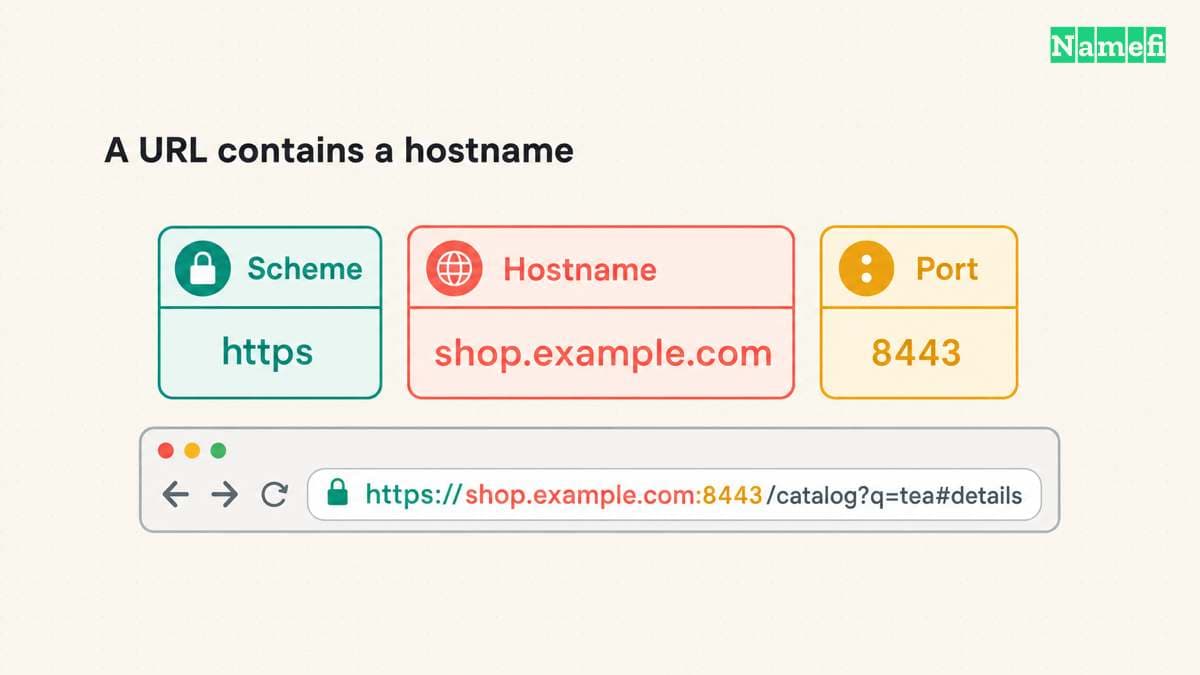
Consider https://shop.example.com:8443/catalog?q=tea#details:
| Term | Example | Meaning in this address |
|---|---|---|
| URL | The complete address above | The resource address, including scheme, hostname, port, path, query and fragment |
| Scheme | https | The access scheme |
| Hostname | shop.example.com | The domain name in the host component |
| Registered domain | example.com | The registration-level name in this example |
| Subdomain | shop.example.com | A domain below example.com |
| Port | 8443 | The explicit port number |
| Path | /catalog | The resource path |
| Query | q=tea | Additional request data |
| Fragment | details | A reference within the resource |
The URL API makes a useful distinction: hostname excludes the port, but host includes a non-default port. For this example, hostname returns shop.example.com and host returns shop.example.com:8443. MDN documents the hostname property. A URL host can also be an IP address, so a URL does not always contain a domain name.
A hostname can include a subdomain. The bare domain example.com can also serve as a hostname. In operating-system settings, “hostname” can instead mean a short local name, such as printer. RFC 9499 explains the different uses. Check the field instructions before entering a complete URL into a hostname field.
The domain name space organizes names in a hierarchy
The domain name space means the naming structure, not a blank character inside a name. RFC 1034 describes a tree with a root and labels. Read shop.example.com from right to left: root, com, example, then shop. The top-level domain is com; example is the second-level label; shop.example.com is a subdomain of example.com.
A fully qualified domain name includes the complete route to the root. DNS presentation format makes the root explicit with a final dot: shop.example.com.. Everyday text usually omits the final dot. RFC 9499 distinguishes those formats.
The registered domain is not always the last two labels. Some registration structures use a suffix with several labels. Use the Public Suffix List when software needs to identify a public suffix, rather than splitting every name at the second dot.
The remaining sections explain the investment and operating terms that domain buyers encounter.
🎯 Domain Investment & Trading
Domain Flipping
The practice of buying domain names at a lower price and then selling them at a higher price for profit. Domain flippers often look for underpriced or high-potential domain names in auctions, expired lists, or direct sales.
Example: Purchasing TechStartup.com for $500 and selling it to a startup company for $5,000.
Premium Domain
A domain name that is considered highly valuable due to its short length, common keywords, or brandability. These domains can fetch high prices on the market, sometimes millions of dollars.
Example: Insurance.com sold for $35.6 million, making it one of the most expensive domain sales ever.
Brandable Domain
A domain name that is catchy, unique, and easy to remember, often used for business branding. These domains are particularly valuable for startups and companies seeking a strong online presence.
Example: Spotify.com, Google.com, Airbnb.com - invented words that became powerful brands.
Domain Portfolio
A collection of domain names owned by an individual or company. A portfolio may include domains that are currently being developed, parked, or held for future sale.
Example: A domain investor might own 100+ domains across different niches like tech, finance, and healthcare.
Aftermarket
The market where previously owned domain names are bought and sold. This includes premium domains, aged domains, and domains that are no longer in use.
Popular Platforms: Sedo, GoDaddy Auctions, Flippa, NameJet
💰 Pricing & Sales
BIN (Buy It Now)
A fixed price at which a domain name is listed for immediate purchase. Instead of participating in an auction, the buyer can choose to pay the listed BIN price to acquire the domain instantly.
Example: SmartHome.tech listed with BIN price of $2,500 for immediate purchase.
Tactical Pricing
The strategy used by domain investors to price their domain names. This may include pricing a domain for quick sale, setting a high price for negotiation, or using BIN pricing to encourage instant purchases.
Strategies:
- Quick Sale: Price 20-30% below market value for fast liquidity
- Negotiation: Set high initial price with room for bargaining
- Premium Positioning: Price at market premium for prestige domains
Domain Auction
A platform or service where domain names are sold through competitive bidding. The domain is sold to the highest bidder at the end of the auction.
Popular Platforms: GoDaddy Auctions, NameJet, Sedo Auctions, SnapNames
Escrow Service
A trusted third-party service used to facilitate the safe exchange of money and domain ownership during a domain sale. The buyer pays the escrow service, and once the domain is transferred, the funds are released to the seller.
Popular Services: Escrow.com (recommended by ICANN), PayPal, Dan.com
🏢 Professional Services
Self-Broker
A domain owner or investor who handles the sale of their own domain names directly without using a third-party broker. This can be beneficial for reducing costs, but requires more involvement in the selling process.
Benefits: Keep 100% of sale proceeds, direct buyer communication Drawbacks: More time investment, need marketing skills
Domain Reseller
An individual or business that buys domain names in bulk and resells them to end-users or other investors, often for a profit. Resellers may work through platforms or directly with buyers.
Business Model: Buy domains at wholesale prices, add markup for retail sales
⚙️ Technical Terms
TLD (Top-Level Domain)
The part of a domain name that comes after the last dot (e.g., .com, .org, .net, .ai, etc.). The choice of TLD can affect the value and perception of a domain name.
Categories:
- Generic TLDs: .com, .org, .net, .info
- Country Code TLDs: .us, .uk, .de, .cn, .ai, .io
- New TLDs: .tech, .shop
Subdomain
A domain that is part of a larger domain. For example, "blog.example.com" is a subdomain of "example.com." Subdomains can be used to organize different sections of a website.
Common Uses: blog.domain.com, shop.domain.com, api.domain.com
DNS (Domain Name System)
The system that translates human-readable domain names into IP addresses that computers use to communicate with each other. It is often referred to as the "phonebook" of the internet.
Illustrative DNS example: example.com → 192.0.2.1. RFC 5737 §3.
WHOIS
A protocol used to query databases that store registered domain name information. WHOIS provides details like the domain's owner, registration dates, and contact information.
Information Provided:
- Domain owner details
- Registration and expiration dates
- Name servers
- Registrar information
📅 Domain Lifecycle
Renewal Fee
The annual fee charged to maintain ownership of a domain name. If you don't pay the renewal fee, the domain can expire, and someone else can register it.
Typical Costs: $10-15/year for .com domains, varies by TLD
Backorder
A service that allows someone to "reserve" a domain name before it becomes available for registration, especially when it is about to expire and is not yet taken.
Use Case: Secure a valuable domain that's about to expire before competitors
Dropcatching
The process of registering a domain name as soon as it becomes available (usually after it expires) before others can get it. This requires specialized tools and timing.
Tools: DropCatch, SnapNames, NameJet
Domain Parking
The practice of registering and holding onto a domain without developing it into a website, often monetizing it through ads or affiliate links while waiting to sell it.
Revenue Sources: Pay-per-click ads, affiliate marketing, lead generation
🚀 Getting Started with Domain Investing
Research Tools
- EstiBot: Domain valuation estimates
- NameBio: Historical domain sale data
- Wayback Machine: Check domain history
- Google Keyword Planner: Search volume data
Best Practices
- Start Small: Begin with $1,000-5,000 budget
- Focus on .com: Most liquid and valuable TLD
- Short is Better: 1-2 words, under 10 characters
- Common Words: Dictionary words, business terms
- Avoid Trademarks: Legal complications and costs
Common Mistakes to Avoid
- Buying domains without research
- Ignoring renewal costs and portfolio management
- Overvaluing personal preferences
- Not understanding market demand
- Failing to track expenses and profits
📈 Market Insights
High-Value Categories
- Technology: AI, blockchain, fintech terms
- Health: Medical, wellness, pharmaceutical
- Finance: Banking, investment, cryptocurrency
- E-commerce: Shopping, retail, marketplace
- Education: Learning, training, courses
Emerging Trends
- AI Domains: Artificial intelligence related terms
- Crypto Domains: Blockchain and cryptocurrency
- Sustainability: Green energy, climate tech
- Remote Work: Virtual, digital, remote
🔗 Register Your Domains at Namefi
Ready to start your domain investing journey or secure your perfect domain name?
Namefi is your trusted ICANN-accredited registrar offering:
- Competitive Pricing: Best rates for all major TLDs
- Professional Tools: Portfolio management and analytics
- Expert Support: Guidance for domain investors
- Secure Transactions: Safe buying and selling platform
👉 Visit namefi.io and start building your domain portfolio today.
Master these terms, understand the market, and make informed decisions in your domain investing journey. Knowledge is your most valuable asset in the domain industry!
Technical terminology updated October 21, 2026. Investment examples remain illustrative.
These sources define the technical terms
- IETF RFC 9499, section 2 — fetched October 21, 2026.
- IETF RFC 3986, section 3 — fetched October 21, 2026.
- IETF RFC 1034, section 3.1 — fetched October 21, 2026.
- MDN URL.hostname — fetched October 21, 2026.
- Public Suffix List — fetched October 21, 2026.
- IANA .ai — fetched October 21, 2026.
- IANA .io — fetched October 21, 2026.
- IETF RFC 5737, section 3 — fetched October 21, 2026.
Contributors
Fenwei Bian is a software developer in her thirties who spends her working hours in pull requests and her weekends with her hands in soil or sawdust. Years of open source on GitHub taught her that names are interfaces: a good one is clear, honest about what it does, and kind to whoever has to use it next.
She gardens because it rewards patience and punishes wishful thinking, and she does woodwork because a joint either fits or it doesn't. Both habits show up in how she writes about naming — measure twice, check the source, and don't sand over a rough spot and hope no one notices.
For Namefi she writes about how domain markets actually move, the practical trade-offs of tokenizing and flipping names, and picking a domain you'll still be glad you own in twenty years.
Victor Zhou is a technology founder and standards editor focused on digital identity and trust. He founded Namefi, edits Ethereum Improvement Proposals, and previously led smart-contract architecture work at Google Labs.
His work sits at the intersection of naming, ownership, and the systems people use to establish identity online. That perspective makes him especially interested in the way names move between personal meaning, public recognition, and digital infrastructure.
For Namefi, Victor edits and writes about domains as durable digital identity: how names become ownable onchain assets, how tokenization changes custody and trust, and what naming can learn from the systems people use to establish identity online.