
Running a Domain Portfolio Like a Business
Run your domains like inventory: track cost basis, watch sell-through rate, control renewal drag, prune losers, and keep the books clean.
- domains
- domain-investing
- domain-flipping
- guide

The first ten domains feel like a collection. You remember why you bought each one, what you paid, and roughly what you hope to get. Somewhere around the hundredth name, that memory stops working. You can no longer hold the portfolio in your head, the renewal emails arrive in clumps you don't recognize, and you start paying to keep names you'd forgotten you owned. That is the moment flipping stops being a series of clever trades and becomes inventory management.
This guide is about that shift. A domain portfolio run on instinct quietly bleeds money; a domain portfolio run like a business knows its numbers and acts on them. We'll cover the four disciplines that separate the two: tracking what you hold, watching your sell-through rate, controlling renewal drag, and pruning the losers before they prune your profit. It's the management pillar of our wider guide to domain flipping.
Why a portfolio needs a system at all
Start with what a portfolio actually is. You are a holder of inventory in the domain aftermarket — which Wikipedia defines as the secondary resale market for Internet domain names in which a party interested in acquiring a domain that is already registered bids or negotiates a price. Every name you hold is a small bet with a recurring cost, and the math of the whole book only works if a few wins cover the carry on everything else.
That structure is unforgiving of disorganization. A stock portfolio reprices itself for you every second; a domain portfolio sits silent until a renewal hits or a buyer emails, and in between it is entirely on you to know what you own, what it cost, and whether it's still worth keeping. The single most common way to lose money flipping isn't a bad buy — it's a hundred forgotten okay-buys renewing on autopilot for years. A system is what turns a pile of names back into a set of decisions.
Track everything: the portfolio ledger
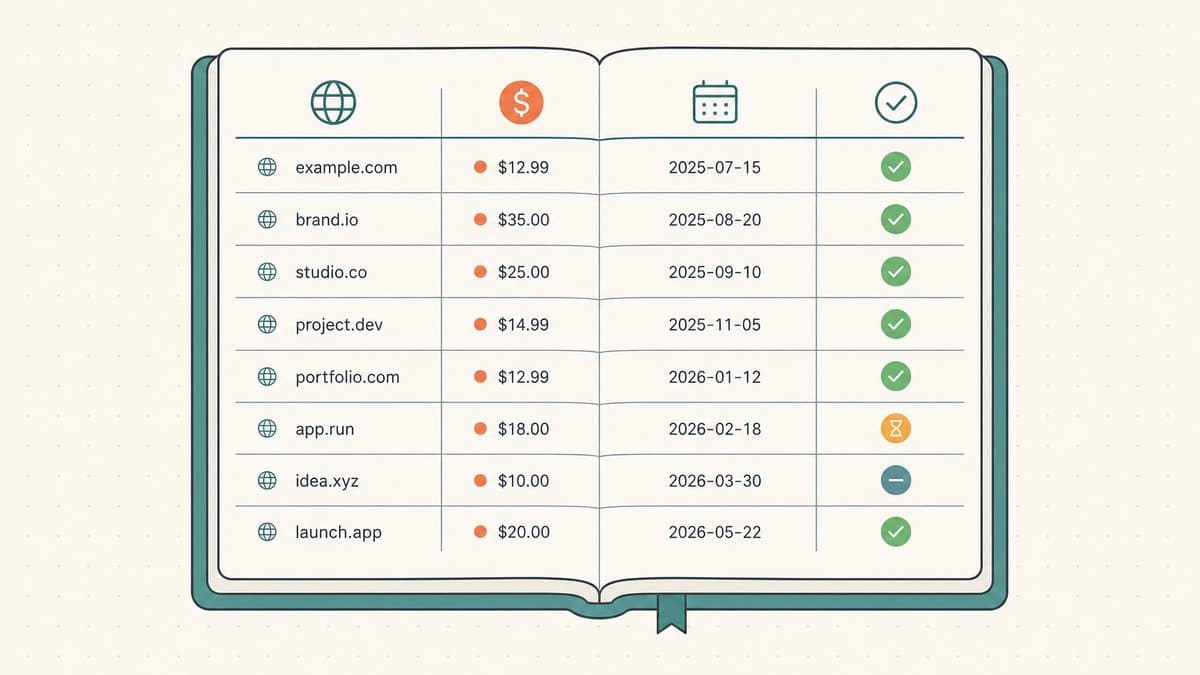
Before you optimize anything, you have to be able to see it. The foundation of running domains as a business is a single source of truth — a spreadsheet is plenty to start — with one row per name and the columns that let you make decisions later. At minimum, track:
- The name and its registrar. Which account holds it matters the moment you need to move or sell it.
- Acquisition date and cost basis. What you actually paid, whether a hand-registration fee or an aftermarket purchase. This is the number your eventual profit is measured against, and the number your accountant will ask for.
- Renewal date and annual renewal cost. The recurring bill. This column is the one that prevents surprise charges and the one your whole budget is built on.
- Asking price and any offers received. What you're listing at, and the real demand signal of what anyone has actually offered.
- Status. Live and listed, parked, in negotiation, or marked for the drop. Status is what turns the ledger into a to-do list.
The cost-basis and renewal columns aren't just operational hygiene; they're the raw material for the tax side of the business, where holding period and basis determine what you owe when a name finally sells. We go deeper on that in taxes and accounting for domain investors. And the registrar column earns its keep on the day a buyer wants to inspect a name — a portfolio where WHOIS records, contact emails, and DNS are all current looks like an asset; one with bounced contacts and broken nameservers looks like a risk, and a risk sells for less.
Sell-through rate: the one number that tells the truth
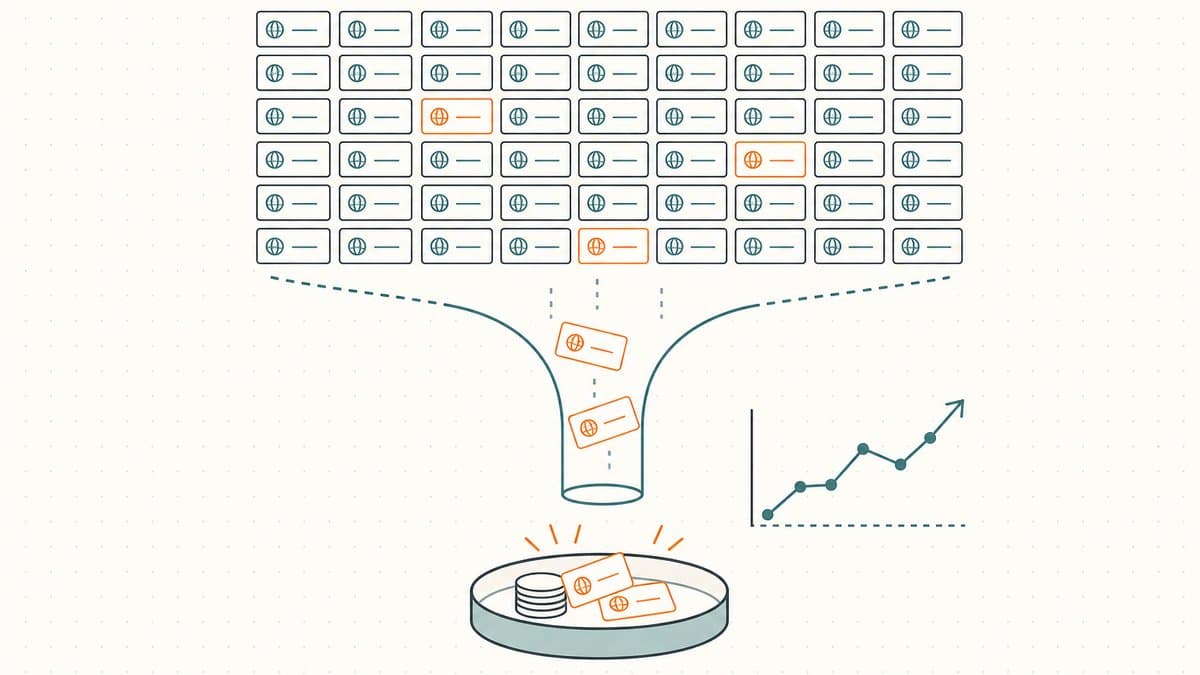
If you track only one performance metric, track sell-through rate — the share of your portfolio that actually sells in a given year. Everything else (how clever your names are, how high you've priced them) is opinion. Sell-through is the number that tells you whether the portfolio is a business or a hobby with a subscription fee.
The arithmetic is simple. If you hold 500 names and 10 sell this year, your sell-through rate is 2%. Whether that's good depends entirely on price: 10 sales at an average that comfortably exceeds the renewal bill on all 500 is a healthy operation, while 10 cheap sales that barely dent the carry is a slow-motion loss. Be honest that the headline industry figures here are rules of thumb, not measured statistics — a hand-registered portfolio's annual sell-through is widely discussed as low single-digit percentages, but treat any specific number you see (including that one) as an estimate, not a fact, and measure your own. Your real sell-through, computed from your own ledger, is worth more than any benchmark.
Two refinements make the metric actionable. First, watch the trend, not just the level: a sell-through rate that's falling year over year is telling you your sourcing or pricing has drifted, regardless of the absolute number. Second, segment it. Sell-through on your .coms will look nothing like sell-through on a speculative new-TLD batch, and blending them hides the signal. When you can see which slices of the portfolio actually move, you know where to put your next acquisition dollar — and where to stop. The mechanics of computing and improving this number get their own treatment in domain renewal costs and sell-through rate.
Renewal drag: the cost that compounds against you
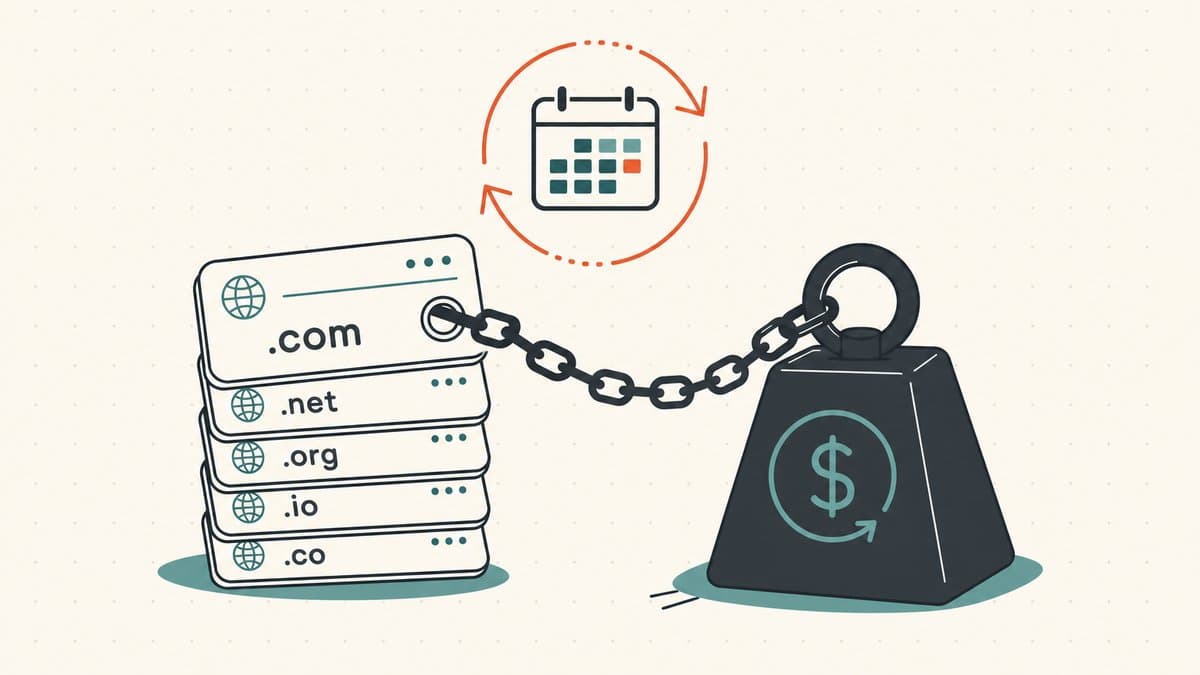
Sell-through is the numerator of the business. Renewal drag is the denominator, and it's the cost most new flippers underestimate, because it arrives one small charge at a time. A domain isn't bought; it's rented. You register it for a term and must keep paying to keep it, and even the longest commitments are bounded — per Wikipedia, the maximum period of registration for a gTLD domain name is 10 years. Where registrars advertise longer, it isn't a longer title; Wikipedia notes that 100-year offers involve the registrar renewing the registration for their customer every 10 years by themselves. The bill never goes away; you just prepay it.
Per name, the cost looks trivial. Wikipedia puts the retail cost generally ranges from a low of about $9.70 per year to about $35 per year for a simple .com. That's a rounding error on one name. Multiply it by a few hundred, and add the premium extensions — a portfolio of .io or .ai names carries renewals several times a plain .com — and the annual nut becomes the single biggest number in your business. Some registry-tiered "premium" names carry renewals in the hundreds of dollars every year, which can quietly turn a name you bought as an asset into a name you're paying to babysit.
The discipline is to manage renewal drag as a budget, not a series of surprises. Know your total annual renewal bill as one figure. Stagger renewals so they don't all land in the same brutal month. And measure every name against the question that matters: will the expected sale value, discounted by how unlikely and how distant it is, beat the cumulative renewals you'll pay waiting for it? When the honest answer is no, you're not holding an investment — you're funding a habit.
Pruning: deciding what to drop
Pruning is where most portfolios fail, because dropping a name feels like admitting a mistake, and the sunk renewals make it worse. Reframe it. The renewals you've already paid are gone whether you keep the name or not; the only question is whether the next renewal is worth paying. A name that won't sell is not an asset you're protecting by renewing — it's a liability you're subsidizing.
Turning off auto-renew can be a clean operational exit, but expiration is not a low-risk undo button. Registrar terms and TLD policies differ. For gTLDs, a registrar that does not delete the name immediately may offer an Auto-Renew Grace Period of 1–45 days, but the name's DNS can be interrupted and, depending on the registration agreement, the registrar may auction or otherwise make the name available to a third party during that period. (ICANN registrant guidance)
The 30-day Redemption Grace Period applies only after the registrar deletes a covered gTLD registration; it does not begin automatically at expiration. During that period the prior registrant can request restoration through the deleting registrar, usually for a separately disclosed restore fee, while DNS remains disrupted. (ICANN Expired Registration Recovery Policy) After redemption, a typical gTLD proceeds through a five-day pending-delete phase before becoming available again, but ccTLD and registrar-specific lifecycles can differ. Treat expiry as a destructive decision: remove production DNS and email dependencies, verify the exact registrar/TLD timeline and fees, and assume the name may be lost rather than planning to recover it later.
A practical pruning pass, run once a year before the bulk of your renewals: sort the ledger by renewal date, and for each name ask three things. Has it had a single offer or serious inquiry in the time you've held it? Does it still pass the same fundamentals you'd demand of a new buy — short, real word, real buyers, a credible extension? And does its realistic sale value still clear its cumulative carry? A name that fails all three is a drop, full stop. Letting your weakest names go isn't a loss; it's how you free up budget to renew and source the names that actually move. The full decision framework — including the names worth keeping despite a quiet year — is in when to drop a domain.
Putting it together: the portfolio as a P&L
The four disciplines connect into one picture. Your ledger tells you what you hold and what it cost. Your sell-through rate tells you how fast it converts. Your renewal drag is the fixed cost of holding it. Pruning keeps that cost pointed at names with a future. Together they turn a vague "I think I'm up?" into a real profit-and-loss statement: sales revenue, minus cost basis on what sold, minus renewals on everything, equals whether this is a business.
That frame also keeps you honest about scale. Doubling your portfolio doubles your renewal drag now and your sales only later, and only if the new names are as good as the old. The aftermarket is enormous — Wikipedia reports that according to NameBio, 144,700 domain name sales totaling US$185 million were recorded in 2024 — but that money went to holders who could see their own books clearly enough to price, list, and close.
The Namefi angle
A clean ledger and a disciplined drop list answer what you own and whether to keep it. They don't, on their own, make the ownership itself easy to prove or move. When a buyer finally appears for one of your tracked names, the trade still hinges on the old standoff: the seller won't transfer before payment, the buyer won't pay before transfer, and a six-figure name sitting at a registrar is only as auditable as a WHOIS record and an auth code you email over.
This is the layer Namefi is built for. Tokenizing a real ICANN domain makes ownership verifiable and transferable as an on-chain asset, with DNS continuity so the name keeps resolving cleanly through the handover. For a portfolio operator, that means inventory whose control is provable rather than asserted, and exits that close with less friction — the natural endpoint of treating the whole book like a business.
Friendly Disclaimer (Read Me!)
We're not lawyers, accountants, financial advisors, or doctors, and nothing in this article is legal, financial, tax, accounting, medical, or any other flavor of professional advice. We write these posts to educate ourselves and as a convenience for our customers. Info here may be out of date, geography-specific, or just plain wrong. We make mistakes too.
For any important decision, please consult a real professional (seriously!). Or if that's not your vibe, ask a friend, ask Twitter, ask Reddit, ask an AI, or ask a psychic. In short: DOYR - Do Your Own Research. Let's learn and have fun.
Sources and further reading
- Wikipedia — Domain name registrar (10-year max gTLD term; 100-year offers; retail
.comrenewal range) - Wikipedia — Domain aftermarket (secondary-market definition; NameBio 2024 sales volume)
- ICANN — Expired Registration Recovery Policy
- ICANN — Five things registrants should know about expiration recovery
- ICANN — Life cycle of a typical gTLD domain name
Contributors

Aileen Wright is a student in her twenties living in New York City, where the distance between a museum wall and a library reading room is a short walk and a long afternoon. She came to name writing through art and history — the way a single portrait, coin, or manuscript margin can carry a name across centuries and change its meaning on the way.
Most weeks you can find her in Central Park with a paperback, or in the quiet of a public reading room chasing down where a name actually comes from rather than what a name-list says it means. She is also teaching herself to code, which has made her oddly precise about spelling, sorting, and the small details that decide whether a name ages well.
For Namefi she writes about the history and culture behind domain names, the stories brands carry as they rename, and the difference between a good story and a verified source.

Victor Zhou is a technology founder and standards editor focused on digital identity and trust. He founded Namefi, edits Ethereum Improvement Proposals, and previously led smart-contract architecture work at Google Labs.
His work sits at the intersection of naming, ownership, and the systems people use to establish identity online. That perspective makes him especially interested in the way names move between personal meaning, public recognition, and digital infrastructure.
For Namefi, Victor edits and writes about domains as durable digital identity: how names become ownable onchain assets, how tokenization changes custody and trust, and what naming can learn from the systems people use to establish identity online.
Related guides
- For-Sale Landing Pages That ConvertHow to build a domain for-sale landing page that converts: a clear price or offer path, real trust signals, and a frictionless way to buy or make an offer.
- Domain Pricing Psychology: Buy-Now vs Make-OfferHow listing mode and initial numbers can influence a domain sale: anchoring, when to name a price, planned concessions, and buy-now vs make-offer.
- Hand-Registering Domains to Flip: Finding Available GemsHow to find still-available domains worth a registration fee: wordlists, TLD permutations, brandable patterns, and the filters that beat impulse buys.
- How to Find Domains to Flip: Every Sourcing ChannelThe four ways to source domains to flip — hand-registration, expired drops, auctions, and the aftermarket — and each channel's risk and price profile.