.com vs Tech TLDs (.ai, .io, .dev, .app): Best for Startups?
Choose .com, .ai, .io, .dev, or .app for your startup with verified registry facts, HTTPS requirements, and practical registration trade-offs.

- guide
Choose .com when the exact name fits your budget and you want a company address that leaves the product category open. Choose .ai when artificial intelligence defines the product, .io for broader technology positioning, .dev when developers are the audience, and .app when the application is the brand.
A good tech-domain name can be a better purchase than a compromised .com. Don't add awkward spelling, a long prefix, or an acquisition bill you can't justify just to get those three letters. Compare the complete addresses you can actually register or buy.
This guide picks a primary startup address. Our startup TLD guide covers a wider defensive-registration portfolio. If you've already narrowed the decision to the two country codes, read the detailed .ai versus .io comparison.
The five extensions serve different startup needs
| Extension | Best fit to consider | Registry manager or operator | Origin date | Main trade-off |
|---|---|---|---|---|
.com | A company whose products may change | VeriSign Global Registry Services | IANA record created January 1, 1985 | An exact name may require buying from its holder |
.ai | A product built around artificial intelligence | Government of Anguilla; Identity Digital operates the registry platform | IANA record created February 16, 1995 | AI-specific positioning and a two-year minimum registration term |
.io | Technology products without an AI-only identity | Internet Computer Bureau Limited | IANA record created September 16, 1997 | Country-code eligibility deserves long-term attention |
.dev | Developer tools, documentation, engineering products | Charleston Road Registry Inc., Google's registry company | Delegated December 18, 2014 | HTTPS must work before browsers can load the site |
.app | A named application or software product | Charleston Road Registry Inc., Google's registry company | Delegated July 2, 2015 | HTTPS is mandatory; the name suggests an application |
IANA supplies the managers and record dates for .com, .ai, .io, .dev, and .app. Those dates are not all retail launch dates. Google opened general registration for .dev on February 28, 2019, and .app on May 8, 2018.
The fit recommendations are editorial judgments, not measured promises about customer trust or conversion.
.com leaves room for a changing company
.com works well when today's app may become tomorrow's platform, services business, or collection of products. The suffix doesn't commit the company to artificial intelligence, developers, or an application. Stripe's financial-infrastructure business at stripe.com gives a concrete example of that broad company-address role.
Verisign's Domain Name Industry Brief reports 169.8 million .com registrations as of September 30, 2026. That's a count of registrations, not a count of businesses or evidence that your preferred name is unavailable. Read the Q3 2026 report.
For eligibility, .com isn't limited to incorporated technology businesses: Zoho's registration page describes use by businesses, organizations, and individuals worldwide. Availability and the registrar's registration terms still apply.
Choose .com if the actual address is strong. Reject a weak address even when the extension is familiar. A short, clearly spelled product name on .app can be a better choice than a .com that needs a spelling lesson every time you say it.
.ai and .io share country-code origins but suggest different products
Both are country-code TLDs, rather than generic technology categories created for startups. .ai belongs to Anguilla. .io belongs to the British Indian Ocean Territory. Their technology associations don't change their underlying delegation type.
For .ai, distinguish the manager from the technical platform: IANA names the Government of Anguilla, while Identity Digital says it began exclusively serving .ai on its platform on January 15, 2025. That announcement reported more than 600,000 registered names at the time. It is a dated milestone, not a current total. Read the migration announcement.
Jasper illustrates the AI association: jasper.ai describes its marketing AI agents. Choose .ai when that association helps explain the product and should remain relevant after launch. If AI is merely one implementation detail, .com or .io leaves more room for your positioning to change.
You don't need to live in Anguilla or work in AI to register. Zoho's .ai registration FAQ explicitly states no eligibility requirements and a two-year minimum registration period. The registry separately requires non-abusive use and reserves enforcement powers in its published rules.
.io supports a broader technology identity. It doesn't require an artificial-intelligence story: itch.io describes an independent digital-creator marketplace focused on games. The registry's second-level registration rules say an applicant may reside in any legal jurisdiction. Those rules distinguish direct registrations such as brand.io from third-level registrations, which have a territory-residency requirement.
The long-term caveat is country-code eligibility. IANA's current .io record lists an active delegation, without a retirement date. IANA's retirement process ties eligibility to ISO 3166-1 and provides a formal notification and transition process. That supports neither an imminent-shutdown claim nor a promise of permanent operation. Choose .io only after considering whether that policy dependency fits your company's intended lifespan.
.dev and .app share an HTTPS requirement but address different audiences
Google operates both through Charleston Road Registry Inc. Both accept general registration: Google's FAQs say anyone can register .dev and .app has no eligibility requirements. You don't need a developer credential or an app-store listing.
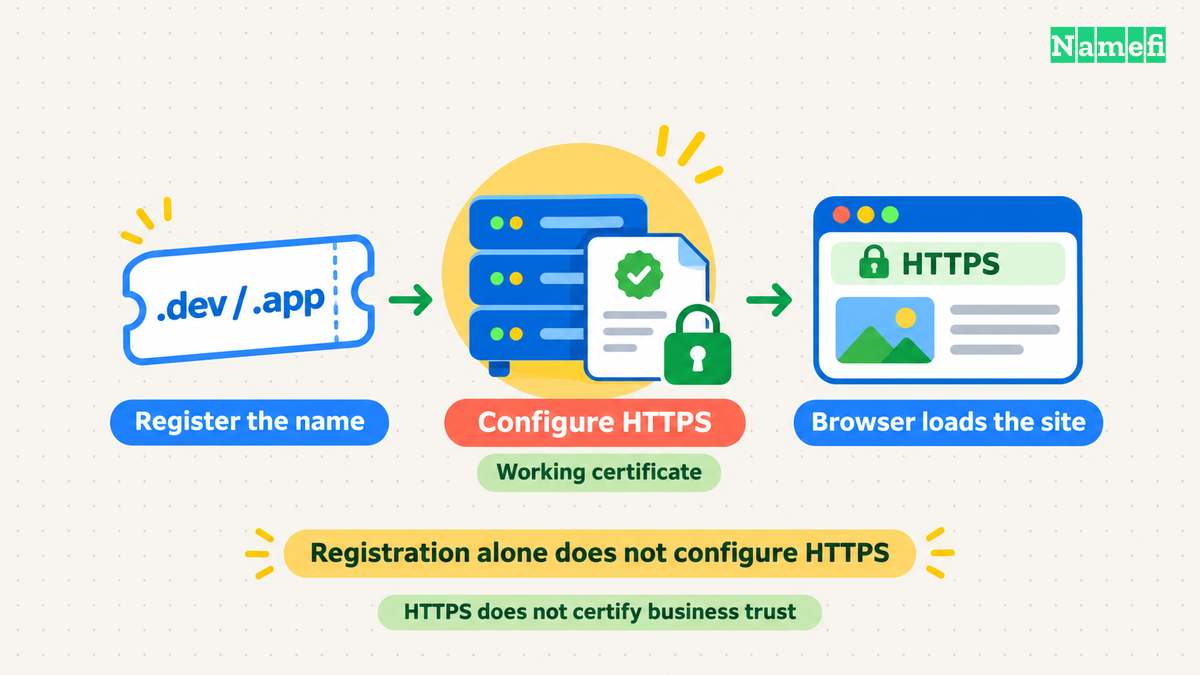
Both extensions appear on the HSTS preload list. Browsers require HTTPS, so the website needs a working certificate before it will load. Google's .dev certificate guidance and .app certificate guidance explain the requirement. Registration alone doesn't configure HTTPS for your host, and HTTPS doesn't certify that a business is trustworthy.
Choose .dev when the people using the product are developers. Google names Zed.dev, an open-source code editor, among its examples. The same May 1, 2024 article reported over 600,000 .dev registrations; Google describes registrations seen since launch, so don't read that as today's active-domain count. Read Google's anniversary article.
Choose .app when customers buy an application rather than a developer tool. Google documents Concepts moving from a .com address to concepts.app. That is a useful counterexample to the idea that every startup must eventually move toward .com. Read the Concepts example.
Neither suffix limits you to those uses. The difference is the expectation you choose to set: .dev emphasizes the builder audience, while .app emphasizes the software product.
Your situation should decide the registration
- You sell across industries and expect the product to change. Start with a clean
.com. If the exact address costs more than the business can justify, compare a better name or a fitting tech extension. - Your core product is an AI agent, model, or AI service. Prefer
.aiwhen the full address is strong and the registration commitment fits. Don't buy it solely because your app calls a model API. - You sell APIs, infrastructure, or general technology software. Compare
.ioand.dev. Prefer.devfor a deliberately developer-facing identity; consider.iofor a broader product identity after reviewing the ccTLD caveat. - Your startup revolves around one consumer or business app. Give
.appserious consideration. A matching product address can justify choosing.appover an awkward.com. - Your company and developer portal need different addresses. Start with one primary company address. Add
.devonly if a separate developer identity has a clear purpose; a documentation subdomain may already serve the need.
These choices concern audience and naming fit. They don't establish that an extension produces more sales, email delivery, or investor interest.
Google doesn't give a keyword TLD a ranking advantage
Google's published guidance says its systems treat new generic TLDs like other generic TLDs, and keywords in a TLD don't confer a search advantage or disadvantage. That addresses the idea that .app or .dev automatically helps relevant searches.
Google's current geographic-targeting documentation also lists both .ai and .io among ccTLDs treated as generic. Google notes that the list may change. This is a geographic classification, not a ranking guarantee or a change to IANA's country-code designation.
Don't pay extra for a claimed TLD ranking boost. Choose the address for your audience, budget, and operating requirements.
Compare the full commitment before you buy
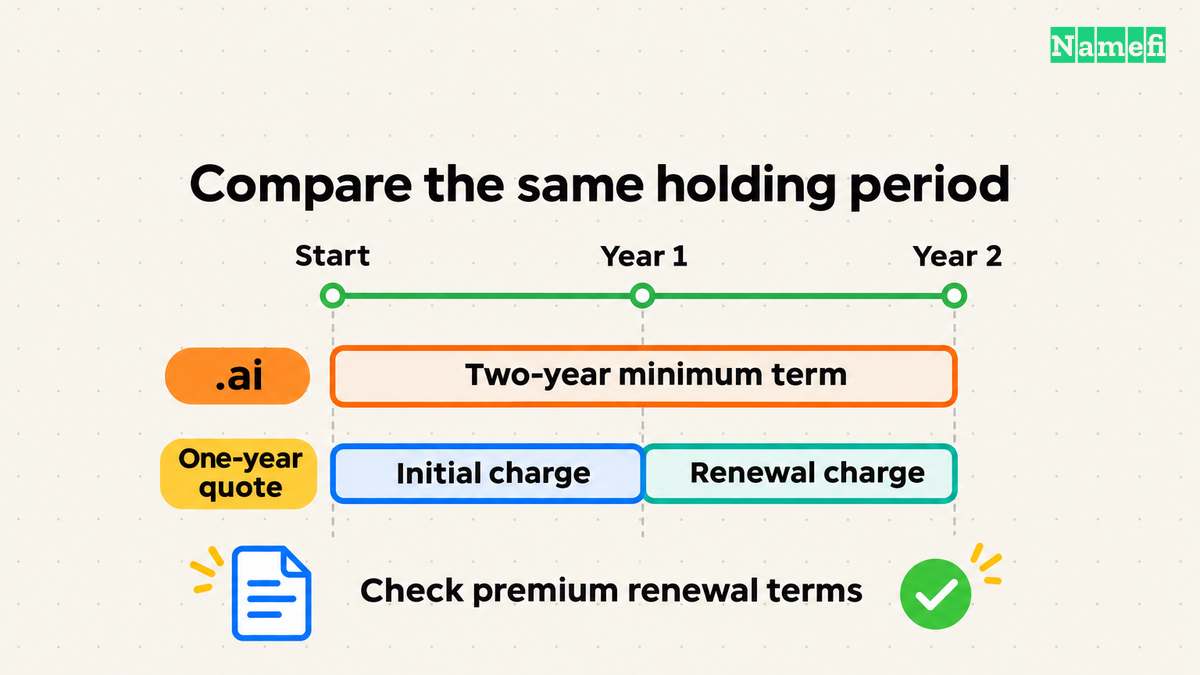
Ask the registrar for the exact name's initial charge, renewal charge, registration term, and any premium renewal terms. Compare the same holding period across candidates. A two-year .ai invoice and a one-year quote aren't directly comparable. No price table here would replace a live quote for the actual names.
Separate a new registration from an acquisition: an already-registered .com requires agreement with its holder. Set a maximum acquisition budget before negotiating. Don't base the launch on an assumed future purchase of the matching .com.
Before checkout, say the complete address aloud, ask someone to type it, and inspect what already operates on the matching .com. If the alternative creates obvious confusion with another business, revisit the name. For selective defensive registrations, use the portfolio guidance linked above rather than buying all five by default.
Once the choice is clear, check the live catalog and terms at your chosen registrar, including Namefi if you're considering it. The decision should stand on the name and its ongoing obligations, without depending on extra services you don't need.
Comparing more options? Start with our guide to .com vs every other TLD.
Sources and further reading
- IANA —
.comWHOIS record, manager and creation date; fetched 2026-11-06. - IANA —
.aiWHOIS record, manager and creation date; fetched 2026-11-06. - IANA —
.ioWHOIS record, manager, creation date, and active status; fetched 2026-11-06. - IANA —
.devdelegation, operator and delegation date; fetched 2026-11-06. - IANA —
.appdelegation, operator and delegation date; fetched 2026-11-06. - Verisign / DNIB — Q3 2026 report, September
.comregistration base; fetched 2026-11-06. - Zoho Domains —
.comregistration and.airegistration FAQ, eligibility and.aiminimum term; fetched 2026-11-06. - Identity Digital —
.aiplatform migration, January 2025 operator transition and registration milestone; fetched 2026-11-06. .airegistry — Usage rules, abuse restrictions and enforcement; fetched 2026-11-06.- NIC.IO — Allocation rules, second-level and third-level residency rules; fetched 2026-11-06.
- IANA — ccTLD retirement, eligibility and notification process; fetched 2026-11-06.
- Google Registry —
.devand.app, retail launch dates, eligibility, HTTPS, and Concepts example; fetched 2026-11-06. - Google Registry — May is for .dev-elopers, May 2024 registration milestone and Zed example; fetched 2026-11-06.
- Google Search Central — Handling new TLDs and multi-regional sites, search and geographic treatment; fetched 2026-11-06.
- Stripe — Company site,
.comexample; fetched 2026-11-06. - Jasper — Company site,
.aiexample; fetched 2026-11-06. - itch.io — About,
.ioexample; fetched 2026-11-06.
About the author(s)
Fenwei Bian is a software developer in her thirties who spends her working hours in pull requests and her weekends with her hands in soil or sawdust. Years of open source on GitHub taught her that names are interfaces: a good one is clear, honest about what it does, and kind to whoever has to use it next.
She gardens because it rewards patience and punishes wishful thinking, and she does woodwork because a joint either fits or it doesn't. Both habits show up in how she writes about naming — measure twice, check the source, and don't sand over a rough spot and hope no one notices.
For Namefi she writes about how domain markets actually move, the practical trade-offs of tokenizing and flipping names, and picking a domain you'll still be glad you own in twenty years.