
From AirBedAndBreakfast.com to Airbnb.com: The Domain Upgrade That Let a Company Outgrow Its Air Mattresses
How Airbnb launched in 2008 as AirBed & Breakfast on AirBedAndBreakfast.com, then shortened to Airbnb.com in 2009 to escape the literal air-mattress name and become a scalable global brand.
- domains
- branding
- startups
- domain-upgrades

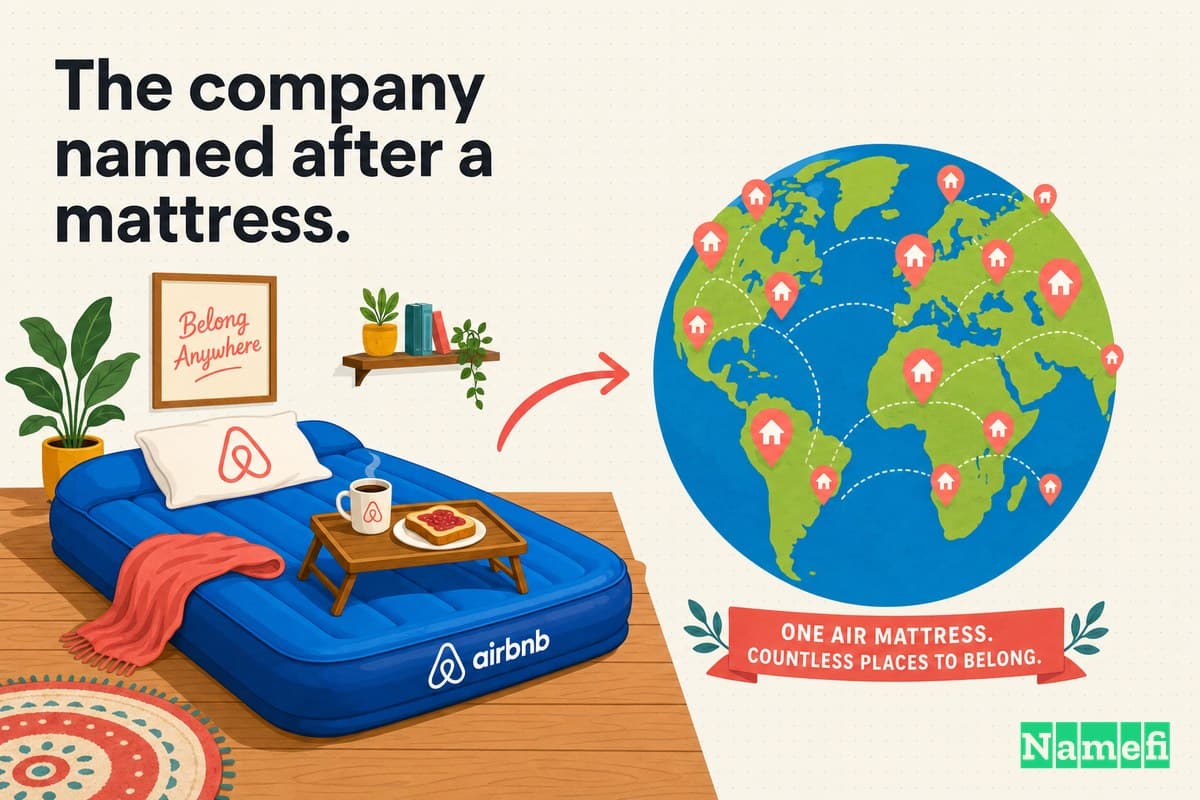
Before Airbnb was a verb, a public company, and a fixture of the way the world travels, it was an extremely literal proposition: an AirBed & Breakfast, living at AirBedAndBreakfast.com.
The name was honest to the point of being a product spec. When Brian Chesky moved to San Francisco in October 2007 to live with his Rhode Island School of Design classmate Joe Gebbia, Chesky did not have enough money to pay his rent, so the two opened their apartment to strangers during a design conference, providing air mattresses for guests to sleep on and Pop-Tarts for breakfast when hotel rooms were scarce. The "air" in the name was not a metaphor. As one history of the company puts it, the "Air" part of Airbedandbreakfast.com, the original incarnation of Airbnb, was literal.
For that first audience, AirBedAndBreakfast.com was perfect. It told you exactly what you were buying: a cheap mattress on someone's floor and a bowl of cereal in the morning.
But the product's ambition outgrew the mattress almost immediately. Within two years the company was facilitating bookings for spare rooms, whole apartments, and unique homes — and a domain named after inflatable beds had become a description of a business it no longer was. So in March 2009 the company shortened everything to one word and moved to Airbnb.com.
That was not a cosmetic URL cleanup. It was a young startup deliberately shedding the most literal version of its name so the brand could mean something bigger than its origin story.
2007–2008: the company named after a mattress
In the beginning, literal was an asset.
A pair of unknown designers asking strangers to sleep in their living room needed a name that explained itself instantly. "AirBed & Breakfast" did exactly that. It mapped a strange new offer — pay to crash on a floor — onto the familiar, trusted idea of a bed and breakfast. The first three guests were charged $80 per night, and the concept worked well enough to become a company.
Gebbia and Chesky then asked a third person to build a real website for the company then known as Airbed & Breakfast: Nathan Blecharczyk, Chesky's former roommate, who joined as the chief technology officer and the third co-founder. The public site, Airbedandbreakfast.com, was launched on August 11, 2008, and the matching airbnb-era domain records show airbnb.com itself was Registered On: 2008-08-05 — meaning the founders had already grabbed the shorter name days before the longer one even went live.
TechCrunch covered the scrappy early company in 2008 as a peer-to-peer pad crashing site for travelers. That was the whole identity at the time: floors, air beds, and breakfast.
March 2009: dropping the mattress from the name
The early launches were rough. At the SXSW 2008 Conference, the website only received two bookings, one of which was Chesky himself. The company kept iterating, kept relaunching, and slowly the product stopped being about air mattresses at all. People were listing real bedrooms and whole homes.
That mismatch is what forced the rename. In March 2009, the name of the company was shortened to Airbnb.com to eliminate confusion over air mattresses. The literal name had become a liability: it told new hosts and guests that this was a service for sleeping on inflatable beds, exactly when the company needed them to believe it was a service for booking any kind of space.
The new word kept the heritage without the baggage. "Airbnb" preserved the Air... as a nod to the company's origin story and the initial air mattress concept, while "bnb" carried the universally understood "bed & breakfast" idea — a name short enough to scale, type, and say out loud.
The branding angle: a name that scales versus a name that explains
The case for the change was not aesthetic. It was structural.
By 2009 the original name was simply doing the wrong job. As the company evolved beyond air mattresses in its own apartment and started facilitating bookings for spare rooms, entire apartments, and unique homes offered by other hosts, the need for a shorter, catchier, and more scalable name became apparent.
"AirBedAndBreakfast" is an eighteen-letter name before the .com extension. It is hard to say on a phone call, awkward on a business card, and — worse — it makes a promise the product had already broken. Every time a host read it, the domain quietly insisted the platform was about air beds. "Airbnb.com" makes no such claim. It is a coined word that can mean whatever the company grows into: a room, a loft, a castle, an "Experience," a global travel brand.
This is the recurring pattern in domain upgrades. Early names explain. Great names own. A descriptive domain is a fantastic on-ramp when nobody understands your product yet, and a ceiling once they do.
The money looked different then
It is tempting to treat the rebrand as an obvious, costless decision. In hindsight, "of course they should be Airbnb." But in March 2009 the company had almost no money and no certainty it would survive at all.
The founders were so broke that, after the 2008 Democratic National Convention left each of them roughly twenty thousand dollars in debt, they funded the company by selling election-themed cereal — repackaging commercial cereal into "Obama O's" and "Cap'n McCains," with each box costing $39. That cereal stunt, not the business model, helped them limp into Y Combinator in early 2009, where the course provided US$20,000 in seed money and training from Paul Graham, among others, in exchange for a six-percent stake in the company.
Only in April 2009 did the company receive $600,000 in seed money from Sequoia Capital. So the rename to Airbnb.com happened before the first real venture check cleared, when the entire operation was a few thousand dollars of cereal money and a YC stipend away from shutting down. Choosing to abandon a name that already had some recognition — the press had covered "AirBed & Breakfast," guests had used it — was a bet placed at the moment of maximum uncertainty, not from the safety of success.
That is exactly when the decision counted. The company was small enough that the cleaner name could still become canonical, and serious enough about scaling that the literal name had become a drag.
Why shortening to "Airbnb" mattered
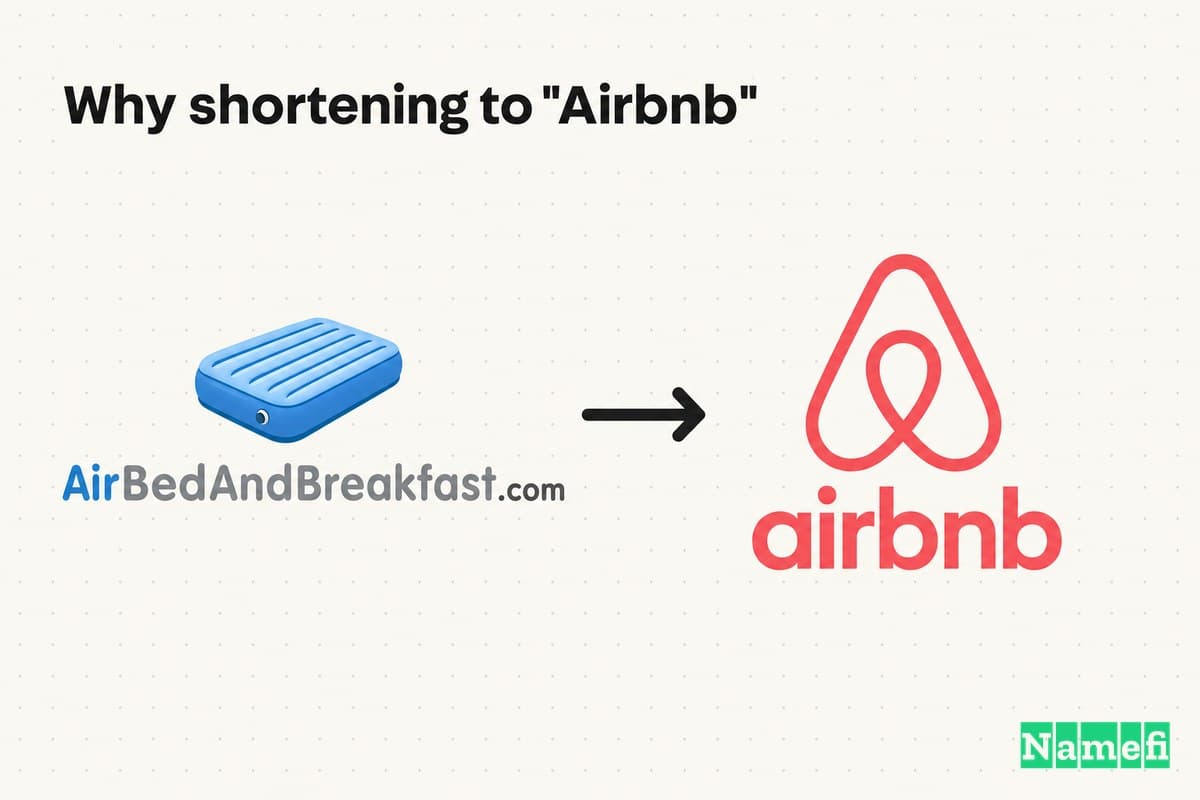
The distance between AirBedAndBreakfast.com and Airbnb.com is a few syllables in speech. Strategically, it is the difference between a description and a brand.
AirBedAndBreakfast.com tells you what the founders did one weekend in 2007. Airbnb.com names a category big enough to hold everything that came after.
| Before | After |
|---|---|
| AirBedAndBreakfast.com | Airbnb.com |
| Describes air mattresses and breakfast | Names a global lodging brand |
| Promises a floor to sleep on | Promises any kind of space |
Eighteen-letter name before .com, hard to say | One coined word, easy to say |
| Anchored to a 2007 origin story | Travels into rooms, homes, and experiences |
| Reads like a product | Reads like a company |
By March 2009 the platform had 10,000 users and 2,500 listings — enough traction to know the brand mattered, but early enough that almost no one outside a small circle had hardened on the old name. The timing was close to ideal: upgrade once the product is clearly working, but before the weaker name becomes the one the world remembers.
Timing: the domain that moved with the pivot
The sequence is the whole lesson.
- October 2007: Chesky and Gebbia rent out air mattresses during a San Francisco design conference to make rent — the literal "AirBed & Breakfast."
- August 2008: Blecharczyk having joined as the third co-founder, Airbedandbreakfast.com launches on August 11, 2008 — with airbnb.com already quietly registered on August 5.
- Early 2009: The founders enter Y Combinator with $20,000 and Paul Graham's mentorship after funding themselves on cereal.
- March 2009: The company shortens to Airbnb.com to eliminate confusion over air mattresses, with 10,000 users on the platform.
- April 2009: Sequoia invests $600,000 — into a company that now had the right name on the door.
The rename did not follow the company's success. It preceded the bulk of it. The clean domain was in place before the venture funding, before the global expansion, before the brand became a household word — which is precisely why the world only ever learned the short version.
The domain became part of the operating system
Premium, brandable domains are not about prestige. They are about repetition.
A company's core domain shows up in places the marketing team never directly controls:
- In every host listing and every guest confirmation email.
- In app store names and search results.
- In press headlines and investor decks.
- In browser bars and shared links.
- In every spoken recommendation from one traveler to another.
Every one of those repetitions either adds friction or removes it. AirBedAndBreakfast.com made each mention longer, harder to spell, and quietly wrong — it kept insisting the product was about air mattresses. Airbnb.com made each mention short, sayable, and category-free. Multiply that across millions of hosts and hundreds of millions of guests, and the rename stops looking like a 2009 branding tweak and starts looking like a permanent reduction in drag.
The domain did not build Airbnb's marketplace. But once Airbnb.com was the address, every future repetition of the name compounded on a cleaner foundation.
What founders should learn from Case 15
The easy takeaway — "never pick a literal name" — is wrong. The literal name was the right call at the start. The better lesson is staged:
- Use a literal, descriptive domain to launch if it makes the product instantly understandable. AirBedAndBreakfast.com worked because nobody yet knew what "renting a stranger's floor" meant; the name explained the whole offer in four words.
- Watch for the moment the description stops matching the company. The signal to upgrade isn't aesthetic — it's when the name starts promising something smaller or narrower than what you actually do. For Airbnb, that was the day the listings stopped being air mattresses.
- Treat the shorter name as infrastructure, not decoration. Shortening to Airbnb.com bought scalability, sayability, and a brand that could expand into rooms, homes, and experiences — not just a tidier URL.
- Move before the weak name hardens, even when money is tightest. Airbnb rebranded while broke, pre-venture-funding, with about 10,000 users — early enough that the world only ever learned the clean version.
The domain upgrade did not make Airbnb win. Product, design, relentless founder hustle, timing, and capital mattered far more. But Airbnb.com made the company nameable as something far bigger than the air mattresses it started on.
The Namefi angle
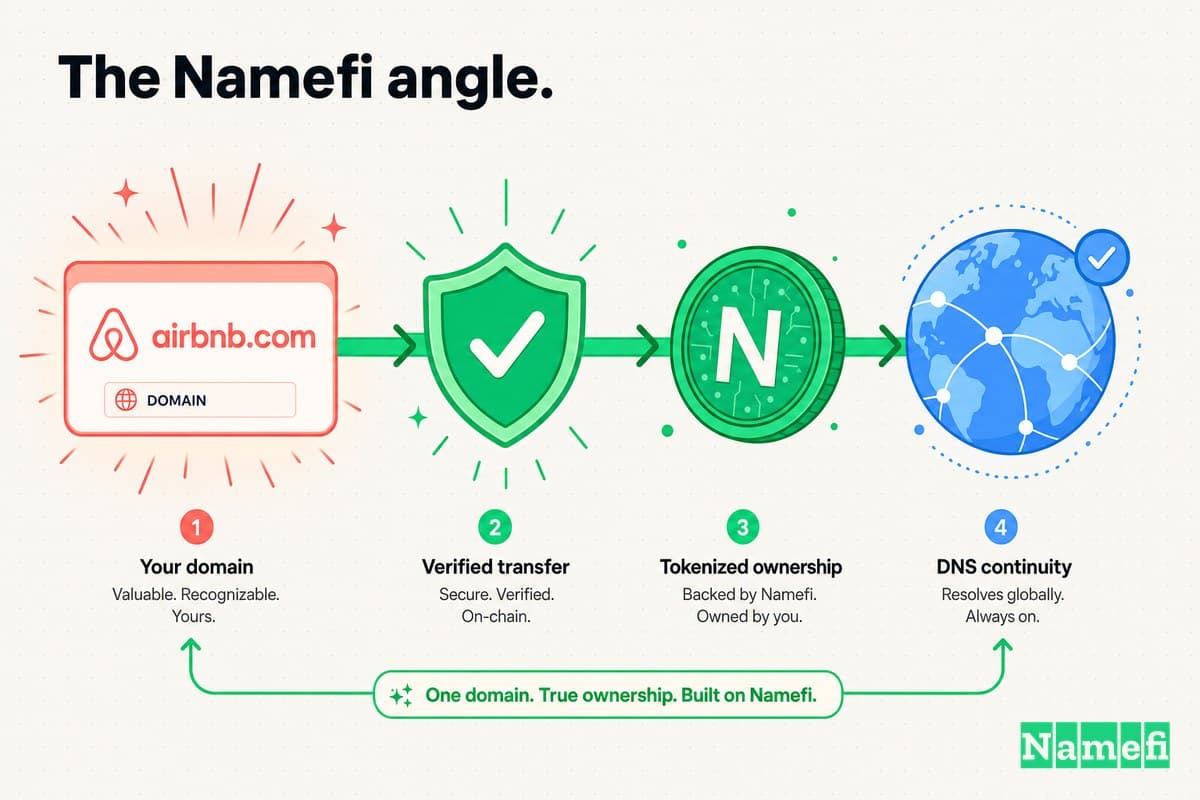
Airbnb's rename was, at its core, an asset decision dressed up as a branding decision.
The hard part of most domain upgrades is rarely deciding that the better name matters. It is executing the move safely: securing the new domain, proving ownership, transferring control without breaking the live site, and making sure the asset doesn't sit fragile and undocumented inside one founder's registrar account during the most chaotic year of the company's life. Airbnb was lucky enough to have registered its short domain early — but most companies discover the name they want only after someone else already owns it.
Namefi is built around the idea that domains should behave like internet-native assets. Tokenized ownership can make domain control easier to verify, transfer, and integrate into modern workflows while staying compatible with DNS — turning the messiest part of a rebrand, proving who owns what and moving it cleanly, into something closer to an auditable transaction.
Airbnb.com looks inevitable now because Airbnb became enormous. But the lesson lands long before that scale: when a name is going to carry the business, the domain isn't decoration. It's the part of the brand worth shortening, securing, and getting right while you still can.
Sources and further reading
- Wikipedia — Airbnb
- Wikipedia — Brian Chesky
- Product Habits — How Two Designers Created Airbnb
- TechCrunch — What's For Breakfast At Your House: Obama O's or Cap'n McCain's?
- AirROI — Why Is Airbnb Called Airbnb?
- Hostaway — Airbnb Founders: Brian Chesky, Nathan Blecharczyk, and Joe Gebbia
- Whois.com — airbnb.com WHOIS record
- iGMS — Airbnb History: From Air Mattress to Household Name
- Knowledge at Wharton — The Inside Story Behind the Unlikely Rise of Airbnb
- CNBC — In 2009, Airbnb collected $734 in fees in a week, and was clawing toward 'ramen profitability'
Contributors

Fenwei Bian is a software developer in her thirties who spends her working hours in pull requests and her weekends with her hands in soil or sawdust. Years of open source on GitHub taught her that names are interfaces: a good one is clear, honest about what it does, and kind to whoever has to use it next.
She gardens because it rewards patience and punishes wishful thinking, and she does woodwork because a joint either fits or it doesn't. Both habits show up in how she writes about naming — measure twice, check the source, and don't sand over a rough spot and hope no one notices.
For Namefi she writes about how domain markets actually move, the practical trade-offs of tokenizing and flipping names, and picking a domain you'll still be glad you own in twenty years.

Victor Zhou is a technology founder and standards editor focused on digital identity and trust. He founded Namefi, edits Ethereum Improvement Proposals, and previously led smart-contract architecture work at Google Labs.
His work sits at the intersection of naming, ownership, and the systems people use to establish identity online. That perspective makes him especially interested in the way names move between personal meaning, public recognition, and digital infrastructure.
For Namefi, Victor edits and writes about domains as durable digital identity: how names become ownable onchain assets, how tokenization changes custody and trust, and what naming can learn from the systems people use to establish identity online.
Related guides
- From Box.net to Box.com: The ~$1M Upgrade That Dropped the ".net" and Bought the Exact MatchHow Box launched in 2005 on Box.net because Box.com was taken, pivoted from consumer storage to the enterprise, and in 2011 paid Digimedia close to $1 million for the exact-match Box.com — a .net-to-.com upgrade that landed right as the company became simply "Box."
- From BufferApp.com to Buffer.com: The 624-Day, Bank-Statement-Open Domain DealHow Buffer launched in 2010 on BufferApp.com because Buffer.com was taken, then spent 624 days acquiring the exact-match domain — even showing the seller its bank balance — and why a company famous for radical transparency stayed quiet on the one number everyone wanted: the price.
- Who Owns Trip.com? Ctrip, Trip.com Group, and the RebrandUnderstand how Trip.com relates to Ctrip and Trip.com Group, and trace the acquisition and company-name changes behind the travel brand.
- From del.icio.us to Delicious.com: The Cleverest Domain Hack on the Web — and Why Yahoo Untangled ItHow the pioneering social-bookmarking site launched in 2003 as the famous domain hack "del.icio.us," why those dots became a permanent tax on every mention, and how Yahoo moved it to the cleaner Delicious.com in 2008.