
From TeslaMotors.com to Tesla.com: The $11M Domain Upgrade That Took a Decade
How Tesla spent over a decade and a reported $11M to move from TeslaMotors.com to the exact-match Tesla.com, and why the domain upgrade arrived right before the company dropped "Motors" from its name.
- domains
- branding
- startups
- domain-upgrades

For its first thirteen years, the most valuable car company of the next decade lived at a slightly awkward address: TeslaMotors.com.
The name was honest. When the company was incorporated in 2003, it was focused on developing cars, and only cars; regular production of the Tesla Roadster did not begin until March 2008. "Tesla Motors" described the business it was building, and TeslaMotors.com described exactly where to find it. The extra word did real work: it told you this was an automaker named after Nikola Tesla, not a battery startup, not an electricity utility, not the domain some other "Tesla" had been sitting on since the early days of the web.
Because someone else had been sitting on Tesla.com. The exact-match domain belonged to Stuart Grossman, a Silicon Valley engineer who had held it long before an electric-car company existed, and who had already defended it in a UDRP dispute brought by a different company called Tesla Industries. Tesla Motors could not simply ask for the name. It had to buy it, and the owner was in no hurry to sell.
So for over a decade, the company built one of the most recognizable brands on earth on a domain that wasn't quite its brand.
That changed in February 2016. Tesla finally acquired Tesla.com — and in 2018, Elon Musk put a number on it: $11 million, and "an amazing amount of effort."
2003–2016: the company that outgrew "Motors"
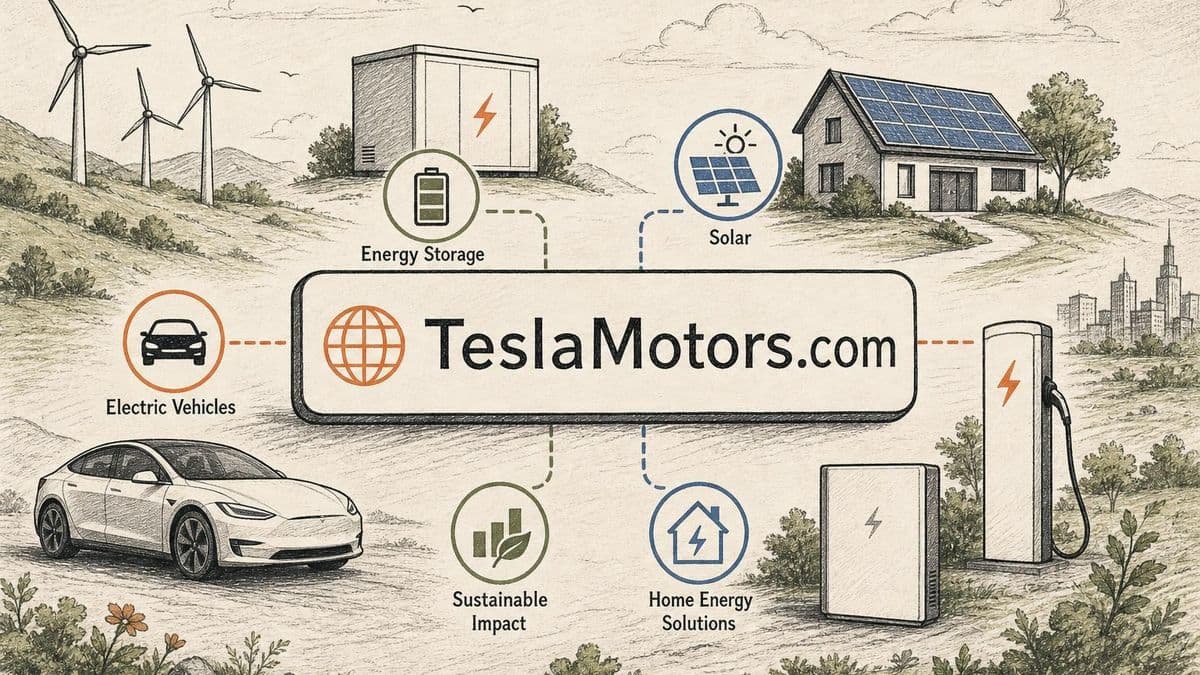
In the beginning, "Motors" was a feature, not a bug.
A new company asking strangers to put down deposits on a $100,000 electric sports car needed every signal of legitimacy it could get. "Tesla Motors" sounded like a car maker because it was supposed to. The Roadster, the Model S, the Model X — for years the entire public story was about vehicles, and TeslaMotors.com matched that story word for word.
But the ambition kept widening past the name. By the mid-2010s Tesla was no longer only a carmaker. It was shipping the Powerwall home battery, building grid-scale storage, and moving toward the acquisition of SolarCity and the launch of its solar roof. The company that had described itself with the word "Motors" was becoming an energy company that happened to also make the best-known cars in the world.
At that point "Motors" started to do the opposite of what it did in 2003. Instead of adding credibility, it added a ceiling. It pinned a company with planetary-scale ambitions to a single product category. TeslaMotors.com was the right domain for the first phase — and the wrong domain for the one that was coming.
2016: paying $11M for the exact match
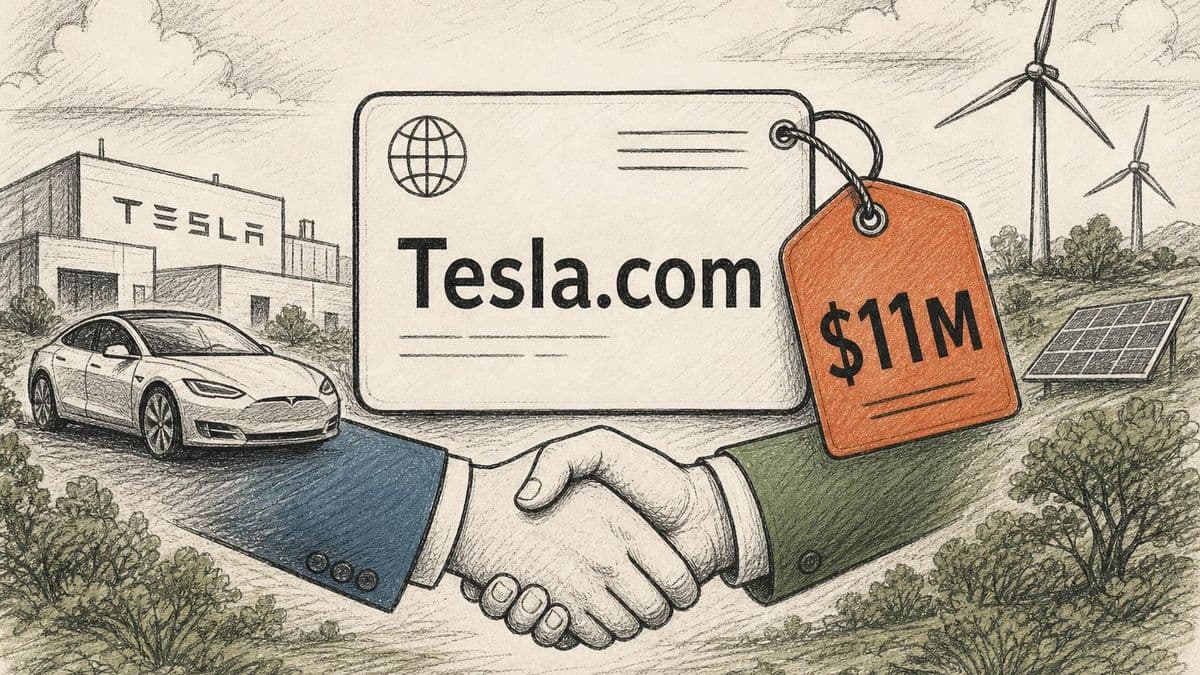
On Friday, February 12, 2016, the transfer went through. Tesla gained control of Tesla.com, and the name began redirecting to the company's site. Bloomberg framed the moment in its headline: Musk Gets Tesla.com Domain Name After Waiting a Decade. Green Car Reports put it even more bluntly: Tesla had finally gotten its hands on the domain name "Tesla.com" — after roughly 10 years of trying.
At the time, the price was hidden behind a non-disclosure agreement, and early estimates ranged from the high six figures into the low millions. The real number stayed secret for almost three years.
Then, in December 2018, Musk answered it himself in a single tweet:
"Buying Tesla.com took over a decade, $11M & amazing amount of effort. Didn't like teslamotors.com even when we were only making cars."
That one line carries the whole lesson. $11 million for a single word. Smart Branding later summarized the move plainly: "Tesla Motors shortened its name to simply Tesla and the company upgraded its domain name from TeslaMotors.com to the exact brand match Tesla.com."
And note what Musk admitted in that tweet: he didn't like teslamotors.com even when the company only made cars. The descriptive domain never felt canonical to him — it always felt like scaffolding the company would eventually have to replace.
A decade of "no": the seller's side
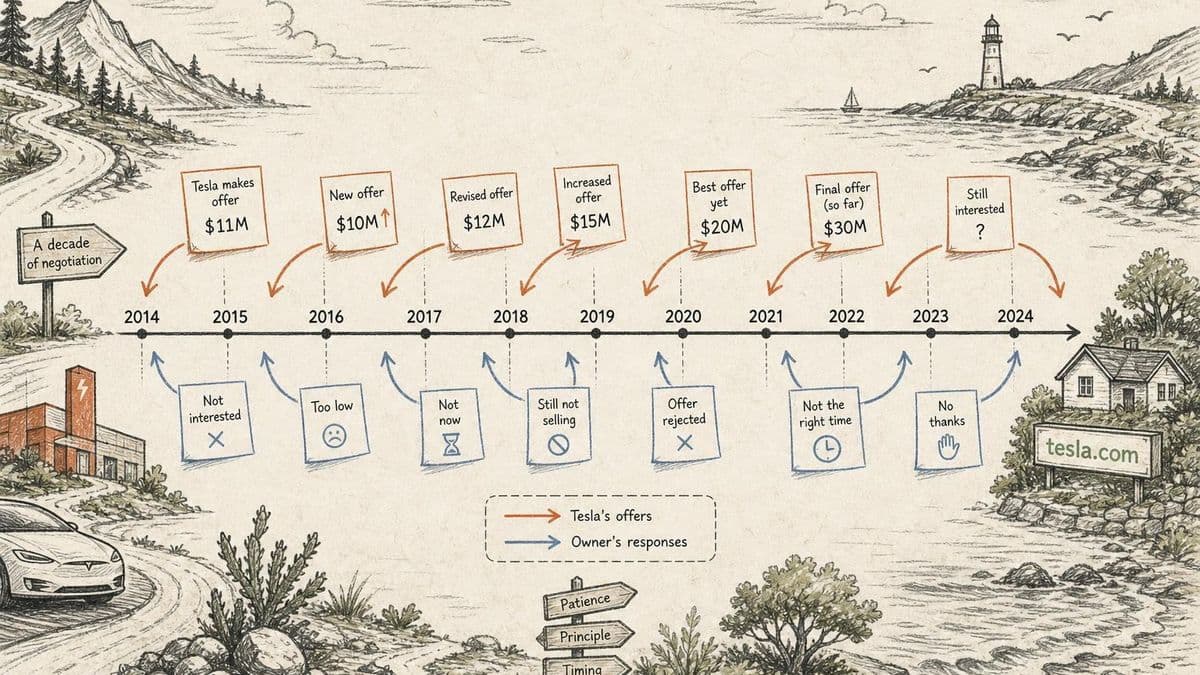
The reason it took ten years is that the owner didn't need to sell.
Stuart Grossman had held Tesla.com for years, through at least one ownership challenge, and had no commercial project riding on it. That is the hardest kind of counterparty in a domain negotiation: not a flipper looking for a quick exit, but a long-term holder who can comfortably say "no" indefinitely. There is no leverage against someone who isn't trying to win.
What eventually moved the deal was not pressure but fatigue. Grossman described the domain as more liability than asset by the end — at one point a wave of spam went out using tesla.com as the faked originating address, the kind of headache a dormant premium domain can quietly generate. As he put it in a 2016 interview, he realized he would never use the name productively and it was becoming a burden.
That is the unglamorous reality behind most blockbuster domain sales. The buyer has a strategic need and a deadline-shaped ambition. The seller has time. The price is whatever closes the gap between "I don't have to sell" and "this is finally worth the trouble." For Tesla, closing that gap cost $11 million and the better part of a decade.
The money looked different then
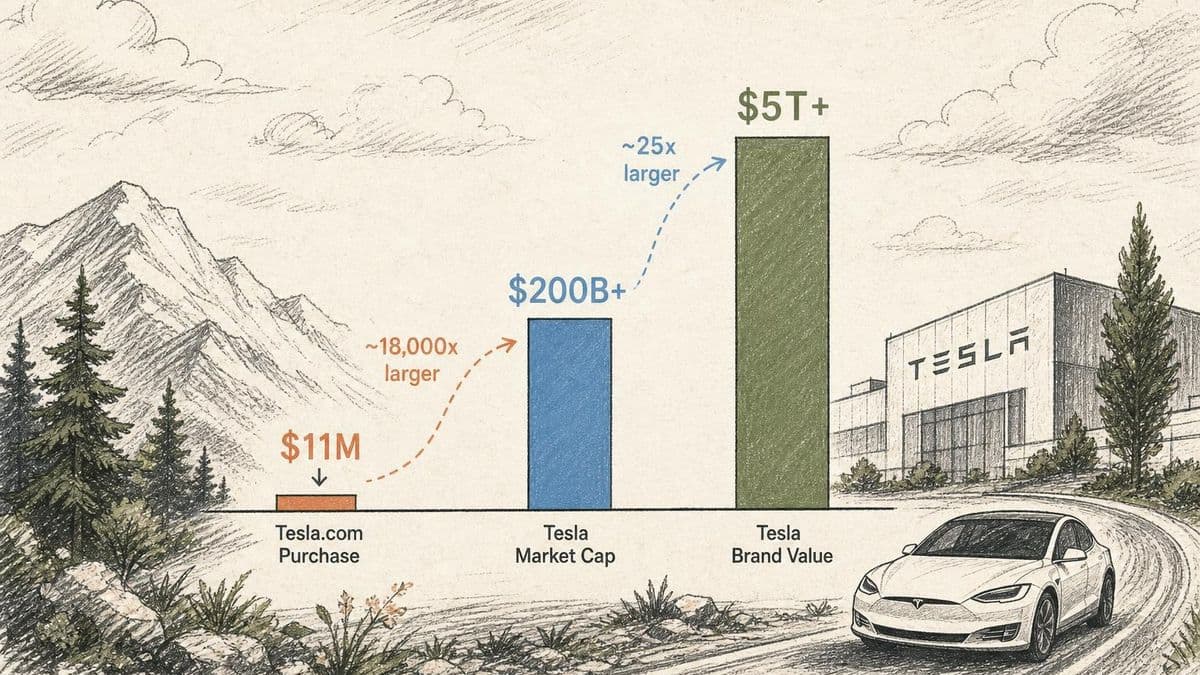
It is tempting to call $11 million an easy decision in hindsight. Tesla is now one of the most valuable companies in the world, and Tesla.com is one of its quietest, most permanent assets. Against that, eleven million dollars looks rounding-error small.
But it should be judged at the moment it was spent, not from the far end of the story.
In early 2016, Tesla was not the colossus it later became. It was a cash-hungry company in the middle of an enormous bet: ramping the Model X, preparing to unveil the mass-market Model 3, building the Gigafactory, and about to take on SolarCity. Free cash flow was a constant pressure. In that context, $11 million spent on a domain name — not a factory, not tooling, not battery supply — was the kind of line item a CFO would question.
The decision only makes sense if you treat the domain as infrastructure rather than decoration. Tesla was about to ask the world to stop thinking of it as a car company. Every press release, every charging-network sign, every energy product, every investor deck was going to carry its web address. Spending $11 million to make that address the clean, exact-match version of the brand was a bet that the name would be repeated billions of times — and that each repetition should land on Tesla.com, not TeslaMotors.com.
Why dropping "Motors" mattered
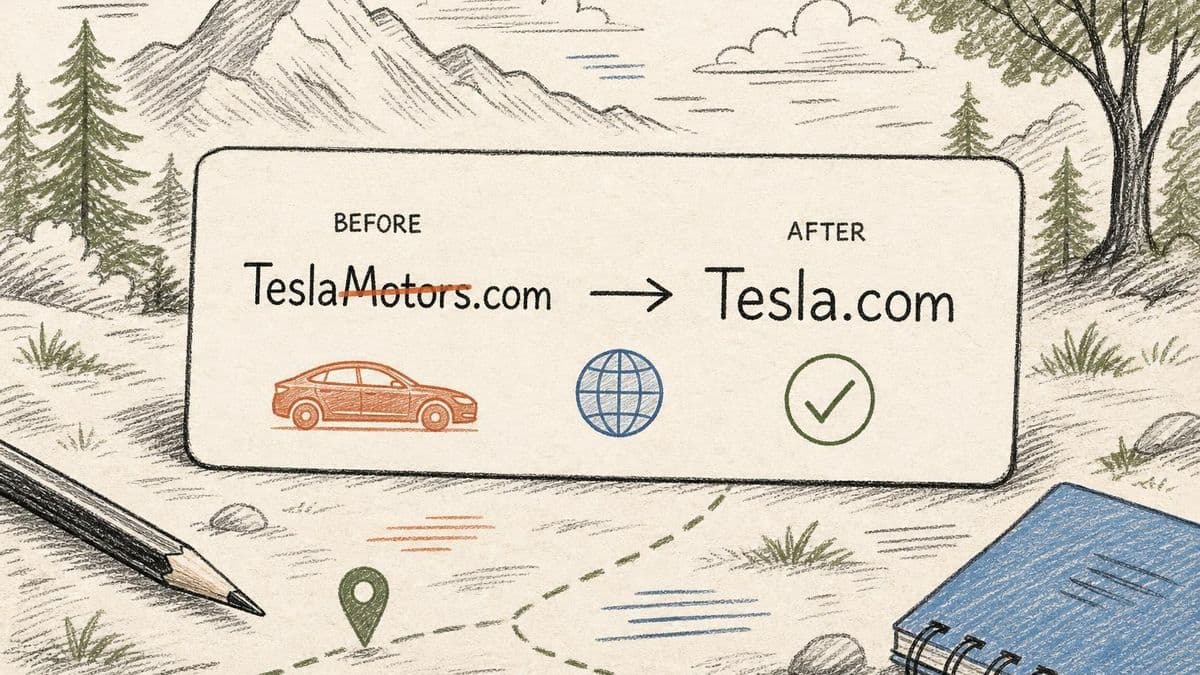
The gap between TeslaMotors.com and Tesla.com is one word. Strategically, it is the difference between a product and a category.
TeslaMotors.com describes what the company sold. Tesla.com names what the company is. One is a label on a car business; the other is a container big enough for cars, batteries, solar, software, energy, and whatever comes next.
| Before | After |
|---|---|
| TeslaMotors.com | Tesla.com |
| Names a car company | Names a company without a ceiling |
| Anchored to one product category | Travels across cars, energy, and software |
| Reads like a division | Reads like the parent |
| Adds a word to every mention | Reduces the brand to one word |
This is the same pattern that shows up again and again in domain upgrades: early names explain, great names own. The descriptive version helps when a company still has to tell you what it does. The exact-match version helps once the company is big enough that the name should simply be the category. Tesla bought its way from one to the other.
2017: the domain that arrived just before the rebrand
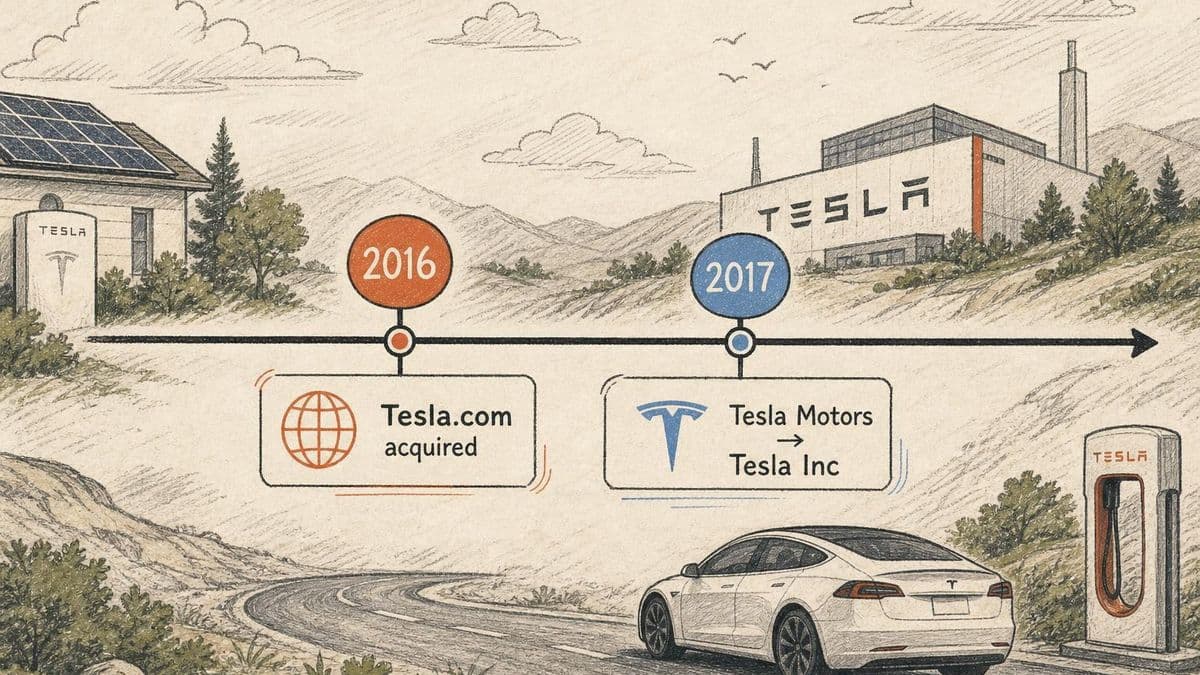
Here is the detail that makes Tesla.com more than a vanity purchase: the domain came first, and the corporate rebrand followed.
When Tesla acquired the domain in 2016, observers immediately read it as a tell. Green Car Reports noted that acquiring the shorter name removed one hurdle should Musk decide to change the name of "Tesla Motors" to simply "Tesla". You don't pay $11 million for Tesla.com if you intend to stay Tesla Motors forever.
The prediction landed. On February 1, 2017, Tesla officially changed its name from Tesla Motors, Inc. to Tesla, Inc. The reasoning matched the domain logic exactly: the company was now not just an automaker, but also a technology and design company with a focus on energy innovation.
Sequence matters here. The domain was the first public, paid-for commitment to dropping "Motors." Owning Tesla.com made the rebrand cheap and obvious instead of awkward and incomplete. Imagine the alternative: announcing you're now "Tesla, Inc." while your website still lives at TeslaMotors.com. The name change and the domain had to move together, and the expensive, slow-to-acquire piece — the domain — had to be secured first.
The domain became part of the operating system
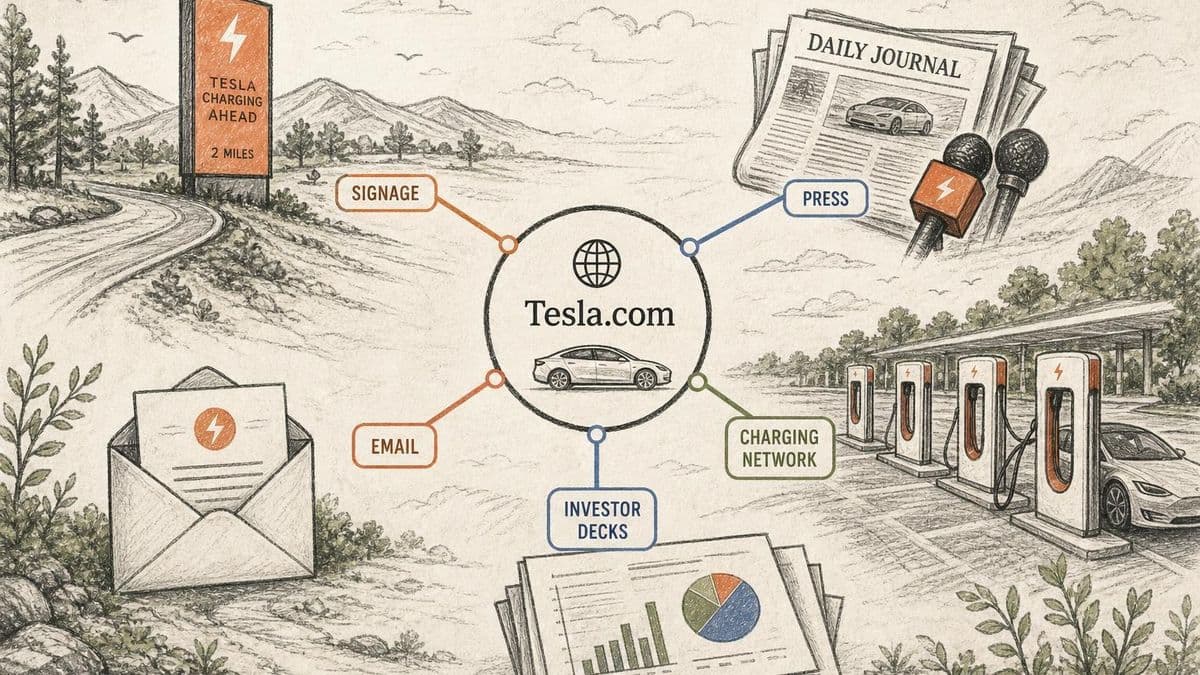
Premium domains are not about prestige. They are about repetition.
A company's core domain shows up in places the marketing team never directly controls:
- In email addresses and employee signatures.
- In press headlines and analyst reports.
- In Supercharger signage, retail stores, and delivery paperwork.
- In search results and browser bars.
- In every investor deck and every word-of-mouth recommendation.
Every one of those repetitions either adds friction or removes it. TeslaMotors.com made each mention slightly longer, slightly more product-bound, slightly more "car company." Tesla.com made each mention shorter, cleaner, and category-free. Multiply that across millions of customers, hundreds of thousands of employees over time, and a brand mentioned in the news almost daily, and the $11 million stops looking like a luxury and starts looking like a permanent reduction in drag.
The domain didn't build Tesla's brand. But once Tesla.com was the address, every future repetition of the name compounded on a cleaner foundation.
What founders should learn from Case 2
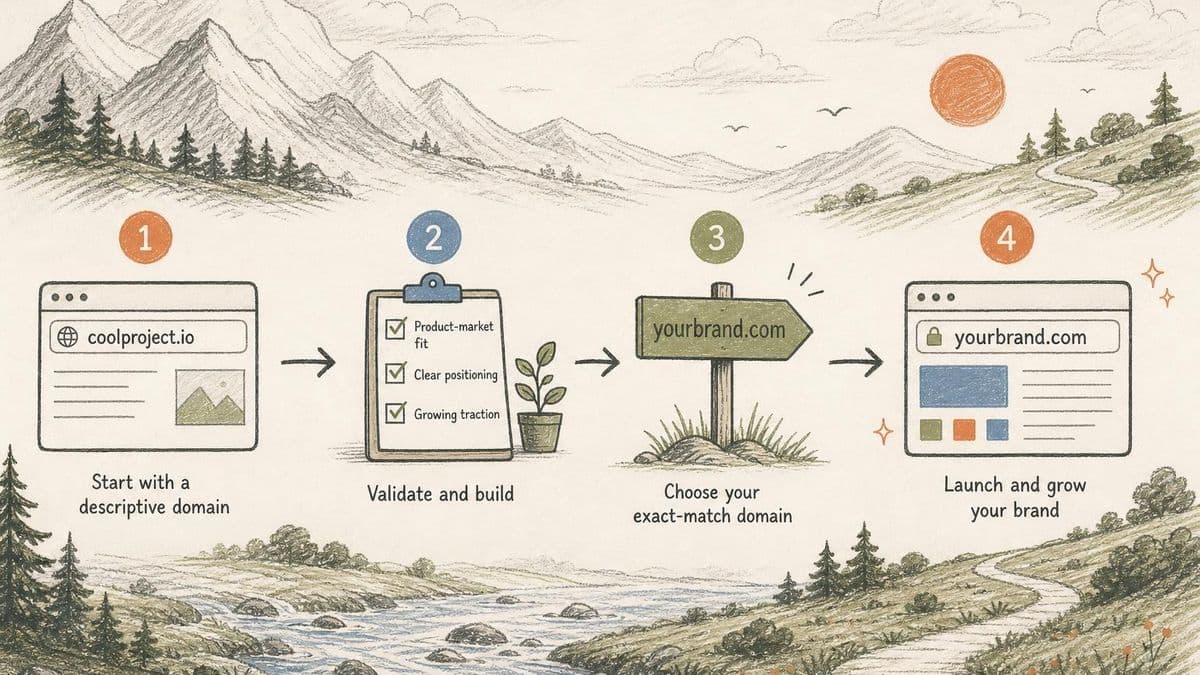
The easy takeaway — "buy your exact-match .com early" — is the wrong one. Tesla couldn't buy Tesla.com early; the owner wouldn't sell. The more useful lessons are about timing and treatment:
- A descriptive domain is fine to start. TeslaMotors.com did its job for thirteen years and through some of the most important product launches in the company's history. A modifier like "Motors," "App," or "HQ" is not a failure; it is a reasonable on-ramp.
- Watch for the moment the modifier becomes a ceiling. The signal to upgrade isn't aesthetic. It's when your name starts describing a smaller company than the one you're becoming. For Tesla, that was the pivot beyond cars.
- Treat the exact-match domain as infrastructure. $11 million bought brand clarity, recruiting signal, press cleanliness, and a rebrand runway — not a nicer URL.
- Secure the domain before the rename, not after. The slow, expensive, externally-owned asset has to be locked down first. The corporate identity can follow in an afternoon; the domain can take a decade.
The domain upgrade did not make Tesla win. Product, capital, timing, and execution mattered far more. But Tesla.com made the company's reinvention as an energy business nameable — and it had to be bought years before anyone could use it.
The Namefi angle
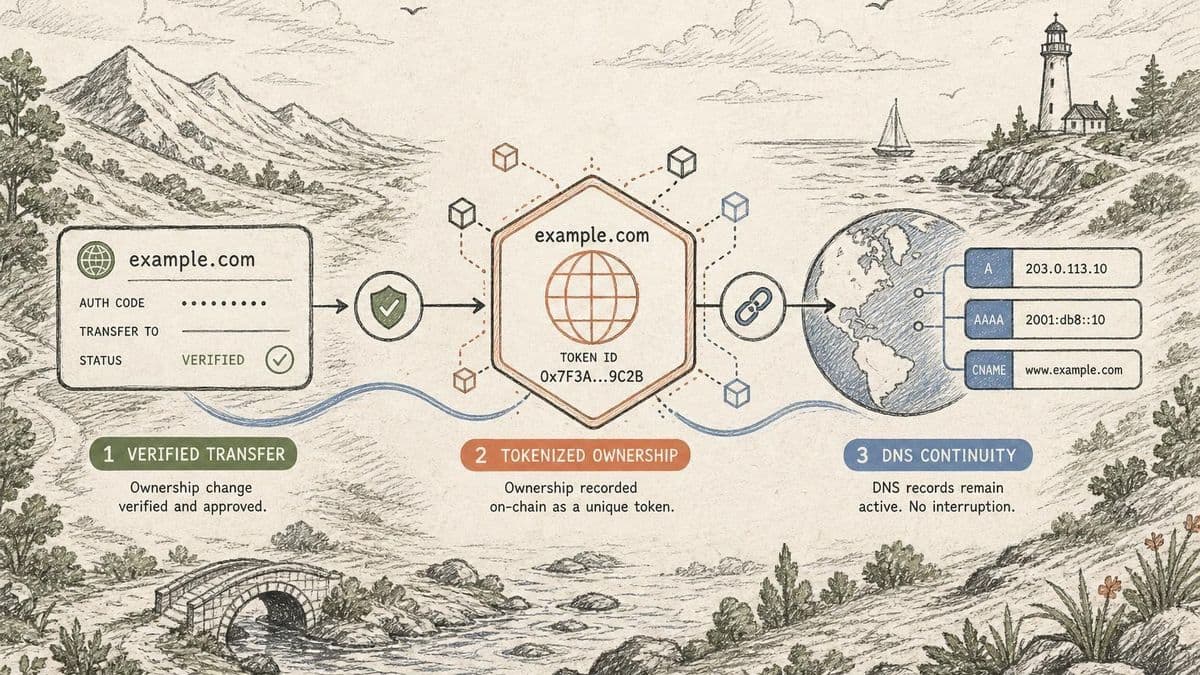
Tesla's ten-year saga is, at its core, a transfer problem.
The strategic decision was never really in doubt — of course a company called Tesla should own Tesla.com. The hard part was everything around the asset: finding terms a reluctant long-term owner would accept, negotiating under NDA, agreeing on a price with no public comparables, moving millions of dollars, transferring control cleanly, and doing it all without disrupting the live site or the brand. A decade of effort went not into deciding whether to upgrade, but into safely executing the upgrade.
Namefi is built around the idea that domains should behave like internet-native assets. Tokenized ownership can make domain control easier to verify, transfer, and integrate into modern workflows while staying compatible with DNS — turning the messiest part of a deal like this (proving who owns what, and moving it safely) into something closer to a clean, auditable transaction.
Tesla.com looks inevitable now because Tesla became enormous. But the lesson lands long before that scale: when a name is going to carry the business, the domain isn't decoration. It's the part of the brand worth waiting a decade — and paying eleven million dollars — to get right.
Sources and further reading
- Electrek — Tesla Motors acquires premium domain name 'Tesla.com'
- Bloomberg — Musk Gets Tesla.com Domain Name After Waiting a Decade
- Green Car Reports — Tesla Finally Gets Tesla.com Domain; Could Name Change Follow?
- DomainInvesting.com — Elon Musk on What it Took to Acquire Tesla.com
- Smart Branding — TeslaMotors.com Upgrades to Tesla.com
- James Names — Case Study: Why Musk Acquired Tesla.com for $11 Million
- TechCrunch — Tesla Motors, Inc. is now officially Tesla, Inc.
- Tesla Investor Relations — Tesla Motors Begins Regular Production of the 2008 Tesla Roadster
Contributors

Fenwei Bian is a software developer in her thirties who spends her working hours in pull requests and her weekends with her hands in soil or sawdust. Years of open source on GitHub taught her that names are interfaces: a good one is clear, honest about what it does, and kind to whoever has to use it next.
She gardens because it rewards patience and punishes wishful thinking, and she does woodwork because a joint either fits or it doesn't. Both habits show up in how she writes about naming — measure twice, check the source, and don't sand over a rough spot and hope no one notices.
For Namefi she writes about how domain markets actually move, the practical trade-offs of tokenizing and flipping names, and picking a domain you'll still be glad you own in twenty years.

Victor Zhou is a technology founder and standards editor focused on digital identity and trust. He founded Namefi, edits Ethereum Improvement Proposals, and previously led smart-contract architecture work at Google Labs.
His work sits at the intersection of naming, ownership, and the systems people use to establish identity online. That perspective makes him especially interested in the way names move between personal meaning, public recognition, and digital infrastructure.
For Namefi, Victor edits and writes about domains as durable digital identity: how names become ownable onchain assets, how tokenization changes custody and trust, and what naming can learn from the systems people use to establish identity online.
Related guides
- From Box.net to Box.com: The ~$1M Upgrade That Dropped the ".net" and Bought the Exact MatchHow Box launched in 2005 on Box.net because Box.com was taken, pivoted from consumer storage to the enterprise, and in 2011 paid Digimedia close to $1 million for the exact-match Box.com — a .net-to-.com upgrade that landed right as the company became simply "Box."
- From BufferApp.com to Buffer.com: The 624-Day, Bank-Statement-Open Domain DealHow Buffer launched in 2010 on BufferApp.com because Buffer.com was taken, then spent 624 days acquiring the exact-match domain — even showing the seller its bank balance — and why a company famous for radical transparency stayed quiet on the one number everyone wanted: the price.
- Who Owns Trip.com? Ctrip, Trip.com Group, and the RebrandUnderstand how Trip.com relates to Ctrip and Trip.com Group, and trace the acquisition and company-name changes behind the travel brand.
- From del.icio.us to Delicious.com: The Cleverest Domain Hack on the Web — and Why Yahoo Untangled ItHow the pioneering social-bookmarking site launched in 2003 as the famous domain hack "del.icio.us," why those dots became a permanent tax on every mention, and how Yahoo moved it to the cleaner Delicious.com in 2008.