
From Facebook.com to Meta.com: How a $60M Name Deal and a Borrowed Science Domain Powered the Metaverse Pivot
How Facebook, Inc. became Meta in October 2021, why Meta.com was already a Zuckerberg-related asset forwarding from a science search engine, and how a separate $60M deal bought the "Meta" name from a Sioux Falls bank — while the Facebook app kept Facebook.com.
- domains
- branding
- startups
- domain-upgrades

Most rebrands in this series start with a company outgrowing a name. Case 7 is the opposite: a company so large it had already become a verb, a regulator's headache, and a household word — deciding it needed a new name anyway, one big enough to hold a future it hadn't built yet.
On October 28, 2021, at its Connect event, the company behind Facebook announced it was no longer, at the corporate level, Facebook. TechCrunch put the scale of it plainly: after 17 years of being called Facebook, the social networking parent company behind Facebook, Instagram, WhatsApp and Oculus has a new name. That name was Meta, and the address was Meta.com.
But this is not a story about Facebook.com being retired. It wasn't. The crucial, often-missed detail is that only the parent company changed. As Zuckerberg said in the same announcement, our apps and our brands — they're not changing either. The Facebook app stayed Facebook. Facebook.com stayed Facebook.com. What moved was the corporate identity — the holding company, the stock ticker, the masthead — onto a domain the company, conveniently, already controlled through a different Zuckerberg venture entirely.
That last part is the real domain story. Meta.com wasn't a panicked, last-minute multimillion-dollar buy. It was a borrowed asset from a science search engine, paired with a separate $60 million deal to buy the literal word "Meta" from a regional bank in South Dakota.
The era when Facebook was the parent
For 17 years, "Facebook" was both the product and the parent. Facebook the app, Facebook the company, Facebook the stock — all one word, all one domain. The company had spent serious money over the years to make that single name canonical, including the $200,000 it paid for Facebook.com in 2005 (Case 1 in this series) and the $8.5 million it later paid for FB.com.
By 2021, that tight identity had become a problem. Facebook the app was one of several huge properties — alongside Instagram, WhatsApp, and Oculus — but it lent its name to all of them. When the app drew controversy, the controversy attached to the parent. And the parent wanted to talk about something the app couldn't contain: the metaverse.
A company can't credibly say "we are bigger than our most famous product" while that product's name is also the company's name, the company's domain, and the company's stock ticker. To separate the two, Facebook needed a parent-level identity that lived somewhere other than Facebook.com.
October 28, 2021: the metaverse rebrand and the Meta.com move
The rebrand was staged as a pivot, not a retreat. Zuckerberg framed the company's whole future around a single word: from now on, we're going to be metaverse-first, not Facebook-first. In the official announcement, the company said Meta's focus will be to bring the metaverse to life and described how the metaverse will feel like a hybrid of today's online social experiences. The name itself was chosen for reach: Meta, from the Greek for "beyond." Even the stock ticker was set to move — the company said it intended to start trading under the new stock ticker we have reserved, MVRS, on December 1.
And the corporate web identity moved to Meta.com — a domain that, on the day of the announcement, quietly switched what it pointed to. Domain Name Wire caught it in real time: at some point today, Meta.com stopped forwarding to Meta.org, and the domain began forwarding to a page within the Facebook.com website about the metaverse. The same report noted the punchline that made the whole rebrand logistically painless: because a Mark Zuckerberg related entity owned Meta.com already, it would be pretty easy for Facebook to rebrand as Meta.
That is the difference between Case 7 and almost every other domain story: the company didn't have to find the owner of Meta.com under deadline pressure. The owner was, more or less, family.
Who already owned Meta.com — and the "Meta" name
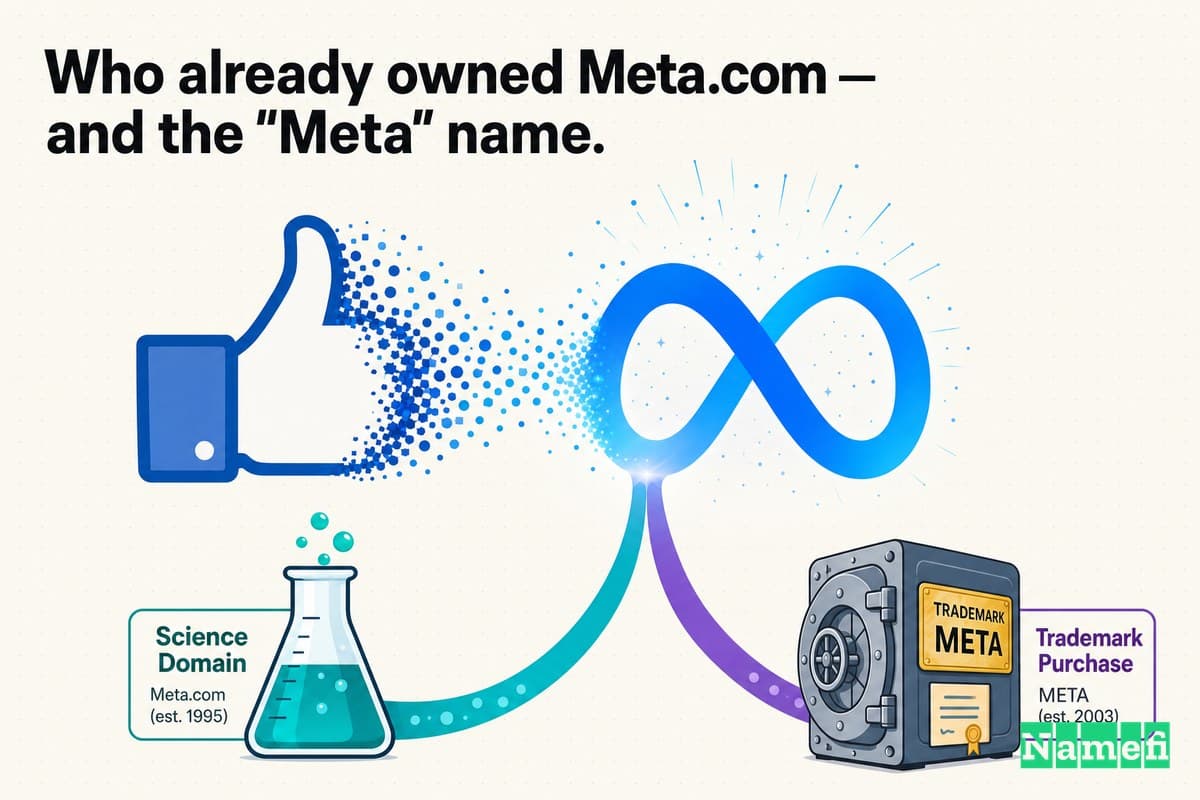
Meta.com had a long, unglamorous life before it became the front door of a trillion-dollar company. The domain was registered in 1991, and over the years it pointed at a real-estate news site, then at an events company — Smart Branding's history notes a period redirecting users to Meta Productions, LLC. Then, as that history records, a significant change occurred in early 2017 when Meta.com began pointing to a scientific discovery platform known as Meta.
That science platform is the key. In January 2017, the Chan Zuckerberg Initiative — the philanthropy founded by Mark Zuckerberg and Priscilla Chan — announced it was acquiring Meta, an AI-powered research search engine startup that helped scientists search, read and tie together more than 26 million science research papers. CZI promised to make its tool free to all. That science startup controls the URL meta.org — and, as Domain Name Wire confirmed, Meta.com was forwarding to Meta.org, the website for a project called Meta from the Chan Zuckerberg Initiative.
So the domain came in through philanthropy. The trademark came in through a bank. Meta.com and the science name were a Zuckerberg-adjacent asset, but the worldwide commercial rights to the word "Meta" sat with Meta Financial Group, a Sioux Falls, South Dakota bank holding company (parent of MetaBank). Reuters revealed the buyer: Meta Platforms Inc, the owner of social media platform Facebook, is behind a $60 million deal to acquire the trademark assets of U.S. regional bank Meta Financial Group. The deal ran through a Delaware shell: a Delaware company called Beige Key LLC agreed to acquire the worldwide rights to its company names for $60 million in cash, and a Meta spokesperson confirmed Beige Key is affiliated with us and we have acquired these trademark assets.
That $60 million bought more than a logo. The Sioux Falls coverage spelled out the scope: Meta Financial would assign the company's names and trade names, including MetaBank, to Meta Platforms, along with the associated domain names and social media accounts — and the agreement allows a year for phasing out the Meta name on the bank's side. (The bank later rebranded as Pathward.)
The money looked different then
It's tempting to read "$60 million for a name" as Facebook flexing. But the structure of the deal shows a company managing risk, not just spending.
Meta Financial's own SEC filing laid out the mechanics, executed December 7, 2021: the bank would receive $50,000,000 upon execution and delivery of the Agreement, with $10,000,000 held in escrow by a third-party agent, to be released only after the bank certified that the phase-out period was complete. In other words, $10 million of the price was contingent on Meta Financial actually stopping its use of the name — Meta wasn't just buying a word, it was buying the quiet exit of the only other prominent commercial "Meta" in the U.S.
Set against the company's scale, $60 million was rounding error. But the shape of the spend is the lesson: a clean global identity is worth real money, and the messy part isn't the headline price — it's clearing every competing claim to the name so the new brand can be canonical and unconflicted everywhere at once.
That's also why the science-search "Meta" had to go. On the very day of the Facebook rebrand, Vice reported, the Initiative announced it will shut down by 2022 — and the piece noted, dryly, that Facebook — er, Meta — owns meta.com. The domain was freed up by sunsetting the thing it used to point to.
Why the rebrand to Meta mattered
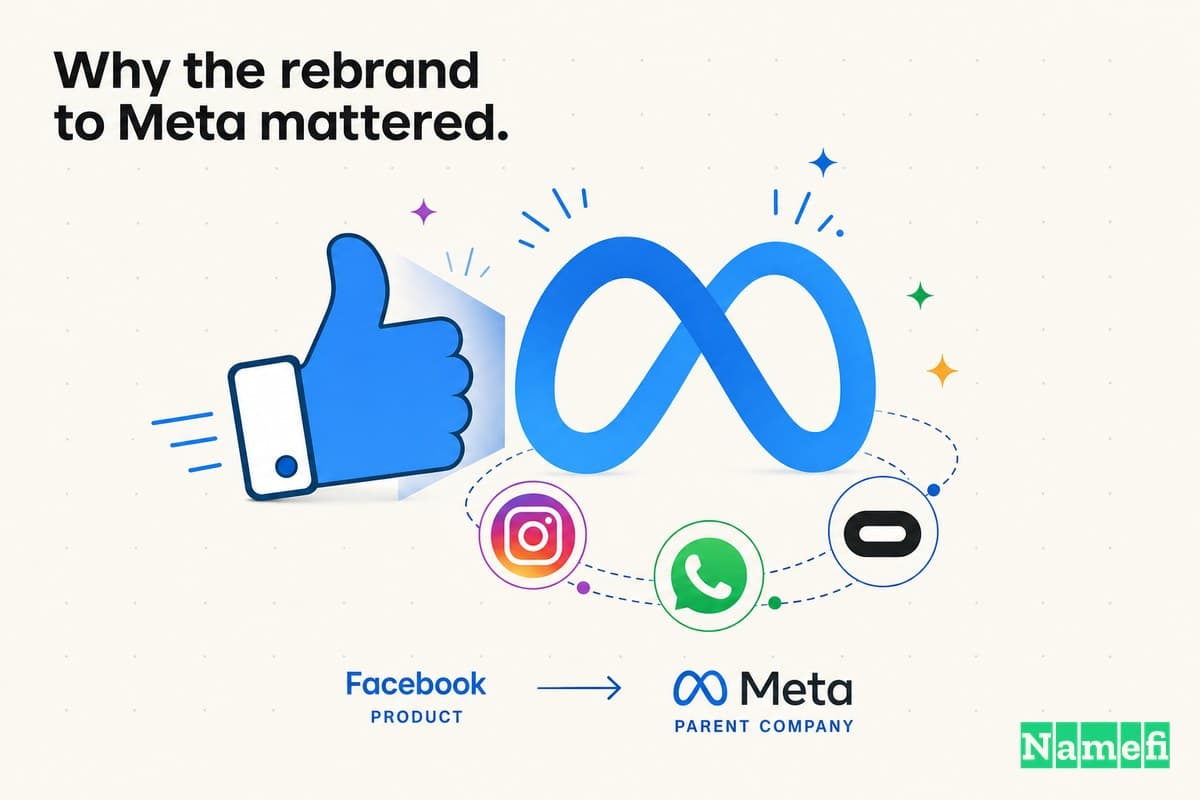
The gap between Facebook.com and Meta.com isn't an upgrade from a worse name to a better one. Both are excellent domains. The change is structural: it splits a product identity from a parent identity that had been fused for 17 years.
| Before | After |
|---|---|
| Facebook.com (company + app) | Meta.com (company) + Facebook.com (app) |
| Parent named after one product | Parent named after the whole portfolio |
| Controversy on the app hits the company brand | Parent brand sits one layer above any single app |
| Identity anchored to social networking | Identity anchored to "the metaverse," open-ended |
| One name carries everything | A holding-company name lets sub-brands breathe |
This is a different move than dropping "The" from TheFacebook.com or "Cab" from UberCab.com. Those upgrades made a single brand cleaner. The Meta rebrand built a roof — a parent name that could sit above Facebook, Instagram, WhatsApp, Oculus, and whatever came next, without any one of them being the thing the whole company was named after.
For founders, the takeaway isn't "rename your company to a Greek prefix." It's that there's a stage where the product name and the company name should stop being the same word — and when that day comes, the company needs a parent-level domain it can actually control.
The sequence: borrow the domain, then buy the name
The order of operations is what makes Case 7 unusually smooth.
Meta didn't announce a new name and then scramble for the domain. The pieces were lined up first, in a sequence most companies can't replicate:
- The domain was already in the family. Meta.com forwarded to meta.org, the CZI science project — a Zuckerberg-related entity. Control of the address existed before the rebrand was public.
- The competing science brand was sunset on cue. The science Meta announced its wind-down on rebrand day, freeing both the name and the domain's destination.
- The trademark was bought separately, and confidentially. The Beige Key shell quietly negotiated the $60 million Meta Financial deal so the rebrand wasn't tipped off by a public name fight.
- The redirect flipped on announcement day. Meta.com stopped pointing at meta.org and started pointing at the metaverse page — the visible switch that made the rebrand feel instant.
Notice what's externally owned and slow in every other case in this series — the domain — was, here, the easy part. The hard, money-and-lawyers part was the trademark, owned by an unrelated bank. Meta had to clear both, but it staged them so the public only ever saw a clean flip.
The domain became part of the operating system
A parent-company domain isn't decoration. Once the rebrand landed, Meta.com had to start doing the quiet, infinite work a core domain does:
- It's the masthead of corporate communications and the newsroom.
- It's the identity investors and regulators address.
- It's the umbrella over Facebook.com, Instagram.com, WhatsApp.com, and more.
- It's where a "metaverse-first" story gets told without the word "Facebook" in the URL.
That last point is the entire reason to move. Every time the company wanted to talk about its future on its own letterhead, the old domain dragged the most controversial product's name back into the sentence. Meta.com gave the parent a place to stand that wasn't named after any single app — while Facebook.com kept doing its own job, unchanged, for billions of users who never had to think about the rebrand at all.
The genius wasn't paying for Meta.com. It was already controlling it. The work was making sure that, on a single day, the world's most scrutinized company could change its corporate name without a domain dispute, a trademark suit, or a broken redirect.
What founders should learn from Case 7
The easy version of this story — "Facebook became Meta" — hides the useful lessons. The real ones are about separation and sequencing:
- Know when the product name should stop being the company name. For 17 years they were one word. When the parent needed to be bigger than its most famous app, the names — and the domains — had to split. Most companies hit a smaller version of this when a second product matters as much as the first.
- A parent-company domain is a different asset than a product domain. Facebook.com names the app. Meta.com names the holding company. Founders building a portfolio should secure a clean parent-level name before the org chart demands it, not during a crisis.
- Clearing the name is harder than buying the domain. Meta already controlled Meta.com. The expensive, slow part was the trademark — buying the bank's rights for $60 million and sunsetting the science brand. A great domain you own is worthless if someone else owns the word commercially.
- Stage the moving parts so the public sees one clean flip. The redirect, the trademark deal, the science wind-down, and the announcement were sequenced so that on October 28 it all looked instantaneous. Behind that was months of un-public work clearing claims.
Meta didn't win because of a domain. It had already won, on the back of Facebook.com. The rebrand was about giving the next bet a name and an address that the existing brand couldn't constrain.
The Namefi angle
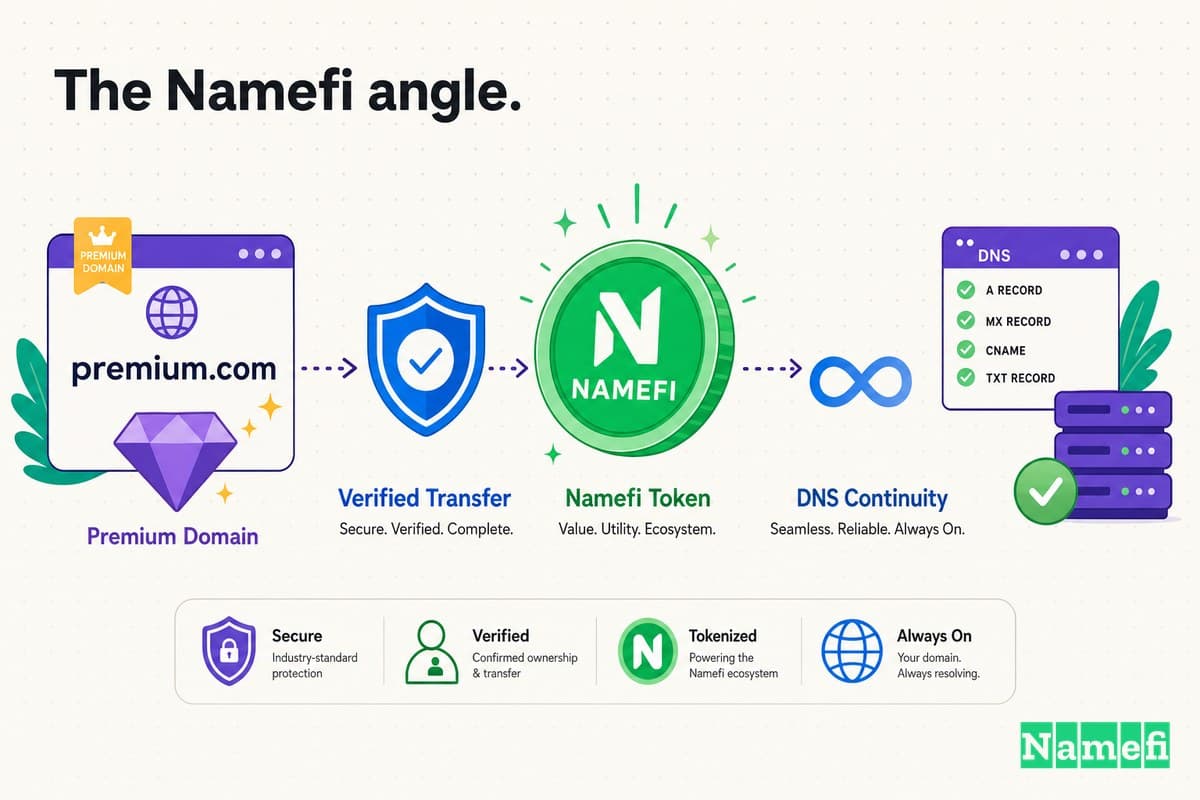
Strip away the metaverse and Case 7 is a study in everything that makes domain-plus-name deals hard — and a preview of how they could be easier.
Look at how many separate, friction-heavy threads Meta had to braid together: a domain held by a philanthropy-owned entity, forwarding to a second domain (meta.org); a competing commercial brand owned by a bank, cleared through a confidential shell company for $60 million with $10 million held in escrow against a phase-out; a redirect that had to flip on an exact date; and a trademark that had to be clean worldwide for the new identity to be safe everywhere. Even for a company with unlimited lawyers, proving who owned what, agreeing on value, structuring the escrow, and moving control cleanly took a Delaware LLC and an SEC filing to surface.
Namefi is built around the idea that domains should behave like internet-native assets. Tokenized ownership can make domain control easier to verify, transfer, and integrate into modern workflows while staying compatible with DNS — turning the murkiest parts of a deal like this (who actually holds Meta.com, what the name is worth, how to move it without breaking the redirect, how to bind payment and transfer into a single verifiable step) into something closer to a clean, auditable, programmable transaction.
Meta.com looks inevitable now because Meta became enormous. But the lesson lands earlier: when a company decides its parent identity must outgrow its most famous product, the domain and the name behind it aren't decoration. They're the foundation the next chapter gets built on — and they're worth clearing, escrowing, and sequencing with the same care Meta spent to make one rebrand look like a single, effortless flip.
Sources and further reading
- Meta Newsroom — The Facebook Company Is Now Meta
- TechCrunch — Facebook changes its corporate branding to Meta
- NPR — Facebook is changing its name to Meta, Zuckerberg announces
- Domain Name Wire — Yes, Facebook chose Meta for its new name and forwards Meta.com
- Smart Branding — The many lives of a domain name
- TechCrunch — Chan Zuckerberg Initiative acquires and will free up science search engine Meta
- Vice — Zuckerberg's Foundation Kills 'Meta' Science Company on Day of Facebook Rebrand
- KFGO / Reuters — Exclusive: Facebook owner is behind $60 million deal for Meta name rights
- SiouxFalls.Business — Money for Meta: Facebook paying Sioux Falls company $60M for trademark, name
- U.S. SEC — Meta Financial Group, Inc. Form 8-K (Dec. 7, 2021)
- DomainInvesting.com — Facebook Rebrands as Meta; Using Meta.com
- InformationWeek — Facebook Paid $8.5 Million For FB.com
- NBC Bay Area — Facebook Paid Big Bucks to Farm Bureau
- Wikipedia — Meta Platforms
Contributors

Fenwei Bian is a software developer in her thirties who spends her working hours in pull requests and her weekends with her hands in soil or sawdust. Years of open source on GitHub taught her that names are interfaces: a good one is clear, honest about what it does, and kind to whoever has to use it next.
She gardens because it rewards patience and punishes wishful thinking, and she does woodwork because a joint either fits or it doesn't. Both habits show up in how she writes about naming — measure twice, check the source, and don't sand over a rough spot and hope no one notices.
For Namefi she writes about how domain markets actually move, the practical trade-offs of tokenizing and flipping names, and picking a domain you'll still be glad you own in twenty years.

Victor Zhou is a technology founder and standards editor focused on digital identity and trust. He founded Namefi, edits Ethereum Improvement Proposals, and previously led smart-contract architecture work at Google Labs.
His work sits at the intersection of naming, ownership, and the systems people use to establish identity online. That perspective makes him especially interested in the way names move between personal meaning, public recognition, and digital infrastructure.
For Namefi, Victor edits and writes about domains as durable digital identity: how names become ownable onchain assets, how tokenization changes custody and trust, and what naming can learn from the systems people use to establish identity online.
Related guides
- From Box.net to Box.com: The ~$1M Upgrade That Dropped the ".net" and Bought the Exact MatchHow Box launched in 2005 on Box.net because Box.com was taken, pivoted from consumer storage to the enterprise, and in 2011 paid Digimedia close to $1 million for the exact-match Box.com — a .net-to-.com upgrade that landed right as the company became simply "Box."
- From BufferApp.com to Buffer.com: The 624-Day, Bank-Statement-Open Domain DealHow Buffer launched in 2010 on BufferApp.com because Buffer.com was taken, then spent 624 days acquiring the exact-match domain — even showing the seller its bank balance — and why a company famous for radical transparency stayed quiet on the one number everyone wanted: the price.
- Who Owns Trip.com? Ctrip, Trip.com Group, and the RebrandUnderstand how Trip.com relates to Ctrip and Trip.com Group, and trace the acquisition and company-name changes behind the travel brand.
- From del.icio.us to Delicious.com: The Cleverest Domain Hack on the Web — and Why Yahoo Untangled ItHow the pioneering social-bookmarking site launched in 2003 as the famous domain hack "del.icio.us," why those dots became a permanent tax on every mention, and how Yahoo moved it to the cleaner Delicious.com in 2008.