From Instagr.am to Instagram.com: The $100K Domain Hack That Spelled a Brand With Armenia
How Instagram launched in 2010 on the instagr.am domain hack — borrowing Armenia's .am ccTLD to spell its own name — then paid $100,000 to consolidate on Instagram.com, and what the tradeoffs of a clever ccTLD hack teach founders.
- domains
- branding
- startups
- domain-upgrades

Before Instagram became a billion-user platform, a verb for taking pictures, and one of the most valuable apps Facebook ever bought, it had a name that was also a piece of clever engineering: instagr.am.
That address was not a typo and not a redirect trick. It was a domain hack — a domain name where the extension itself finishes the word. Wikipedia defines the form precisely: a domain hack is a domain name that suggests a word, phrase, or name when concatenating two or more adjacent levels of that domain, and it names Instagram's as a textbook case: instagr.am makes use of the ccTLD .am (Armenia) to spell the name of photo-sharing service "Instagram".
Read that again. To spell its own brand, a San Francisco photo app borrowed the country-code top-level domain of Armenia, a country roughly 7,000 miles away. The "am" in Instagram lived, technically, in Yerevan.
For a tiny startup launching into a crowded App Store, the hack was a gift. It was short, it was exact, it read as one word, and — crucially — it was available when the obvious address, Instagram.com, was not.
But a borrowed country code is a borrowed foundation. Within a few months of launch, Instagram quietly went and bought the real thing. The company made the decision to pay $100,000 for the domain in January 2011, consolidating onto Instagram.com before most of the world had even heard the name.
This is the story of the cleverest launch domain in startup history — and why the company that built it didn't keep it.
October 2010: the launch that crashed under its own success
Instagram came out of a pivot. Kevin Systrom and Mike Krieger had been building a location-based check-in app called Burbn; when they stripped it down to photos, filters, and sharing, the modern app emerged. Per Wikipedia, Instagram was launched for iOS in October 2010 by Kevin Systrom and the Brazilian software engineer Mike Krieger. The WIPO record for a later domain dispute fixes the exact date: Instagram was launched on October 6, 2010.
The reception was instant and overwhelming. Wikipedia's timeline records that over 25,000 users registered on launch day, and over 100,000 in just a few days after launch. Entrepreneur's history notes that Systrom and Krieger launched with just 80 initial users the day before — and within hours the site crashed multiple times under the traffic. The growth didn't stop: Instagram kept reaching 1 million registered users in two months, 10 million in a year, and the September 2011 redesign added new and live filters that cemented the aesthetic.
Through all of that explosive early adoption, the brand people typed and shared was instagr.am.
The instagr.am era: spelling a brand with a country code
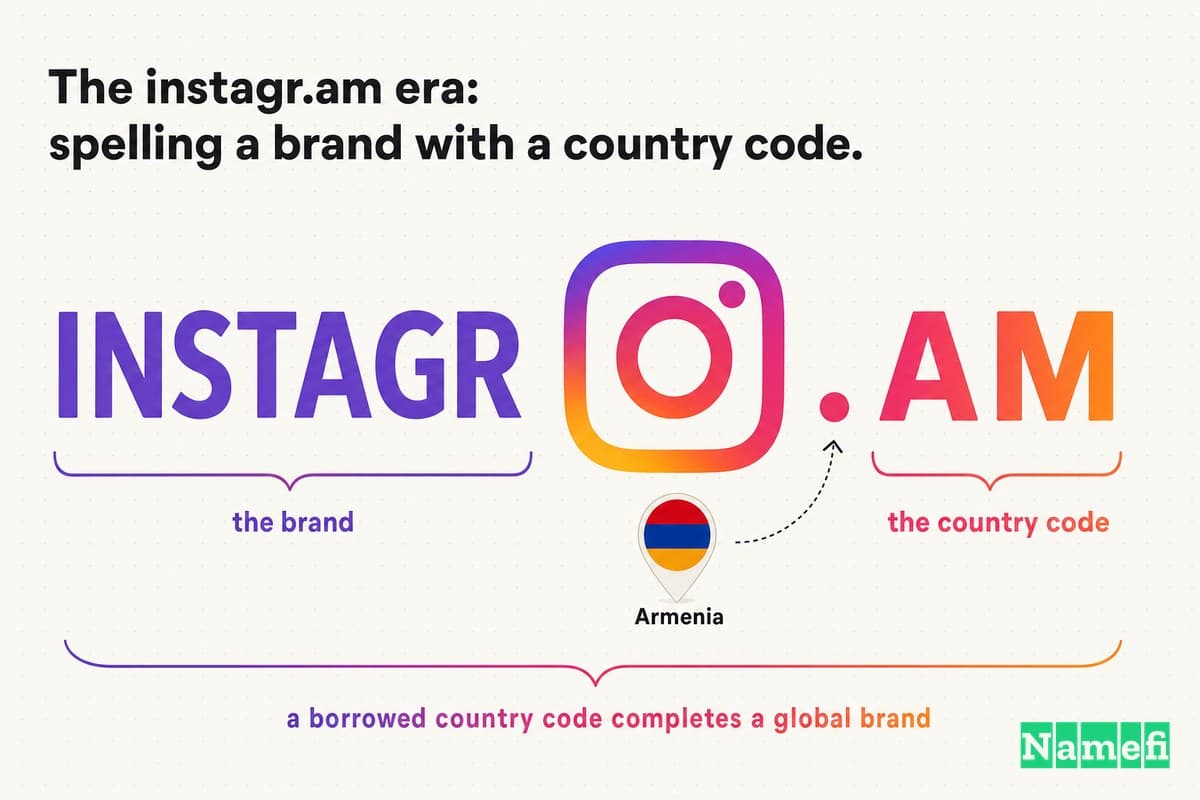
To understand why instagr.am was so attractive, you have to understand what .am actually is. It is not a generic extension. Per Wikipedia, .am is the internet country code top-level domain (ccTLD) for Armenia, introduced in 1994 and operated by ISOC-AM, the local chapter of the Internet Society. The reason it works as branding is liberal registration policy plus a useful ending: any person in the world can register a .am domain, and the extension is prized for the ability to form English words ending in "am". Instagram was in good company; the same Wikipedia page lists fellow .am hacks like the streaming service Stre.am and musician will.i.am.
For a 2010 startup, the appeal was obvious:
- It was exact. "instagr" + ".am" reads as the full brand, with nothing extra to explain — the holy grail of an early-stage launch.
- It was short and shareable. A photo app lives or dies on how easily a link gets passed around. instagr.am was tight enough to print, text, and tweet.
- It was available right now. Instagram.com was already owned by someone else, and a brand-new app had little leverage to pry it loose on day one.
The hack let Instagram look like it owned its exact-match name long before it actually did. That was the whole trick — and it worked beautifully while the company was small.
The problem is what a borrowed foundation costs once you are no longer small.
The catch in a clever ccTLD hack
A domain hack built on a country code carries a quiet set of dependencies that a plain .com does not.
First, you are a guest in someone else's namespace. The policies, pricing, and stability of .am are set by Armenia's registry, not by you. That is fine until your brand is worth billions and your address answers to a registry on the other side of the world.
Second, the hack can read as a typo. "instagr.am" looks, to a casual user, like a mistyped "instagram." People drop the dot, assume .com, and type "instagram.com" out of habit — which means every share leaks traffic to whoever owns the obvious address.
Third — and this is the part founders underrate — the obvious address was a liability as long as someone else held it. While Instagram grew on instagr.am, Instagram.com was a parking page. WIPO's later record notes that by January 22, 2011, the website connected to instagram.com was pointing to a parking page displaying links related to the Complainant's services like photos and iPhone apps. In other words, a third party was monetizing Instagram's own name and momentum.
Domain-history write-ups land on the same lesson. One retrospective quotes Bloomberg Businessweek observing that early Instagram lacked real company accoutrements — not even a permanent web address since it was still using instagr.am — and concludes that hacks like this should generally be secondary URLs, with the pronounceable, default-typed .com as the real home.
A clever hack is a great front door. It makes a risky permanent address.
The money looked different then
It is tempting to judge the $100,000 from the end of the story, where Instagram is worth tens of billions and a hundred grand for the exact-match .com looks like a rounding error.
But rewind to January 2011. Instagram was a few months old. It had a hit app and a crash-prone server, but no revenue, a tiny team, and a future that was anything but guaranteed in a market where photo apps appeared and vanished weekly. Against that backdrop, $100,000 in cash for a domain — when you already had a working address at instagr.am — was a real allocation decision, not an obvious one.
And the deal itself was not clean. Reporting on a later Facebook lawsuit revealed the seller was a Chinese registrant; the purchase was processed by Sedo, according to a copy of the deal filed as evidence. Years later the transaction grew teeth: as one account put it, Murong's mother and sisters are suing her and Instagram in China, claiming she did not have the authority to sell the domain. Instagram had bought its own name — and still ended up litigating who really owned what.
That is the unglamorous truth behind almost every premium-domain story: the strategic call ("we should own Instagram.com") is the easy part. Proving clean title and moving the asset safely is the hard part.
Why moving to Instagram.com mattered
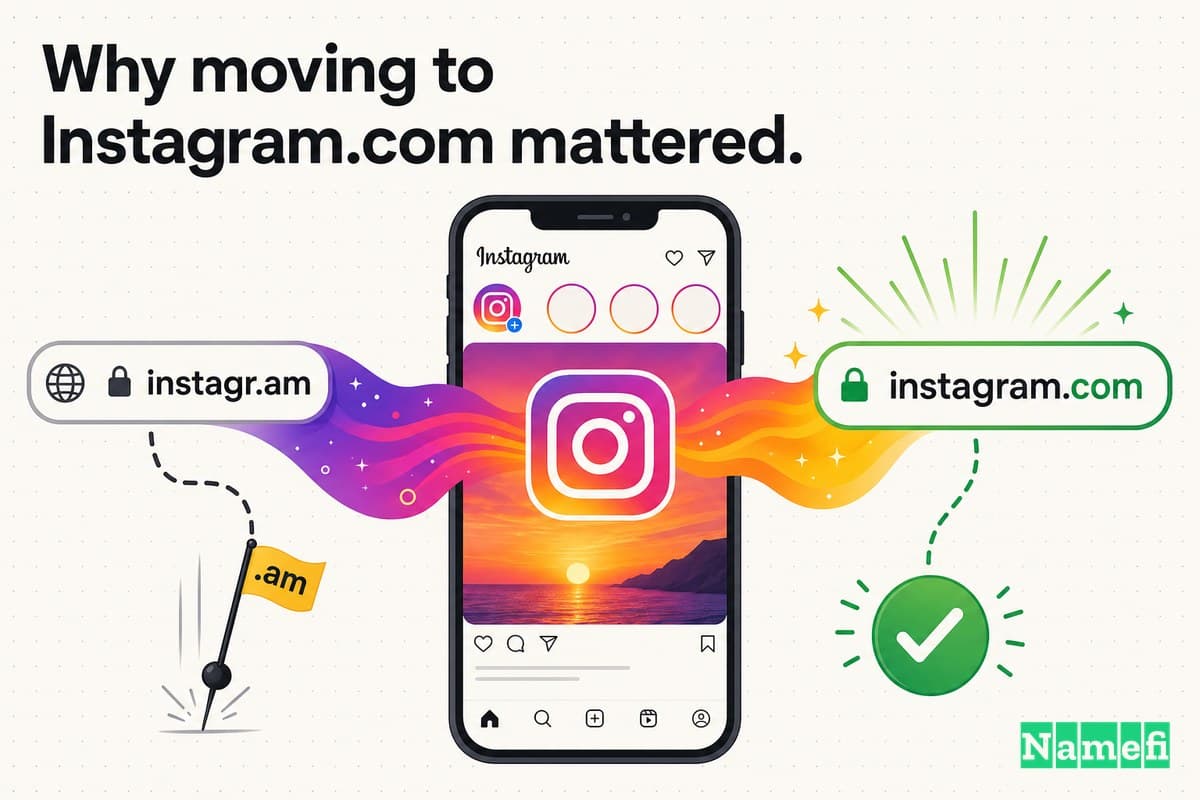
The gap between instagr.am and Instagram.com is one dot and two letters. Strategically, it is the difference between renting your name and owning it.
instagr.am is a clever guest in Armenia's namespace — exact, but borrowed, easy to mistype, and forever competing with the .com people type by reflex. Instagram.com is the default destination, the address that needs no explanation, the one that captures rather than leaks the traffic of its own brand.
| Before | After |
|---|---|
| instagr.am | Instagram.com |
Borrows Armenia's .am country code | Owns the global default .com |
| Policies set by a foreign registry | Controlled by the company itself |
| Reads as a possible typo | Reads as the canonical brand |
| Leaks traffic to whoever owns instagram.com | Captures the traffic users type by reflex |
| A clever front door | A permanent home |
This is the same pattern that recurs across domain upgrades: early names (and early hacks) explain and improvise; great domains own. The hack was the perfect on-ramp for a company that needed to look bigger than it was. The .com was what it needed once it actually became bigger than the hack.
The timing: upgrade before the hack hardens
The order of events is the instructive part. Instagram did not wait until it was famous to fix its address. The app launched in October 2010; the company moved on Instagram.com by January 2011 — roughly a quarter of a year in, while it was still racing through its first millions of users.
That timing is the lesson. Buy the canonical domain early enough that the cleaner version can still become the one the world remembers, but late enough that you actually know the brand is worth it. By moving in its first months, Instagram ensured that as it scaled — to 1 million users in two months and 10 million in a year — the address those users learned, linked, and typed was Instagram.com, not the hack.
By the time Facebook arrived — on April 9, 2012, Facebook, Inc. (now Meta Platforms) bought Instagram for $1 billion in cash and stock — the brand it was buying lived at a .com the company fully controlled, not a country code it merely rented.
The domain became part of the operating system
Premium domains are not about prestige. They are about repetition.
A core domain shows up in places the marketing team never directly touches:
- In every shared photo link and embed.
- In press headlines and App Store listings.
- In email addresses and employee signatures.
- In search results and browser address bars.
- In every spoken recommendation — "put it on Instagram" — passed from one person to the next.
Every one of those repetitions either adds friction or removes it. instagr.am asked people to remember an unusual dot in an unusual place, and to resist the reflex to type .com. Instagram.com asked nothing. It was the reflex.
The hack didn't build Instagram's growth — filters, timing, and the iPhone camera did. But once Instagram.com was the address, every future repetition of the name compounded on a foundation the company actually owned, with no borrowed country code to explain away and no parking page skimming its traffic.
What founders should learn from Case 11
The easy takeaway — "never use a domain hack" — is wrong. The hack was good. The more useful lessons are about how to use one without getting trapped by it:
- A domain hack is a great launch front door. instagr.am was exact, short, shareable, and available when the
.comwasn't. For an early-stage launch, that is a real edge, not a failure. - Know what you're borrowing. A ccTLD hack means a foreign registry sets your policies and pricing. That is fine at small scale and a liability once your brand is valuable. Treat the hack as a secondary URL, not the permanent home.
- Secure the canonical
.comearly — while it can still become the one people remember. Instagram bought Instagram.com in its first months, not after it was famous. The window to make the clean name canonical is narrow. - Budget for the transaction, not just the price. The strategic call is obvious; clean title is not. Instagram paid $100,000 and still ended up in a multi-year ownership dispute over who had the authority to sell.
The domain upgrade did not make Instagram win. The product, the timing, and the camera in everyone's pocket mattered far more. But moving from instagr.am to Instagram.com is what made the brand ownable instead of merely clever — and the company did it before the hack could harden into the thing the world remembered.
The Namefi angle
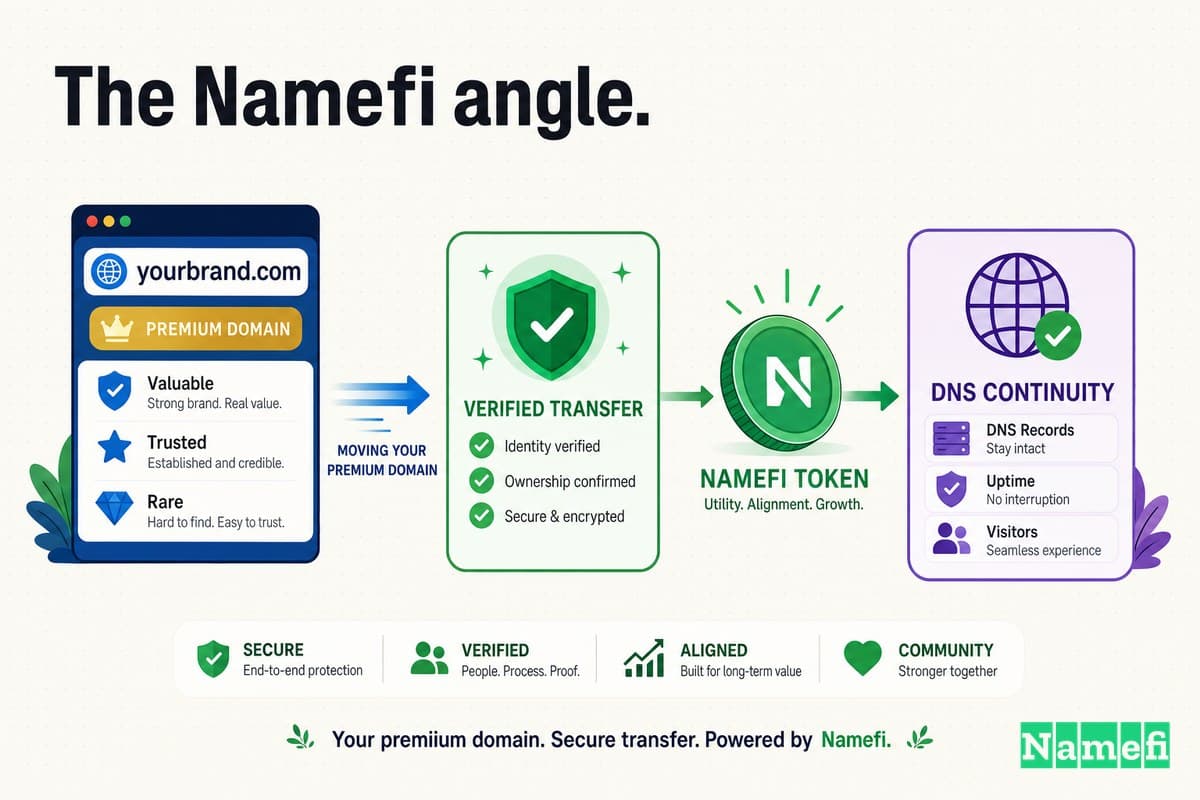
This case is, at its core, a transfer-and-ownership problem wearing a branding costume.
Nobody doubted that a company called Instagram should own Instagram.com. The hard part was everything around the asset: prying the exact-match .com away from a third party who was parking it, agreeing on a price, moving control cleanly through a marketplace, and — years later — defending who actually had the authority to sell it when relatives of the seller contested the deal. A $100,000 purchase turned into a long tail of provenance questions.
Namefi is built around the idea that domains should behave like internet-native assets. Tokenized ownership can make domain control easier to verify, transfer, and integrate into modern workflows while staying compatible with DNS — turning the messiest parts of a deal like this (proving who truly owns a name, agreeing on value, and moving it safely without a multi-year paper trail) into something closer to a clean, auditable transaction.
Instagram.com looks inevitable now because Instagram became enormous. But the lesson lands long before that scale: a clever domain hack can launch you, yet when a name is going to carry the business, the domain isn't decoration and it isn't something to merely rent from a foreign registry. It's the part of the brand worth buying, securing, and proving you own.
Sources and further reading
- Wikipedia — Domain hacks
- Wikipedia — .am
- Wikipedia — Instagram
- Wikipedia — Timeline of Instagram
- TechCrunch — Burbn closes a $500,000 seed round before the Instagram pivot
- DomainIncite — Instagram paid Chinese cybersquatter $100,000 for instagram.com, Facebook lawsuit reveals
- WIPO Arbitration and Mediation Center — Instagram, LLC v. Zhou Murong, Case No. D2014-1550
- Entrepreneur — How Instagram Went From Idea to $1 Billion in Less Than Two Years
- Domain Gravity — instagr.am to Instagram.com
Contributors

Aileen Wright is a student in her twenties living in New York City, where the distance between a museum wall and a library reading room is a short walk and a long afternoon. She came to name writing through art and history — the way a single portrait, coin, or manuscript margin can carry a name across centuries and change its meaning on the way.
Most weeks you can find her in Central Park with a paperback, or in the quiet of a public reading room chasing down where a name actually comes from rather than what a name-list says it means. She is also teaching herself to code, which has made her oddly precise about spelling, sorting, and the small details that decide whether a name ages well.
For Namefi she writes about the history and culture behind domain names, the stories brands carry as they rename, and the difference between a good story and a verified source.

Victor Zhou is a technology founder and standards editor focused on digital identity and trust. He founded Namefi, edits Ethereum Improvement Proposals, and previously led smart-contract architecture work at Google Labs.
His work sits at the intersection of naming, ownership, and the systems people use to establish identity online. That perspective makes him especially interested in the way names move between personal meaning, public recognition, and digital infrastructure.
For Namefi, Victor edits and writes about domains as durable digital identity: how names become ownable onchain assets, how tokenization changes custody and trust, and what naming can learn from the systems people use to establish identity online.
Related guides
- From Box.net to Box.com: The ~$1M Upgrade That Dropped the ".net" and Bought the Exact MatchHow Box launched in 2005 on Box.net because Box.com was taken, pivoted from consumer storage to the enterprise, and in 2011 paid Digimedia close to $1 million for the exact-match Box.com — a .net-to-.com upgrade that landed right as the company became simply "Box."
- From BufferApp.com to Buffer.com: The 624-Day, Bank-Statement-Open Domain DealHow Buffer launched in 2010 on BufferApp.com because Buffer.com was taken, then spent 624 days acquiring the exact-match domain — even showing the seller its bank balance — and why a company famous for radical transparency stayed quiet on the one number everyone wanted: the price.
- Who Owns Trip.com? Ctrip, Trip.com Group, and the RebrandUnderstand how Trip.com relates to Ctrip and Trip.com Group, and trace the acquisition and company-name changes behind the travel brand.
- From del.icio.us to Delicious.com: The Cleverest Domain Hack on the Web — and Why Yahoo Untangled ItHow the pioneering social-bookmarking site launched in 2003 as the famous domain hack "del.icio.us," why those dots became a permanent tax on every mention, and how Yahoo moved it to the cleaner Delicious.com in 2008.