Elon Musk Lost the CEO Job, Then Bought Back X.com
PayPal's filings show how Elon Musk lost the top job at X.com in 2000, why the company dropped his chosen name, and how he bought the domain back in 2017.


- domains
- branding
- startups
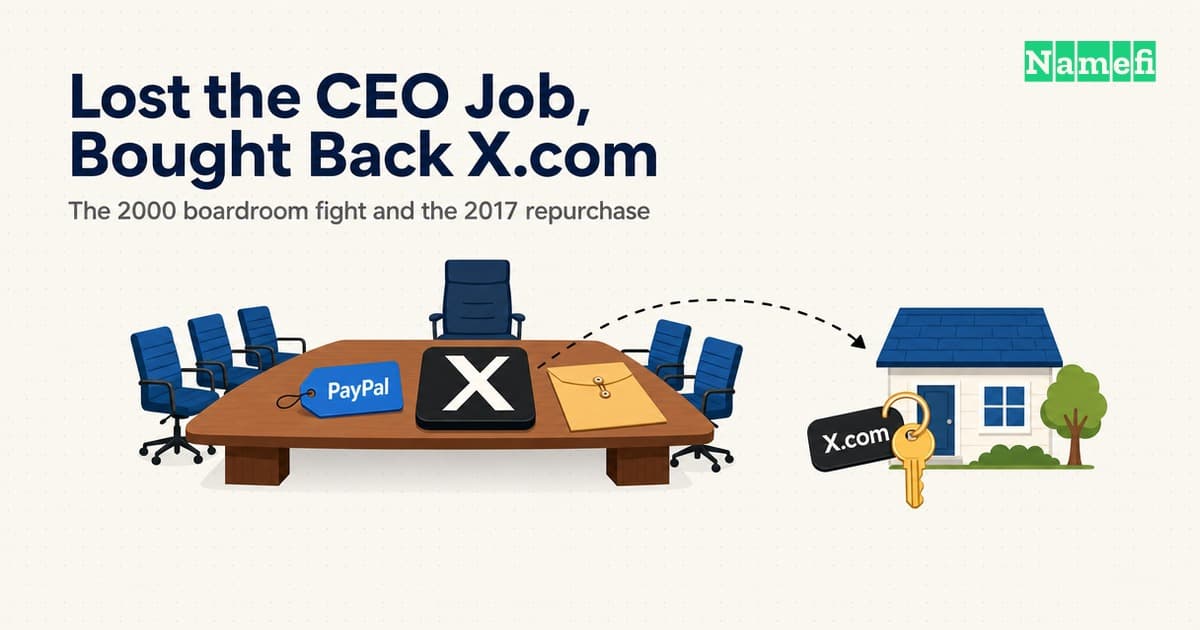
The paper that closed Elon Musk's first fight over the letter X is dated May 4, 2001. PayPal, Inc. filed it that September as Exhibit 10.15 to its IPO registration. The first section says Musk "resigned as Chief Executive Officer and President of the Company effective September 24, 2000." The fifth carries the heading "Deletion of Reference to 'Founders.'" In it, PayPal acknowledged Musk as "a founder of the Company and its predecessor X.com" and agreed to strip references to founders from its website.
The agreement settles his shares, his benefits and his standing as a founder. The word "domain" does not appear in it.
Musk chose the name X.com, fought to keep it and lost the top job while that fight was running. The domain stayed with the company, as it had since 1999. Sixteen years after the separation agreement, he bought it. The filings show how a founder could lose the office, keep a large stake and still leave without the single letter he had picked. (The later journey from Twitter.com to X.com is told in our case study of that rename. This piece stays with the boardroom.)
The domain entered the books as stock in May 1999
Jimmy Soni, the author of The Founders, traced the domain to two engineers, Marcel DePaolis and Dave Weinstein, who bought it for their company in the early 1990s. Musk considered it, in Soni's telling, "the coolest URL on the internet." Soni writes that they sold it to Musk in exchange for cash and a small stake in the company. Sherwood News, reviewing a 1999 Wayback Machine capture, says the site looks like it belonged to a software engineer, Robert Walker, so the chain before Musk is not fully settled.
PayPal's S-1 records the stock side of the purchase in note 7 to its financial statements: "In May 1999, the Company acquired the X.com domain name in exchange for 1,500,000 shares of the Company's Series A convertible preferred stock at an aggregate value of $500,000." The cash flow statement for that first year shows a separate $116,630 spent on domain names and licenses without saying which names. The Washington Post quotes Max Chafkin's book The Contrarian as saying Musk paid at least $1 million, with the qualifier "legend within the company had it." The filing does not settle the total. It does name the acquirer, and that is the company. Soni names Musk as the buyer, and the filing does not explain how the two descriptions fit together.
Musk's reasons were practical as well as aesthetic. Soni reports that he valued how easy the address was to type and believed handheld devices were coming. In December 1999, X.com's own press release named former Intuit chief Bill Harris president and chief executive and described Musk as "founder and chairman."

The merger joined two teams and settled neither name
Confinity, co-founded by Peter Thiel and Max Levchin, had the product called PayPal. X.com had the bank plan and the single letter. Soni says that weeks before the merger the two were "truly trying to destroy one another." Levchin has said the first proposal from X.com, a 90-10 split, insulted his pride. The result was a 50-50 deal he now says he does not recommend to anyone.
The S-1 gives the legal outcome: "On March 30, 2000, X.com merged with Confinity, Inc., with X.com as the surviving entity." The surviving corporate name was therefore the one Musk had chosen. The Washington Post describes PayPal as the more popular money-transfer service. Soni called the deal a shotgun wedding.
The top job changed hands quickly. Roelof Botha, later PayPal's chief financial officer, recalls in a Sequoia podcast that a coup removed Harris soon after the deal. The S-1 lists Musk as CEO from May to September 2000 and Thiel as chairman from May 2000. The filing is not fully consistent on Harris, giving his CEO tenure an end date of May in one footnote and March in another.
The name fight ran beside a fight over the code
As CEO, Musk wanted one brand. The Washington Post, citing Chafkin, says he wanted to make X more prominent, "phasing out the PayPal name altogether." The Post also quotes Chafkin on focus groups in which customers said the name reminded them of porn. It quotes Ashlee Vance's biography of Musk on the split: "Musk kept championing X.com, while most everyone else favored PayPal."
Musk's own argument, in the Post's quotation of Walter Isaacson, was about scale: "If you want to just be a niche payment system, PayPal is better." X, in his view, was the name for an attempt on the whole financial system.
Isaacson's version, as summarized by Fox Business, escalates from there. Colleagues assembled a study behind Musk's back showing that the PayPal brand was worth more than X.com's, and Musk responded by trying to pull PayPal's branding from the website. This detail rests on Isaacson's reporting as Fox Business relays it.
The engineering dispute is better attested by people who were there. Botha recalls that Musk wanted to move the infrastructure to Windows NT, while most of the Confinity engineers worked in UNIX. Levchin, who held the chief technology officer title, says his position was that he should be the one making technical decisions. A brand and an operating system are different questions. In a 50-50 merger they reduced to the same one, which was who decided.
The accounts of the removal agree on the outcome and differ on the details
The departure has been retold many times, and the retellings differ. Fortune's account has Musk preparing to fly to Australia with his first wife, Justine Wilson, for a belated honeymoon, the Sydney Olympics and meetings with investors, when he learned that fellow executives had delivered letters of no confidence to the board.
Botha supplies the most physical detail, in the first person. Management, he says, drove to Sequoia's headquarters with signed resignation letters in manila envelopes to show the board they were serious. He remembers being terrified. Isaacson's version, again through Fox Business, says Levchin suggested that Thiel return as CEO on a temporary basis, that Thiel, Reid Hoffman and David Sacks joined the plotters, and that Musk cut his honeymoon short only to find the board had voted to remove him.
Michael Moritz of Sequoia, a director since 1999, recalled the other end of the line: Musk phoning from Australia, "labeling it all a heinous crime." Musk's later summary, given to Fortune in 2007 and quoted by the Post, was shorter: "That's the problem with vacations."
The records diverge on two points that matter. Botha places the coup in August. The S-1 says Thiel became CEO in September 2000, and the separation agreement gives September 24. The verb differs too. The Post, citing Vance, says the board ousted him, and Fox Business, citing Isaacson, says it voted to remove him. The agreement both sides signed months later says he resigned. Neither word is a record of the board's deliberations, and none of the sources reviewed here includes minutes of that meeting.
What the filings do show is what he kept. Musk stayed an employee until March 9, 2001. He kept his board seat. In the S-1's ownership table his 28,406,630 shares, or 14.2 percent before the offering, were the largest block listed, ahead of Sequoia's 10.7 percent and Thiel's 5.6 percent. On September 28, 2001, he signed the registration statement as a director, alongside Thiel and Moritz. He had lost the office and remained the largest listed holder. By then the company had already dropped the name he chose.

The company dropped the name and wrote off its domain purchases
The new management moved quickly. The S-1 says in one passage that the company decided by October 2000 to focus on the PayPal product and abandon internet banking (another passage says by December), and that "We formally changed our name to PayPal, Inc. in February 2001."
The accounting followed. A note to the financial statements reads: "The Company purchased domain names and licenses related to the Internet banking operations and capitalized the related cost. Upon termination of this business in December 2000 (see Note 17), the Company wrote-off the unamortized balance of $492,894." The sentence does not name X.com. But the purchased domain names line in note 7 shows $606,630 at the end of 1999 and nothing a year later, and X.com was the $500,000 item in that category. The likely reading is that the letter that started the fight went to zero on the company's books within about three months of Musk's exit.
Book value and registration are separate things. Domain investor Elliot Silver wrote in 2017 that for many years X.com was registered to PayPal Inc.. The IPO filing still lists an application for the "X.com" service mark, next to a note that the company had registered "www.paypal.com" for ten years. Sherwood's walk through Wayback Machine captures finds the address serving as PayPal Labs in 2007 and as a site for x.commerce, an eBay company, in 2013.
The repurchase surfaced as a change in a WHOIS record
The return came quietly. On July 5, 2017, Silver noticed that the WHOIS data had gone private and that the name had moved from MarkMonitor to GoDaddy. TechCrunch dated the change of hands to July 3.
Silver then contacted PayPal. Amanda Miller, the company's director of corporate communications, confirmed the sale to him by email: "We are delighted to sell the domain x.com back to its previous owner, Elon Musk." She was unable to comment on the price. Andrew Rosener of Media Options, who said his firm acted as broker for the buyer, would not share it either. No source reviewed here gives the figure.
On the evening of July 10, Pacific time, Musk posted: "Thanks PayPal for allowing me to buy back X.com! No plans right now, but it has great sentimental value to me." Soni reports Musk recalling a heartfelt letter from the broker that said, "We are so happy to have restored this URL to you."
"Back," "previous owner" and "restored" describe the sentiment. Note 7 describes something narrower. It names the company as the buyer of X.com, and the filing does not show Musk holding the domain personally.
The rename arrived six years later
On July 24, 2023, Twitter was reintroduced as X. That migration has its own case study, and it belongs to a different kind of story, one about moving a global platform. This one ended earlier.
In 2000 Musk made his case for the letter to a board and a management team, and they went the other way. The argument was about strategy. The outcome turned on a plainer fact: the name sat with a corporation, and a corporation follows whoever runs it. Founders tend to think of a name as theirs because they chose it. The registrant of record is the party that holds it. The 2001 agreement gave Musk a contract protecting the word "founder," backed by a right to sell $750,000.75 of stock to the company if it was breached. It does not mention the domain.
Sources and further reading
- PayPal, Inc. — Form S-1 registration statement, filed September 28, 2001: note 7 on the X.com acquisition; merger summary; directors and officers; beneficial ownership table; intellectual property section. Fetched 2026-11-03.
- PayPal, Inc. — Exhibit 10.15, Separation Agreement and Mutual Release, between the company and Elon Musk, sections 1 and 5. Fetched 2026-11-03.
- X.com — press release naming Bill Harris president and CEO, press release dated December 7, 1999, archived March 3, 2000. Fetched 2026-11-03.
- Sequoia Capital — Crucible Moments, "PayPal: A Merger of Enemies That Reshaped Silicon Valley", transcript with Max Levchin, Michael Moritz, Roelof Botha and Jimmy Soni. Fetched 2026-11-03.
- Jimmy Soni — "The Colorful History of X.com", by the author of The Founders. Fetched 2026-11-03.
- Timothy Bella, The Washington Post via Yahoo — "Elon Musk tried to rebrand PayPal as X.com. Some thought it was a porn site.", July 25, 2023. The source read for all Chafkin and Vance passages and for the Isaacson passages on the name; the books themselves were not reviewed. Fetched 2026-11-03.
- Eric Revell, Fox Business — "Elon Musk was dethroned by Peter Thiel in a coup led by the 'PayPal Mafia'", September 15, 2023. The source read for the Isaacson passages on the study and the removal; the book itself was not reviewed. Fetched 2026-11-03.
- Paige Hagy, Fortune — "The last time Elon Musk tried to make his 'X' company happen it failed miserably", July 26, 2023. Fetched 2026-11-03.
- Elliot Silver, DomainInvesting.com — "Elon Musk Acquires X.com Domain Name", July 10, 2017, updated July 11. Fetched 2026-11-03.
- Taylor Hatmaker, TechCrunch — "Elon Musk confirms that he just bought back X.com, the domain he owned in 1999", July 10, 2017. Fetched 2026-11-03.
- Elon Musk — post on X, formerly Twitter, July 10, 2017, 6:10 p.m. Pacific. Fetched 2026-11-03.
- Sherwood News — "See what Elon Musk's X.com looked like through the years". Fetched 2026-11-03.
- X Blog — "Building the future of X", launch timeline. Fetched 2026-11-03.
Contributors
Aileen Wright is a student in her twenties living in New York City, where the distance between a museum wall and a library reading room is a short walk and a long afternoon. She came to name writing through art and history — the way a single portrait, coin, or manuscript margin can carry a name across centuries and change its meaning on the way.
Most weeks you can find her in Central Park with a paperback, or in the quiet of a public reading room chasing down where a name actually comes from rather than what a name-list says it means. She is also teaching herself to code, which has made her oddly precise about spelling, sorting, and the small details that decide whether a name ages well.
For Namefi she writes about the history and culture behind domain names, the stories brands carry as they rename, and the difference between a good story and a verified source.
Victor Zhou is a technology founder and standards editor focused on digital identity and trust. He founded Namefi, edits Ethereum Improvement Proposals, and previously led smart-contract architecture work at Google Labs.
His work sits at the intersection of naming, ownership, and the systems people use to establish identity online. That perspective makes him especially interested in the way names move between personal meaning, public recognition, and digital infrastructure.
For Namefi, Victor edits and writes about domains as durable digital identity: how names become ownable onchain assets, how tokenization changes custody and trust, and what naming can learn from the systems people use to establish identity online.