
Why Did Twitter Become X? The Rebrand and X.com Story
Trace Twitter’s change to X, the history of X.com, and how the name, domain, and redirect changes fit into the rebrand.
- domains
- branding
- startups
- domain-upgrades

Twitter became X in July 2023 as part of the company's stated plan to expand beyond its earlier social-network identity into an “everything app.” X's own retrospective connects the change to consuming media, interacting, watching video, and eventually transacting in one interface. That is management's explanation of the strategy, not proof that the rebrand achieved those ambitions.
The company's launch timeline dates X's introduction to July 24, 2023. The new name and the website migration were separate steps: the sections below trace the initial redirect to Twitter, the later move to X.com, and the domain's earlier history.
Most domain-upgrade stories run in a straight line: a company starts on a descriptive name, grows up, and buys the clean exact-match. Twitter.com to X.com is stranger than that. It is a round trip. The destination domain — X.com — was the first domain in the story, used by the online bank Musk co-founded in 1999, retained by the company that became PayPal, bought back by Musk in 2017 for sentimental value, and finally attached to a global social network in 2023.
For seventeen years, Twitter lived at exactly the address you'd expect: Twitter.com. The name was honest and the domain matched it. A "tweet" happened on Twitter, at Twitter.com, under a blue bird that users had seen since the platform's early days. There was no descriptive modifier to outgrow, no "App" or "HQ" to shed. By the usual logic of this series, Twitter.com was already the destination.
Then the owner changed, and so did the destination.
In July 2023, nine months after buying the company for $44bn, Musk did something no other founder in this series did: he threw away a perfectly good exact-match domain and replaced it with a one-letter brand tied to his first online bank and back in his personal ownership since 2017. Twitter became X, and the website began the long migration to X.com — a domain whose history is older than Twitter itself.
Twitter.com: the rare startup that launched on its own name
In the beginning, there was no domain problem to solve.
When Twitter launched in 2006, it had the thing most startups in this series spent years and millions chasing: the exact-match .com that matched its name. Twitter.com was Twitter. The blue bird, the verb "to tweet," the @-reply, the hashtag — an entire vocabulary grew on top of an address that needed no explanation. For most of its life, Twitter was the counter-example to every "buy your exact match" lesson, because it never had to.
That is what makes this case different. The pressure to change the domain did not come from the product outgrowing the name, the way "Motors" outgrew Tesla or "Cab" outgrew Uber. It came from a new owner who already had a different name in mind — and had been waiting on it for a very long time.
July 2023: throwing away the bird
The trigger was not a regulator or a reluctant seller. It was a weekend tweet.
Musk teased the change on Sunday, July 23, 2023, announcing that the company would, in his words, "bid adieu to the Twitter brand and, gradually, all the birds." Within a day the bird was gone. Al Jazeera reported that Twitter has launched its new logo, dropping the blue bird on its website for an X, describing the new mark plainly: the social media network's site on Monday showed the company's new logo: a white X on a black background.
And the domain moved too — though, tellingly, in the wrong direction at first. On day one, the domain x.com now redirects to Twitter. The new name pointed at the old one. The single most valuable asset in the rebrand — the X.com domain — was being used as a forwarding address for Twitter.com, not the other way around.
That detail is the whole tension of this case. Musk had the destination domain in hand on day one. What he did not have, yet, was a clean way to move a network of hundreds of millions of users — every bookmark, every link, every "twitter.com" typed into a browser bar — onto it without breaking the internet.
The 24-year journey back to X.com
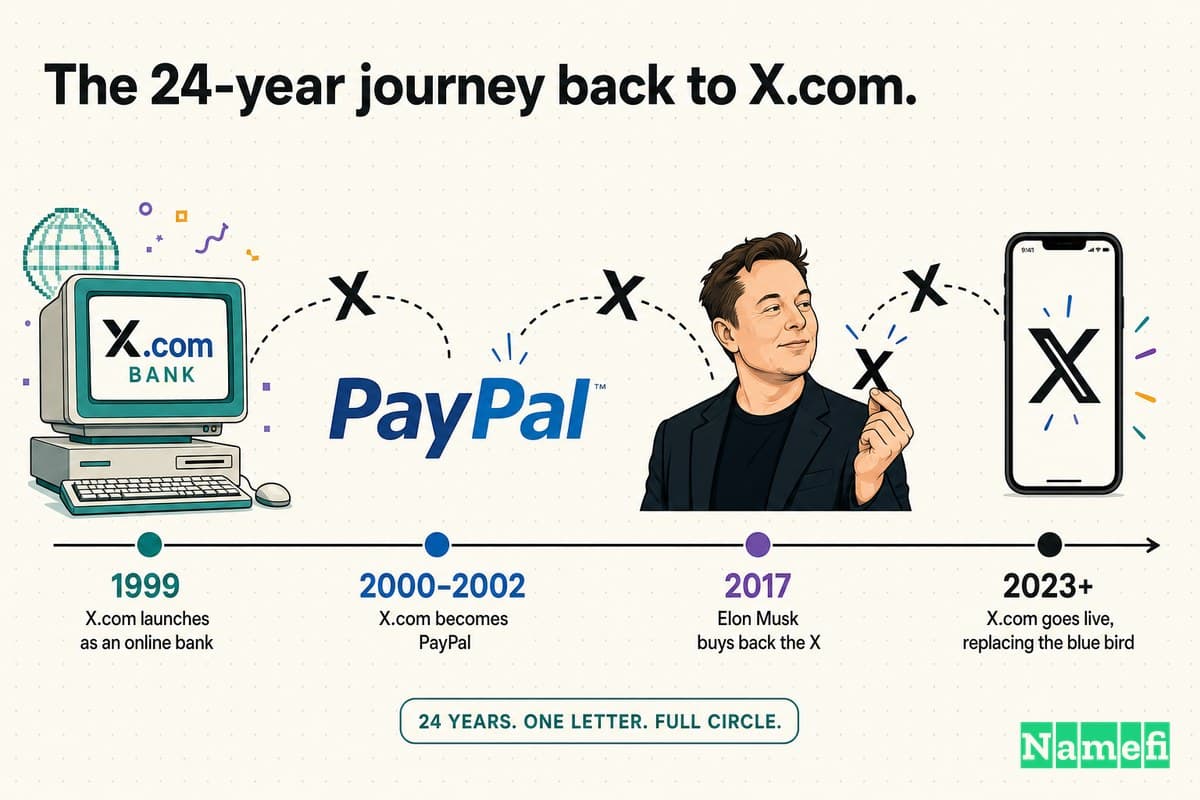
To understand why Musk wanted X.com badly enough to discard Twitter.com, you have to go back to the dot-com era — because X.com is where his career in software money actually began.
In March 1999, Musk co-founded X.com, an online bank. Wikipedia records that X.com was an American online bank founded by Ed Ho, Harris Fricker, Elon Musk, and Christopher Payne in 1999 in Palo Alto, California, and that Musk invested about $12 million into co-founding X.com in March 1999. The ambition was not a narrow payments tool. X.com was conceived as a broad online financial-services platform, offering internet-based banking services and person-to-person payments rather than only a payment-transfer product. The "everything app" idea Musk would pitch in 2022 was, in embryo, the X.com pitch of 1999.
It grew fast. Within two months, X.com attracted over 200,000 signups. But across town was a competitor: Confinity, founded in December 1998 by Max Levchin, Peter Thiel, Luke Nosek, Ken Howery, and Yu Pan, which launched its milestone product, PayPal, in late 1999. In March 2000, the two merged: X.com merged with its competitor Confinity, the company that had built PayPal.
Then Musk lost control of the company. In September 2000, when Musk was in Australia for a honeymoon trip, the X.com board voted for a change of CEO from Musk to Peter Thiel. The new leadership had little affection for the X.com brand, and in June 2001, the x.com domain was changed to PayPal.com. The company Musk had co-founded and the domain it used now answered to "PayPal," and X.com remained with the corporate successor.
"Great sentimental value to me": buying it back in 2017
For sixteen years, X.com remained inside PayPal's portfolio. Then in July 2017, Musk quietly bought it back.
There was no business plan attached. PYMNTS reported simply that space entrepreneur Elon Musk, the head of Tesla, has purchased the X.com domain name from PayPal, and that X.com was the brand name Musk created for a financial service startup that later merged with Confinity to become PayPal. Musk himself framed it as pure nostalgia. Engadget quoted his tweet: "Thanks PayPal for allowing me to buy back X.com! No plans right now, but it has great sentimental value to me."
Engadget also captured the wound underneath the purchase: when Musk was pushed out, the domain (with its aught-tastic logo, above) stayed behind with PayPal. Buying it back, seventeen years later, was Musk repossessing the one piece of his first company that had outlived everything else.
This is the rarest motivation in the entire series. Tesla bought Tesla.com because it had to. Uber traded equity for Uber.com because it had to. Musk bought X.com in 2017 because he wanted to — "no plans right now." The domain was an heirloom before it was a strategy.
The money looked different then
It is easy, from 2026, to read the 2017 purchase as the opening move of a master plan that ended with Twitter. It almost certainly wasn't.
Neither side disclosed a price. PayPal did not disclose how much Musk paid for the X.com domain name, and observers were left guessing. Engadget reached for a comparable to size it: nobody's saying how much he paid, but as a term of reference, Z.com sold for around $6.8 million three years ago. A single-letter .com like X.com sits in the same rarefied tier — a handful of the most valuable domains on the internet.
But judged at the moment it happened, this was not a calculated land-grab ahead of a social-media rebrand. In July 2017, Musk did not own Twitter and had given no public hint that he ever would. He ran Tesla and SpaceX. He told the world there were "no plans" for X.com, and there is no reason to doubt him. The domain was cheap relative to his net worth, emotionally priceless, and strategically idle. It would sit unused for another six years.
The lesson is one founders rarely internalize: the domain that defines your next company may be one you already own, bought for reasons that had nothing to do with the plan. Musk didn't buy X.com for X. He bought it because it was his. The strategy arrived later and found the asset already in the drawer.
Why the rebrand to X mattered
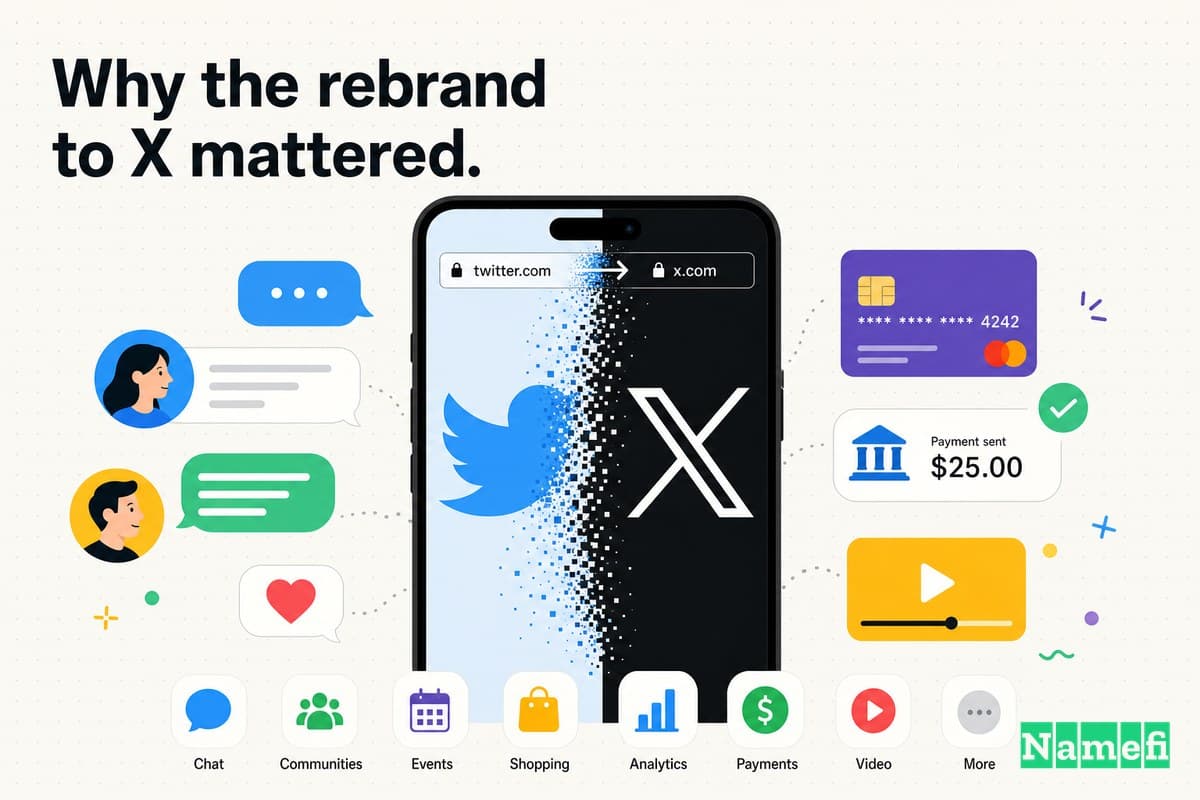
Replacing "Twitter" with "X" was not a domain upgrade in the usual sense of this series. By every conventional metric, Twitter.com was the better brand domain: pronounceable, globally famous, attached to a verb people used without thinking. X.com is a single ambiguous letter.
So why do it? Because Musk wasn't trying to name a social network. He was trying to name an everything app. "Twitter" describes one thing — short public messages. "X" describes nothing in particular, which is exactly the point: it is a container with no product baked into it, room enough for messaging, payments, video, and whatever else he wanted to bolt on. The same logic that took Tesla from "Motors" to "Tesla" runs here, only more extreme. Musk didn't trade a narrow word for a slightly broader one. He traded a beloved, specific word for a maximally generic letter.
| Before | After |
|---|---|
| Twitter.com | X.com |
| Names one product: public 280-character posts | Names nothing specific — a blank container |
| A globally recognized brand and a verb ("to tweet") | A single letter with no built-in meaning |
| Anchored to social media | Open to payments, video, messaging — an "everything app" |
| A famous brand the owner inherited | A domain tied to the owner's first online bank and reacquired in 2017 |
It is the riskiest move in the series, and the most personal. Every other founder here upgraded toward clarity. Musk traded recognized clarity for deliberate openness — and for the chance to put his oldest brand back on top.
The sequence: domain first, redirect saga second
The order of events explains why the rebrand felt so messy in public.
Musk had owned the destination domain since 2017, so the brand could flip overnight — logo on Monday, bird gone by Monday night. But the domain migration could not be rushed, and the redirect ran backwards for almost a year:
- July 2023: the rebrand lands. The white X replaces the bird, and at first x.com now redirects to Twitter — the new name pointing at the old one.
- May 17, 2024: the direction finally reverses. Euronews reported that the social media platform formerly known as Twitter has officially transitioned its website address from Twitter.com to X.com, with Musk posting that all core systems are now on X.com.
Roughly ten months passed between the logo change and the domain actually leading. That gap is the real story of the case: owning X.com was the easy part — Musk had it in hand. Moving a planet-scale user base onto it, without breaking links, sessions, security cookies, and the muscle memory of hundreds of millions of people, was the hard part. The brand can change in a night. The domain takes a year.
The domain became part of the operating system
Premium domains are not about prestige. They are about repetition — and Twitter.com had a decade and a half of repetition behind it that X.com had to inherit.
A platform's core domain shows up in places no marketing team controls:
- In every shared link and embedded post across the rest of the web.
- In billions of bookmarks and saved passwords keyed to "twitter.com."
- In every login session, security cookie, and two-factor flow.
- In press headlines, browser bars, and spoken shorthand.
- In a verb — "tweet" — that lived inside the old name.
Every one of those had to survive the move. This is why twitter.com still resolves: kill the redirect and you break a meaningful slice of the internet's accumulated links. So X.com didn't replace Twitter.com so much as it had to absorb everything Twitter.com had ever carried, while the old domain stayed alive as a permanent forwarding layer. The expensive, emotional, single-letter domain was the new front door. The old descriptive domain became plumbing — load-bearing plumbing that can't be switched off.
What founders should learn from Case 3
The easy takeaway — "rename to a single letter like Musk did" — is exactly the wrong one. Twitter.com was a better brand domain than X.com by almost every objective measure, and the rebrand remains one of the most debated marketing decisions of the decade. The useful lessons are subtler:
- An exact-match domain is not always the destination. Twitter.com was already the perfect exact match — and the owner still left it. A domain serves the company's ambition, not the other way around. When the ambition changed from "social network" to "everything app," the perfect domain for the old goal became the wrong one for the new.
- The domain you need next may be one you already hold. Musk bought X.com in 2017 with "no plans," for sentiment. Six years later it became the foundation of a rebrand. Holding a great domain you can't yet use is not waste; it is optionality.
- The brand flips in a night; the domain migration takes a year. Musk owned X.com outright and still needed ten months to make twitter.com point at it cleanly. Budget for the migration, not just the announcement.
- Never break the old domain. Twitter.com still redirects, and it must. The descriptive or legacy domain becomes infrastructure the moment a brand is famous enough to have links pointing at it from everywhere.
The rebrand did not, on its own, make X succeed or fail — product, moderation, advertisers, and execution matter far more, and the jury is still out. But the case shows something the others don't: sometimes the upgrade runs away from the obvious domain, toward one tied to the founder's much earlier career.
The Namefi angle
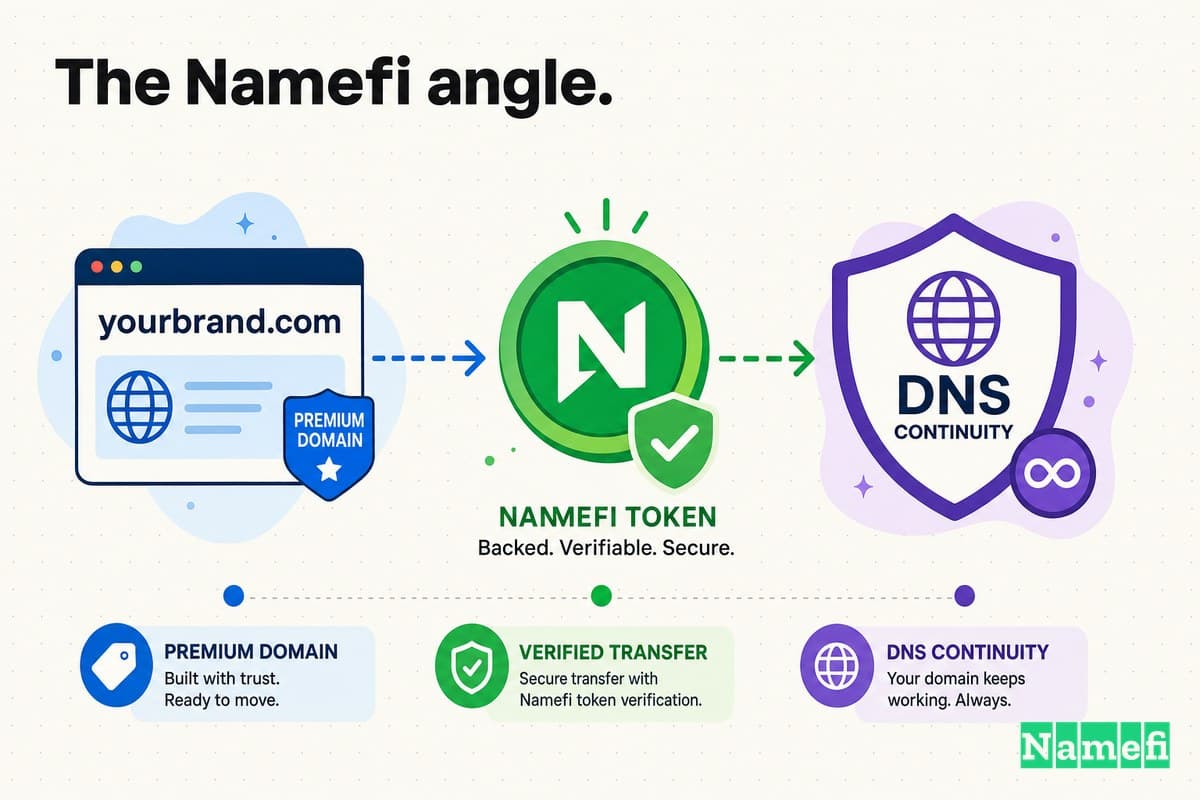
Strip away the spectacle and Case 3 is, like the others, a transfer-and-continuity problem — just spread across 24 years and several owners.
X.com remained with the company through the X.com–Confinity merger and the shift to the PayPal name, before PayPal sold it back to Musk in 2017 for an undisclosed price. Then came the hardest visible part: not owning X.com, but migrating onto it — pointing a global platform's links, logins, and bookmarks at a new domain while keeping the old one (twitter.com) alive as a durable redirect. Ownership, valuation, transfer, and DNS continuity all meet at the boundary between a brand and its domain.
Namefi is built around the idea that domains should behave like internet-native assets. Tokenized ownership can make domain control easier to verify, transfer, and integrate into modern workflows while staying compatible with DNS — making steps such as proving control, agreeing on value, and moving an asset without disturbing live records easier to audit. A domain that can move cleanly between owners while preserving DNS continuity is useful infrastructure for any long-lived brand asset.
X.com looks inevitable now only because Musk's history with the name began in 1999 and he reacquired the domain in 2017. But the lesson lands long before the rebrand: a domain can outlive the company that used it, survive a corporate renaming, and later return to define another business. When a name is going to carry the business, the domain isn't decoration; it is durable infrastructure whose ownership history should be described precisely.
Sources and further reading
-
X — One year in, the future of X is bright, October 26, 2023, item 9, “From Twitter to X” — fetched 2026-09-15.
-
X — Building the future of X, July 2023 timeline — fetched 2026-09-15.
-
Wikipedia — X.com (bank)
-
Wikipedia — Confinity
-
Al Jazeera — Twitter changes logo to 'X', replacing blue bird symbol
-
Euronews — Elon Musk's X sheds the last of its Twitter branding by changing web address to x.com
Contributors

Aileen Wright is a student in her twenties living in New York City, where the distance between a museum wall and a library reading room is a short walk and a long afternoon. She came to name writing through art and history — the way a single portrait, coin, or manuscript margin can carry a name across centuries and change its meaning on the way.
Most weeks you can find her in Central Park with a paperback, or in the quiet of a public reading room chasing down where a name actually comes from rather than what a name-list says it means. She is also teaching herself to code, which has made her oddly precise about spelling, sorting, and the small details that decide whether a name ages well.
For Namefi she writes about the history and culture behind domain names, the stories brands carry as they rename, and the difference between a good story and a verified source.

Victor Zhou is a technology founder and standards editor focused on digital identity and trust. He founded Namefi, edits Ethereum Improvement Proposals, and previously led smart-contract architecture work at Google Labs.
His work sits at the intersection of naming, ownership, and the systems people use to establish identity online. That perspective makes him especially interested in the way names move between personal meaning, public recognition, and digital infrastructure.
For Namefi, Victor edits and writes about domains as durable digital identity: how names become ownable onchain assets, how tokenization changes custody and trust, and what naming can learn from the systems people use to establish identity online.
Related guides
- From Box.net to Box.com: The ~$1M Upgrade That Dropped the ".net" and Bought the Exact MatchHow Box launched in 2005 on Box.net because Box.com was taken, pivoted from consumer storage to the enterprise, and in 2011 paid Digimedia close to $1 million for the exact-match Box.com — a .net-to-.com upgrade that landed right as the company became simply "Box."
- From BufferApp.com to Buffer.com: The 624-Day, Bank-Statement-Open Domain DealHow Buffer launched in 2010 on BufferApp.com because Buffer.com was taken, then spent 624 days acquiring the exact-match domain — even showing the seller its bank balance — and why a company famous for radical transparency stayed quiet on the one number everyone wanted: the price.
- Who Owns Trip.com? Ctrip, Trip.com Group, and the RebrandUnderstand how Trip.com relates to Ctrip and Trip.com Group, and trace the acquisition and company-name changes behind the travel brand.
- From del.icio.us to Delicious.com: The Cleverest Domain Hack on the Web — and Why Yahoo Untangled ItHow the pioneering social-bookmarking site launched in 2003 as the famous domain hack "del.icio.us," why those dots became a permanent tax on every mention, and how Yahoo moved it to the cleaner Delicious.com in 2008.