.com vs Legacy TLDs (.net, .org, .info): Still Worth It?
Compare .com, .net, .org, and .info by registry, eligibility, purpose, and practical trade-offs before choosing a domain to register.

- guide
Yes, these extensions are still worth registering—but for different reasons. Choose .com for a general commercial brand when the complete name works and the cost fits. Choose .org deliberately for a community, nonprofit, or open-source project. Consider .net for a technical service with a strong available name, and .info for a site whose main job is to provide information. Don't ruin a good name just to force it onto .com.
Those are editorial recommendations about fit, not promises about traffic, trust, or resale value. The useful comparison is between complete addresses you can actually obtain and maintain.
These established generic extensions share open registration, but serve different purposes
The group in this comparison consists of established generic top-level domains, rather than country-code endings. .com, .net, and .org have IANA creation records dated January 1, 1985. .info belongs to the later expansion: its IANA record dates to June 26, 2001. “Legacy” does not mean that all four launched together. (IANA: .com, .net, .org, .info.)
| Extension | Current registry manager | IANA creation date | Applicant eligibility | Best fit to consider |
|---|---|---|---|---|
.com | VeriSign Global Registry Services | January 1, 1985 | Open; no commercial-company qualification | A business, product, or broad personal brand |
.net | VeriSign Global Registry Services | January 1, 1985 | Open; no network-operator qualification | A technical service or a strong alternative full name |
.org | Public Interest Registry (PIR) | January 1, 1985 | Open; nonprofit status is not required | A nonprofit, association, community, or open-source project |
.info | Identity Digital Limited | June 26, 2001 | Unrestricted applicant category | A reference site, directory, or public information service |
IANA confirms the managers for .com, .net, .org, and .info. The dates above describe IANA records, not the opening date of a particular registrar's retail sales.
For eligibility, ICANN explicitly describes .com, .net, and .org as unrestricted. PIR confirms that anyone may register and use .org, and WIPO identifies .info as unrestricted. Open eligibility does not make every name available or remove registration terms and acceptable-use policies.
The distinction between a registry and a registrar matters here. The registry manages the extension; the registrar supplies your registration offer. Compare the exact name and renewal terms at the registrar rather than assuming a registry name tells you the checkout price.
Registration counts show scale, not which name you should buy
Verisign's Q4 2025 Domain Name Industry Brief provides a common dated snapshot:
| Extension | Reported registrations at December 31, 2025 |
|---|---|
.com | 161.0 million |
.net | 12.5 million |
.org | 11.5 million |
.info | 5.1 million |
The figures appear in the report's largest-gTLD chart on page 5. These are the report's rounded registration totals, not counts of active businesses or unique website owners. The report compiles data from several sources; the numbers are a historical snapshot, not live availability checks.
The practical lesson is limited: .com operates at a much larger scale, while the other three also have substantial registration bases. A larger base does not establish that your preferred name is unavailable, that visitors will trust it more, or that Google will rank it higher.
Choose .com when the business needs a broad identity
For a general shop, consultancy, or commercial product, start the shortlist with .com. The recommendation is about leaving room for the business to change direction. A name that works for a single service today should still make sense if the company adds another service tomorrow.
Technical businesses can use .com, too. GitHub uses github.com for its developer platform. A technical audience doesn't create a requirement to choose .net.
Compare the full spelling, though. A short, clear alternative can be a better purchase than a .com padded with awkward words or a seller's asking price you cannot justify. Before taking the alternative, inspect the matching .com: a direct competitor with the same name is a reason to reconsider the name itself.
If the only reason to buy .com is “we'll rank better,” pause. The search guidance below does not support that purchase rationale.
Choose the other legacy endings for their individual strengths
The alternatives share established generic status and open applicant eligibility. Their strongest uses differ enough that treating them as interchangeable leftovers would be a mistake.
Choose .net when the complete technical name earns its place
.net deserves a place on the shortlist for developer tools, networking services, and technical communities. PHP's official site at php.net demonstrates a technical identity on the extension. You don't need to operate a telecommunications network to apply.
The trade-off is the relationship with the matching .com. Test the full address aloud with prospective users. If people repeatedly substitute .com, include that correction burden in the decision. Don't invent a traffic-loss percentage; observe the problem for your own audience.
Our Box.net-to-Box.com case study covers one company's upgrade. Use the case as a prompt to plan, not as evidence that every .net business must eventually move. A new registration should work without depending on a future acquisition.
Choose .org when the project leads with a mission or community
For a volunteer association, charitable initiative, or open-source project, .org can be the first choice even when the .com is available. WordPress.org describes its open-source project and publishing mission. The extension fits that kind of public identity without asking the project to present itself as a storefront.
PIR's open eligibility is important: .org does not certify nonprofit status. Choose it because the address fits what you do, not because the suffix will verify your organization for visitors.
A business may qualify to register .org, but eligibility and suitability answer different questions. For an ordinary retail brand, prefer .com unless the .org has a clear role. The separate WordPress.org domain story explores that project's identity in more detail.
Choose .info when information is the product
.info is worth considering for a timetable, reference library, local guide, or public directory. The Metropolitan Transportation Authority uses mta.info, a concrete example of an information-oriented public service on the extension.
The limitation is future scope. If the project will become a broad commercial brand, decide whether an information-oriented address still describes the destination. A directory that stays a directory and a directory that becomes a retail marketplace may need different names.
Don't select .info solely because of an introductory offer. Compare renewal and transfer quotes for the exact name. This article gives no universal price ranking because the registrar, date, and name-specific offer matter.
Google does not provide a reason to pay for .com alone
Google's published explanation says its systems treat new generic TLDs like other generic TLDs, naming .com and .org as examples. It also states that keywords in a TLD confer no search advantage or disadvantage.
That guidance does not promise equal performance for different websites. It does remove the basis for claiming that .info automatically ranks worse, or that .com buys a ranking bonus. Keep the naming decision separate from unsupported SEO claims.
All four extensions here are generic TLDs. Google's separate treatment of some country-code endings is a different question, covered in our .ai versus .io comparison. Don't apply a country-code exception list to this group.
Check the complete name before registering
Use this order to make the final decision:
- Choose the role. Start with
.comfor a broad business,.orgfor a mission or community,.netfor a fitting technical identity, or.infofor a reference destination. - Check the exact address. Search availability, inspect matching names on the other endings, and check for potential brand conflicts. An available suffix is not enough to settle a naming conflict.
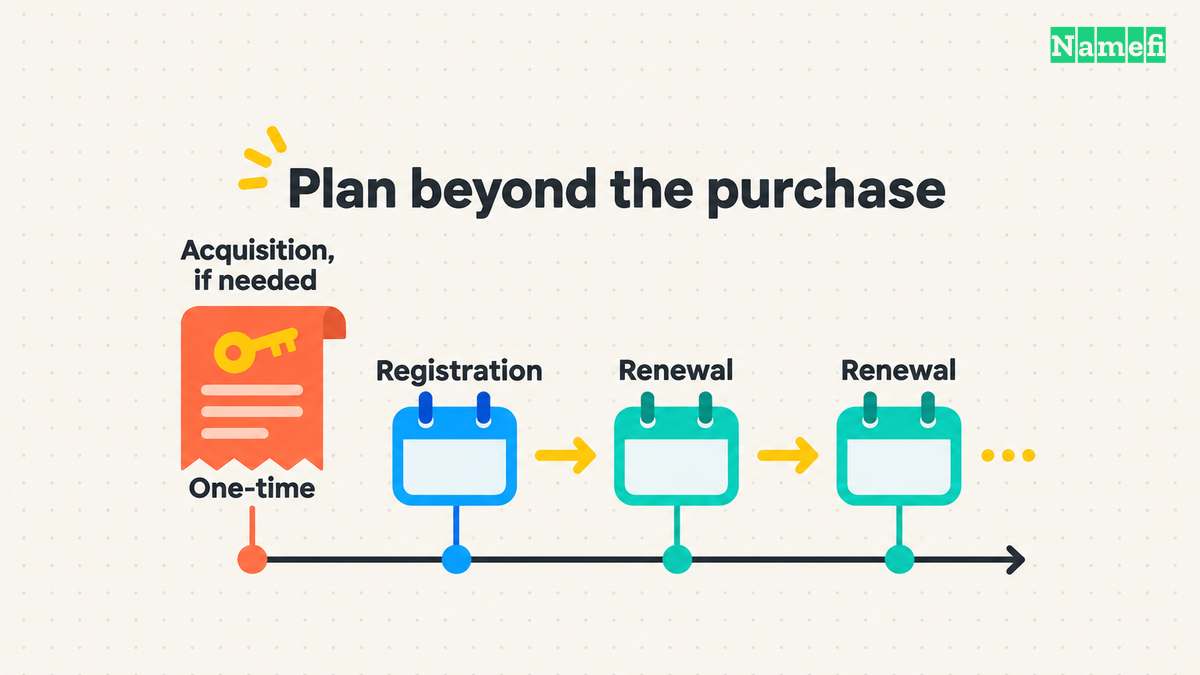
- Compare ongoing costs. Record registration, renewal, transfer, and any premium-name terms from the actual offer. Separate a one-time acquisition cost from the recurring registration obligation.
- Test the spelling. Ask intended users to repeat the address after hearing it. Prefer the full name they can reproduce without coaching.
- Choose a name you can keep. Don't make an unaffordable future
.comacquisition part of the launch plan. Buy extra endings only when each has a defined purpose and a renewal budget.
For a wider shortlist, use our domain extensions list. Once the choice is clear, Namefi's domain registration guide covers the next step. The right ending is the one that fits the project and a sustainable registration plan—not simply the oldest or the largest.
Comparing more options? Start with our guide to .com vs every other TLD.
Sources and further reading
- IANA —
.comWHOIS record, creation date; fetched 2026-11-06. - IANA —
.netWHOIS record, creation date; fetched 2026-11-06. - IANA —
.orgWHOIS record, creation date; fetched 2026-11-06. - IANA —
.infoWHOIS record, creation date; fetched 2026-11-06. - IANA —
.comdelegation, registry manager; fetched 2026-11-06. - IANA —
.netdelegation, registry manager; fetched 2026-11-06. - IANA —
.orgdelegation, registry manager; fetched 2026-11-06. - IANA —
.infodelegation, registry manager; fetched 2026-11-06. - ICANN — New TLD Application Process Overview, unrestricted
.com,.net, and.org; fetched 2026-11-06. - Public Interest Registry — FAQ, open
.orgeligibility; fetched 2026-11-06. - WIPO — Internet domain names FAQ, unrestricted
.infoclassification; fetched 2026-11-06. - Verisign / DNIB — Q4 2025 Domain Name Industry Brief, pages 2 and 5, dated registration totals; fetched 2026-11-06.
- GitHub — About GitHub, official
.comexample; fetched 2026-11-06. - PHP — Official website, official
.netexample; fetched 2026-11-06. - WordPress — About WordPress, open-source project and mission; fetched 2026-11-06.
- Metropolitan Transportation Authority — About the MTA, official
.infoexample; fetched 2026-11-06. - Google Search Central — Google's handling of new top level domains, generic-TLD search treatment; fetched 2026-11-06.
About the author(s)
Fenwei Bian is a software developer in her thirties who spends her working hours in pull requests and her weekends with her hands in soil or sawdust. Years of open source on GitHub taught her that names are interfaces: a good one is clear, honest about what it does, and kind to whoever has to use it next.
She gardens because it rewards patience and punishes wishful thinking, and she does woodwork because a joint either fits or it doesn't. Both habits show up in how she writes about naming — measure twice, check the source, and don't sand over a rough spot and hope no one notices.
For Namefi she writes about how domain markets actually move, the practical trade-offs of tokenizing and flipping names, and picking a domain you'll still be glad you own in twenty years.