
Uber’s Original Name: Why UberCab Became Uber
Discover Uber’s original name, why UberCab became Uber, and how its domain change supported a broader brand.
- domains
- branding
- startups
- domain-upgrades

Uber's original brand was UberCab. Its public brand shortened during the October 2010 regulatory dispute, according to contemporary coverage. In branding terms, removing “Cab” makes the name less tied to one transport category. That interpretation does not mean the rename resolved the underlying operating questions.
The corporate rename came later: Uber's SEC prospectus says it incorporated as Ubercab, Inc. in July 2010 and became Uber Technologies, Inc. in February 2011. The public brand, legal company name, and acquisition of Uber.com are related events with different timelines.
Before "Uber" became a verb, a logistics empire, and a synonym for an entire category of on-demand services, it was a more literal, more cautious thing: UberCab.com.
The original name made sense. When Garrett Camp and Travis Kalanick built the service, it did one narrow thing: it let you press a button and summon a black car. TechCrunch described the early product as an app that lets users request a car service to pick them up wherever they are right now. The word "Cab" told you exactly what you were getting. It mapped a new, confusing idea — hail a car from your phone — onto a familiar offline object everyone already understood.
For that first audience, UberCab.com was clear. It explained the product.
But the service had a regulatory problem the founders didn't choose. In October 2010, San Francisco and California transportation regulators challenged UberCab's operation. The reported concerns involved taxi licensing, insurance, dispatch, and prebooking rules. The startup got a cease-and-desist, and within days its logo dropped the word "Cab."
The rename created a separate branding requirement: the company needed the exact-match domain, Uber.com. The catch was that Uber.com already belonged to someone else — a music label — and the young company was short on cash. So reports say it paid in something else.
Multiple secondary accounts say Uber acquired Uber.com from Universal Music Group in exchange for a 2% stake in the company. The equity percentage is consistently reported; the exact dollar value and later economics are less certain.
2009–2010: the cab in the name that did real work
In the beginning, "Cab" was a feature, not a bug.
A brand-new company asking strangers to summon a stranger's car with a phone app needed every shortcut to comprehension it could find. "UberCab" did that work in one syllable. It said: this is like a taxi, but better — more uber. The product matched the name word for word. When the app launched, TechCrunch noted that anyone in San Francisco could download the app to their iPhone or iPad and use it to call up a car at any time.
The early traction was real. By mid-October 2010, UberCab had closed a $1.25 million angel financing round led by First Round Capital, with Lowercase Capital, Founder Collective, and more than a dozen individual angels participating.
But the ambition was already wider than the name. The founders weren't trying to build a slightly nicer taxi line in one city. They were building a logistics layer. And "Cab" — the word that made the product legible on day one — was about to become the word that drew a regulator's attention and capped the company's identity at the same time.
UberCab.com was the right domain for the first stage. It was the wrong domain for the company underneath it.
October 2010: the rebrand during a regulatory dispute
The trigger came from the government, not the marketing department.
On October 20, 2010, UberCab was hand-delivered a cease-and-desist order. TechCrunch reported that the San Francisco Metro Transit Authority & the Public Utilities Commission of California have ordered the startup to cease and desist. The stakes were not trivial. The orders carried the threat of up to $5,000 fee per instance of Ubercab's operation, and potentially 90 days in jail per each day the company remains in operation past the orders.
The cited report does not say the word "Cab" was the legal basis for the order. It lists concrete operating concerns: UberCab acted like a cab company without a taxi license, its cars did not carry taxi-equivalent insurance, the model threatened taxi dispatchers, and it offered immediate pickups despite rules that generally required limousines to be prebooked. The name change happened in the same regulatory window, but removing a word did not resolve those compliance questions.
So Uber did. Almost immediately, the logo changed. TechCrunch noted that Ubercab's logo now reads simply "Uber," and the company told its own Facebook community, in a line that captured the whole pivot, that it was more uber than cab. Smart Branding summarized the public-brand sequence: On the same day, Uber officially changed its name from UberCab to Uber.
The rename came amid that pressure. It also pointed at a domain the company didn't yet own.
The domain that belonged to a music label
Once the name became "Uber," the obvious address was Uber.com. But that domain was taken — and not by a competitor or a domain flipper.
The story went back to a different startup. Universal Music Group had invested in an earlier company also called Uber. That venture raised money from backers like Discovery Communications and Sterling Stamos Capital Management, but it fizzled out quickly. When it collapsed, UMG was left with one asset of value: the domain name.
So the exact-match domain the ride-hailing company now needed was sitting, unused, inside a major record label's portfolio — a leftover from a dead Web 2.0 startup, waiting for a buyer with the right offer.
The reluctant-owner problem that makes most premium-domain deals slow was, in this case, less about stubbornness and more about the buyer's wallet: Uber was brand-new and short on cash, so it would buy the domain not with money but with a slice of itself.
The trade: 2% of the company for one word
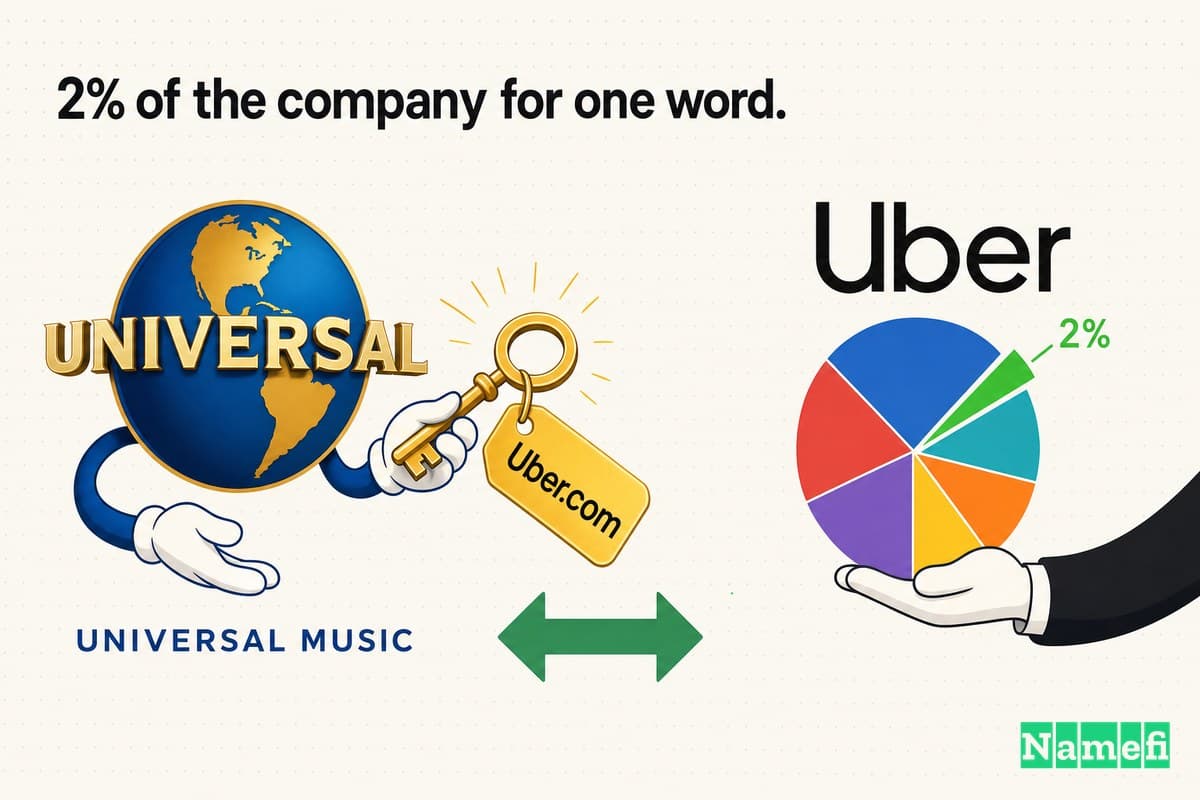
This is the part that makes the case unusual. Uber didn't pay cash. It paid in itself.
When the team behind UberCab reached out in 2010, they reportedly did not have much cash to offer. Instead, Uber offered UMG 2% equity in the company in exchange for the domain name. One later article assigns the stake a $107,000 value at the time, but the cited material does not show the valuation method or primary transaction documents, so that figure should be treated as an estimate rather than a verified purchase price.
The detail was later confirmed in Vanity Fair's reporting by Kara Swisher, which described Uber buying the Uber.com domain name from Universal Music Group for what was then 2 percent of the company. Smart Branding framed the same arrangement plainly: Uber offered Universal Music 2% of the company in exchange for the domain.
Equity-for-domain deals ask a seller to take a bet instead of a check. In this account, Universal accepted a stake in a tiny startup that called black cars in one city. Without the transaction documents, the public record cannot establish what cash alternatives were discussed or how either side valued the exchange at closing.
The seller's exit — and the cost of cashing out early
Here is where the story turns from clever deal into cautionary tale — for the seller.
Universal did not hold the equity indefinitely. The secondary accounts disagree on the exact buyback amount: Snagged reports $863,000, while a DomainInvesting summary of Vanity Fair reports about $1 million. In the absence of primary deal records, the defensible statement is that Uber reportedly repurchased the shares for roughly $1 million.
Later articles estimate very large counterfactual values for the original 2% stake. Those calculations implicitly treat the stake as if it remained an undiluted 2% through later financing and public-market changes, so they should not be presented as a verified value that Universal would actually have held.
That is the mirror image of many equity-for-asset stories. The buyer had a strategic need and limited cash, so it reportedly paid with a stake in itself. The seller later chose a reported cash buyback. Uber ended up with both the domain and the repurchased equity, but the surviving public evidence does not support a precise claim that Universal "lost" billions.
The money looked different then
It is tempting to judge this deal from the end of the story, where Uber is a global company and counterfactual estimates for the repurchased stake can become enormous. But every party in 2010 was acting in a fog, and those estimates depend on assumptions about dilution and holding history.
In 2010, Uber was a single-city black-car app facing an order whose reported penalties included fines and possible jail time for continued operation. It had raised $1.25 million. It had no idea whether it would survive the cease-and-desist, let alone whether "Cab" or no "Cab" it would ever be more than a luxury convenience for San Francisco tech workers.
From that vantage point, the math looks different on both sides:
- For Uber, a cash purchase would have consumed scarce operating capital. Trading 2% of a company that might fail shifted the consideration into uncertain future value, but it was not free: the equity diluted the other owners if the company succeeded. The upside was owning its own name.
- For Universal, accepting equity in a tiny, legally embattled car app instead of cash was the risky choice. The later reported buyback around $1 million exchanged uncertain future upside for cash, without giving us enough primary evidence to calculate the exact opportunity cost.
The lesson isn't "Universal was foolish." It's that a domain trade priced in equity is really two bets stacked together: a bet on the name, and a bet on the company. Uber won both. Universal won the first and folded on the second.
Why dropping "Cab" mattered
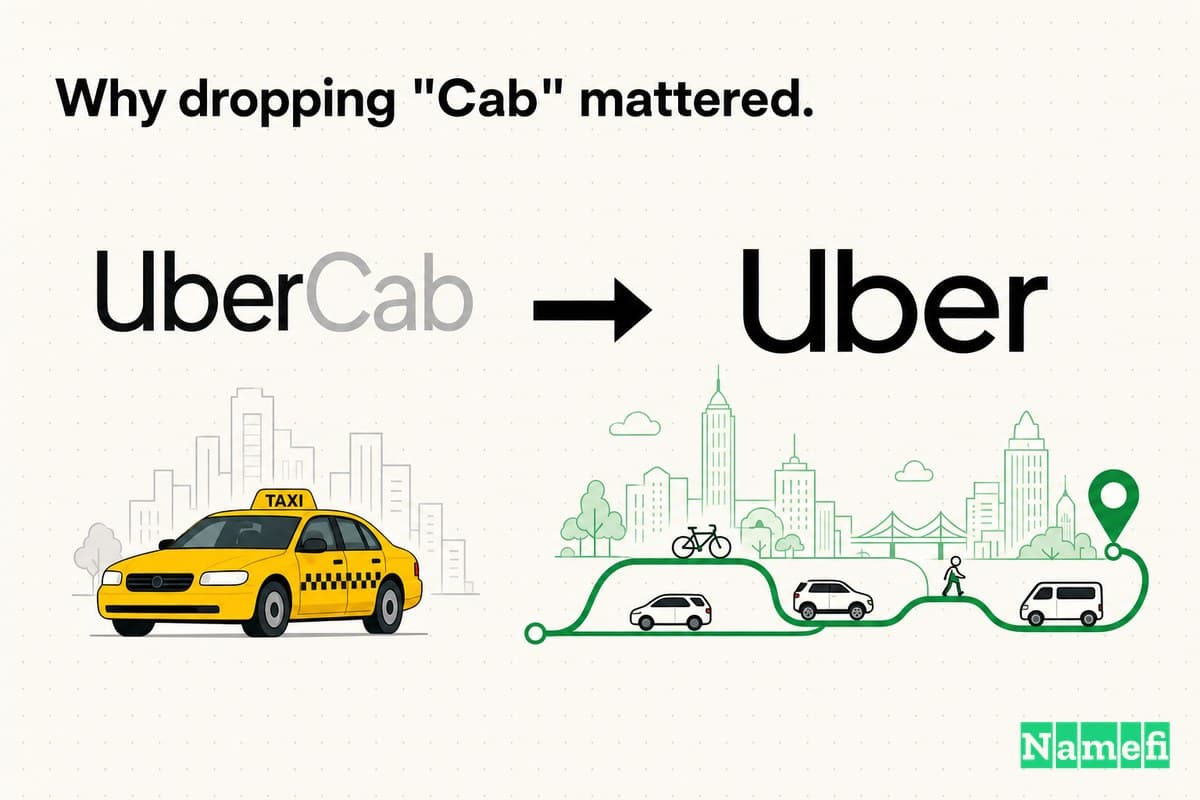
The gap between UberCab.com and Uber.com is one word. Strategically, it is the difference between a product and a category.
UberCab.com describes a thing you already know: a fancy taxi. Uber.com names something with no ceiling — a brand that could expand into pooled rides, food delivery, freight, two-wheelers, and eventually a verb people use without thinking about cars at all. One word ties you to the taxi industry and its regulators. The other lets you become the category itself.
| Before | After |
|---|---|
| UberCab.com | Uber.com |
| Names a taxi-like service | Names a company without a ceiling |
| Anchored to the "cab" category | Travels across rides, food, freight, and more |
| Carries a taxi-category label | Removes that category label from the brand |
| Adds a word to every mention | Reduces the brand to one word — and then to a verb |
This is the same pattern that shows up again and again in domain upgrades: early names explain, great names own. The descriptive version helps while a company still has to tell you what it does. The exact-match version helps once the company is ready to be the thing people reach for by default. Dropping "Cab" did not settle the regulatory dispute, but it removed the category cap baked into the name.
As Smart Branding observed, Uber really wasn't a taxicab company in the traditional sense, so there was no reason to attach the term "cab" to its name.
The sequence: rename first, then grow into the name
The order of events is what makes this case instructive.
The cease-and-desist arrived in October 2010. The logo dropped "Cab" within a day. The Uber.com domain was acquired around the same window, via the equity trade. And the formal corporate identity followed: per Wikipedia, in 2011, the company changed its name from UberCab to Uber, and the public app rolled out from there.
Notice the dependency. Uber couldn't credibly be "Uber" while its website lived at UberCab.com. The brand, the logo, and the domain had to move together — and the piece least under Uber's control was the domain, because someone else owned it. Securing Uber.com (even with equity instead of cash) was what made the rename real instead of cosmetic.
Imagine the alternative: a company announcing it is now "Uber," telling regulators it is more uber than cab, while still sending customers to UberCab.com. The mismatch would have undercut the whole point of the rename. The domain wasn't decoration on top of the rebrand. It was the load-bearing piece.
The domain became part of the operating system
Premium domains are not about prestige. They are about repetition.
A company's core domain shows up in places the marketing team never directly controls:
- In the app and on every receipt.
- In press headlines and regulatory filings.
- In email addresses and employee signatures.
- In search results and browser bars.
- In every spoken recommendation — "just take an Uber" — passed from one person to the next.
Every one of those repetitions either adds friction or removes it. UberCab.com made each mention longer, more taxi-bound, and more legally loaded. Uber.com made each mention shorter, cleaner, and category-free. Repeated across a global service and a name that became a verb in everyday speech, the domain starts to look like durable brand infrastructure — even though its equity cost cannot be reduced to a single verified dollar figure.
The domain didn't build Uber's brand. But once Uber.com was the address, every future repetition of the name compounded on a cleaner foundation — one with no "Cab" to explain away.
What founders should learn from Case 4
The easy takeaway — "drop the descriptive word and buy your exact-match .com" — is too blunt. The more useful lessons are about sequence, leverage, and how you pay:
- A descriptive domain is fine to start. UberCab.com did real work: it made an alien idea — summon a car with your phone — instantly legible. A modifier like "Cab," "App," or "HQ" is a reasonable on-ramp, not a failure.
- Watch for the moment the modifier becomes a mismatch, not just a ceiling. For Uber, the cease-and-desist made the taxi classification central, while the cited operating concerns went well beyond the brand name. When a modifier describes a narrower regulated category than the business claims to occupy, reassess it — without mistaking a rename for regulatory compliance.
- Secure the exact-match domain before the rename is real. Uber couldn't be "Uber" while it lived at UberCab.com. The slow, externally-owned asset — the domain — had to be locked down for the corporate rename to mean anything.
- When cash is scarce, a domain can still move through a structured trade. Reports say Uber used equity to acquire the name. The deal also shows the seller's risk: startup equity is volatile consideration, and later accounts place Universal's buyback at roughly $1 million rather than agreeing on an exact figure.
The domain upgrade did not make Uber win. Product, capital, aggression, timing, and execution mattered far more. But Uber.com made the company's reinvention — from "a better cab" into a category — nameable, and it had to be secured the moment the old name turned toxic.
The Namefi angle
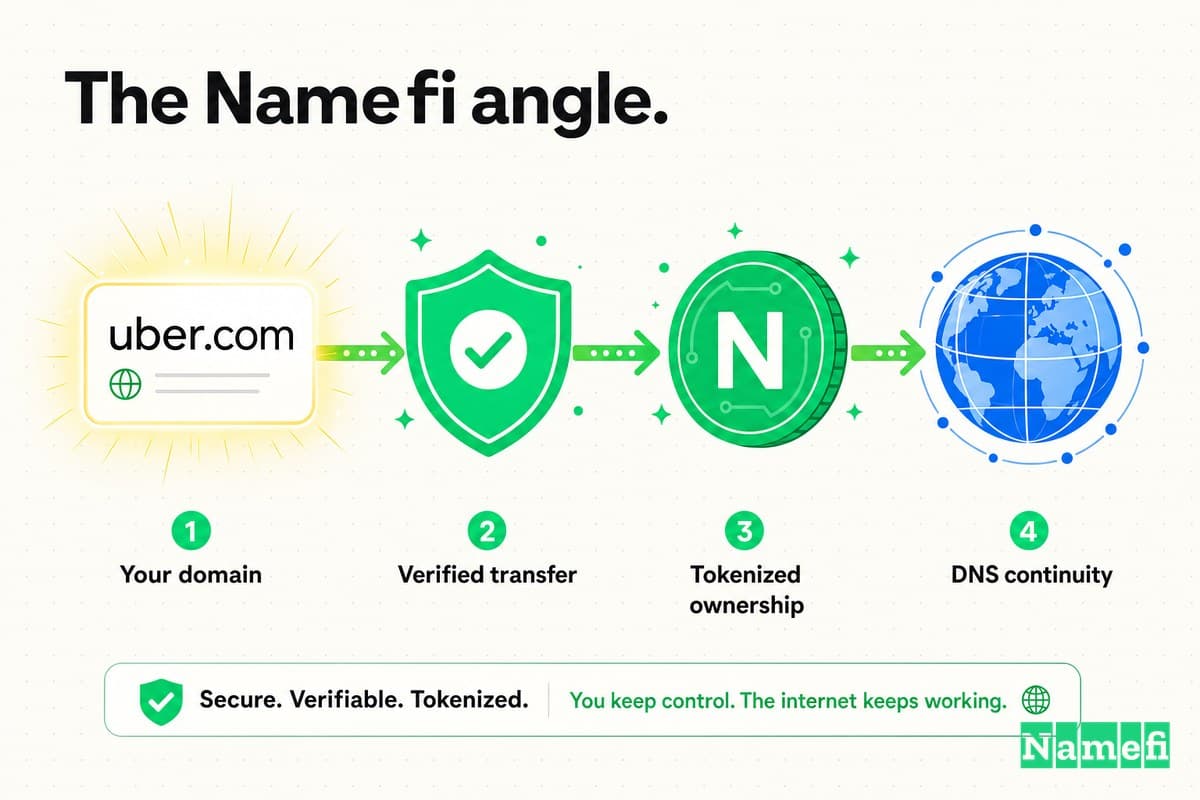
This case is, at its core, a transfer problem wearing a branding costume.
The strategic appeal is easy to understand — a company called Uber benefits from owning Uber.com. Reports describe an unusual owner and an equity-for-domain structure, but they do not expose the complete negotiation, transfer process, valuation method, or capitalization history. Those gaps are why the 2% figure is more defensible than the precise dollar values later attached to it.
Namefi is built around the idea that domains should behave like internet-native assets. Tokenized ownership can make domain control easier to verify, transfer, and integrate into modern workflows while staying compatible with DNS — turning tasks such as proving control and moving an asset into something closer to a clean, auditable transaction. That is a general benefit of more transparent domain infrastructure; the public Uber.com record does not show which transfer mechanisms the parties actually used.
Uber.com looks inevitable now because Uber became enormous. But the lesson lands long before that scale: when a name is going to carry the business — and especially when the old name has become a liability — the domain isn't decoration. It's the part of the brand worth trading a slice of the company to get right.
Sources and further reading
-
TechCrunch — UberCab Ordered to Cease And Desist, October 24, 2010, opening update on the public logo — fetched 2026-09-15.
-
Uber — 2025 prospectus supplement, “Corporate Information,” p. S-1 — fetched 2026-09-15.
-
TechCrunch — UberCab Ordered To Cease And Desist
-
TechCrunch — UberCab Closes Uber Angel Round
-
Snagged — Uber.com: The $3.46B Domain That Universal Music Let Go
-
DomainInvesting.com — Vanity Fair Reveals Cost of Uber.com Domain Name
-
Smart Branding — UberCab.com Upgrades to UBER.com
-
Smart Branding — A creative approach to domain name acquisitions: Domain deals with equity
-
Wikipedia — Uber
Contributors

Aileen Wright is a student in her twenties living in New York City, where the distance between a museum wall and a library reading room is a short walk and a long afternoon. She came to name writing through art and history — the way a single portrait, coin, or manuscript margin can carry a name across centuries and change its meaning on the way.
Most weeks you can find her in Central Park with a paperback, or in the quiet of a public reading room chasing down where a name actually comes from rather than what a name-list says it means. She is also teaching herself to code, which has made her oddly precise about spelling, sorting, and the small details that decide whether a name ages well.
For Namefi she writes about the history and culture behind domain names, the stories brands carry as they rename, and the difference between a good story and a verified source.

Victor Zhou is a technology founder and standards editor focused on digital identity and trust. He founded Namefi, edits Ethereum Improvement Proposals, and previously led smart-contract architecture work at Google Labs.
His work sits at the intersection of naming, ownership, and the systems people use to establish identity online. That perspective makes him especially interested in the way names move between personal meaning, public recognition, and digital infrastructure.
For Namefi, Victor edits and writes about domains as durable digital identity: how names become ownable onchain assets, how tokenization changes custody and trust, and what naming can learn from the systems people use to establish identity online.
Related guides
- From Box.net to Box.com: The ~$1M Upgrade That Dropped the ".net" and Bought the Exact MatchHow Box launched in 2005 on Box.net because Box.com was taken, pivoted from consumer storage to the enterprise, and in 2011 paid Digimedia close to $1 million for the exact-match Box.com — a .net-to-.com upgrade that landed right as the company became simply "Box."
- From BufferApp.com to Buffer.com: The 624-Day, Bank-Statement-Open Domain DealHow Buffer launched in 2010 on BufferApp.com because Buffer.com was taken, then spent 624 days acquiring the exact-match domain — even showing the seller its bank balance — and why a company famous for radical transparency stayed quiet on the one number everyone wanted: the price.
- Who Owns Trip.com? Ctrip, Trip.com Group, and the RebrandUnderstand how Trip.com relates to Ctrip and Trip.com Group, and trace the acquisition and company-name changes behind the travel brand.
- From del.icio.us to Delicious.com: The Cleverest Domain Hack on the Web — and Why Yahoo Untangled ItHow the pioneering social-bookmarking site launched in 2003 as the famous domain hack "del.icio.us," why those dots became a permanent tax on every mention, and how Yahoo moved it to the cleaner Delicious.com in 2008.