
What Is Domain Parking? Parked Domains and Monetization
Learn what a parked domain is, why people park domains, and how parking, sale landing pages, and monetization differ.
- domains
- domain-investing
- domain-flipping
- explainer

A parked domain is a registered name that is not being used for a developed website. It may show a placeholder, an advertising page, or a notice that the domain is for sale. Parking does not by itself mean the name is available to buy, and it does not guarantee revenue.
People park names while preparing a site, reserving a future name, or evaluating a sale. For investors, the choice is what the visitor should see while the registration remains in their account. The domain flipping guide explains that wider holding-and-selling decision.
What domain parking actually is
| Page choice | Purpose | What it does not establish |
|---|---|---|
| Non-monetized placeholder | Reserve the name or announce a future project | That the domain is for sale |
| Advertising parking page | Earn under a provider's advertising terms from eligible traffic | That revenue will cover renewals |
| For-sale landing page | Invite offers or present a purchase path | That a sale will occur |
These choices can overlap. Sedo, for example, distinguishes an ads page and a sales landing page within its parking and marketplace terms. Decide whether your immediate goal is a placeholder, ad revenue, or buyer inquiries before configuring the domain.
Earning ad and affiliate revenue while you hold

The traditional reason to park a name was money from clicks. The model is simple: the parked page is filled with advertising links, and you get a cut when visitors click them. Wikipedia describes the mechanics directly — the domain name will usually resolve to a web page containing advertising listings and links, and usually the domain holder is paid based on how many links have been visited (e.g. pay per click).
Where do the visitors come from? Almost entirely from type-in traffic — people who type a guessable name straight into the address bar. Wikipedia defines it as exactly that: type-in traffic is a term that historically describes visitors finding a website by directly entering a URL in a web browser's address bar. Someone who wants cheap flights and types cheapflights.com directly, with no search engine in between, is type-in traffic — and if you happen to own a descriptive name like that, an ad-filled parking page can quietly earn off them.
That dynamic was strong enough to drive a whole wave of speculation. As Wikipedia records, the ease with which PPC revenue could be derived from parked domains effectively created a situation where domains were being registered purely for their type-in traffic, and many of exact phrases that people were searching for in search engines were being registered for the sole purpose of serving PPC advertising. The big registrars built this in: per Wikipedia, some hosters such as Godaddy have their own domain parking systems and allow unused domains to be parked with the registrant receiving a share of the PPC revenue earned.
The honest version for today: this only pays meaningfully on names that already get real type-in traffic, which in practice means short, generic, dictionary-grade names on a strong extension that people would actually guess at directly. For the brandable, invented, or niche names most flippers hold, parking revenue is closer to noise than income. Affiliate parking (pointing the page at a relevant retailer and earning commission instead of raw PPC) can do slightly better when the name maps to a clear product category, but the same constraint holds: no traffic, no revenue. Treat any earnings on a name you're holding to sell as a small offset against renewals, not a business. The drivers behind which names get that traffic are the same ones covered in what makes a domain valuable.
Modern parking is a sales channel, not a billboard
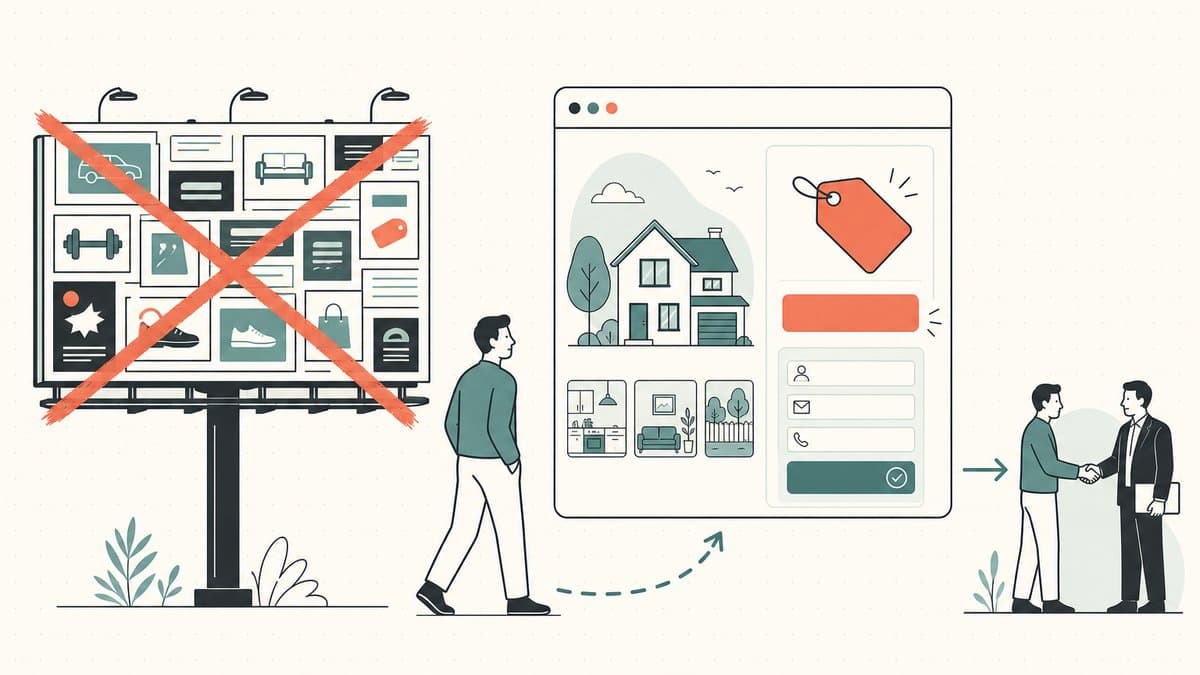
Here's the shift that matters. For a flipper, the most valuable thing a parked page can do is not earn pennies from clicks — it's announce that the name is for sale, capture interest, and route a buyer toward a deal. The parked page is the most-visited surface your domain has, because anyone curious enough to type the name in lands there. Wasting that surface on someone else's ads, instead of your own "for sale" message, is leaving the actual money on the table.
A sales-oriented parking page does a few specific jobs. It states clearly that the domain is available. It gives a way to make an offer or, better, a fixed buy-now price so a buyer can act without a back-and-forth. And it captures the inquiry — a name, an email, an offer amount — so a serious buyer who arrives at 2 a.m. doesn't bounce. This is its own discipline, covered in domain for sale landing pages. The broader playbook of getting the right buyer to that page is the cluster pillar, marketing your domains for sale, and the search side — making your listings findable — is marketplace SEO for domain listings, which leans on the same SEO fundamentals as any other page.
Most marketplaces and parking providers now ship this for free: list a name and they give you a for-sale lander, an offer form, and often a buy-now flow wired to a checkout. For a name you have deliberately chosen and cleared to market, pointing it at a for-sale page rather than a generic ad page can turn the one surface you control into a sales rep that works while you sleep. It is not the right default for every registration: active domains, names held for development, and names with unresolved trademark risk need a different decision. When an offer comes in, the handoff usually runs through a neutral escrow flow so neither side has to move first; we walk through that in domain escrow explained, and the step-by-step of closing a single sale lives in how to sell a domain name you own.
One caution worth stating plainly: a for-sale page is a public signal, and on names that brush up against a trademark, broadcasting "make me an offer" can contribute to evidence of bad-faith targeting. The UDRP does not treat "generic," "dictionary," or "brandable" as automatic safe harbors; panels examine the name, the trademark, the registrant's intent and use, and the overall circumstances. Resale and generalized offers can be legitimate when they do not target a trademark, but a label alone does not make the conduct safe. (WIPO Overview 3.1, sections 2.10 and 3.1.1) The full framework is in what is UDRP.
When parking is actually worth it

Parking is cheap, so the temptation is to treat it as free upside and never think about it. The sharper question is what you're parking for.
Park for sale when the name is appropriate to market. For a domain you genuinely intend to flip and have screened for trademark and contractual risk, a clear for-sale page is often the highest-leverage thing parking does. For an active service, a name with unresolved rights questions, or a registration whose policy or agreement limits the intended use, it is not a default. Document the decision for each name instead of treating publication as automatic.
Park for ad revenue, rarely. Monetized parking is worth setting up only on names that genuinely pull type-in traffic — short, generic, guessable strings on a liquid extension like .com or a strong alternative such as .co or .io. A brandable or invented name with little eligible traffic may earn little or nothing, and a busy ad page can actually hurt you by making a serious buyer think the name is just another parked junk domain rather than an asset with a clear owner who'll sell. When in doubt, choose the clean for-sale page over the cluttered ad page.
Run the arithmetic. Compare actual parking payouts after provider fees with the domain's quoted renewal cost. Include periods with no earnings, and do not assume type-in traffic exists before measuring it. The domain cost guide explains the recurring bill; an unsold name must justify that bill on its own merits.
If you want the bigger picture on monetizing names you hold beyond a parking page — leasing, rent-to-own, and revenue-sharing arrangements all rent out a name's value without selling it outright — those are separate strategies worth knowing. For domains that are appropriate to market, a clean sales lander can be the baseline; other held names may be better left on an operational page, a noncommercial placeholder, or no public content at all.
The Namefi angle
A for-sale parking page is only as good as what happens after a buyer clicks "make an offer." That's where most deals stall — the seller won't transfer before getting paid, the buyer won't pay before receiving the name, and the whole thing collapses into mutual suspicion. The page captured the interest; the settlement is where it's won or lost.
This is the gap Namefi is built to narrow. Tokenized ownership makes control of a real ICANN domain easier to verify and transfer. Transferring the ownership token does not by itself rewrite nameservers or records, so an existing parking configuration can remain in place when the parties and operators leave that configuration unchanged; it is not an unconditional DNS uptime guarantee. Registrar delegation and any external DNS provider remain separate control planes that need their own access, change, and recovery procedures. (How DNS works on tokenized domains) For a flipper, an auditable ownership transfer can reduce part of the settlement friction after a parking page starts a deal.
Friendly Disclaimer (Read Me!)
We're not lawyers, accountants, financial advisors, or doctors, and nothing in this article is legal, financial, tax, accounting, medical, or any other flavor of professional advice. We write these posts to educate ourselves and as a convenience for our customers. Info here may be out of date, geography-specific, or just plain wrong. We make mistakes too.
For any important decision, please consult a real professional (seriously!). Or if that's not your vibe, ask a friend, ask Twitter, ask Reddit, ask an AI, or ask a psychic. In short: DOYR - Do Your Own Research. Let's learn and have fun.
Sources and further reading
-
Wikipedia — Domain parking (definition; monetized vs non-monetized; pay-per-click mechanics)
-
Wikipedia — Type-in traffic (definition)
-
Wikipedia — Domain name speculation (PPC revenue from parked domains; registrar parking systems)
-
WIPO — Overview of WIPO Panel Views on Selected UDRP Questions, Third Edition, version 3.1
-
Sedo — Price list, parked ads pages versus sales landing pages. Fetched 2026-09-15.
Contributors

Fenwei Bian is a software developer in her thirties who spends her working hours in pull requests and her weekends with her hands in soil or sawdust. Years of open source on GitHub taught her that names are interfaces: a good one is clear, honest about what it does, and kind to whoever has to use it next.
She gardens because it rewards patience and punishes wishful thinking, and she does woodwork because a joint either fits or it doesn't. Both habits show up in how she writes about naming — measure twice, check the source, and don't sand over a rough spot and hope no one notices.
For Namefi she writes about how domain markets actually move, the practical trade-offs of tokenizing and flipping names, and picking a domain you'll still be glad you own in twenty years.

Victor Zhou is a technology founder and standards editor focused on digital identity and trust. He founded Namefi, edits Ethereum Improvement Proposals, and previously led smart-contract architecture work at Google Labs.
His work sits at the intersection of naming, ownership, and the systems people use to establish identity online. That perspective makes him especially interested in the way names move between personal meaning, public recognition, and digital infrastructure.
For Namefi, Victor edits and writes about domains as durable digital identity: how names become ownable onchain assets, how tokenization changes custody and trust, and what naming can learn from the systems people use to establish identity online.
Related guides
- Domain Backorders and Drop-Catching, ExplainedWhat domain backorders and drop-catching are, how services race to grab a name the instant it releases, and when a backorder is worth paying for.
- End-User Price vs Reseller Price: Why One Domain Has Two NumbersWhy a domain has a low wholesale/reseller price and a much higher end-user price, how big the spread is, and which number applies to your sale.
- Expired Domains and the Drop Cycle, ExplainedHow a domain expires and drops: grace period, the 30-day redemption window, 5-day pending delete, release — and where dropped names surface for flippers.
- Inbound vs Outbound Domain SalesInbound vs outbound domain sales: when each works, the effort-and-return tradeoff, and how to run both without your outreach reading as spam.