
From Massdrop.com to Drop.com: How a Group-Buy Community Dropped Half Its Name to Own One Word
How Massdrop spent seven years building an enthusiast group-buying community, then rebranded to Drop in 2019 — quietly acquiring the premium Drop.com domain (asking price once $800,000) before the rename, and why dropping "Mass" mattered.
- domains
- branding
- startups
- domain-upgrades

For its first seven years, one of the internet's most beloved enthusiast communities lived at an address that explained exactly what it did: Massdrop.com.
The name was a description of the mechanic. Massdrop ran mass drops — group buys. When a hundred mechanical-keyboard obsessives or audiophiles wanted the same niche product, Massdrop pooled their demand, negotiated with the manufacturer, and got everyone a better price. The launch announcement put it plainly: Massdrop is an online community for enthusiasts that helped people across several communities pool orders, and the word "Mass" did real work. It told you the trick: nothing here is bought alone.
For that first audience, Massdrop.com was perfect. It named the move.
But the company underneath the name kept changing. By 2019, Massdrop was no longer just a coordinator of bulk orders. It was designing its own keyboards and headphones, running a real commerce platform, and preparing to ship to new markets. The "Mass" — the word that made the model legible on day one — had started to describe a smaller, older company than the one it had become.
So in April 2019, Massdrop did what a surprising number of growing companies eventually do: it dropped half its name. It became simply Drop, and it moved to the exact-match domain it had quietly secured ahead of time — Drop.com, a premium one-word .com that had once carried an asking price of $800,000.
2012–2019: the "Mass" that did real work
In the beginning, "Mass" was a feature, not a bug.
Massdrop was founded in July 2012 by Steve El-Hage, Nelson Wu, and Will Bright. The founders had grown up on hobbyist forums and noticed something inefficient: enthusiasts were already trying to buy together, but badly. As one early account described it, getting 100 enthusiasts to buy together and placing that order with a vendor to get a group purchase was happening on an ad-hoc basis. Massdrop turned that ad-hoc behavior into a product.
The mechanic was the whole brand. As the company explained when it raised its Series A, enthusiasts use Massdrop's polling and discussion systems to determine what products they'd like to purchase together. From there, Massdrop works on the community's behalf to contact manufacturers directly, negotiate the best prices and facilitate logistics. The founders summed up the thesis in one line: we started Massdrop with the simple idea of bringing communities of people together to collectively discover and purchase the products they care about.
It worked. By September 2014, Massdrop had closed $6.5 million in a Series A round of financing, led by Mayfield Fund, and by August 2015 it raised a $40 million Series B. The communities that defined it — especially the mechanical keyboard and audiophile communities — turned Massdrop into a cult brand. People didn't just shop there. They lurked, polled, argued over switch feel and headphone impedance, and waited weeks for a drop to ship.
But the ambition kept widening past the name. Massdrop wasn't only running other people's products through group buys anymore. It was making its own.
April 2019: dropping "Mass," acquiring Drop.com
On April 29, 2019, the company unveiled the change. Notebookcheck reported it cleanly: Massdrop has unveiled its rebrand. It has decided to change the business' name to Drop.
The reasoning was explicitly about outgrowing the original mechanic. CEO Steve El-Hage put it directly: the name Massdrop originated when we were just a group-buying site, but we are so much more than that now. He framed the rename as a marker of the company's evolution: this new brand reflects how we've evolved since our beginnings in 2012, from group-buying site, to commerce platform. The company's own press release described the new Drop as a business that uses data and insights from enthusiasts to develop next-level products — a product company, not a coupon mechanic.
And critically, the domain was already in hand. As DomainInvesting reported, Massdrop announced a rebrand to Drop, and smartly, the company was able to acquire the matching Drop.com domain name in advance of the rebrand. The redirect followed: Smart Branding noted that Massdrop.com now directs to Drop.com, and that the company also managed to secure the @Drop Twitter and Instagram handles.
A four-letter exact-match .com and the matching social handles, all lined up before the name went public. That is not luck. That is a company that understood the domain was the load-bearing part of the rebrand.
The backstory: a one-word .com that was never going to be cheap
The reason this case is interesting is that Drop.com is exactly the kind of domain that almost never trades quietly.
It is one syllable, one common English word, four letters, in the .com namespace. Names like that don't sit unclaimed; they sit in portfolios, owned by people who don't need to sell. DomainInvesting noted that, as of the last public record, the domain name had been owned by a company called Drop Inc. — and earlier, in February 2017, it had been listed with an asking price of $800,000.
What Massdrop actually paid is not public. The domain went dark behind privacy protection: the Drop.com domain name has had Whois privacy enabled at GoDaddy since August of 2017, which makes the exact acquisition date and price impossible to confirm from the outside. But the timeline tells its own story: the $800,000 ask surfaced in early 2017, the domain went private in August 2017, and the rebrand landed in April 2019. Somewhere in that window, the group-buy company quietly secured the word it was about to become.
The money looked different then
It is tempting to look at a one-word .com acquisition in hindsight and call it an easy decision. Drop went on to ship its own keyboards and headphones, expand internationally, and eventually get acquired by Corsair in July 2023. But the actual Drop.com purchase price was never disclosed, so the earlier $800,000 asking price cannot be treated as the amount Massdrop paid.
But it should be judged at the moment it was spent, not from the far end of the story.
In 2017 and 2018, Drop was still Massdrop — a venture-backed community-commerce company that lived and died on margins, logistics, and inventory bets on its own first products. Without a disclosed sale price, we cannot know how large the domain line item was. We can say that negotiating for a one-word .com publicly offered at $800,000 required the company to weigh the address against engineering, inventory, and product tooling — and to treat the domain as infrastructure for a rename it had decided was coming.
That is what makes the sequence telling. The company secured Drop.com before announcing that it needed to stop being "Mass" anything — and the only way to make that shorter identity real was to own the shorter name first.
Why shortening to "Drop" mattered
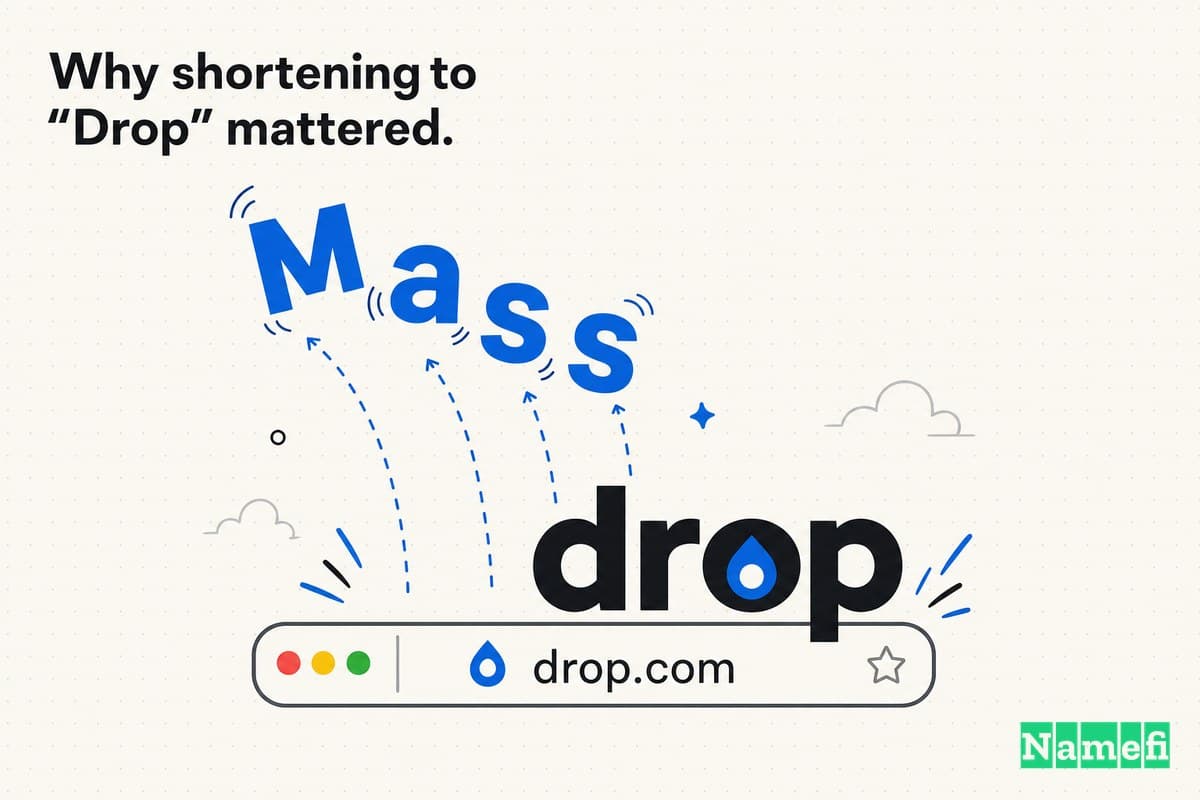
The gap between Massdrop.com and Drop.com is one prefix. Strategically, it is the difference between a mechanic and a brand.
Massdrop.com describes how the thing worked: a mass + a drop, a group buy. Drop.com names what the company became: a single, ownable word that no longer ties the brand to one purchasing model. The company said as much — the old name originated when we were just a group-buying site, and by 2019 the group buy was no longer the whole story.
| Before | After |
|---|---|
| Massdrop.com | Drop.com |
| Describes a mechanic (mass + drop) | Names a brand without a ceiling |
| Anchored to group buying | Travels across commerce and own-brand products |
| Eight letters, two ideas | Four letters, one idea |
| Reads like a feature | Reads like a company |
This is the same pattern that shows up again and again in domain upgrades: early names explain, great names own. The descriptive version helps while a company still has to teach you how it works. The exact-match version helps once the company is ready to simply be the word people already say. "Drop" was a word the community used constantly — every group buy was a drop — so the shorter name didn't abandon the heritage. It distilled it.
The community that made the name worth keeping half of
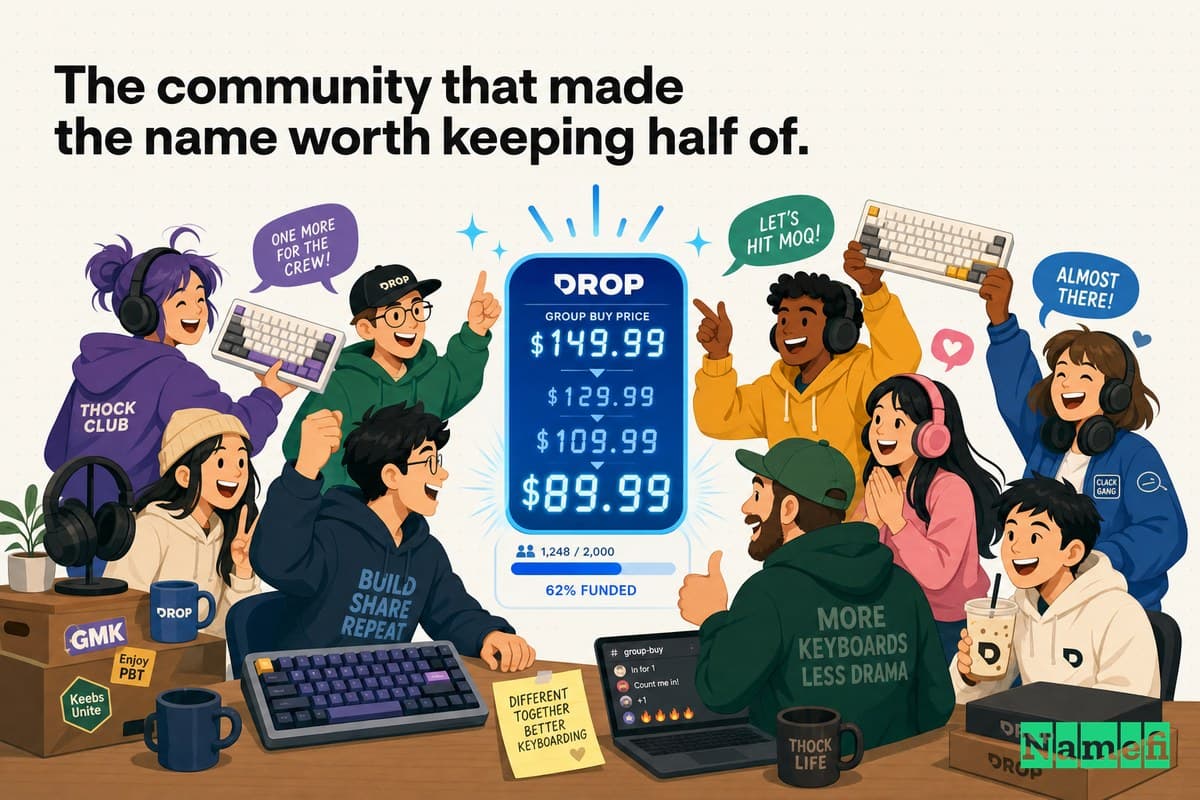
Here is the detail that makes this rebrand different from a typical startup name-swap: the brand the company shortened was one its users genuinely loved.
Massdrop didn't grow on advertising. It grew on identity. Its members weren't passive shoppers; they were participants who influence the products chosen to be sold through forums and polls. The mechanical-keyboard and audiophile communities especially treated a "drop" as an event — something to refresh the page for, to argue about, to wait weeks for. The word "drop" was already the community's word.
So when the company cut "Mass" and kept "Drop," it wasn't discarding the brand. It was keeping the half that carried the emotion and dropping the half that was just describing plumbing. The press release leaned into exactly this continuity, pitching the new Drop as a company that uses data and insights from enthusiasts to develop next-level products — the same community, given a shorter name to rally under.
That is the subtle art of a good rename: cut the word that limits you, keep the word your users already chant.
The timing: domain first, rename second
The order of events is what makes this case instructive.
The $800,000 asking price for Drop.com surfaced in early 2017. The domain went behind Whois privacy in August of 2017. The public rebrand to Drop didn't happen until 29 April, 2019. The expensive, externally-owned asset was locked down well before the name went live.
Notice the dependency. Massdrop couldn't credibly be "Drop" while its website lived at Massdrop.com and someone else owned Drop.com. The brand, the social handles, and the domain had to move together — and the piece least under the company's control was the domain, because it had a price tag and an owner. Securing Drop.com (and the @Drop handles) is what let the company flip the switch in a single announcement, with Massdrop.com now directs to Drop.com on day one.
Imagine the alternative: announcing you are now "Drop" while customers still type Massdrop.com and your shorter name points at a parked page owned by a stranger. The mismatch would have undercut the whole point of the rename. The domain wasn't decoration on top of the rebrand. It was the prerequisite for it.
The domain became part of the operating system
Premium domains are not about prestige. They are about repetition.
A company's core domain shows up in places the marketing team never directly controls:
- In every order confirmation and shipping email.
- In community forum posts and Reddit threads about the latest drop.
- In employee email addresses and signatures.
- In search results and browser bars.
- In every spoken recommendation — "I got it on Drop" — passed from one enthusiast to the next.
Every one of those repetitions either adds friction or removes it. Massdrop.com made each mention longer and pinned it to the group-buy mechanic. Drop.com made each mention shorter, cleaner, and free of any one purchasing model. Multiply that across millions of members and a community that talks about its purchases constantly, and the cost of the domain stops looking like a luxury and starts looking like a permanent reduction in drag.
The domain didn't build Drop's community. But once Drop.com was the address, every future mention of the brand compounded on a cleaner, shorter foundation — one word instead of a compound, with no "Mass" to carry around.
What founders should learn from Case 9
The easy takeaway — "shorten your name and buy the four-letter .com" — is too blunt. Most founders can't buy a one-word .com, and most shouldn't try on day one. The more useful lessons are about timing and continuity:
- A descriptive name is a great on-ramp. Massdrop.com did real work for seven years: it made an unfamiliar idea — pool your order with strangers to lower the price — instantly legible. A descriptive compound like "Massdrop," "UberCab," or "TeslaMotors" is a reasonable starting point, not a failure.
- Watch for the moment the description becomes a ceiling. The signal to upgrade isn't aesthetic. It's when your name describes a narrower or older company than the one you've become. For Massdrop, that was the shift from coordinating group buys to designing its own products.
- Keep the half your users already love. Drop didn't invent a new word. It kept the one the community already chanted and cut the one that merely described plumbing. The best shortening feels like distillation, not abandonment.
- Secure the domain before the rename is public. The slow, expensive, externally-owned asset — Drop.com, once priced at $800,000 — had to be locked down first. The corporate identity can change in an afternoon; the domain can take years to acquire.
The domain upgrade did not make Drop succeed. Community, product quality, and execution mattered far more. But Drop.com made the company's evolution — from a group-buy mechanic into a brand — nameable, and it had to be secured before anyone could use it.
The Namefi angle
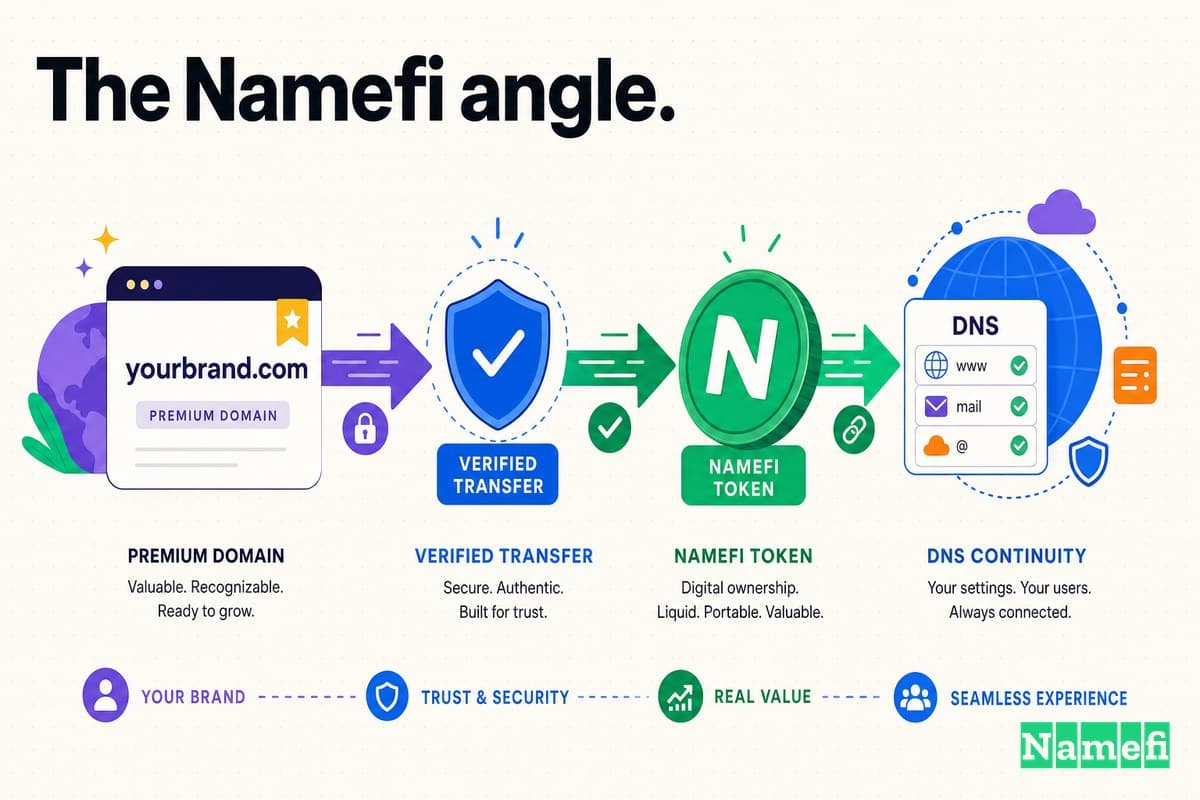
This case is, at its core, a transfer problem wearing a branding costume.
The strategic decision was never really in doubt — of course a company that everyone called "Drop" should own Drop.com. The hard part was everything around the asset: finding terms a premium one-word-.com owner would accept, agreeing on a price with no public comparables (the last public signal was an $800,000 ask), moving control cleanly behind Whois privacy, and timing it so the redirect was live the moment the name went public — all without disrupting an active commerce site or its devoted community.
Namefi is built around the idea that domains should behave like internet-native assets. Tokenized ownership can make domain control easier to verify, transfer, and integrate into modern workflows while staying compatible with DNS — turning the messiest parts of a deal like this (proving who owns what, agreeing on value, and moving it safely) into something closer to a clean, auditable transaction. A future where a premium one-word domain can be priced, transferred, and settled in a single verifiable step without a multi-year paper trail and a privacy curtain is exactly the kind of friction this case spent so much effort quietly overcoming.
Drop.com looks inevitable now because everyone already said "drop." But the lesson lands long before that: when a name is going to carry the business — and especially when you're cutting your old name in half — the domain isn't decoration. It's the part of the brand worth securing before you ever announce the change.
Sources and further reading
- DomainInvesting.com — Massdrop Rebrands as Drop with Drop.com Domain Name
- Smart Branding — Massdrop Rebrands to Drop: From Niche Site to Global Brand
- PR Newswire — Massdrop Evolves Brand to Become Drop
- audioXpress — Massdrop Announces Name Change to Drop
- Notebookcheck — Massdrop becomes Drop, announces new range of own-brand products
- GlobeNewswire — Massdrop Lands $6.5 Million to Empower Enthusiast Communities
- Vator — Massdrop lands $6.5M for group buying among enthusiasts
- Wikipedia — Drop (company)
Contributors

Aileen Wright is a student in her twenties living in New York City, where the distance between a museum wall and a library reading room is a short walk and a long afternoon. She came to name writing through art and history — the way a single portrait, coin, or manuscript margin can carry a name across centuries and change its meaning on the way.
Most weeks you can find her in Central Park with a paperback, or in the quiet of a public reading room chasing down where a name actually comes from rather than what a name-list says it means. She is also teaching herself to code, which has made her oddly precise about spelling, sorting, and the small details that decide whether a name ages well.
For Namefi she writes about the history and culture behind domain names, the stories brands carry as they rename, and the difference between a good story and a verified source.

Victor Zhou is a technology founder and standards editor focused on digital identity and trust. He founded Namefi, edits Ethereum Improvement Proposals, and previously led smart-contract architecture work at Google Labs.
His work sits at the intersection of naming, ownership, and the systems people use to establish identity online. That perspective makes him especially interested in the way names move between personal meaning, public recognition, and digital infrastructure.
For Namefi, Victor edits and writes about domains as durable digital identity: how names become ownable onchain assets, how tokenization changes custody and trust, and what naming can learn from the systems people use to establish identity online.
Related guides
- From Box.net to Box.com: The ~$1M Upgrade That Dropped the ".net" and Bought the Exact MatchHow Box launched in 2005 on Box.net because Box.com was taken, pivoted from consumer storage to the enterprise, and in 2011 paid Digimedia close to $1 million for the exact-match Box.com — a .net-to-.com upgrade that landed right as the company became simply "Box."
- From BufferApp.com to Buffer.com: The 624-Day, Bank-Statement-Open Domain DealHow Buffer launched in 2010 on BufferApp.com because Buffer.com was taken, then spent 624 days acquiring the exact-match domain — even showing the seller its bank balance — and why a company famous for radical transparency stayed quiet on the one number everyone wanted: the price.
- Who Owns Trip.com? Ctrip, Trip.com Group, and the RebrandUnderstand how Trip.com relates to Ctrip and Trip.com Group, and trace the acquisition and company-name changes behind the travel brand.
- From del.icio.us to Delicious.com: The Cleverest Domain Hack on the Web — and Why Yahoo Untangled ItHow the pioneering social-bookmarking site launched in 2003 as the famous domain hack "del.icio.us," why those dots became a permanent tax on every mention, and how Yahoo moved it to the cleaner Delicious.com in 2008.