
From JambaJuice.com to Jamba.com: How a Smoothie Chain Dropped a Word — and Already Owned the Domain
How Jamba Juice spent 29 years explaining itself with the word "Juice," why it dropped that word in 2019 to become simply "Jamba," and the quiet advantage almost no one noticed: Jamba.com was already an established company domain before the rebrand.
- domains
- branding
- startups
- domain-upgrades

For twenty-nine years, one of America's best-known smoothie chains told you what it sold right there in its name: Jamba Juice, living at JambaJuice.com.
The name was honest. When Kirk Perron opened the first store in San Luis Obispo in 1990, it was — in the company's own later words — a little juice shop with a big idea. The original sign didn't even say "Jamba." It said Juice Club. The word "Juice" did real work: it told a curious passerby exactly what was inside, in a category — fresh blended drinks — that most Americans in the early 1990s had never encountered.
Then, in 2019, after almost three decades of explaining itself, the company dropped the word that had defined it. Jamba Juice became simply Jamba.
The reasoning was that "Juice" had stopped describing the business — and started shrinking it. The chain now sold bowls, plant-based bites, and boosts, not just blended drinks, and the word "juice" had quietly turned into a liability in a more sugar-conscious era.
But here's the detail that makes this case different from almost every other story in this series: Jamba didn't have to buy its exact-match domain for the 2019 rebrand. Unlike Tesla, which paid $11 million for Tesla.com, or Uber, which traded equity for Uber.com, Jamba already had an established Jamba.com presence dating back at least two decades — the snapshot record shows the site live and reading Welcome to Jamba.com in January 1999. When the rebrand came, the hardest, most expensive part of a name change was already done.
1990–1995: the Juice Club that became Jamba Juice
In the beginning, "Juice" wasn't even the headline word — "Club" was.
Kirk Perron was a cyclist who wanted to make healthy eating easy. He started the popular juice company Jamba Juice in 1990 as a senior project in college, opening the first location — then called Juice Club — in San Luis Obispo, California. Per the company's own history, the first restaurant, named Juice Club, opened on March 31, 1990, in San Luis Obispo, California.
The "Jamba" name came five years later. In 1995, the company changed its name to Jamba Juice Company to distinguish itself as competitors entered the juice and smoothie market. Later brand histories commonly described the new identity as evoking celebration, but that is best understood as branding intent, not a literal Swahili translation: the TUKI-based MobiTUKI dictionary does not define the Swahili word jamba as "to celebrate". Whatever its exact etymology, the coined name gave the growing chain a richer, more festive identity.
But notice the structure of that 1995 decision. The founders kept "Juice" on the marquee even after choosing a richer, more evocative word. "Jamba" carried the emotion; "Juice" carried the explanation. For a young chain still teaching America what a smoothie even was, the explanation had to stay. JambaJuice.com was the address that matched the storefront word for word.
2019: dropping "Juice"
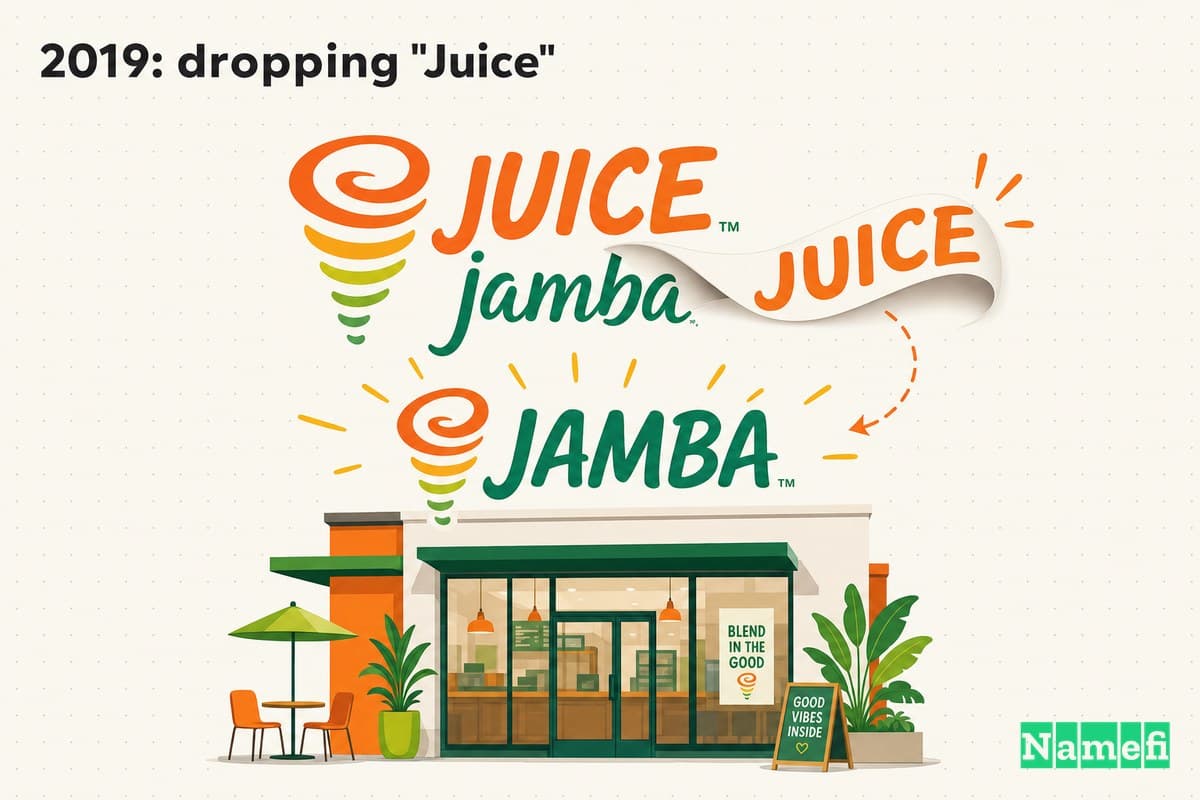
By 2019, the explanation had become a constraint.
On June 6, 2019, the company announced it was dropping "Juice." The new identity was just Jamba, and the new tagline is "Smoothies. Juices. Bowls." — a line that quietly tells you the whole strategy. Juice is still on the menu; it just isn't the menu anymore.
Two forces pushed the change. The first was perception. As one widely-cited account put it, "Juice" had become a "dirty word" in recent years as consumers realized how "sugary and calorie-laden" these beverages actually are. A name that once signaled "healthy" was, two decades later, signaling "sugar."
The second force was simpler: the menu had outgrown the word. Brand president Geoff Henry was blunt about it: The reality is that many guests don't know that Jamba offers bowls. The company had added bowls, boosts and fun size on-the-go bites, reformulating around whole-food ingredients and dropping high-fructose corn syrup and artificial additives. A name with the word "Juice" baked into it actively hid half of what the stores sold.
The rebrand wasn't only a name. As Restaurant Dive reported, the company unveils fresh rebrand, spotlights more than smoothies, pairing the new name with a refreshed logo, redesigned stores, a new app, and broader delivery. But the load-bearing change was the word that left.
Backstory: a $200M sale set the stage
The rebrand didn't happen in a vacuum. It came on the heels of a change in ownership.
In August 2018, Jamba, Inc. agreed to be acquired by Atlanta-based Focus Brands. The deal: Focus brands will acquire Jamba for $13 per share in cash, worth approximately $200m, a transaction expected to be finalized in the third quarter of 2018.
New ownership tends to force the identity question that founders defer for years. Within months of the sale closing, the 29-year-old "Juice" was gone. The rebrand was Focus Brands' first big public statement about what Jamba was going to be — and the simplest, cleanest way to say "we're more than juice now" was to stop saying "Juice."
Kirk Perron, the founder who chose "Jamba" in the first place, lived to see the brand shorten to the single word he'd picked. He passed away on June 20 in 2020, in Palm Springs. The coined identity associated with celebration outlived the descriptive label that had ridden alongside it for a quarter century.
The money looked different then
It is tempting to treat dropping a word as a free decision. It isn't.
For most of Jamba's life, keeping "Juice" was the cheap and safe choice. In the 1990s and 2000s, the chain was still building category awareness. Every new market it entered had customers who needed to be told, in the plainest possible terms, what the store did. "Juice" was a free explainer printed on every sign, cup, and URL. Removing it would have meant paying — in confusion — to look more sophisticated than the market required.
By 2019 the arithmetic had flipped. The category was mature; nobody needed "smoothie" defined anymore. The word that once bought clarity now cost reach, capping an 800-plus-unit brand at a single product line it had already moved beyond. The same word, unchanged, had quietly switched from asset to liability — not because Jamba changed it, but because the world around it did.
That is the real lesson hiding in the timing. A descriptive word in your name isn't permanently good or permanently bad. It is good while you still have to explain yourself, and it turns into ballast the moment you don't. The skill is noticing the day the trade flips.
Why dropping "Juice" mattered
The gap between JambaJuice.com and Jamba.com is one word. Strategically, it is the difference between a product and a brand.
JambaJuice.com describes a thing you order: juice. Jamba.com names something with more room — a wellness brand that can sell smoothies, bowls, plant-based bites, boosts, and whatever the next decade demands, without a noun in its own name arguing against half the menu. One word ties you to a single, increasingly scrutinized category. The other lets the brand stand on its own.
| Before | After |
|---|---|
| JambaJuice.com | Jamba.com |
| Names a juice product | Names a wellness brand |
| Anchored to one menu category | Travels across smoothies, bowls, and beyond |
| Carries "Juice" — a word turning negative | Sheds the sugar association baked into the word |
| Hides that the stores sell bowls | Lets the full menu speak for itself |
This is the same pattern that recurs throughout these case studies: early names explain, mature names own. The descriptive version helps while a company still has to teach the market what it does. The exact-match version helps once the company is big enough — and broad enough — that the name should simply be the brand. Jamba already held both addresses; in 2019 it finally promoted the shorter one.
As brand president Geoff Henry framed the company's ambition after the change, We can't wait to join our guests' wellness journey for decades to come — a "wellness" framing that the word "Juice" could never have carried.
The domain became part of the operating system
Premium domains are not about prestige. They are about repetition — and about removing words you no longer want repeated.
A company's core domain shows up in places the marketing team never directly controls:
- On every cup, bag, and receipt.
- In app stores and on order screens.
- In press headlines and franchise paperwork.
- In email addresses and employee signatures.
- In every spoken recommendation — "let's grab a Jamba" — passed from one person to the next.
Every one of those repetitions either adds friction or removes it. JambaJuice.com made each mention longer and pinned it to a single, increasingly loaded word. Jamba.com made each mention shorter, cleaner, and category-free — letting "bowls" and "boosts" and "plant-based" coexist with the name instead of fighting it.
And the crucial point: Jamba could make that switch instantly, because it already owned the destination. Its own SEC filings list, in plain language, that the Company has registered and maintains numerous Internet domain names, including "jamba.com" and "jambajuice.com." — a sentence on the record years before the 2019 rebrand. The exact-match .com had a documented Jamba web presence by 1999 and appeared again in the company's SEC filings well before the name change.
Is there a public acquisition price for Jamba.com? None appears in the sources reviewed for this article. Unlike the eleven-million-dollar Tesla.com deal or the equity-for-Uber.com trade, there is no documented sale figure here — and we won't invent one. The story is not what the domain cost or how it was first obtained; it is that the company already controlled it before the 2019 rebrand.
What founders should learn from Case 16
The easy takeaway — "drop the descriptive word" — misses the more durable lesson. Jamba's case is really about timing and foresight:
- A descriptive word is fine — even smart — at the start. "Juice" did 29 years of honest work, teaching a young category what the stores sold. A modifier in your name is an on-ramp, not a sin.
- Watch for the day the word flips from asset to liability. For Jamba, "Juice" didn't change — consumer perception did, and the menu outgrew it. The signal to upgrade is when your own name describes a smaller, or more dated, company than the one you've become.
- Control the exact-match .com before you need it. This is the quiet hero of the Jamba story. Jamba.com had a documented company web presence by 1999 and was listed in SEC filings before the rebrand, so the company did not need a last-minute domain hunt when it shortened the name.
- A rebrand is only as real as its address. Announcing you're "Jamba" while still sending customers to JambaJuice.com would have undercut the whole point. Because the domain was already in hand, the new name was instantly, fully real.
The domain upgrade did not make Jamba win or lose; product, ownership, and execution mattered far more. But controlling Jamba.com before the rebrand meant that when the strategy finally called for dropping a word, the company could do it cleanly without a last-minute domain acquisition.
The Namefi angle
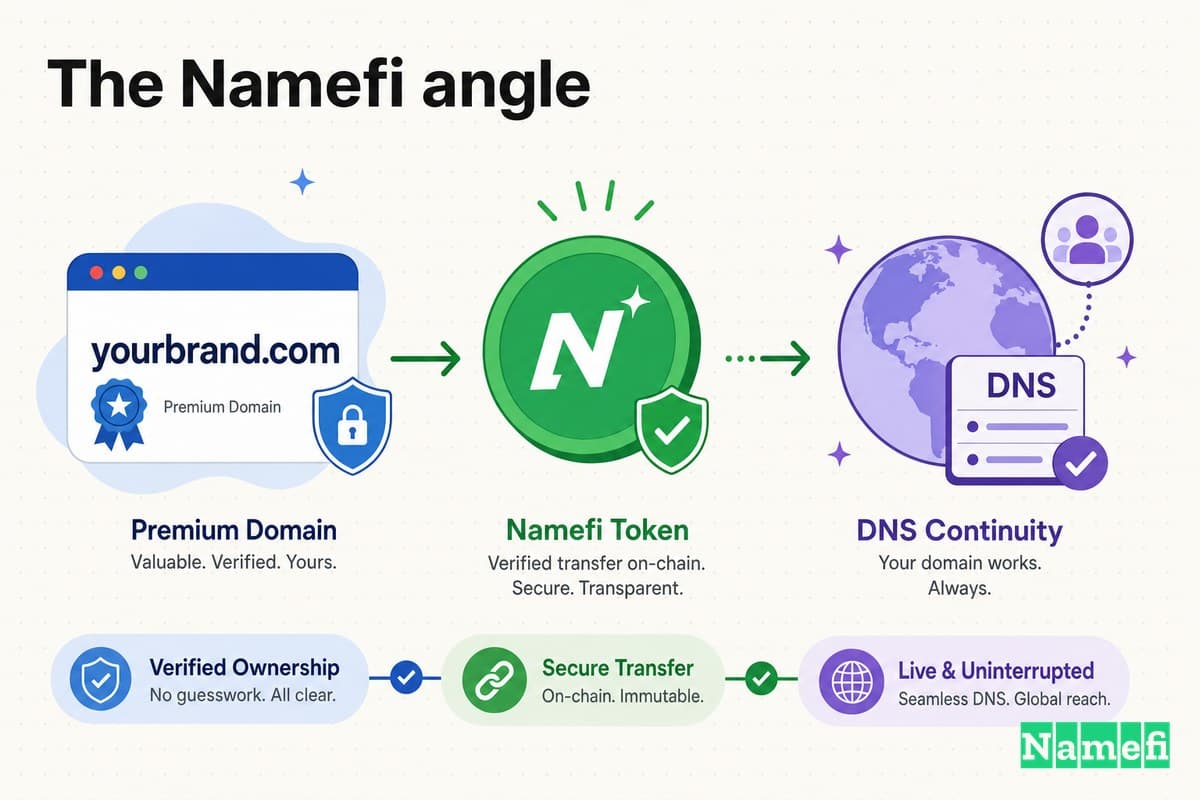
Most cases in this series are transfer problems: a company needs a domain someone else owns, and the drama is in acquiring it. Jamba is the inverse — and just as instructive. The important fact here is readiness: the company had an established Jamba.com presence long before the shorter name became its primary brand.
That readiness is exactly the behavior good domain infrastructure should make easier and cheaper. The hard part of managing a strategic domain over the long term isn't the idea — it's the upkeep: keeping registrations current, proving ownership cleanly across corporate changes (a founder's startup, a public company, a $200M acquisition by Focus Brands), and being able to promote an existing name to primary status the day the strategy calls for it, without breaking anything live.
Namefi is built around the idea that domains should behave like internet-native assets. Tokenized ownership can make domain control easier to verify, hold, transfer, and integrate into modern workflows while staying compatible with DNS — turning the quiet, long-term work of keeping a strategic domain (and proving you still own it through every corporate twist) into something closer to a clean, auditable, programmable asset.
Jamba.com looks obvious now because Jamba grew into it. But the lesson lands long before that: the smartest domain move isn't always a dramatic purchase. Sometimes it's having the exact-match name ready after a web presence dating back twenty years — so that when you finally drop the extra word, the only thing left to do is take it off the sign.
Sources and further reading
- Fox News — Jamba Juice drops 'juice' to become 'Jamba'
- Mashed — This Is Why Jamba Changed Its Name
- MobiTUKI — Swahili-English dictionary entry for
jamba - Restaurant Dive — Jamba unveils fresh rebrand, spotlights more than smoothies
- BeverageDaily — Jamba Juice acquired by Focus Brands for $200m
- U.S. SEC — Jamba Juice Company history and 1995 name change
- U.S. SEC — Jamba, Inc. Form 10-K (intellectual property / domain names)
- Legacy.com — Kirk Perron (1964–2020), Jamba Juice founder
- Wikipedia — Jamba Juice
- Internet Archive (Wayback Machine) — jamba.com, archived January 25, 1999
Contributors

Aileen Wright is a student in her twenties living in New York City, where the distance between a museum wall and a library reading room is a short walk and a long afternoon. She came to name writing through art and history — the way a single portrait, coin, or manuscript margin can carry a name across centuries and change its meaning on the way.
Most weeks you can find her in Central Park with a paperback, or in the quiet of a public reading room chasing down where a name actually comes from rather than what a name-list says it means. She is also teaching herself to code, which has made her oddly precise about spelling, sorting, and the small details that decide whether a name ages well.
For Namefi she writes about the history and culture behind domain names, the stories brands carry as they rename, and the difference between a good story and a verified source.

Victor Zhou is a technology founder and standards editor focused on digital identity and trust. He founded Namefi, edits Ethereum Improvement Proposals, and previously led smart-contract architecture work at Google Labs.
His work sits at the intersection of naming, ownership, and the systems people use to establish identity online. That perspective makes him especially interested in the way names move between personal meaning, public recognition, and digital infrastructure.
For Namefi, Victor edits and writes about domains as durable digital identity: how names become ownable onchain assets, how tokenization changes custody and trust, and what naming can learn from the systems people use to establish identity online.
Related guides
- From Box.net to Box.com: The ~$1M Upgrade That Dropped the ".net" and Bought the Exact MatchHow Box launched in 2005 on Box.net because Box.com was taken, pivoted from consumer storage to the enterprise, and in 2011 paid Digimedia close to $1 million for the exact-match Box.com — a .net-to-.com upgrade that landed right as the company became simply "Box."
- From BufferApp.com to Buffer.com: The 624-Day, Bank-Statement-Open Domain DealHow Buffer launched in 2010 on BufferApp.com because Buffer.com was taken, then spent 624 days acquiring the exact-match domain — even showing the seller its bank balance — and why a company famous for radical transparency stayed quiet on the one number everyone wanted: the price.
- Who Owns Trip.com? Ctrip, Trip.com Group, and the RebrandUnderstand how Trip.com relates to Ctrip and Trip.com Group, and trace the acquisition and company-name changes behind the travel brand.
- From del.icio.us to Delicious.com: The Cleverest Domain Hack on the Web — and Why Yahoo Untangled ItHow the pioneering social-bookmarking site launched in 2003 as the famous domain hack "del.icio.us," why those dots became a permanent tax on every mention, and how Yahoo moved it to the cleaner Delicious.com in 2008.