
From Mr. Chewy to Chewy: The Name and Domain Change
Learn how Mr. Chewy became Chewy and how the shorter name and domain fit the company’s brand evolution.
- domains
- branding
- startups
- domain-upgrades

Mr. Chewy was the original brand of the pet retailer later known as Chewy. A domain-industry retrospective records the simplification to Chewy and Chewy.com. The sources reviewed here do not establish an exact rename or domain-acquisition date, so there is no supported day or year to attach to that change.
The useful timeline is narrower: the business began in 2011, and by the May 31, 2017 acquisition-completion announcement, PetSmart identified it as Chewy, Inc. The company acquisition is separate from the earlier, privately priced domain purchase. This article follows that name and domain history, including the limits of the available record.
Before Chewy was the customer-service legend of pet e-commerce — before the handwritten cards, the condolence flowers, and the $3.35 billion exit — it had a slightly cuddlier, more cautious name. It was Mr. Chewy. Public accounts disagree on whether its early web address was MrChewy.com or MyChewy.com, but they agree on the original brand and the eventual move to Chewy.com.
The honorific made sense at the time. In 2011, two friends in their twenties were asking strangers to buy dog food from a website nobody had heard of, in a category that had already produced one of the most famous failures of the dot-com era. "Mr. Chewy" was friendly. It was approachable. It sounded like a character, not a corporation — a polite, personable shopkeeper for your pet. For a brand-new store trying to feel trustworthy, the "Mr." did real emotional work.
But a name that reads like a mascot is a different thing from a name that reads like a category. As the company grew past its first audience, the "Mr." started to look less like warmth and more like training wheels. The founders dropped it. The store became simply Chewy, and the address became the exact-match Chewy.com — a one-word domain registered years before the pet startup existed.
Six years after launch, PetSmart's owners paid $3.35 billion for Chewy — the company, not the domain — in what was then the largest e-commerce acquisition on record. The domain was not the reason. But by then, the clean, one-word name was load-bearing — the address printed on every box, every receipt, and every "we got it from Chewy" recommendation passed from one pet owner to the next.
2011: the "Mr." that made a new store feel safe
In the beginning, "Mr. Chewy" was a feature, not a bug.
The company was founded with the name "Mr. Chewy" in June 2011 by Ryan Cohen and Michael Day. It almost didn't happen. Cohen and Day were, by their own account, about to launch something else entirely. As the founding story goes, Cohen and Day were a week away from launching their jewelry business. Instead, they sold the inventory and the safe and immersed themselves in learning about the pet food industry. The pivot came from a small, personal moment: Cohen was standing in a pet food store with his poodle talking to an employee about food options when he had a revelation.
They launched the online business in 2011 using their own cash and several small loans under the "Mr. Chewy" brand. Contemporary reporting identifies the startup as MrChewy.com, while a later domain-industry account says it initially operated on MyChewy.com. With that conflict unresolved, the safe conclusion is the brand history — Mr. Chewy became Chewy — rather than a definitive claim about its first domain. The honorific made the unproven store feel like a friendly neighbor instead of a faceless storefront. In a category still haunted by the spectacular collapse of Pets.com, a name that felt warm and human was a deliberate antidote to the cold, sock-puppet memory of the last pet-store gold rush.
The "Mr." was the on-ramp. It was not the destination.
Dropping "Mr." and moving to the exact match
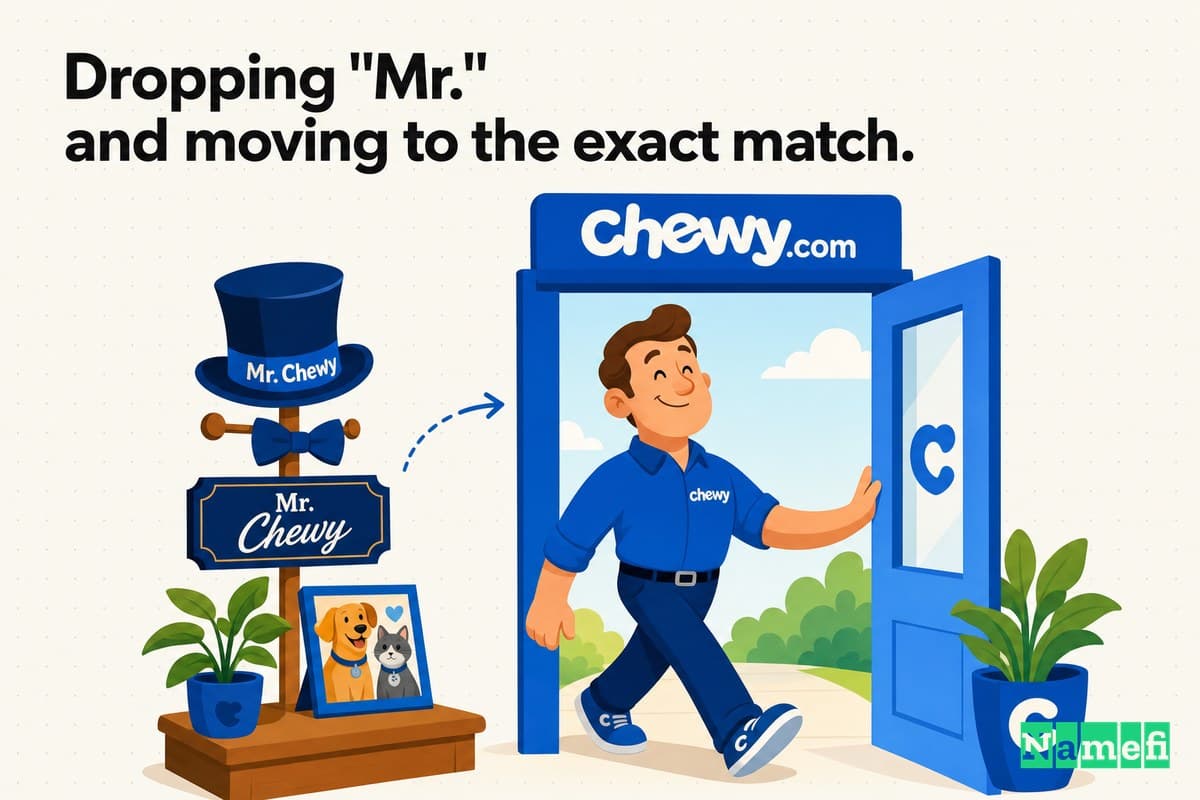
At some point in its early life, the company let go of the honorific. "Mr. Chewy" became Chewy, and the brand consolidated onto the exact-match Chewy.com.
Industry chroniclers of domain upgrades treat the move as a textbook simplification. Smart Branding, recapping a decade of brands trimming their names, notes that Chewy was founded under the name "Mr. Chewy" before consolidating on the shorter name. And the domain itself wasn't lying around for free. The exact-match name had a famous prior owner: the domain Chewy.com appears to have been sold by Frank Schilling's Name Administration, one of the largest and most storied domain portfolios on the internet. Chewy.com was no fresh registration — it had been registered in April of 2004, seven years before Mr. Chewy ever sold a bag of kibble.
How much did the upgrade cost? Here the public record goes quiet. Smart Branding reports that the company acquired the name from domain investor Frank Schilling for an undisclosed amount, and its decade review says the price of the domain was kept private. So the figure that is on the record for this story is not the domain price at all — it's the one at the other end of the arc: PetSmart completed its acquisition of the Chewy company in 2017, in a deal widely reported at $3.35 billion. PetSmart bought the company, not a domain stake.
The backstory: a Java chat room, a jewelry pivot, and dozens of rejections
The founders did not look like people destined to win a category against Amazon.
Cohen and Day met after meeting in a Java chat room, of all places — Cohen working in affiliate marketing, Day a programmer. Before pets, the two put $150,000 of their own money into an online jewelry startup, the venture they abandoned a week before launch.
Then came the wall of "no." Cohen flew from his home base in Florida to Silicon Valley and approached dozens of VC firms. Everyone turned him down because they didn't think Chewy could compete with Amazon. The unlock finally came from a believer who circled back: in late September 2013, an investor who had initially passed took a second look after hearing the company had blown past its projections, and immediately wrote a $15 million check to Cohen and Day to invest in Chewy.
By the time the money arrived, the brand had to be ready to scale — and a brand that scales does not want a mascot's honorific weighing down every mention.
The money looked different then
It is tempting to look at "Chewy" and "Chewy.com" and assume the one-word name was always obvious, always cheap, always inevitable. It wasn't.
In 2011 and 2012, Chewy was a self-funded startup running on the founders' own cash and small loans, in a category investors actively avoided. A premium, exact-match, one-word .com registered in 2004 is not the kind of asset a cash-strapped pet store buys casually. Whatever the undisclosed price was, it would have competed with payroll, inventory, and the customer-service infrastructure that would actually become the company's moat.
That is the right frame for any domain decision: not "what is this name worth at the end of the story," but "what is it worth to the company at the time of purchase." The public sources do not disclose the exact acquisition or changeover date, so the defensible lesson is about evaluating the upgrade against the company's then-current resources — not claiming a precise stage that the record does not establish.
Why dropping "Mr." mattered
The gap between the Mr. Chewy brand and Chewy.com is one word — and arguably not even a word, just a title. Strategically, it is the difference between a character and a category.
Mr. Chewy sounds like a personality: a single, friendly shopkeeper, charming but small. Chewy sounds like the place you buy things for your pet, full stop. One is a mascot you visit; the other is a default you reach for. The honorific that made the store feel safe in 2011 became the thing that made it sound smaller than it was becoming.
| Before | After |
|---|---|
| Mr. Chewy | Chewy / Chewy.com |
| Reads like a mascot / a character | Reads like the category itself |
| Friendly, but small and personal | Friendly and big enough to be the default |
| Two-token name on every box and receipt | One clean word, easy to say and spell |
| "Visit Mr. Chewy" | "Get it from Chewy" |
This is the same pattern that recurs across domain upgrades: early names reassure, great names own. The reassuring version helps while a new company still has to earn your trust. The exact-match version helps once the company is ready to be the thing people name by reflex. Dropping "Mr." didn't just shorten a URL — it removed the diminutive baked into the brand.
The customer-service brand that didn't need a "Mr."
Here is the irony that makes the "Mr." worth dropping: Chewy didn't need an honorific to feel human, because it built humanity into the company itself.
From the start, Cohen and Day believed that customer service had to be king in their business. They poured resources into their call center team, live chat representatives, and employees who responded to customer emails. The most-told example of the brand's warmth is real and quietly devastating: people who cancel their auto-ship orders because of the death of a pet receive condolence flowers from the retailer.
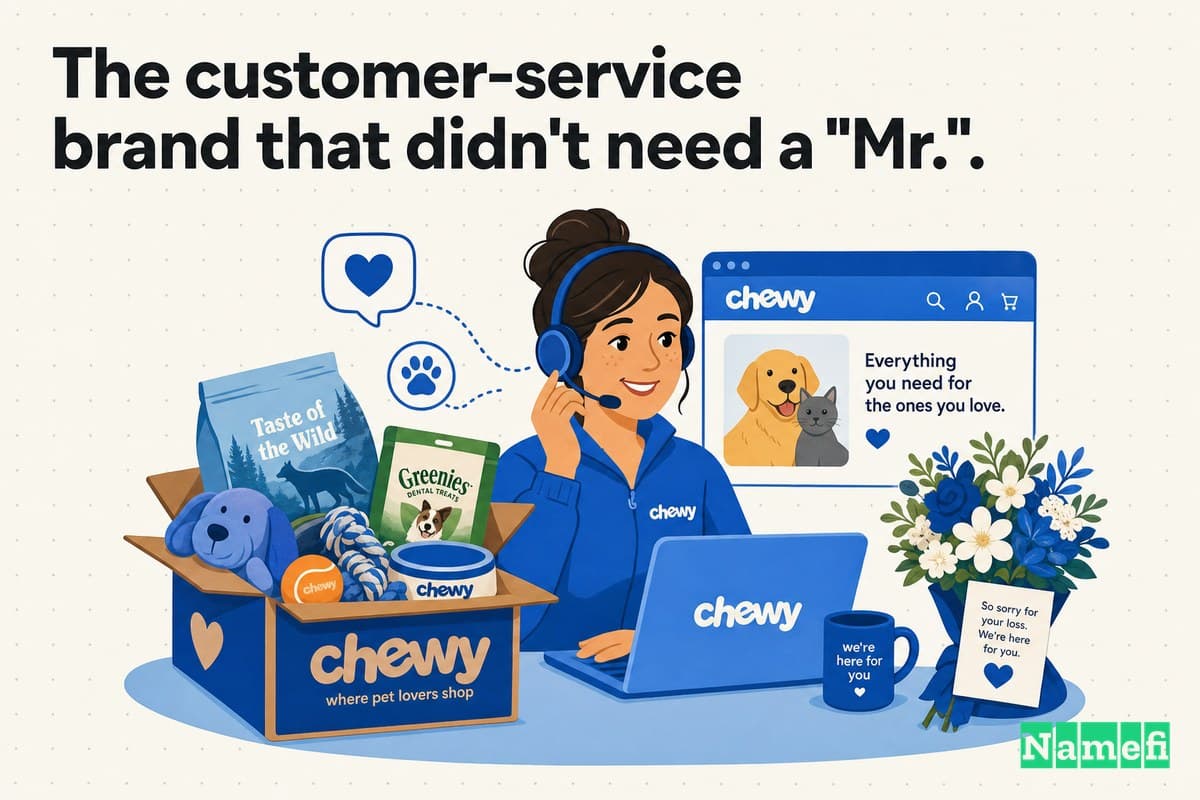
When a company is sending real flowers to grieving pet owners and answering the phone like it means it, the warmth is in the service. It no longer has to be costumed into the name. "Mr." was a promise of friendliness that the young company hadn't yet earned. By the time Chewy was a customer-service legend, it had earned it for real — and the name could afford to be confident, plain, and one word long. The reflective founder line captures the scale that warmth eventually reached: Most people assume that the high point of my professional career came on April 18, 2017, when the owners of PetSmart paid $3.35 billion for Chewy.com, the pet retailer I had cofounded six years earlier.
Timing: simplify before the world says your name millions of times
The order of operations is the lesson.
Chewy did consolidate on its clean name and exact-match domain before PetSmart valued the whole company at $3.35 billion. The available sources do not pin down whether the domain change came before or after the $15 million growth round, so they cannot support a more exact sequencing claim. The general timing principle still holds: changing a name is easier before it has been taught to millions of customers.
Imagine the alternative in general: a company scales a modifier-heavy launch brand to national recognition, prints it on every package, teaches a generation of customers to say it aloud, and only then tries to simplify. That rename means retraining the market and reprinting everything. The Chewy sources do not establish the exact changeover date, but the counterfactual illustrates why founders should investigate an exact-match upgrade before switching costs become entrenched.
The domain became part of the operating system
Premium domains are not about prestige. They are about repetition.
A pet retailer's core domain shows up in places the marketing team never directly controls:
- On every shipping box that arrives at a doorstep.
- On every receipt, every auto-ship reminder, every order confirmation email.
- In the condolence card, the call-center greeting, the live-chat header.
- In search results and browser bars.
- In every spoken recommendation — "just get it from Chewy" — passed from one pet owner to the next.
Every one of those repetitions either adds friction or removes it. A launch name carrying the Mr. modifier makes each mention a touch longer, a touch cuter, and a touch smaller. Chewy.com makes each mention shorter, plainer, and category-sized. Multiply that across millions of orders and the one-word upgrade stops looking like a cosmetic choice and starts looking like a permanent reduction in drag.
The domain didn't build Chewy's brand — the service did. But once Chewy.com was the address, every future repetition of the name compounded on a cleaner, confident foundation, with no "Mr." to explain or outgrow.
What founders should learn from Case 10
The easy takeaway — "drop the cute modifier and grab your exact-match .com" — is too blunt. The more useful lessons are about why the modifier helped, and when to let it go:
- A reassuring name is a fine on-ramp. "Mr. Chewy" wasn't a mistake. In a category scarred by Pets.com, a warm, human, almost-mascot name lowered the trust barrier for a brand-new store. A modifier like "Mr.," "App," or "HQ" can be a smart way to feel approachable on day one.
- Watch for the moment the modifier shrinks you. The signal to upgrade isn't aesthetic — it's when your name starts describing something smaller than what you're becoming. A mascot name caps you at "charming small business." A category name doesn't.
- Build the substance the name was faking. "Mr." promised friendliness; Chewy's call center, live chat, and condolence flowers delivered it. Once the warmth lives in the company, the name no longer has to costume it — and can afford to be plain and confident.
- Upgrade before switching costs compound. The switching cost of a rename grows with every customer who has learned the old name. Chewy's public record does not disclose the exact date of the domain change, so this case should not be used to claim a precise cutoff; the practical lesson is to weigh the externally owned exact match before the old name becomes harder to replace.
The domain upgrade did not make Chewy win. Service, logistics, capital, and relentless execution mattered far more. But dropping "Mr." and consolidating on Chewy.com made the company's growth nameable — and removed a modifier the brand no longer needed.
The Namefi angle
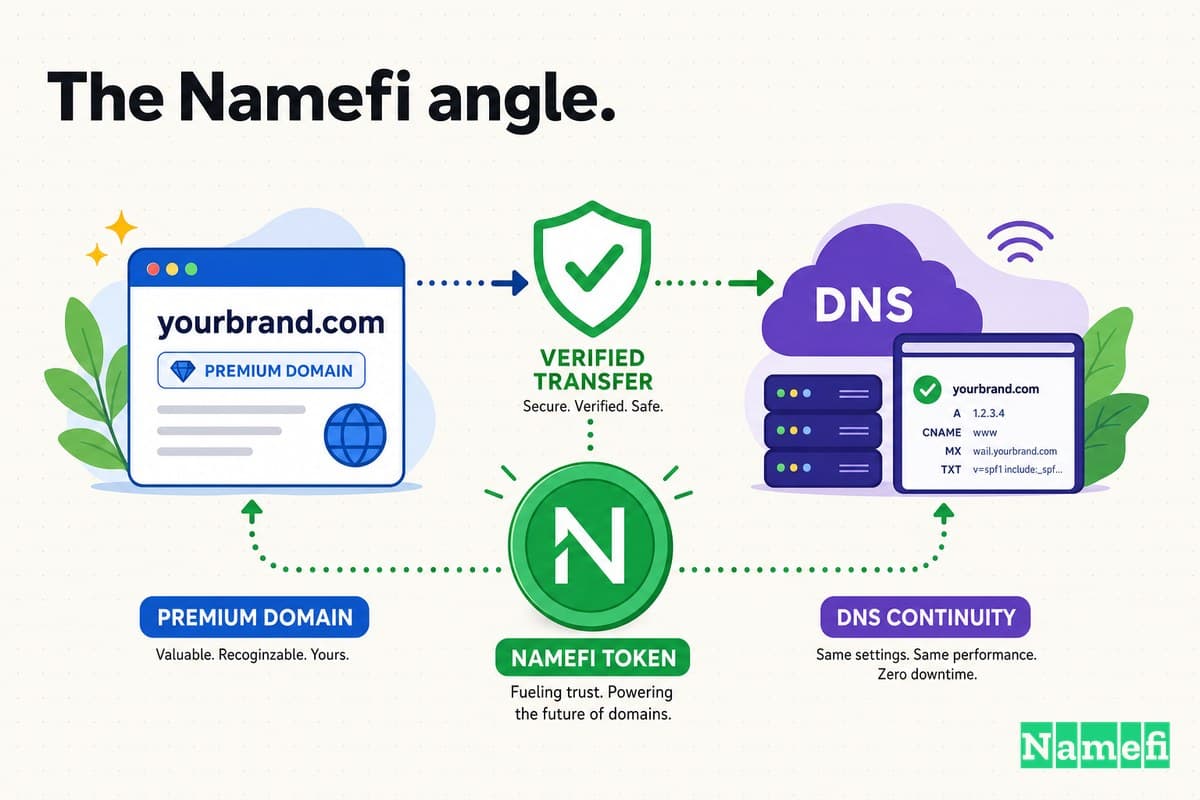
This case is, at its core, a transfer problem wearing a branding costume.
The strategic appeal is easy to see — a pet store called Chewy benefits from owning Chewy.com instead of a longer launch address. The hard part was everything around the asset: negotiating for a premium one-word .com registered in 2004, agreeing on a price that stayed private, and moving control of a name the brand would depend on — all without breaking the live store. The most consequential parts of this story are the parts the public record can't see: the undisclosed price, the terms, and the transfer process.
Namefi is built around the idea that domains should behave like internet-native assets. Tokenized ownership can make domain control easier to verify, transfer, and integrate into modern workflows while staying compatible with DNS — turning the messiest parts of a deal like this (proving who owns what, agreeing on value, and moving it safely) into something closer to a clean, auditable transaction. The next founder who needs to graduate from a cute, modifier-laden launch domain to the confident exact-match shouldn't have to do it through a private, unverifiable handshake.
Chewy.com looks inevitable now because Chewy became enormous. But the lesson applies before that scale: when a name is going to ride on every box you ship, the domain isn't decoration. It is worth evaluating and securing cleanly before the company has to grow out of a name already taught to the market.
Sources and further reading
-
Smart Branding — Brands simplified their names, Chewy section; secondary account — fetched 2026-09-15.
-
Chewy/PetSmart — PetSmart Completes Acquisition of Chewy, May 31, 2017 — fetched 2026-09-15.
-
Wikipedia — Chewy (company)
-
Harvard Business Review — The Founder of Chewy.com on Finding the Financing to Achieve Scale
-
The Business of Business — Why Chewy succeeded where Pets.com failed
-
AOL / Business Insider — Meet the young founders of Chewy.com, which PetSmart just bought for $3.35 billion
-
Smart Branding — 2010–2020, a Decade in Domains: Brands simplified their names
-
Smart Branding — MyChewy.com upgrades to Chewy.com
-
Secure Your Trademark — The Chewy.com Trademark
Contributors

Aileen Wright is a student in her twenties living in New York City, where the distance between a museum wall and a library reading room is a short walk and a long afternoon. She came to name writing through art and history — the way a single portrait, coin, or manuscript margin can carry a name across centuries and change its meaning on the way.
Most weeks you can find her in Central Park with a paperback, or in the quiet of a public reading room chasing down where a name actually comes from rather than what a name-list says it means. She is also teaching herself to code, which has made her oddly precise about spelling, sorting, and the small details that decide whether a name ages well.
For Namefi she writes about the history and culture behind domain names, the stories brands carry as they rename, and the difference between a good story and a verified source.

Victor Zhou is a technology founder and standards editor focused on digital identity and trust. He founded Namefi, edits Ethereum Improvement Proposals, and previously led smart-contract architecture work at Google Labs.
His work sits at the intersection of naming, ownership, and the systems people use to establish identity online. That perspective makes him especially interested in the way names move between personal meaning, public recognition, and digital infrastructure.
For Namefi, Victor edits and writes about domains as durable digital identity: how names become ownable onchain assets, how tokenization changes custody and trust, and what naming can learn from the systems people use to establish identity online.
Related guides
- From Box.net to Box.com: The ~$1M Upgrade That Dropped the ".net" and Bought the Exact MatchHow Box launched in 2005 on Box.net because Box.com was taken, pivoted from consumer storage to the enterprise, and in 2011 paid Digimedia close to $1 million for the exact-match Box.com — a .net-to-.com upgrade that landed right as the company became simply "Box."
- From BufferApp.com to Buffer.com: The 624-Day, Bank-Statement-Open Domain DealHow Buffer launched in 2010 on BufferApp.com because Buffer.com was taken, then spent 624 days acquiring the exact-match domain — even showing the seller its bank balance — and why a company famous for radical transparency stayed quiet on the one number everyone wanted: the price.
- Who Owns Trip.com? Ctrip, Trip.com Group, and the RebrandUnderstand how Trip.com relates to Ctrip and Trip.com Group, and trace the acquisition and company-name changes behind the travel brand.
- From del.icio.us to Delicious.com: The Cleverest Domain Hack on the Web — and Why Yahoo Untangled ItHow the pioneering social-bookmarking site launched in 2003 as the famous domain hack "del.icio.us," why those dots became a permanent tax on every mention, and how Yahoo moved it to the cleaner Delicious.com in 2008.