From SlackHQ.com to Slack.com: The $60K Upgrade That Dropped the "HQ"
How Slack launched on SlackHQ.com because someone else had Slack.com, paid a reported $60,000 to buy the exact-match domain, dropped the "HQ" — and why @SlackHQ still survives on social to this day.
- domains
- branding
- startups
- domain-upgrades

Before Slack was a verb for "message me at work," it was a quieter thing with a longer address: SlackHQ.com.
The "HQ" was not a branding flourish. It was a workaround. When Stewart Butterfield's team turned an internal chat tool into a product, the exact-match domain — Slack.com — already belonged to someone else. So did the @Slack handle on Twitter, which a software engineer from Holland, Michigan named Matt Slack had grabbed years earlier. A young company that wanted to be called "Slack" had to settle, at first, for "Slack, headquarters edition."
That gap between the name a company wants and the name it can get is one of the most common — and most underrated — problems in startup branding. The product was already called Slack. The world just couldn't reach it at Slack.com yet.
That changed early. Slack quietly bought Slack.com from its previous owner, and the founder later put a number on it: a reported $60,000. The "HQ" came off the web address — even though, in a twist that survives to this day, @SlackHQ never came off the social handle.
This is the story of a domain upgrade that worked exactly as intended, and one modifier that never went away.
2013: the tool that needed a name it couldn't have
Slack did not start as a product. It started as plumbing.
The company behind it was Tiny Speck, the studio Butterfield founded after co-creating Flickr. Tiny Speck's actual product was an online game called Glitch, and Slack had begun as an internal tool for Tiny Speck during the development of Glitch. Wikipedia describes the same origin: Slack originated as an internal communication tool used within Stewart Butterfield's company Tiny Speck, during its work on the development of Glitch.
The game did not make it. When Glitch wound down, the team realized the chat tool they had built for themselves was the more valuable thing. By summer 2013 they had polished it into something shippable and, as Butterfield's own launch retrospective recounts, announced their preview release in August 2013.
The name was already "Slack." It even carried a tidy backronym — Searchable Log of All Communication and Knowledge — though the team has always been clear the word came first and the expansion came after. As one early employee put it, we undertook a roundabout search for alternatives to the name "Slack," mostly while bullshitting before or after a meeting.
So the brand was settled. The address was not. The product launched onto the web wearing a modifier — SlackHQ.com — because the bare word was taken.
The acquisition moment: buying the bare word
The fix was not a rebrand. The product never had to change its name. It just had to change its address — from SlackHQ.com to Slack.com.
To do that, Slack had to buy the exact-match domain from whoever already held it. The founder later disclosed the price on Quora, and it propagated through the domain press: communications app Slack paid $60,000 for the domain. The founder had first disclosed that figure in his own Quora answer, and the domain press picked it up from there.
Sixty thousand dollars is a striking number — not because it is large, but because it is small. For an exact-match, five-letter, dictionary-word .com that would go on to anchor one of the most recognized brands in software, $60,000 reads, in hindsight, like a clearance price.
Co-founder and CTO Cal Henderson has explained why the word was worth chasing in the first place: it's a five-letter domain name, it's an English word that we could actually get — it doesn't get better than that. The whole appeal of the name was that it was a real word a real company could own. The only thing standing between Slack and Slack.com was the person who owned it.
The seller's side: a domain for cat pictures
Most blockbuster domain stories involve a reluctant holder, a long stalemate, and an eventual capitulation. Slack's is gentler — and a little funnier.
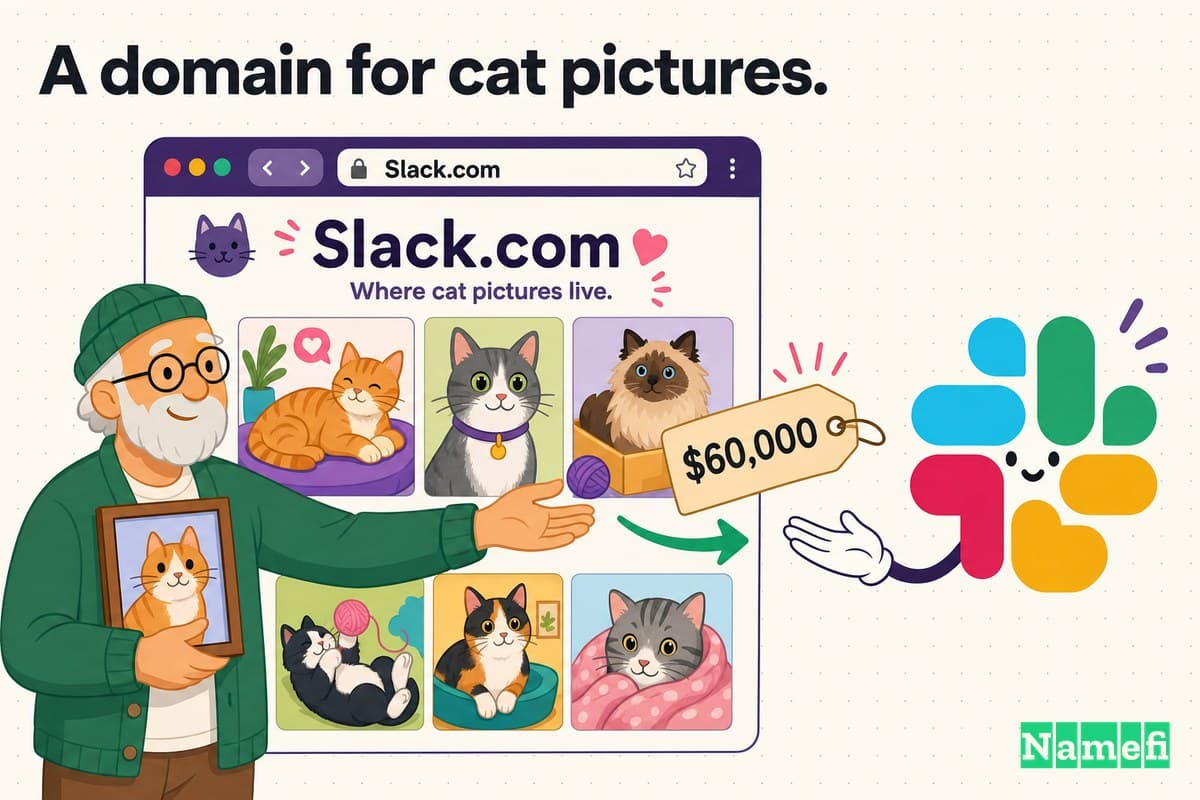
Henderson described the previous owner through an unexpectedly personal use of the name: we bought the domain from a guy who had been using it as a personal website for pictures of his cats. A five-letter English word — one of the most valuable kinds of .com there is — had been quietly serving as a hobbyist's photo album.
That detail establishes how the domain had been used before Slack acquired it, but it does not reveal the seller's motives, competing bids, or the negotiation itself. Public accounts give us the reported $60,000 price and the cat-photo anecdote; they do not tell us why the seller accepted that figure or how difficult the transaction was.
The lesson is not "domains are cheap." It is that the price of an exact-match domain has very little to do with how valuable it will become, and almost everything to do with who happens to be holding it when you call.
The money looked different then
It is tempting to wave off $60,000 as a rounding error. Slack would later be valued in the billions and was acquired by Salesforce. Against that arc, the domain looks free.
But a domain purchase should be judged at the moment of uncertainty, not from the far end of the story.
In 2013, Slack was a few-months-old product spun out of a failed game studio. Tiny Speck had taken angel funding of $1.5 million in 2009 and then spent years building a game that did not work. The team was, in effect, asking investors and itself to believe that the byproduct was the business.
In that context, spending $60,000 on a domain — not on engineers, not on servers, not on runway — was a real allocation decision. The early signals were extraordinary: the preview drew enormous interest, with Butterfield's account noting that on the first day, 8,000 people did just that; and two weeks later, that number had grown to 15,000. But early traction is not the same as certainty. Buying Slack.com was a bet that the name would matter enough to be worth owning outright — placed before anyone knew it would.
Why dropping "HQ" mattered
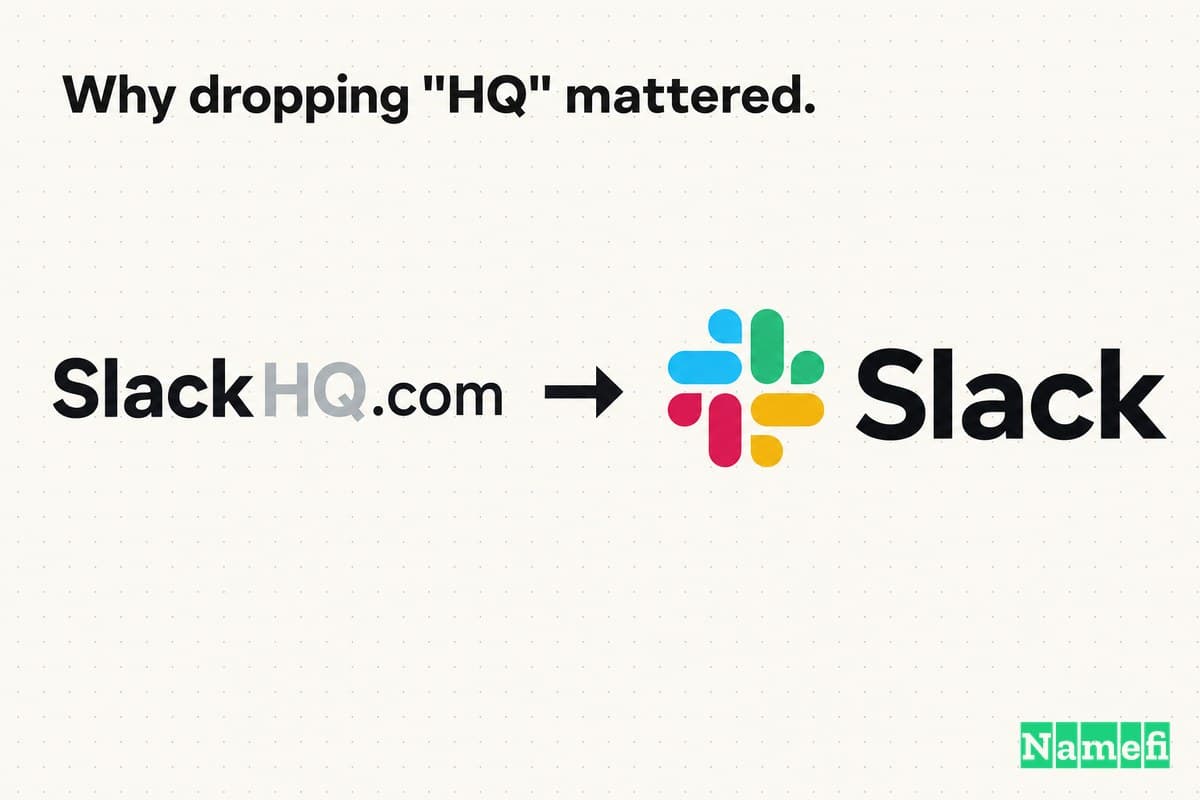
The distance between SlackHQ.com and Slack.com is two letters. Strategically, it is the distance between a place that belongs to a brand and the brand itself.
SlackHQ.com reads like an address for the company behind the product — the headquarters, the org, the team. Slack.com reads like the product, the verb, the thing you live in all day. One points at Slack. The other simply is Slack.
| Before | After |
|---|---|
| SlackHQ.com | Slack.com |
| Names the company's "headquarters" | Names the product itself |
| Carries a workaround modifier | Carries nothing but the word |
| Signals "the bare name was taken" | Signals "this is the canonical home" |
| Adds two letters to every mention | Reduces the brand to one word |
This is the recurring pattern in domain upgrades: early names explain or qualify; great names own. A modifier like "HQ," "Motors," "App," or "The" is a reasonable on-ramp when the clean name isn't available. It becomes drag the moment the company is big enough that the word itself should be the destination.
Slack had the unusual luxury of fixing this early. The modifier never had time to harden into the brand, and most of the world only ever knew the product as Slack.com.
Sequence: the word, then the address
The order of operations here is worth slowing down on, because it inverts the usual advice to "secure your .com before you launch."
Slack couldn't. The sequence was:
- The name was chosen first — "Slack," settled while the tool was still an internal experiment at Tiny Speck.
- The product launched on a modifier — the preview release in August 2013 went out under SlackHQ.com because Slack.com was occupied. Wikipedia marks the same moment: in August 2013, Slack was launched to the public.
- The exact match was acquired — Slack bought Slack.com from the cat-photo owner for a reported $60,000, retiring the "HQ" from the primary web address.
- The company formalized the identity — after the launch, the company renamed itself to Slack Technologies in August 2014, shedding the Tiny Speck name entirely.
The domain didn't have to come before the launch. But it did have to come before the name calcified. Slack secured the clean address while it was still a young product, not after a decade of users had memorized the workaround.
The domain became part of the operating system — except @SlackHQ
Premium domains matter for one unglamorous reason: repetition.
A core domain shows up everywhere a company can't fully control — in email addresses, press links, app stores, browser bars, search results, and every spoken recommendation. Each repetition either adds friction or removes it. SlackHQ.com asked everyone to carry two extra letters forever. Slack.com asked for nothing.
But here is the wrinkle that makes Slack's case distinctive: the domain upgrade succeeded, and the social handle never did. The web address became Slack.com, while the official social presence stayed @SlackHQ — because the bare @Slack handle was, and remains, owned by Matt Slack, who joined Twitter as @slack in October, 2006. When Tiny Speck rebranded, it pointed everyone to the handle it actually had, announcing: Tiny Speck is no more. We're now Slack Technologies, Inc. See @SlackHQ. Bye!
The "HQ" Slack paid to remove from its domain is still right there on its social channels — and on its GitHub organization, github.com/slackhq. And SlackHQ.com itself never disappeared; the company still owns it and quietly redirects it. (Old Slack-blog links at slackhq.com now 301-redirect to slack.com.) The modifier didn't die. It just stopped being the front door.
What founders should learn from Case 14
The easy takeaway — "always own your exact-match .com before launch" — is the wrong one, because Slack literally could not. The more useful lessons are about modifiers and timing:
- A modifier is a fine on-ramp. "HQ" let Slack launch under its real name while the bare word was held by someone else. Launching on SlackHQ.com was not a failure; it was a reasonable way to ship without waiting.
- Treat the bare name as something to acquire, not assume. The brand was decided; the address was a transaction. Slack budgeted for the upgrade and pursued the holder rather than renaming around the obstacle.
- Move while the modifier is still cheap to remove. Slack bought Slack.com early for a reported $60,000, so the "HQ" never became load-bearing. The longer a workaround lives, the more expensive — and confusing — it can become to undo.
- Accept that some modifiers survive forever. Slack got Slack.com but never got @Slack. Different platforms have different occupants. Owning the canonical .com is the high-leverage win; matching it on every social channel is a nice-to-have you may never fully get.
The domain upgrade didn't make Slack win. Product, timing, distribution, and an almost magical preview launch mattered far more. But Slack.com made the win easier to type — and cheaper than almost anyone would guess.
The Namefi angle
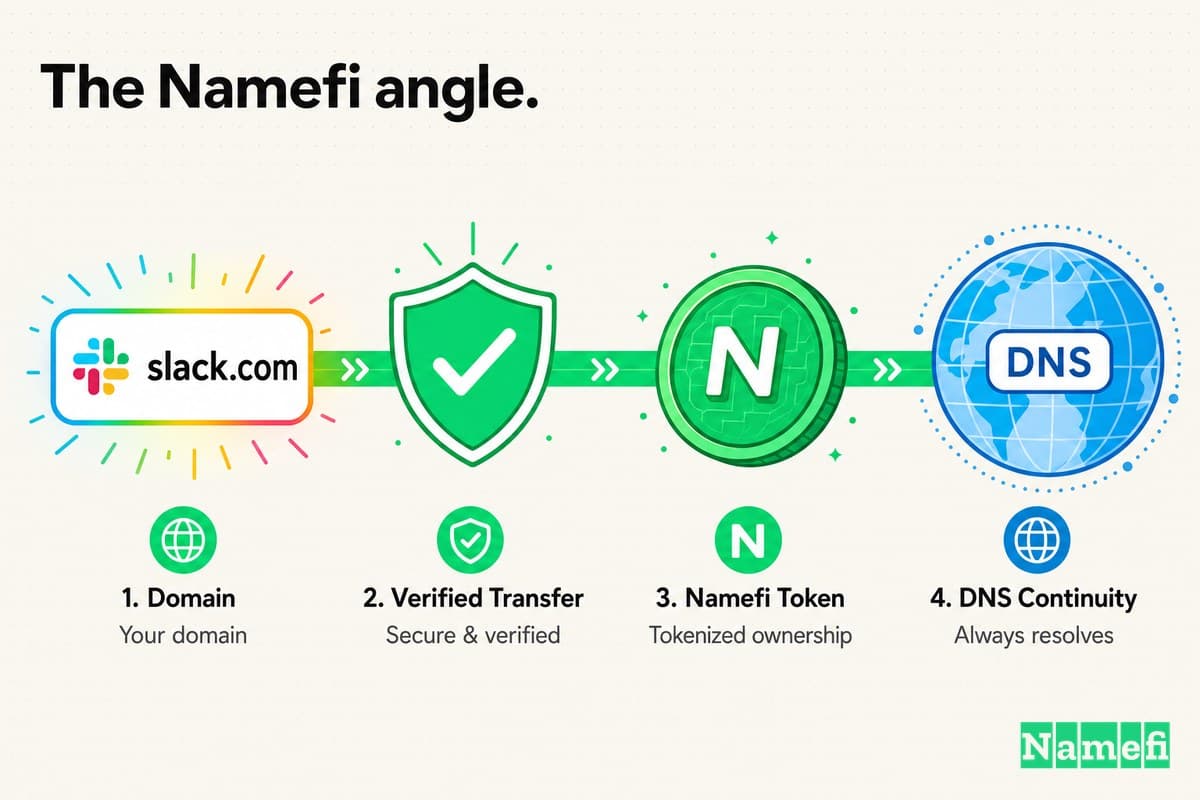
Slack's story is, underneath the jokes about cat photos, a transfer problem.
The strategic logic is easy to see in hindsight — a product named Slack benefits from living at Slack.com. The public sources identify the domain's former use and a reported price, but they do not document Slack's negotiation, payment, or transfer process. More generally, domain upgrades still require the buyer and seller to verify control, agree on terms, transfer the asset safely, and redirect the old address without disrupting a live product.
Namefi is built around the idea that domains should behave like internet-native assets. Tokenized ownership can make domain control easier to verify, transfer, and integrate into modern workflows while staying compatible with DNS — making common acquisition steps such as confirming ownership, agreeing terms, and moving the asset easier to audit.
Slack.com looks obvious now because Slack became enormous. But the lesson lands at the very beginning of the story: when a name is going to carry the business, the domain isn't decoration. It's the difference between launching as a workaround and launching as the real thing — and sometimes it costs less than a single engineer's salary to fix.
Sources and further reading
- The Domains — Slack.com was purchased for $60,000
- Silicon Republic — Slack co-founder Cal Henderson interview
- Wikipedia — Slack (software)
- Wikipedia — Slack Technologies
- First Round Review — From 0 to $1B: Slack's Founder Shares Their Epic Launch Strategy
- Frederick AI — Founder Story: Stewart Butterfield of Slack
- Kottke — TIL that Slack is an acronym
- Mio — The History of Slack & Its Impact on Business Communication
- CNBC Make It — Meet Matt Slack, who owns the Twitter handle @Slack
- GitHub — Slack's slackhq organization
- Slack — old slackhq.com blog link now redirecting to slack.com
Contributors

Aileen Wright is a student in her twenties living in New York City, where the distance between a museum wall and a library reading room is a short walk and a long afternoon. She came to name writing through art and history — the way a single portrait, coin, or manuscript margin can carry a name across centuries and change its meaning on the way.
Most weeks you can find her in Central Park with a paperback, or in the quiet of a public reading room chasing down where a name actually comes from rather than what a name-list says it means. She is also teaching herself to code, which has made her oddly precise about spelling, sorting, and the small details that decide whether a name ages well.
For Namefi she writes about the history and culture behind domain names, the stories brands carry as they rename, and the difference between a good story and a verified source.

Victor Zhou is a technology founder and standards editor focused on digital identity and trust. He founded Namefi, edits Ethereum Improvement Proposals, and previously led smart-contract architecture work at Google Labs.
His work sits at the intersection of naming, ownership, and the systems people use to establish identity online. That perspective makes him especially interested in the way names move between personal meaning, public recognition, and digital infrastructure.
For Namefi, Victor edits and writes about domains as durable digital identity: how names become ownable onchain assets, how tokenization changes custody and trust, and what naming can learn from the systems people use to establish identity online.
Related guides
- From Box.net to Box.com: The ~$1M Upgrade That Dropped the ".net" and Bought the Exact MatchHow Box launched in 2005 on Box.net because Box.com was taken, pivoted from consumer storage to the enterprise, and in 2011 paid Digimedia close to $1 million for the exact-match Box.com — a .net-to-.com upgrade that landed right as the company became simply "Box."
- From BufferApp.com to Buffer.com: The 624-Day, Bank-Statement-Open Domain DealHow Buffer launched in 2010 on BufferApp.com because Buffer.com was taken, then spent 624 days acquiring the exact-match domain — even showing the seller its bank balance — and why a company famous for radical transparency stayed quiet on the one number everyone wanted: the price.
- Who Owns Trip.com? Ctrip, Trip.com Group, and the RebrandUnderstand how Trip.com relates to Ctrip and Trip.com Group, and trace the acquisition and company-name changes behind the travel brand.
- From del.icio.us to Delicious.com: The Cleverest Domain Hack on the Web — and Why Yahoo Untangled ItHow the pioneering social-bookmarking site launched in 2003 as the famous domain hack "del.icio.us," why those dots became a permanent tax on every mention, and how Yahoo moved it to the cleaner Delicious.com in 2008.