From Snapchat.com to Snap.com: The $5M Domain That Turned an App Into a Camera Company
How Snapchat quietly bought Snap.com from Idealab for a reported $5M in 2014, then in September 2016 renamed itself Snap Inc., "a camera company," and let the short exact-match domain carry an identity bigger than any single app.
- domains
- branding
- startups
- domain-upgrades

Before Snap Inc. was a publicly traded "camera company," it was a single app with a literal, self-explaining name: Snapchat. The product told you what it did. You took a snap, you chatted, the snap disappeared. The name and the verb were the same thing.
For a messaging app aimed at teenagers, that was an advantage. "Snapchat" explained itself in one word, and Snapchat.com pointed exactly where you expected. The name did real work: it told you this was ephemeral, playful, and conversational — not another permanent, archival social network.
But the ambition outgrew the app long before the public saw it. By 2016 the company was building hardware, experimenting with augmented reality, and reframing itself around the camera rather than around chat. A name that perfectly described one product had quietly become a ceiling on a company that wanted to be much more than one product.
So the company did two things, years apart, that fit together. First, quietly, it bought the exact-match Snap.com — a domain it didn't yet have a public use for. Then, in September 2016, it changed its corporate name and let that short domain become the front door to a new identity. When the company behind Snapchat changed its name from Snapchat Inc. to just Snap Inc., the domain it needed was already paid for.
The reported price for that domain — discovered later in an SEC filing, never officially confirmed — was $5 million.
2011–2016: the app whose name was the product
In the beginning, "Snapchat" was a feature, not a constraint.
The whole pitch lived inside the word. A "snap" was the unit of content; "chat" was the mode. Snapchat.com matched the app word-for-word, which is exactly what an early consumer product wants: zero translation cost between hearing the name, finding the app, and understanding what it does. For a product spreading through high schools and colleges by word of mouth, the self-describing name was a growth feature.
That tight coupling is also why the name eventually became limiting. "Snapchat" doesn't just name a company — it names a behavior. It says messaging. It says disappearing photos. It says one specific app. And the company's plans were widening fast past that single behavior.
By 2016, Snap was no longer only an app maker. It was about to ship its own hardware, position itself around the camera as a primitive, and tell investors that it intended to reinvent how people capture the world. The company that had described itself with the word "chat" was becoming something that "chat" could no longer contain. Snapchat.com was the right domain for the first phase — and the wrong domain to name the company that was coming.
September 2016: the rebrand and the Snap.com moment

On September 24, 2016, the company made the shift public. The company was named Snapchat Inc. at its inception, but it was rebranded Snap Inc. on September 24, 2016, to include the Spectacles product under the company name. The trigger was a product reveal: Snap unveiled Spectacles, a pair of sunglasses that have a built-in video camera in them with a 115 degree view.
The rebrand was not a single tweak. The Drum described a sweeping rebrand that saw web domains and social media counts renamed as Snap Inc. And the explicit logic for the new name was that the old one was now too small. Evan Spiegel's reasoning was that now that we are developing other products, like Spectacles, we need a name that goes beyond just one product.
That is the entire thesis of a domain upgrade compressed into one sentence: a name that goes beyond just one product. The app stayed Snapchat. The company became Snap. And the new corporate identity needed the short, exact-match address to stand on. The Snap Inc. homepage promptly bills itself as a camera company — a description that would have looked absurd on a domain called Snapchat.com.
Crucially, the expensive, slow-to-acquire piece was already done. Snap had quietly secured Snap.com two years earlier. The rebrand could move at the speed of a press release because the domain wasn't a blocker.
The seller's side: Idealab, an SEC filing, and a number nobody announced
Unlike the loud, decade-long Tesla.com saga, the Snap.com purchase was almost invisible at the time. There was no press release, no founder tweet, no confirmed price. The story had to be reverse-engineered.
The domain's prior owner was Idealab, Bill Gross's long-running technology incubator, which had held Snap.com for years. Domain researchers traced the handoff through public WHOIS records: according to the WHOIS history at DomainTools, Snap.com changed from Idealab in mid-November of 2014 into privacy-protected and then corporate registrar accounts — the classic fingerprint of a quiet acquisition by a company that didn't want to tip its hand.
The price surfaced only when Snap filed to go public. Buried in the financials was a domain-name line item that domain investors immediately recognized. As the analysis put it, there is a $5 million number for domain names, can't imagine any other domain purchases by the company that would account for this number. The amortization schedule fit a single large purchase: this lines up almost perfectly with a single $5 million deal in November/December 2014.
It is worth being precise here, because rigor matters: Snap never publicly confirmed a Snap.com price. The $5 million figure is a well-reasoned inference from the SEC filing's amortization math combined with WHOIS timing, not an announced number. The honest version of the story is that a careful read of public records points strongly to roughly $5 million paid to Idealab around November 2014 — and that nobody at Snap has ever said otherwise on the record.
That, too, is a pattern. Many of the most important domain deals are the ones the buyer works hardest to keep quiet until the asset is locked down.
The money looked different then
From here, $5 million for Snap.com looks small. Snap went public in 2017 at a valuation in the tens of billions of dollars. Against that, a single domain purchase is rounding error.
But the deal should be judged at the moment it was made, not from the far side of an IPO.
In late 2014, Snapchat was still "just" a wildly popular but unproven app. It had famously turned down a reported multibillion-dollar acquisition offer, it had no public hardware, and it was burning money to grow with no profit and no IPO in sight. Spending $5 million on a domain name — not engineers, not servers, not user acquisition — was the kind of line item a finance team would interrogate. There was no Spectacles yet, no "Snap Inc.," no public reason the company even needed Snap.com.
That is what makes the purchase interesting. Snap bought the domain before it had a use for it. The acquisition only makes sense if you read it as buying option value: securing the short, exact-match brand asset while it was available and relatively cheap, against a future in which the company would want to be more than one app. Two years later, when the rebrand arrived, that option paid off instantly. The hard, expensive, externally-owned piece was already in hand.
Why shortening to "Snap" mattered
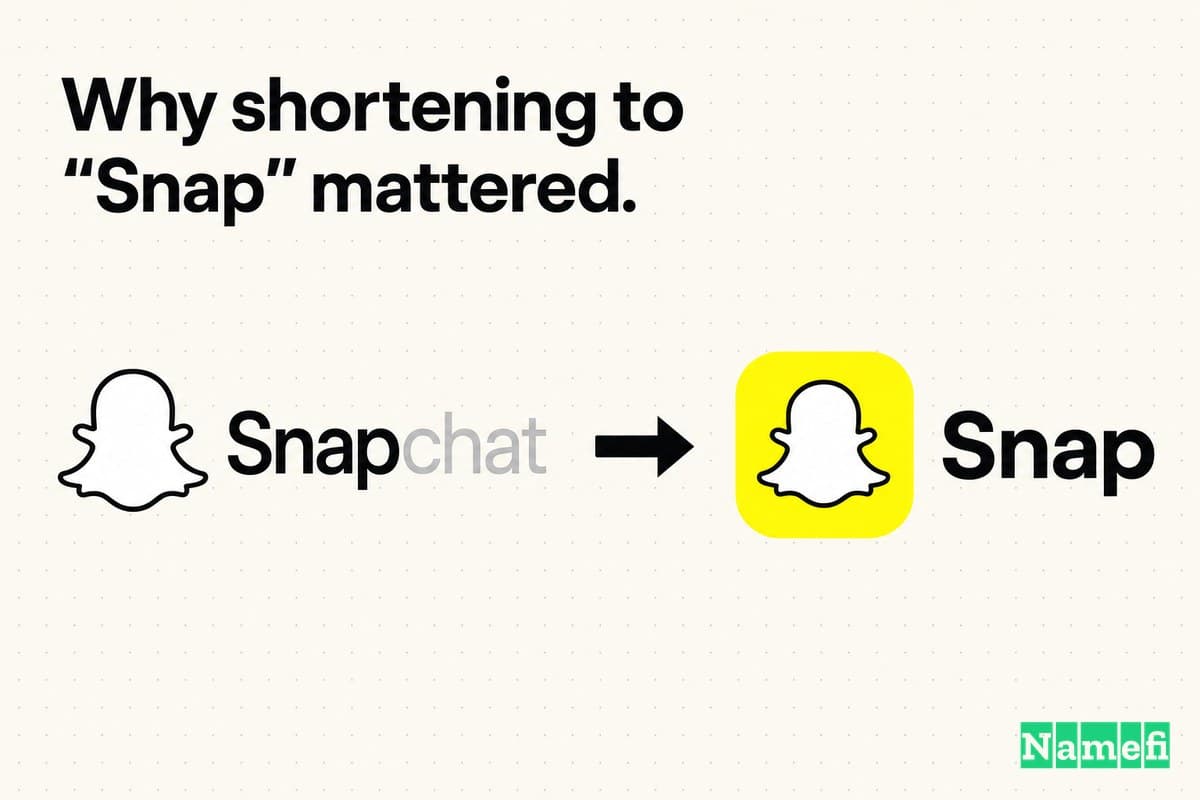
The gap between Snapchat.com and Snap.com is a single syllable. Strategically, it is the difference between a behavior and a category.
Snapchat.com names an action: you snap, you chat. It is a verb wearing a domain. Snap.com names a company — a container big enough for an app, a pair of camera glasses, an AR platform, and whatever the company decides to build next. One describes what the product does; the other refuses to be pinned to any single product at all.
| Before | After |
|---|---|
| Snapchat.com | Snap.com |
| Names one app | Names a company without a ceiling |
| Means "messaging / disappearing chat" | Travels across app, hardware, and AR |
| Reads like a product | Reads like a parent brand |
| Couples the company to "chat" | Frees the company to be "a camera company" |
This is the same pattern that recurs across domain upgrades: early names explain, great names own. "Snapchat" was the perfect name while the company was one app that needed to teach you what it did. "Snap" became the better name once the company wanted the brand to simply be the category. The two-year-early domain purchase is what let the company cross from one to the other without friction.
2014 then 2016: domain first, rename second
The detail that makes Snap.com more than a vanity buy is the sequence: the domain came first, and the corporate rebrand followed two years later.
In November 2014, Snap.com quietly changed hands. There was no announcement because there was nothing yet to announce — Snapchat the app was thriving and "Snap Inc." did not exist. The domain sat as a held asset.
Then in September 2016 the public story arrived. The reveal of Spectacles became the occasion to rename the company, and the new product was unveiled on September 24, 2016, and released on November 10, 2016. The hardware needed a company name that wasn't an app name, and the company name needed an exact-match domain that wasn't an app domain.
Picture the alternative. Snap announces it's now "Snap Inc., a camera company," unveils a $130 pair of camera glasses — and the corporate site still lives at Snapchat.com, with someone else holding Snap.com and naming their price under pressure. The rebrand would have been awkward and incomplete, or hostage to a last-minute negotiation. Instead, because the slow, expensive, externally-owned piece was secured in 2014, the 2016 rename could happen cleanly. The domain led; the identity followed.
The domain became part of the operating system
Premium domains are not about prestige. They are about repetition.
A company's core domain shows up in places the marketing team never directly controls:
- In the app stores, the app's company name, and the developer page.
- In Spectacles packaging, Snapbot signage, and product PR.
- In press headlines and analyst notes about "Snap" the company versus "Snapchat" the app.
- In email addresses, employee signatures, and recruiting.
- In every investor deck, S-1 page, and word-of-mouth mention.
Every one of those repetitions either adds friction or removes it. A company called Snap that lived at Snapchat.com would force a tiny translation every single time: the company is Snap, but the site is Snapchat-dot-com. Snap.com erases that gap. When Snap told the public it was now a camera company, the address matched the message word-for-word.
The domain didn't build Snap's brand — the app, the camera, and the culture did. But once Snap.com was the address, every future repetition of the company name compounded on a clean, exact-match foundation instead of dragging an app's name behind it.
What founders should learn from Case 12
The easy takeaway — "buy your short .com" — misses the more useful structure. Snap's lesson is about sequence and quiet timing:
- A literal, self-describing domain is a great way to start. Snapchat.com matched the app perfectly and made the product spread by word of mouth. A descriptive name is an on-ramp, not a failure.
- Watch for when the product name becomes a company ceiling. The signal to upgrade wasn't aesthetic — it was strategic. Once "chat" no longer described the ambition (hardware, camera, AR), the app name could not also be the company name.
- Buy the exact-match domain before you publicly need it. Snap acquired Snap.com in 2014, quietly, two years before the rebrand. Securing the slow, externally-owned asset early — without tipping your hand — is what makes a future rename cheap and clean.
- Let the domain lead the rename, not trail it. When the rebrand came, the corporate identity changed in a day because the expensive piece was already locked. Domain first, announcement second.
The domain upgrade didn't make Snap win. Product, capital, culture, and timing mattered far more — and Snap's later years show that owning the perfect domain guarantees nothing. But Snap.com made the company's reinvention as "a camera company" nameable, and it was bought years before anyone outside the company knew why.
The Namefi angle
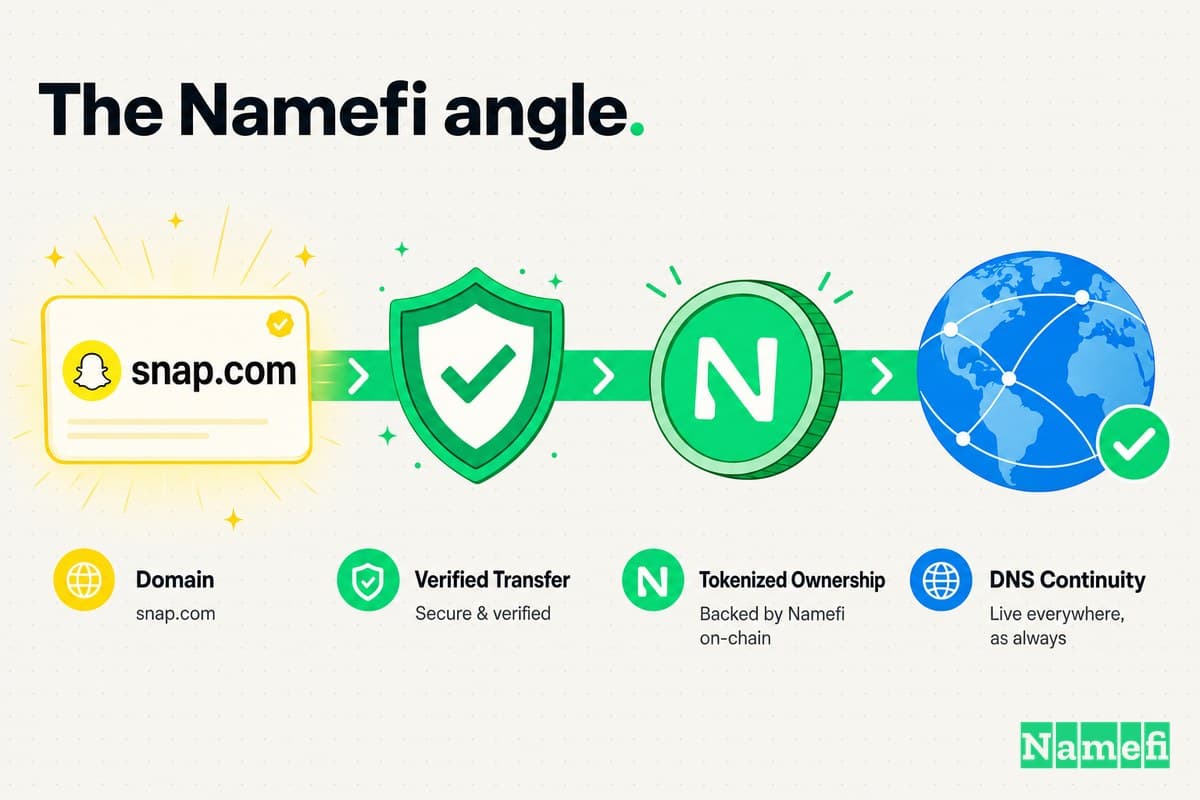
Snap's story is, at its core, a quiet transfer problem.
The strategic decision was never really in doubt — a company that wanted to be called Snap should own Snap.com. The hard part was everything around the asset: identifying that a long-term holder like Idealab controlled it, negotiating privately, agreeing on a price with no public comparables, moving millions of dollars, transferring control cleanly, and doing it all quietly so the rebrand could be revealed on the company's own schedule rather than the seller's. The fact that the price only surfaced later, reverse-engineered from an SEC filing, shows how opaque and manual these deals still are.
Namefi is built around the idea that domains should behave like internet-native assets. Tokenized ownership can make domain control easier to verify, transfer, and integrate into modern workflows while staying compatible with DNS — turning the messiest parts of a deal like this (proving who owns what, agreeing on terms, and moving the asset safely) into something closer to a clean, auditable transaction.
Snap.com looks inevitable now because Snap became a public company. But the lesson lands long before that scale: when a name is going to carry the company — not just the product — the domain isn't decoration. It's the part of the brand worth buying quietly, years early, so the rebrand can simply be the address.
Sources and further reading
- GSMArena — Snapchat changes company name to Snap Inc., announces Spectacles
- Wikipedia — Snap Inc.
- Wikipedia — Spectacles (product)
- The Drum — Snapchat rebrands as Snap Inc after camera 'Spectacles' unveil
- It's Nice That — Snapchat renamed Snap Inc. and launches Spectacles sunglasses
- TechCrunch — Snap Inc says cameras define smartphones in IPO filing's tiny letter to investors
- TheDomains.com — Did Snap pay $5 million for Snap.com?
- Social Media Today — Snapchat Launches Spectacles, Re-Brands as "Snap Inc."
- Marketing Dive — Snap Inc. touts vision as camera company on investor roadshow
Contributors

Aileen Wright is a student in her twenties living in New York City, where the distance between a museum wall and a library reading room is a short walk and a long afternoon. She came to name writing through art and history — the way a single portrait, coin, or manuscript margin can carry a name across centuries and change its meaning on the way.
Most weeks you can find her in Central Park with a paperback, or in the quiet of a public reading room chasing down where a name actually comes from rather than what a name-list says it means. She is also teaching herself to code, which has made her oddly precise about spelling, sorting, and the small details that decide whether a name ages well.
For Namefi she writes about the history and culture behind domain names, the stories brands carry as they rename, and the difference between a good story and a verified source.

Victor Zhou is a technology founder and standards editor focused on digital identity and trust. He founded Namefi, edits Ethereum Improvement Proposals, and previously led smart-contract architecture work at Google Labs.
His work sits at the intersection of naming, ownership, and the systems people use to establish identity online. That perspective makes him especially interested in the way names move between personal meaning, public recognition, and digital infrastructure.
For Namefi, Victor edits and writes about domains as durable digital identity: how names become ownable onchain assets, how tokenization changes custody and trust, and what naming can learn from the systems people use to establish identity online.
Related guides
- From Box.net to Box.com: The ~$1M Upgrade That Dropped the ".net" and Bought the Exact MatchHow Box launched in 2005 on Box.net because Box.com was taken, pivoted from consumer storage to the enterprise, and in 2011 paid Digimedia close to $1 million for the exact-match Box.com — a .net-to-.com upgrade that landed right as the company became simply "Box."
- From BufferApp.com to Buffer.com: The 624-Day, Bank-Statement-Open Domain DealHow Buffer launched in 2010 on BufferApp.com because Buffer.com was taken, then spent 624 days acquiring the exact-match domain — even showing the seller its bank balance — and why a company famous for radical transparency stayed quiet on the one number everyone wanted: the price.
- Who Owns Trip.com? Ctrip, Trip.com Group, and the RebrandUnderstand how Trip.com relates to Ctrip and Trip.com Group, and trace the acquisition and company-name changes behind the travel brand.
- From del.icio.us to Delicious.com: The Cleverest Domain Hack on the Web — and Why Yahoo Untangled ItHow the pioneering social-bookmarking site launched in 2003 as the famous domain hack "del.icio.us," why those dots became a permanent tax on every mention, and how Yahoo moved it to the cleaner Delicious.com in 2008.