From TheFacebook to Facebook: Why the Name and Domain Changed
Explore why TheFacebook became Facebook, how the domain acquisition fit the rebrand, and what the move changed for the growing company.
- domains
- branding
- startups
- domain-upgrades

Facebook's original name was TheFacebook, and its early web address was TheFacebook.com. It dropped “the” in 2005 as the name and domain became Facebook and Facebook.com. Meta's company-history timeline records the official naming milestone on September 20, 2005. Historical accounts below place the domain acquisition in August; the purchase and official branding milestone should not be treated as one precisely dated event.
The shorter name made the spoken brand and web address more compact. That is the branding interpretation explored here, rather than a claim that the domain purchase alone caused Facebook's growth. The reported acquisition amounts and later FB.com purchase remain separate parts of the story.
Before Facebook became one of the default verbs of the internet, it was a narrower, more literal thing: TheFacebook.com.
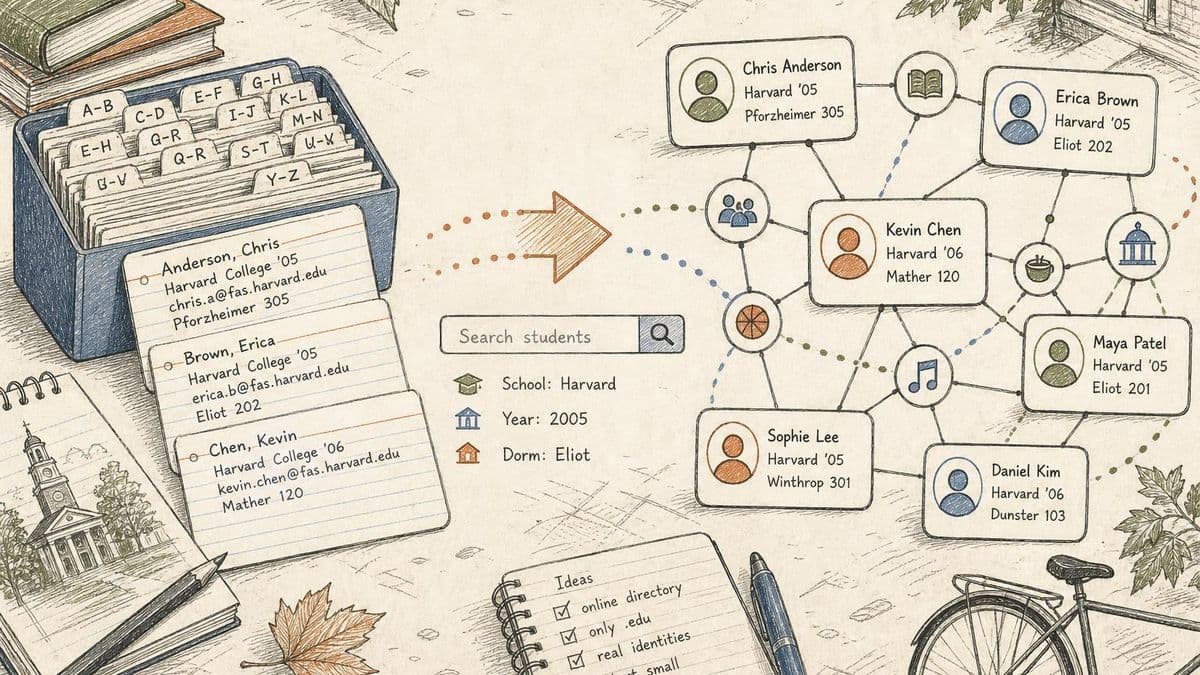
The original name made sense. When Mark Zuckerberg launched the site at Harvard on February 4, 2004, a "facebook" was already a familiar campus object: a student directory with a photograph and identifying facts. The product was not trying to be a universal social graph yet. It was trying to make the offline college directory searchable, clickable, and alive.
For that first audience, TheFacebook.com was clear. It explained the product.
But the product's ambition changed faster than the name. By 2005, Facebook was no longer just a Harvard utility. It had nearly three million registered users at over 800 colleges, raised major venture funding, and was pushing toward a larger identity in the middle of the social networking boom. At that point, the extra word "The" started to feel like launch scaffolding: useful when the product needed explanation, awkward when the company wanted to own the category.
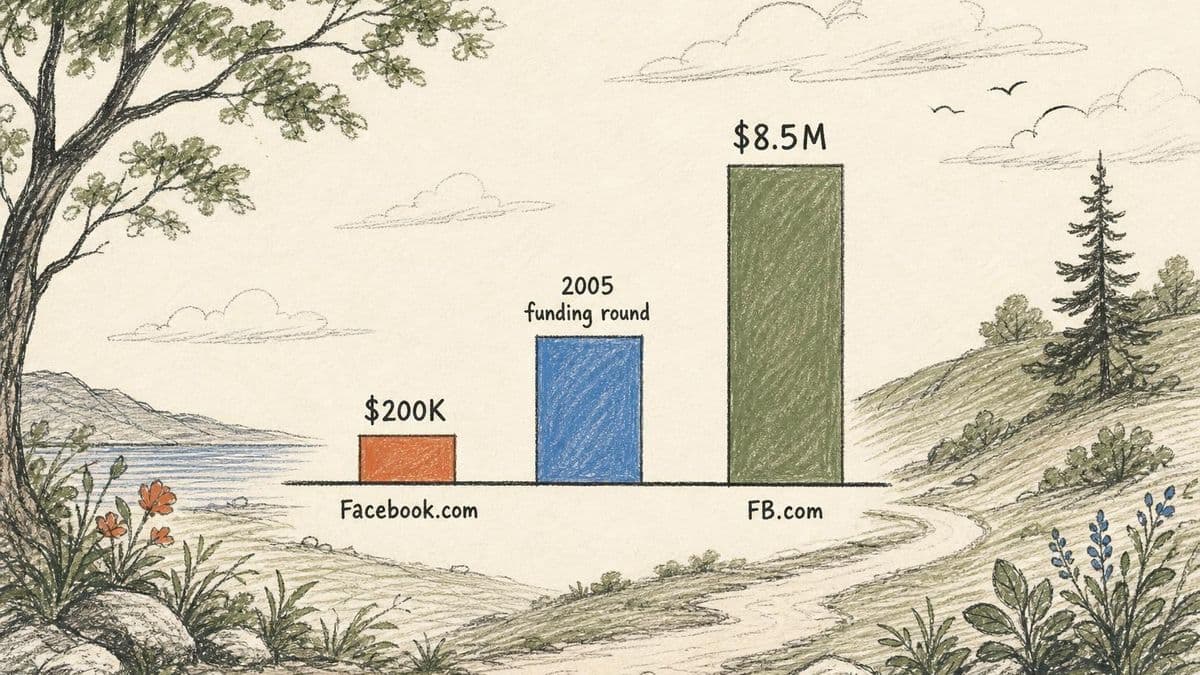
So Facebook bought Facebook.com for a reported $200,000 and dropped "The."
That was not just a cosmetic URL cleanup. It was an early example of a startup using a premium domain to turn momentum into inevitability.
The story did not end there. Five years later, Facebook would reportedly pay $8.5 million for FB.com, turning the domain lesson from a naming decision into a portfolio strategy.
2004: the campus network that needed a literal name
TheFacebook.com launched into a very specific historical moment. Friendster was the social media leader in early 2004, and MySpace was beginning its run toward mass-market dominance. But most social networks of that era were open, messy, and identity-light.
Facebook's early distinction was the opposite: it was restricted, structured, and tied to real campus identity.
The New Yorker described the early product as a Harvard social network built around profiles, search, "poking," and friend links, with membership initially tied to a Harvard e-mail address. The same account notes that by the end of February, about three-quarters of Harvard undergraduates had signed up, and The Harvard Crimson later remembered the early service as an internal directory for Harvard undergraduates that quickly became part of campus life.
That context matters because the name "The Facebook" was not random branding. It was a reference users already understood. In the early days, a descriptive domain was an advantage:
- It mapped the online product to a familiar offline object.
- It signaled that this was for students, not a generic public profile site.
- It reduced the explanation cost for the first wave of users.
TheFacebook.com was not a bad domain. It was the right kind of domain for the first stage: descriptive, campus-native, and good enough to start a network effect.
2005: the name had to grow up
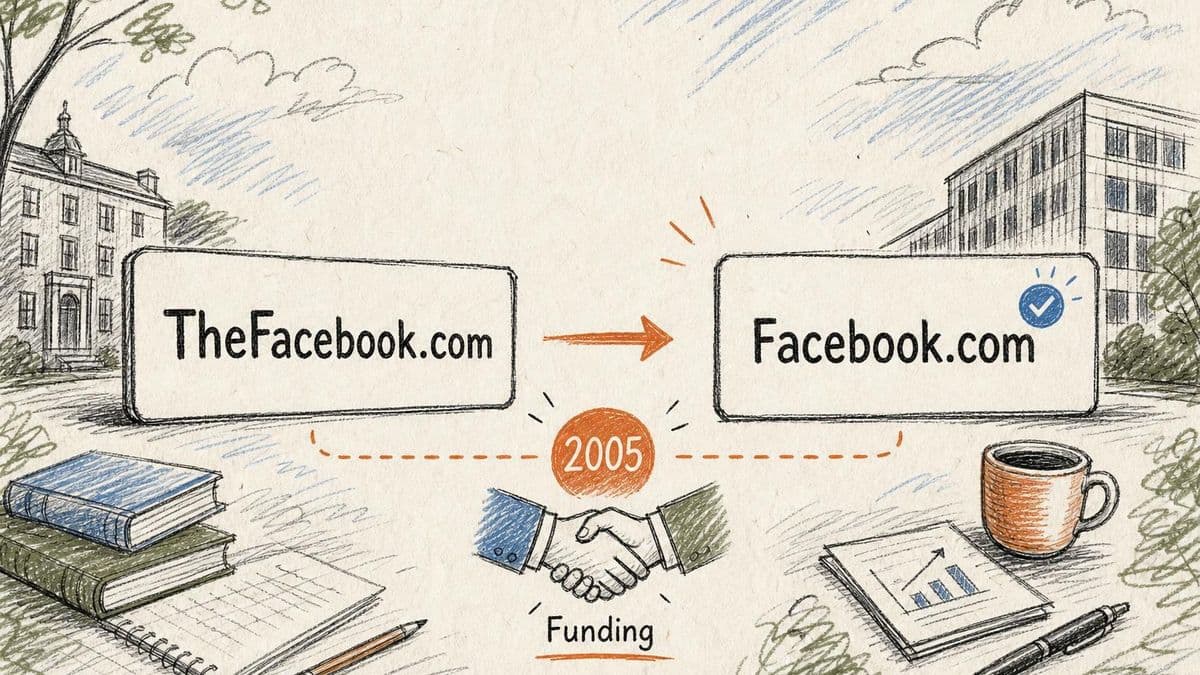
By 2005, the company was moving into a different phase. The Facebook was no longer a dorm-room experiment. The Harvard Crimson reported in May 2005 that Accel Partners would invest $13 million into the 15-month-old company, which already had nearly three million registered users across more than 800 colleges.
That financing headline is important because it puts the domain purchase in context. Today, $200,000 for Facebook.com sounds like a bargain. In 2005, it was still a meaningful capital-allocation decision for a very young company.
Several histories report that Facebook acquired Facebook.com in August 2005 for $200,000. InformationWeek later compared that purchase with Facebook's much larger acquisition of FB.com, noting that Facebook.com cost 42.5 times less than the later FB.com deal. Wired's history of Facebook also describes the move from TheFacebook.com to Facebook.com in 2005.
Even with the Accel round announced, $200,000 was not "just" $200,000. It was:
- A large single spend for a company that was only about a year and a half old.
- Equal to 20% of Jim Breyer's reported $1 million personal investment alongside Accel.
- A bet that the cleanest version of the name would matter more than another short-term hire, server allocation, or campus marketing push.
That last point is the lesson. Facebook was spending startup capital on brand infrastructure.
2010: FB.com and the price of operational shorthand
The Facebook.com purchase made the public brand cleaner. The later FB.com purchase was different. It was not about replacing the consumer-facing name. It was about owning the shortest possible shorthand for a company whose infrastructure, employees, products, and communications had outgrown the main domain.
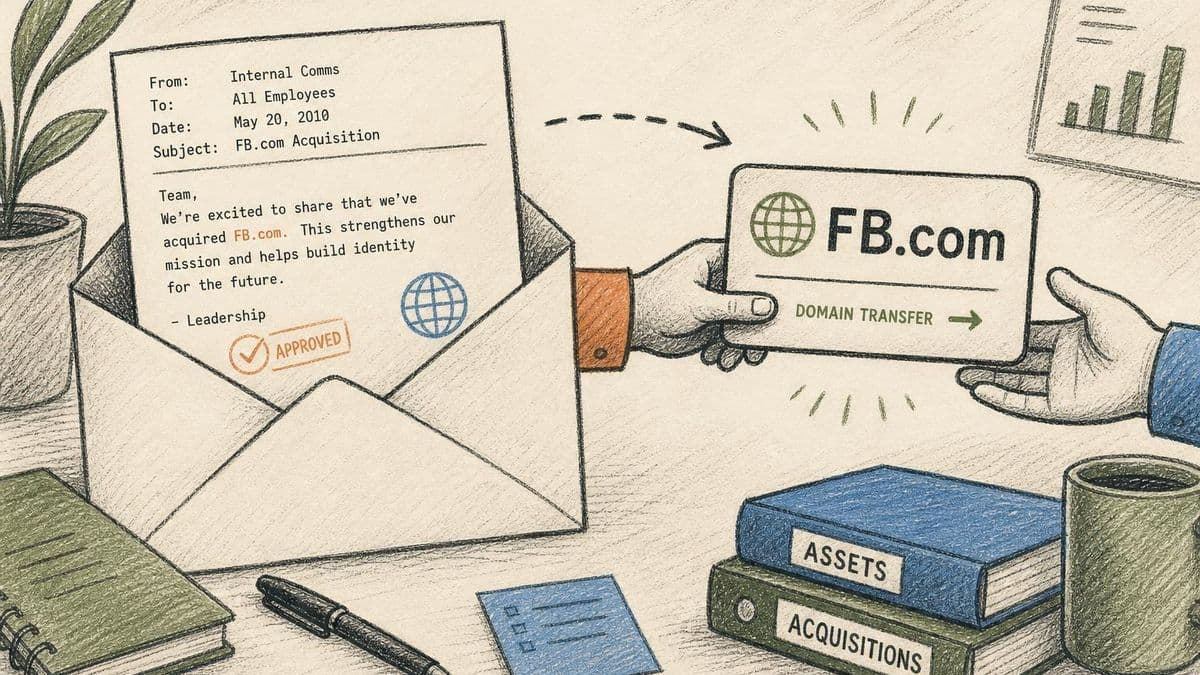
In November 2010, Facebook was rolling out a redesigned Messages product, and coverage at the time said Zuckerberg had revealed that Facebook had acquired FB.com from the American Farm Bureau Federation for internal email use because Facebook Messages was using the Facebook.com namespace. TechCrunch summarized the setup: Facebook had acquired FB.com from the Farm Bureau to use as the domain for internal email addresses.
The price surfaced later. NBC Bay Area reported that Farm Bureau officials said the organization had earned $8.5 million by selling a couple of domain names, while InformationWeek reported that Facebook acquired FB.com from the American Farm Bureau Federation for up to $8.5 million. CBS, also citing Reuters, described the same transaction as Facebook paying $8.5 million to buy FB.com.
That number changes how the $200,000 Facebook.com purchase looks. The first upgrade bought the exact public brand. The second bought a two-letter operating asset. InformationWeek put the contrast plainly: FB.com was more than 42 times the amount Facebook originally paid for Facebook.com.
In other words, Facebook's domain strategy matured in layers:
- TheFacebook.com helped explain a campus product.
- Facebook.com made the public brand canonical.
- FB.com gave the company compact infrastructure for internal and product-facing uses.
The later deal also shows why premium domains do not have one fixed kind of value. Sometimes the value is marketing clarity. Sometimes it is trust. Sometimes it is operational convenience at massive scale. By 2010, Facebook was large enough that a two-letter domain was not a vanity purchase; it was a high-leverage shortcut in a system used by thousands of employees and hundreds of millions of users.
The money looked different then
The temptation is to judge the deal from the end of the story. Facebook became Meta. Facebook.com became one of the most visited domains in the world. $200,000 now looks almost comically cheap.
But a domain purchase should be evaluated at the moment of uncertainty, not after the outcome is obvious.
In 2005, Facebook was still one player in a crowded social networking market. MySpace was the mainstream giant. Friendster had already shown how quickly a social network could rise and stumble. News Corp bought MySpace in 2005 for $580 million, which made the category look enormous but also intensely competitive. The New Yorker captured the mood in 2006: Facebook was growing quickly, but it was still mostly a college network with about seven and a half million registered members, still negotiating how open it should become, and still facing questions about whether college-only identity could scale.
Against that backdrop, spending $200,000 on a domain was not obvious. It was a thesis:
If this network becomes much bigger than campuses, the shorter, exact-match brand will compound every day.
That thesis turned out to be right.
Why dropping "The" mattered
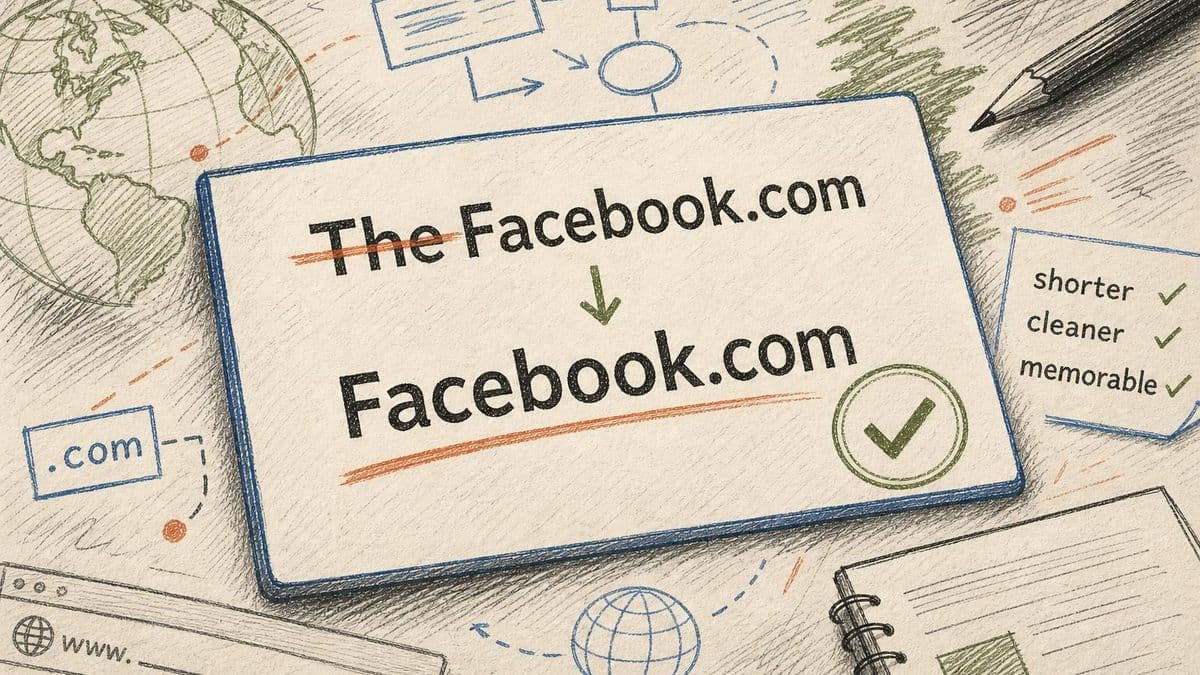
The difference between TheFacebook.com and Facebook.com is only three letters and a space in speech, but strategically it is much larger.
TheFacebook.com sounds like a product description. It points to a thing: the facebook, the directory, the campus tool.
Facebook.com sounds like a proper noun. It can become the name of a company, a platform, a verb, and eventually a social layer of the web.
The upgrade improved the brand in several ways:
| Before | After |
|---|---|
| TheFacebook.com | Facebook.com |
| Describes a campus directory | Names a broader network |
| Feels like an early product | Feels like the canonical destination |
| Carries the launch context | Travels beyond the launch context |
| Makes users remember an article | Reduces the brand to one word |
This is a common pattern in startup naming. Early names explain. Great names own.
At launch, explanation helps. Later, explanation can become drag. The best domain upgrades happen when the company has enough traction to know the brand matters, but early enough that the cleaner name can still become canonical.
Facebook hit that timing well.
Public discussion: hindsight, regret, and the "right domain"
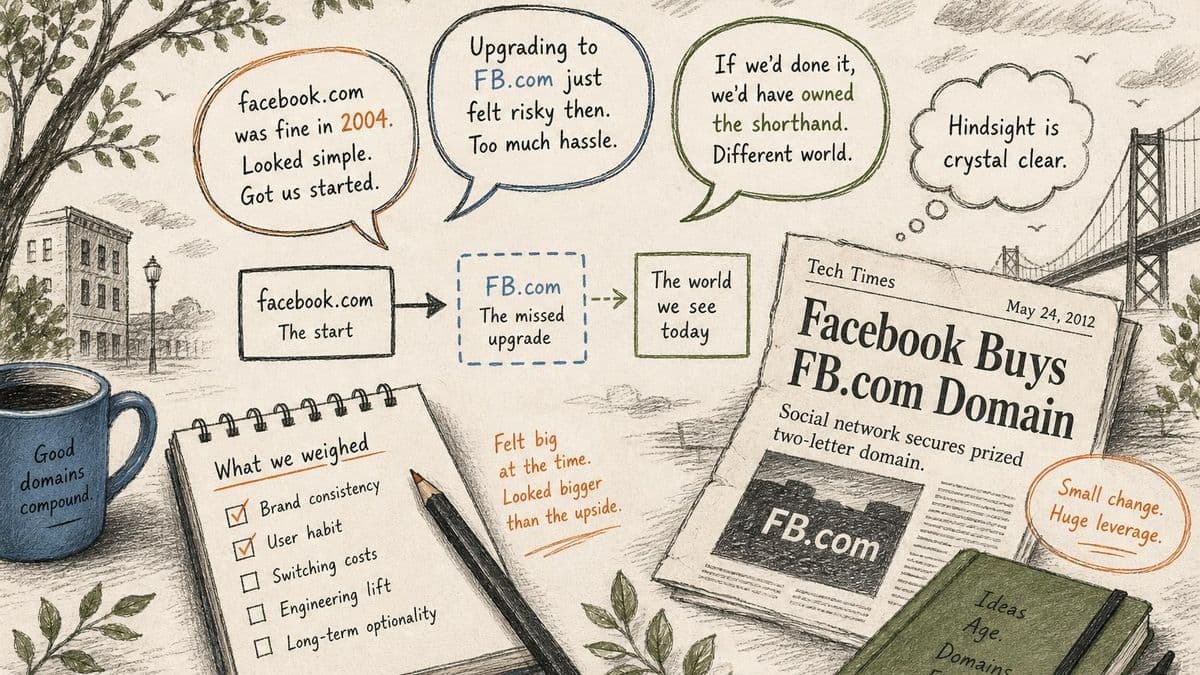
The Facebook.com purchase has become a recurring example in domain and startup discussions because it is so easy to understand in hindsight. Domain investors point to it as proof that exact-match brand domains can look expensive before they look obvious. Startup communities often use it as a counterexample to the idea that a young company should never spend serious money on a domain.
The most interesting public comment came from Zuckerberg himself. In a 2009 TechCrunch interview, when asked what he would do differently, he answered that he would get the right domain name. TechCrunch's transcript frames the lesson plainly: Facebook eventually could get the domain, but it had to pay for the mistake later.
Domain-industry retrospectives have kept returning to the same point. Smart Branding's write-up treats TheFacebook.com to Facebook.com to FB.com as part of a broader pattern of Facebook tightening its domain portfolio as the company matured. Strategic Revenue made a similar argument, noting that the company later acquired domains such as FB.com, Messenger.com, and Internet.org. The FB.com headlines also became their own public discussion, with TechCrunch quoting Zuckerberg's joke that the Farm Bureau would give Facebook FB.com and Facebook would not sell farm subsidies.
There is also a useful tension in public forum discussions. In a Hacker News discussion about spending serious money on a startup domain, some commenters argue that early-stage companies should not overpay before product-market fit. Others point to Facebook, Airbnb, and similar upgrades as evidence that once the product is working, the exact brand domain can be a high-leverage asset. Both sides are right at different stages. TheFacebook.com was good enough to start. Facebook.com was better once the network was clearly working.
The smart move was not buying the perfect domain on day one. The smart move was upgrading as soon as the company knew the name could carry a much larger business.
The domain became part of the operating system
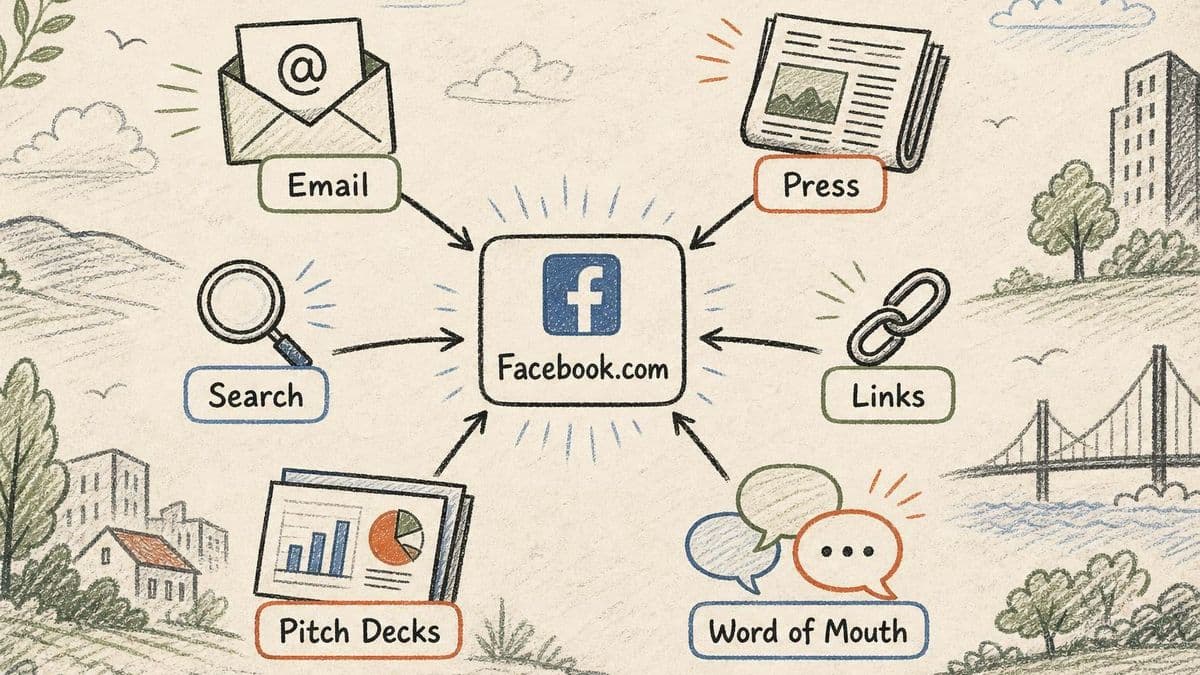
The reason premium domains matter is not vanity. It is repetition.
A core domain appears everywhere:
- In email addresses.
- In press coverage.
- In campus flyers, pitch decks, and investor memos.
- In search results.
- In browser bars and links.
- In every spoken recommendation from one user to another.
Every repetition either adds friction or removes it.
TheFacebook.com asked users to remember the article. Facebook.com did not. That small change multiplied across millions, then hundreds of millions, then billions of interactions. The domain did not create Facebook's network effects, but it made those network effects easier to communicate.
That is why the $200,000 decision aged so well. It was not a one-time branding expense. It was a permanent reduction in friction.
What founders should learn from Case 1
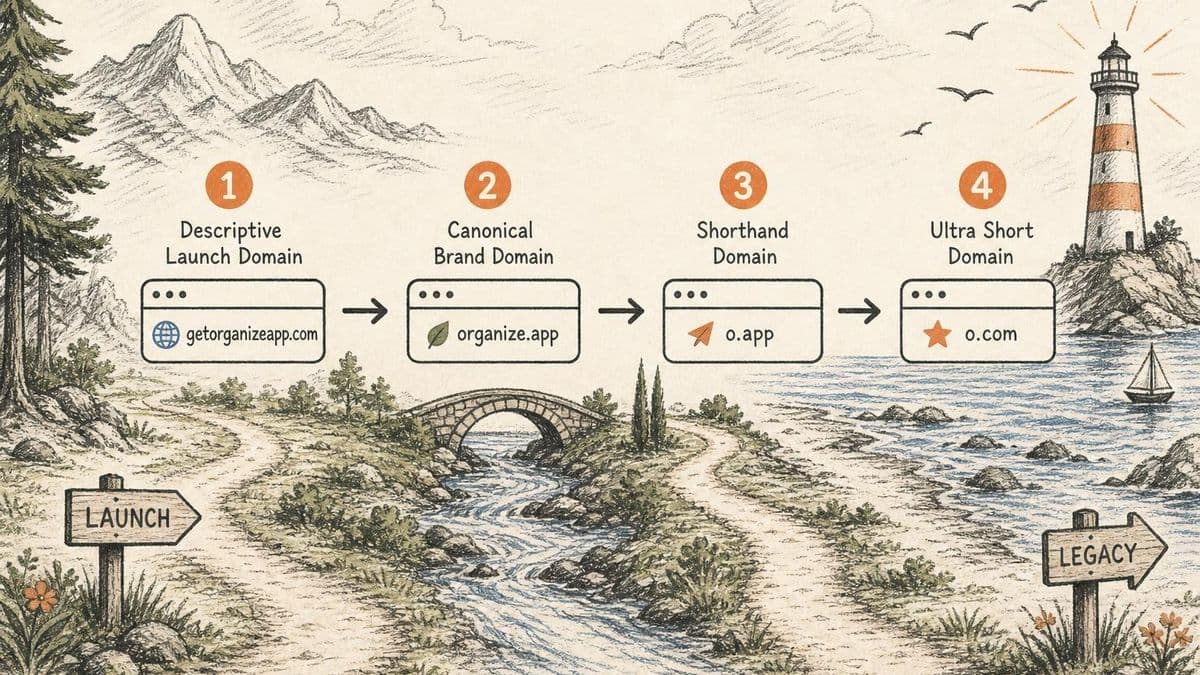
The Facebook story is sometimes simplified into "buy the best domain early." That is too blunt.
The better lesson is staged:
- Use a descriptive domain to start if it helps users understand the product. TheFacebook.com worked because it matched the Harvard use case.
- Watch for the moment when the name stops matching the ambition. Once the service was no longer just a campus directory, "The" became limiting.
- Treat the upgrade as infrastructure, not decoration. A canonical domain improves memory, trust, recruiting, fundraising, press, and user sharing.
- Move before the weaker name hardens. Facebook upgraded early enough that most of the world only ever knew the clean version.
The domain upgrade did not make Facebook win by itself. Product, timing, exclusivity, execution, capital, and network effects mattered more.
But Facebook.com made the win easier to name.
The Namefi angle
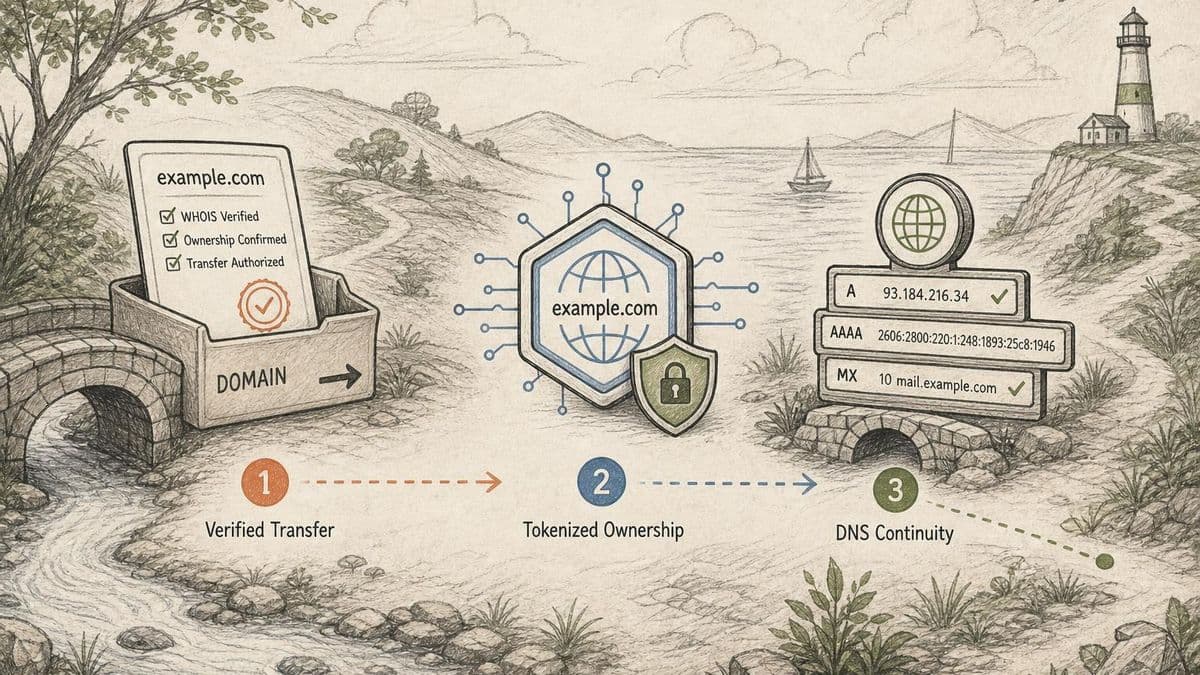
Most domain upgrades are not just naming decisions. They are asset-transfer decisions.
The hard part is often not deciding that the better domain matters. It is making the transaction happen safely: finding the owner, agreeing on price, coordinating payment, transferring control, preserving DNS continuity, documenting ownership, and making sure the domain does not sit inside one person's registrar account after the deal.
Namefi is built around the idea that domains should behave more like internet-native assets. Tokenized ownership can make domain control easier to verify, transfer, and integrate into modern workflows while preserving compatibility with DNS.
Facebook's upgrade is obvious now because the company became enormous. But the strategic lesson applies much earlier: when a name is going to carry the business, the domain is not decoration. It is part of the brand's foundation.
Sources and further reading
-
Meta — Company history, Portuguese edition, timeline entries for February 4, 2004 and September 20, 2005 — fetched 2026-09-15.
-
The Harvard Crimson — Ten Years Later, Facebook's First Users Look Back at Site's Earliest Days
-
The Harvard Crimson — Firm Invests $13M in Facebook
-
The New Yorker — Me Media
-
Wired — All the Times Facebook Moved Fast and Sometimes Broke Things
-
InformationWeek — Facebook Paid $8.5 Million For FB.com
-
NBC Bay Area — Facebook Paid Big Bucks to Farm Bureau
-
TechCrunch — Facebook Paid Farm Bureau $8.5 Million To Acquire FB.com
-
Forbes — The Comeback Kid
-
TechCrunch — Startup School: An Interview With Mark Zuckerberg
-
Smart Branding — From TheFacebook.com to Facebook.com to FB.com
-
Strategic Revenue — If You Didn't Already Know, Facebook.com Was Sold for Just $200,000 in 2005
-
Hacker News — Discussion of a startup domain purchase
Contributors

Aileen Wright is a student in her twenties living in New York City, where the distance between a museum wall and a library reading room is a short walk and a long afternoon. She came to name writing through art and history — the way a single portrait, coin, or manuscript margin can carry a name across centuries and change its meaning on the way.
Most weeks you can find her in Central Park with a paperback, or in the quiet of a public reading room chasing down where a name actually comes from rather than what a name-list says it means. She is also teaching herself to code, which has made her oddly precise about spelling, sorting, and the small details that decide whether a name ages well.
For Namefi she writes about the history and culture behind domain names, the stories brands carry as they rename, and the difference between a good story and a verified source.

Victor Zhou is a technology founder and standards editor focused on digital identity and trust. He founded Namefi, edits Ethereum Improvement Proposals, and previously led smart-contract architecture work at Google Labs.
His work sits at the intersection of naming, ownership, and the systems people use to establish identity online. That perspective makes him especially interested in the way names move between personal meaning, public recognition, and digital infrastructure.
For Namefi, Victor edits and writes about domains as durable digital identity: how names become ownable onchain assets, how tokenization changes custody and trust, and what naming can learn from the systems people use to establish identity online.
Related guides
- From Box.net to Box.com: The ~$1M Upgrade That Dropped the ".net" and Bought the Exact MatchHow Box launched in 2005 on Box.net because Box.com was taken, pivoted from consumer storage to the enterprise, and in 2011 paid Digimedia close to $1 million for the exact-match Box.com — a .net-to-.com upgrade that landed right as the company became simply "Box."
- From BufferApp.com to Buffer.com: The 624-Day, Bank-Statement-Open Domain DealHow Buffer launched in 2010 on BufferApp.com because Buffer.com was taken, then spent 624 days acquiring the exact-match domain — even showing the seller its bank balance — and why a company famous for radical transparency stayed quiet on the one number everyone wanted: the price.
- Who Owns Trip.com? Ctrip, Trip.com Group, and the RebrandUnderstand how Trip.com relates to Ctrip and Trip.com Group, and trace the acquisition and company-name changes behind the travel brand.
- From del.icio.us to Delicious.com: The Cleverest Domain Hack on the Web — and Why Yahoo Untangled ItHow the pioneering social-bookmarking site launched in 2003 as the famous domain hack "del.icio.us," why those dots became a permanent tax on every mention, and how Yahoo moved it to the cleaner Delicious.com in 2008.