
From UrbanCompass.com to Compass.com: How Dropping "Urban" Turned a NYC Rental App Into a National Brokerage
How Urban Compass launched in 2012 as a New York rental app on UrbanCompass.com, dropped "Urban" in its February 2015 rebrand, and upgraded to the exact-match Compass.com — a domain that had been listed at auction for $1 million — right as it set out to go national.
- domains
- branding
- startups
- domain-upgrades

Before Compass became a national residential real-estate brokerage, it was a more literal, more local thing: UrbanCompass.com, an app for finding an apartment to rent in New York City.
The original name made sense. When Robert Reffkin and Ori Allon built the service, it did one narrow thing in one narrow place. The Daily Beast described the early product as a service that launched in beta on May 7 with an endorsement from Mayor Michael Bloomberg, offering a comprehensive database of available rentals and information about the surrounding neighborhoods. The coverage map was small to start: Manhattan and parts of Brooklyn, with more New York neighborhoods to come later. The word "Urban" told you exactly what you were getting: a city tool, for city renters.
For that first audience, UrbanCompass.com was clear. It explained the product.
But the word the founders chose to anchor their brand was the same word that would eventually cap it. "Urban" said city. And a company that wanted to sell homes from Manhattan to Miami to the suburbs of Texas could not stay a city tool forever.
So in February 2015, Urban Compass did two things at once: it dropped "Urban" from its name, and it upgraded to the exact-match domain it would carry to a national rollout — Compass.com, an address that had been listed in an auction back in 2013 for US$ 1 Million.
2012–2014: the "Urban" that did real work
In the beginning, "Urban" was a feature, not a bug.
The company was incorporated in New York City in the fall of 2012. Per Wikipedia, Compass was founded by Ori Allon, Robert Reffkin, and Avi Dorfman as Urban Compass, Inc. in New York City in October 2012. Columbia's entrepreneurship office, where Reffkin earned two degrees, told the same story: Robert Reffkin '00CC, '03BUS founded Urban Compass with his long-time friend Ori Allon in October 2012.
The pairing was unusual. Reffkin was a former Goldman Sachs executive; Allon was a technologist with a rare track record of selling companies to the biggest names in tech. Allon had written the search algorithm Google bought, and then built a social-search startup Twitter acquired — hiring Allon was part of the deal, and he worked as director of engineering in Twitter's New York office. Together, as Columbia put it, the company combined Robert's business experience and Ori's technology background to help people find a great place to live.
A brand-new company asking New Yorkers to trust an app with one of the most stressful transactions of their year needed every signal of local credibility it could get. "Urban Compass" delivered it. The name said: this is built for your city, by people who understand your neighborhoods. The product matched the name word for word — a database of city rentals with local guides attached.
But the ambition was already wider than the name. The founders weren't trying to build a slightly better rental search for Manhattan. And the model itself was shifting fast: per Wikipedia, in January 2014, Compass announced it would change its overall business model by contracting independent real estate agents, receiving a portion of the broker commission. The pivot from rentals to residential sales pulled the company straight toward the limits of its own name. As Reffkin later put it, I realized rentals were pretty specific to New York City.
UrbanCompass.com was the right domain for the first stage. It was the wrong domain for the company underneath it.
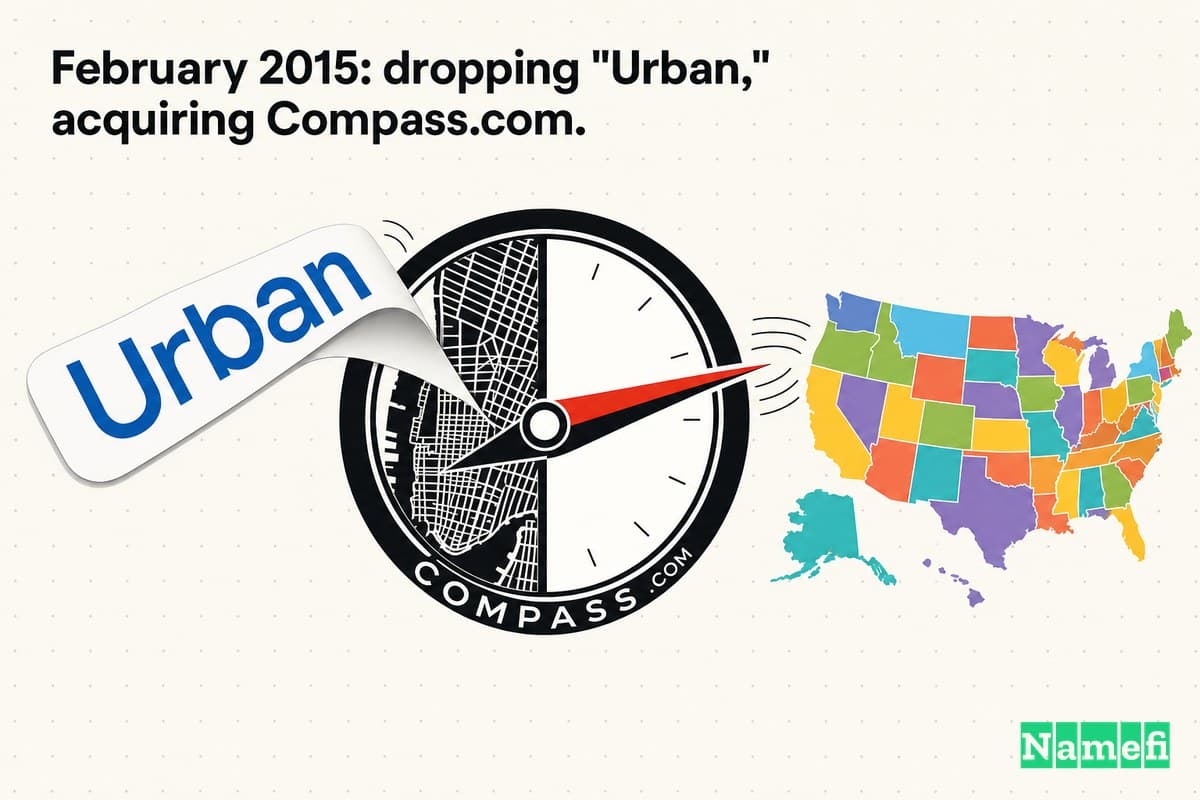
February 2015: dropping "Urban," acquiring Compass.com
The rebrand was deliberate, and it bundled the name change and the domain change into a single move.
Smart Branding documented the upgrade plainly: In February 2015, the brand upgraded its domain name from UrbanCompass.com to the EBM (Exact Brand Match) Compass.com. The company's own marketing leadership framed the logic in terms of reach and memorability. As Matt Spangler, then Compass's Head of Marketing and Creative, explained: Compass is a simpler, more universally memorable brand name that speaks directly to the connection between people and technology that is so central to what we are building.
Read that quote carefully. The word doing the heavy lifting is universally. "Urban Compass" was a New York brand. "Compass" was a brand that could point anywhere.
The domain that had an asking price before Compass needed it
Once the name became "Compass," the obvious address was Compass.com. But that domain wasn't a throwaway. Common single-word English nouns are among the most contested real estate on the internet, and "compass" — a word for direction, navigation, and finding your way — is about as on-brand a noun as a real-estate company could ask for.
The market had already put a number on it. Before Compass ever needed the name, Compass.com was listed in an auction back in 2013 for US$ 1 Million. What Compass actually paid stayed behind closed doors. As Smart Branding noted, the transaction was private so we don't know the investment made towards securing the matching domain name.
The $1 million auction listing was an asking price, not a sale price, appraisal, or public floor. The private transaction record therefore establishes neither what Compass paid nor whether the seller's earlier ask was met. What it does establish is that the exact-match name was already controlled and publicly marketed before Compass adopted it.
The money looked different then
It is tempting to judge a domain purchase from the end of the story, where Compass is a well-known brand and a premium URL can look inevitable. But in early 2015, the math looked different.
At that point Compass was a young, venture-funded brokerage that had recently changed its business model and was looking beyond its original rental product. It was spending on engineers, recruiting agents, and expanding operations. Against that backdrop, paying an undisclosed amount for a domain name — not technology, agent recruiting, or a new office — was the kind of line item a finance team would examine closely.
The decision only makes sense if you treat the domain as infrastructure rather than decoration. Compass was about to ask the country — not just New York — to remember its name. Every yard sign, every agent's email signature, every listing page, every press mention in a new market was going to carry its web address. Paying to make that address the clean, universal, exact-match version of the brand was a bet that the name would be repeated millions of times across the country — and that each repetition should land on Compass.com, not UrbanCompass.com.
Why dropping "Urban" mattered
The gap between UrbanCompass.com and Compass.com is one word. Strategically, it is the difference between a city and a country.
UrbanCompass.com describes a thing you already know: a tool for navigating urban real estate. Compass.com names something with no ceiling — a brand that could open offices in the suburbs, in the Sun Belt, in luxury beach markets, in any place where people buy and sell homes, urban or not. One word ties you to the city. The other lets you become the category.
| Before | After |
|---|---|
| UrbanCompass.com | Compass.com |
| Names a city rental tool | Names a brokerage without a ceiling |
| Anchored to "urban" markets | Travels to suburbs, Sun Belt, and luxury alike |
| Reads like a New York product | Reads like a national brand |
| Adds a word to every mention | Reduces the brand to one universal word |
This is the same pattern that shows up again and again in domain upgrades: early names explain, great names own. The descriptive version helps while a company still has to tell you what it does and where it does it. The exact-match version helps once the company is ready to be the thing people reach for by default — anywhere. Dropping "Urban" didn't just shorten the name; it removed the geographic cap baked into it. A national brokerage cannot live at a domain that says "city."
February 2015: the rename that pointed at a map
The order of events is what makes this case instructive. The rebrand wasn't cosmetic housekeeping — it was the starting gun for national expansion.
When Urban Compass became Compass in February 2015, its marketing leader described the shorter name as more universally memorable. That supports the geographic logic of removing "Urban," but the cited record here does not establish the exact synchronization between the rebrand and each new-market launch. The defensible point is narrower: the new identity no longer limited the brand to dense urban cores.
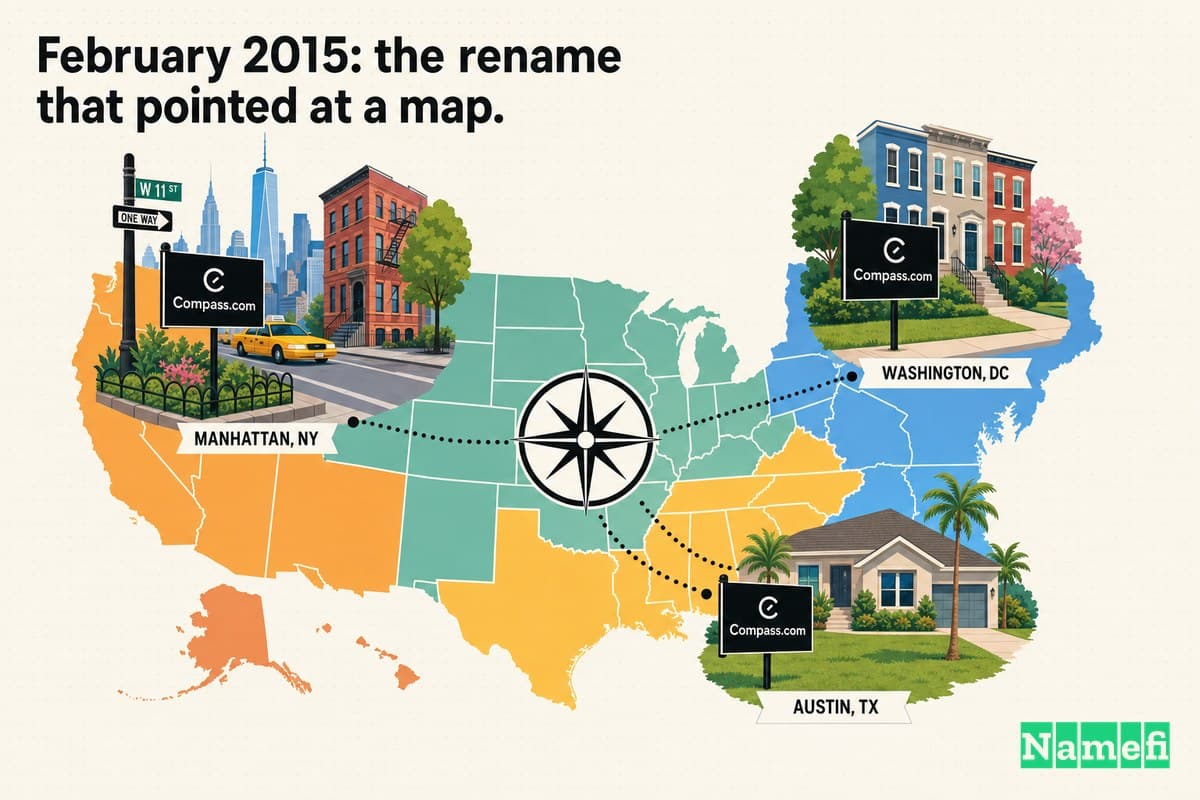
The brand, the logo, and the domain moved together — and the piece least under Compass's control was the domain, because someone else owned Compass.com and had previously listed it at a $1 million ask. The actual transaction price remains unknown. Securing the exact-match name nevertheless removed a visible mismatch between the broader brand and its old, city-qualified address.
Imagine the alternative: a company telling agents and sellers in Texas or Florida that it is a nationwide brokerage, while still sending them to a website with the word "Urban" in it. The mismatch would have undercut the whole point of the rebrand. The domain wasn't decoration on top of the new strategy. It was the load-bearing piece of it.
The domain became part of the operating system
Premium domains are not about prestige. They are about repetition.
A real-estate brand's core domain shows up in places the marketing team never directly controls:
- On every "For Sale" yard sign in every new market.
- In every agent's email address and business card.
- On listing pages, search results, and Zillow/portal syndication.
- In press headlines as the company enters each new city.
- In every word-of-mouth referral — "I listed with Compass" — passed from one neighbor to the next.
Every one of those repetitions either adds friction or removes it. UrbanCompass.com made each mention longer, more city-bound, and more obviously a New York thing. Compass.com made each mention shorter, cleaner, and geography-free. Repeated across a growing brokerage, that reduction in friction can make a premium domain function more like durable brand infrastructure than decoration — without telling us what this particular transaction cost.
The domain didn't build Compass's brand. But once Compass.com was the address, every future repetition of the name compounded on a cleaner foundation — one with no "Urban" to explain away in a suburban market.
What founders should learn from Case 8
The easy takeaway — "drop the descriptive word and buy your exact-match .com" — is too blunt. The more useful lessons are about which word, when, and what it costs:
- A descriptive domain is fine to start. UrbanCompass.com did real work: it made a brand-new company feel local and trustworthy to nervous New York renters. A modifier like "Urban," "App," or "HQ" is a reasonable on-ramp, not a failure.
- Watch for the moment the modifier becomes a ceiling. For Compass the signal was geographic. The instant the strategy turned national, the word "Urban" stopped describing the company and started shrinking it. When your name describes a smaller territory than the one you're moving into, the upgrade is urgent.
- Expect the exact-match name to carry an asking price. Common one-word .coms like Compass.com don't sit around free. This one was listed at auction for $1 million before Compass needed it, although the later sale price is unknown. Budget for the domain the way you'd budget for any strategic asset that someone else already controls.
- Secure the domain before the expansion, not after. The rename and the move to Compass.com came first, then the national rollout. The slow, externally-owned, expensive asset — the domain — had to be locked down for the new strategy to mean anything.
The domain upgrade did not make Compass win. Product, capital, agent recruiting, timing, and execution mattered far more. But Compass.com made the company's reinvention — from a New York rental app into a national brokerage — nameable, and it had to be secured the moment "Urban" turned from an asset into a fence.
The Namefi angle
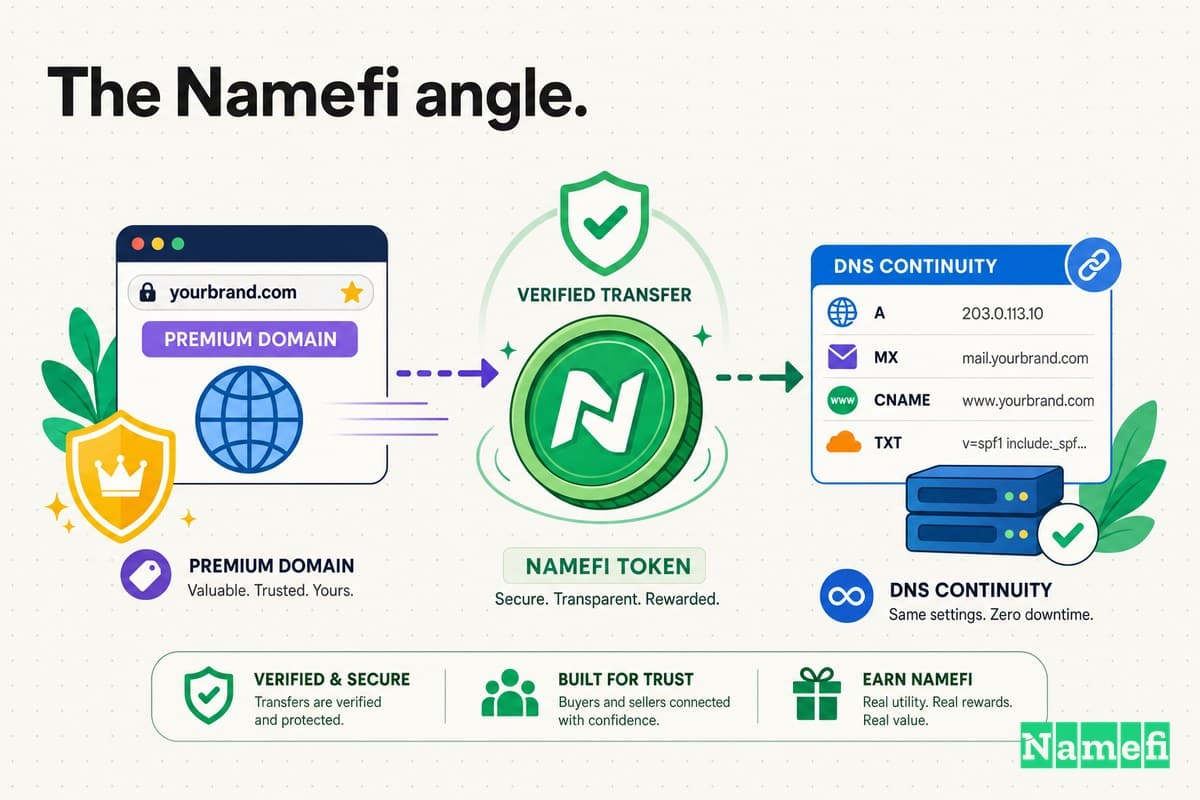
This case is, at its core, a transfer problem wearing a branding costume.
The strategic appeal is easy to understand — a company expanding beyond one urban market benefits from dropping "Urban" and owning Compass.com. The public record confirms the earlier $1 million auction listing and says the later transaction was private, but it does not disclose the negotiated price, contract terms, transfer mechanics, or seller motivation. Those unknowns should remain unknown rather than being reconstructed as a detailed deal narrative.
Namefi is built around the idea that domains should behave like internet-native assets. Tokenized ownership can make domain control easier to verify, transfer, and integrate into modern workflows while staying compatible with DNS — turning tasks such as proving control and transferring an asset into something closer to a clean, auditable transaction. That is a general benefit of more transparent domain infrastructure; the private Compass.com record does not show which mechanisms the parties actually used.
Compass.com looks inevitable in hindsight because Compass grew far beyond its original product. But the lesson lands earlier: when a name is meant to carry a business beyond one city, the domain is not merely decoration. It is worth evaluating as part of the rebrand even when the eventual purchase price remains private.
Sources and further reading
- Wikipedia — Compass, Inc.
- Smart Branding — UrbanCompass.com Upgrades to Compass.com
- The Daily Beast — Start-up Urban Compass Aims to Drive Apartment Rental Online
- Columbia Entrepreneurship — Urban Compass
- INTHEBLACK (CPA Australia) — Ori Allon: the digital wizard who changed Google and Twitter
- DALTX Real Estate (CandysDirt) — Meet Robert Reffkin, CEO of Compass Real Estate and Super Millennial
Contributors

Aileen Wright is a student in her twenties living in New York City, where the distance between a museum wall and a library reading room is a short walk and a long afternoon. She came to name writing through art and history — the way a single portrait, coin, or manuscript margin can carry a name across centuries and change its meaning on the way.
Most weeks you can find her in Central Park with a paperback, or in the quiet of a public reading room chasing down where a name actually comes from rather than what a name-list says it means. She is also teaching herself to code, which has made her oddly precise about spelling, sorting, and the small details that decide whether a name ages well.
For Namefi she writes about the history and culture behind domain names, the stories brands carry as they rename, and the difference between a good story and a verified source.

Victor Zhou is a technology founder and standards editor focused on digital identity and trust. He founded Namefi, edits Ethereum Improvement Proposals, and previously led smart-contract architecture work at Google Labs.
His work sits at the intersection of naming, ownership, and the systems people use to establish identity online. That perspective makes him especially interested in the way names move between personal meaning, public recognition, and digital infrastructure.
For Namefi, Victor edits and writes about domains as durable digital identity: how names become ownable onchain assets, how tokenization changes custody and trust, and what naming can learn from the systems people use to establish identity online.
Related guides
- From Box.net to Box.com: The ~$1M Upgrade That Dropped the ".net" and Bought the Exact MatchHow Box launched in 2005 on Box.net because Box.com was taken, pivoted from consumer storage to the enterprise, and in 2011 paid Digimedia close to $1 million for the exact-match Box.com — a .net-to-.com upgrade that landed right as the company became simply "Box."
- From BufferApp.com to Buffer.com: The 624-Day, Bank-Statement-Open Domain DealHow Buffer launched in 2010 on BufferApp.com because Buffer.com was taken, then spent 624 days acquiring the exact-match domain — even showing the seller its bank balance — and why a company famous for radical transparency stayed quiet on the one number everyone wanted: the price.
- Who Owns Trip.com? Ctrip, Trip.com Group, and the RebrandUnderstand how Trip.com relates to Ctrip and Trip.com Group, and trace the acquisition and company-name changes behind the travel brand.
- From del.icio.us to Delicious.com: The Cleverest Domain Hack on the Web — and Why Yahoo Untangled ItHow the pioneering social-bookmarking site launched in 2003 as the famous domain hack "del.icio.us," why those dots became a permanent tax on every mention, and how Yahoo moved it to the cleaner Delicious.com in 2008.