How Much Does a Domain Name Cost? Registration and Renewal
Compare domain registration, renewal, transfer, and recovery costs, and learn how to spot introductory prices that hide a higher ongoing bill.


- domains
- domain-investing
- domain-pricing
- guide

A domain name has a registration price and a recurring renewal price; the two can differ substantially. The extension, registrar, registration term, and whether the name is already owned or priced as premium determine the quote.
That is the first thing to understand before you register a name. The checkout price is only one line in the ledger. A domain has a first-year registration price, a renewal price, a transfer price, possible restore or redemption fees, privacy settings, taxes, payment-method costs, and sometimes surrounding product fees for DNS, email, hosting, or account services.
A promotional first year can be legitimate and still lead to a higher annual commitment. Compare both prices before checkout to understand the long-term holding cost.
You can find a cheap domain by comparing the same purchase
Compare the exact name, extension, currency, and registration term across registrars. Record registration and renewal separately. Reject a comparison that mixes a premium name with a standard name.
Porkbun publishes separate registration, renewal, and transfer columns. Cloudflare states that registration and renewal have no registrar markup. Cloudflare requires Cloudflare nameservers. Include that requirement when comparing DNS flexibility.
Add the services you need before choosing the lowest total. Check the final cart for taxes and optional products. A promotional registration price alone cannot identify the cheapest long-term option.
Sources checked on October 22, 2026. Quotes and terms can change.
The number you see first is not the cost
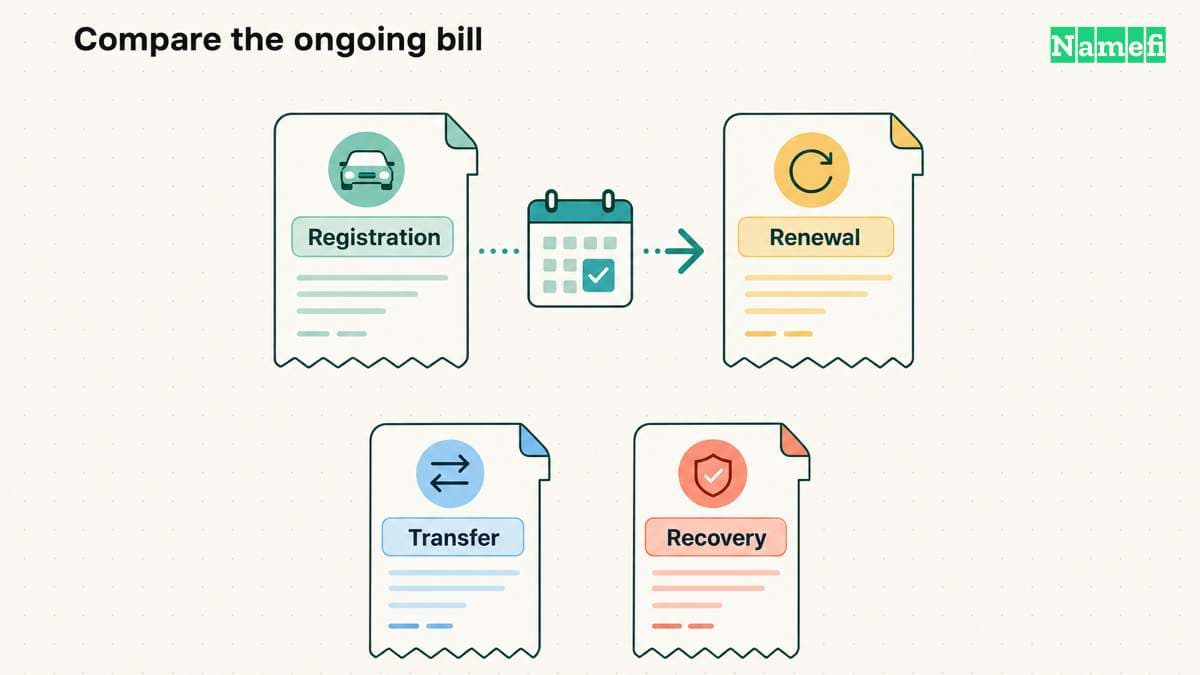
Most people ask "how much is a domain?" and expect one answer. A better question is: "What will this name cost if I keep it for three years and something goes wrong once?"
Here is the cost stack.
| Cost | What it means | Why it matters |
|---|---|---|
| First-year registration | The price to register an available name for the first term | This is where promotions usually appear |
| Renewal | The recurring price to keep the domain after the first term | This is the real long-term cost |
| Transfer | The price to move the name to another registrar | It may differ from renewal and may extend the term |
| Restore / redemption | The fee to recover a name after it has expired and entered a recovery window | This can be many times the annual renewal |
| WHOIS privacy | Contact-data privacy or proxy service | It may be included, paid, unavailable, or handled differently by TLD |
| Taxes and regulatory fees | Sales tax, VAT, GST, local fees, ICANN fees, or other checkout additions | These depend on jurisdiction, currency, and registrar |
| Payment costs | Card foreign-exchange spread, wire costs, crypto network fees, delayed payment methods, refund friction | The registrar price may not be the exact amount that leaves your account |
| DNS / product fees | Hosted-zone, query, email, forwarding, SSL, or bundled service costs | A domain can be cheap while the surrounding account is not |
The line that trips people most often is renewal. ICANN's Expired Registration Recovery Policy requires registrars to make renewal, post-expiration renewal, and redemption/restore fees reasonably available, but the buyer still has to compare them before checkout. A low first-year number is not misleading by itself. It becomes a problem when the buyer treats it as the annual cost.
Why introductory pricing differs from renewal
Introductory pricing is common because the first year and the renewal year are different economic events.
The first year may be discounted because the registry or registrar wants adoption, because a promotion is running, or because the registrar expects many customers to keep the domain for multiple years. The renewal year has a different job. It has to support the ongoing registry fee, registrar margin, payment processing, fraud controls, support, compliance, renewal notifications, and whatever product layer is bundled around the name.
This is normal across many industries: acquisition pricing is often lower than retention pricing. The domain-specific risk is that renewals are not optional if the name matters. If your website, email, brand, app, or portfolio depends on a domain, the renewal bill is the cost of keeping control.
The practical habit is simple: before you register, write down both numbers. Use the recurring renewal quote as your planning baseline and record the introductory discount separately.
Current quotes show why renewal matters
These examples use public prices checked on October 21, 2026. They are snapshots, not future price guarantees.
| Non-premium domain at Porkbun | First year, USD | Renewal per year, USD |
|---|---|---|
.com | $11.08 | $11.08 |
.blog | $2.57 promotional price | $21.11 |
Porkbun’s price table lists single-year prices for non-premium names and includes ICANN and other fees. Confirm the exact name and checkout total before paying. Premium names require a separate quote.
Porkbun also lists a $200 restoration fee plus normal renewal for names recovered through the Redemption Grace Period. A restore fee belongs in an emergency scenario, not every annual budget.
A three-year budget separates recurring and optional costs
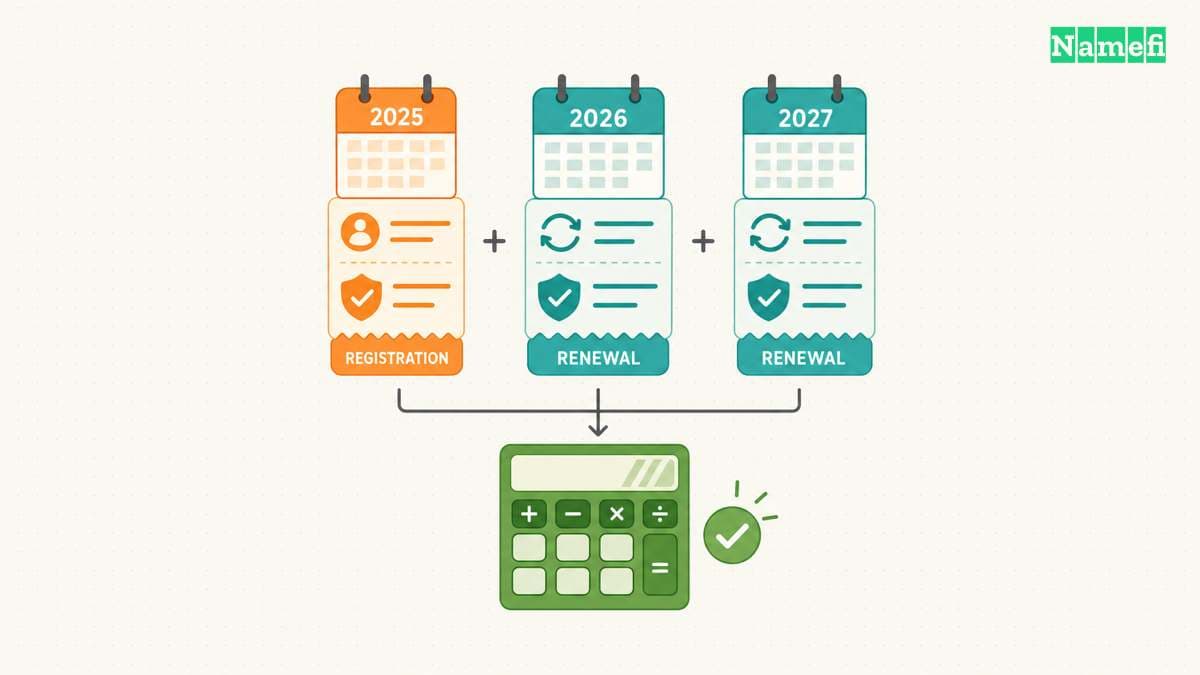
For a hypothetical three-year plan, assume registration costs $5 and each renewal costs $20. The registration-and-renewal total is $5 + $20 + $20 = $45. These figures illustrate the calculation and do not quote a registrar.
Add only services you select. For example, Amazon Route 53 charges $0.50 per hosted zone per month for the first 25 zones. One zone billed for 36 months adds $18, before query charges and other services. That DNS charge does not include domain registration.
Do not add a full renewal again when a transfer payment already includes the same registration year. Check the transfer quote and resulting expiration date. Keep acquisition, recurring services, taxes, and emergency recovery as separate budget lines.
Registration, renewal, transfer, restore
The four domain operations to compare are registration, renewal, transfer, and restore.
Registration is the first term. It is the number marketing pages emphasize because it is the easiest one to understand. A discounted first year can be useful if you are testing an idea, but it is not the right number for long-term planning.
Renewal is the cost of continuing control. A small per-domain difference becomes more significant when multiplied across a portfolio. This is why domain investors obsess over renewal cost and sell-through rate.
Transfer is what you pay to move the domain to another registrar. A transfer may include a one-year term extension, but that is not a universal shortcut you should assume without checking. Also watch transfer locks, recent-registration limits, authorization-code handling, and whether the transfer changes your DNS or privacy settings.
Restore or redemption is the expensive panic button. ICANN's recovery policy requires non-sponsored gTLD registries to offer a 30-day Redemption Grace Period after deletion, except for deletions during an applicable add-grace period. The deleting registrar can restore the deleted registration during that period. Recovery can cost much more than a normal renewal. The lesson is simple: auto-renew is cheaper than rescue.
Privacy, taxes, and payment method costs
WHOIS privacy belongs in the cost comparison because it changes the practical value of the package. Some domains include privacy by default. Some make it optional. Some TLDs or registrant types may handle public contact data differently. If privacy matters to you, compare it as part of the domain cost rather than as an afterthought.
Taxes and regulatory fees are less tidy. Sales tax, VAT, GST, and local rules depend on where you are, where the registrar sells from, and how the service is classified. A checkout total may differ from the advertised base price, especially across currencies or jurisdictions.
Payment method can also change the real cost. A card may add foreign-exchange spread. A bank wire may carry bank fees or minimums. A local bank transfer may delay activation. A crypto payment may involve network fees, confirmation time, and refund limitations. If you are buying one inexpensive name, this may be minor. If you are buying or renewing a portfolio, payment rails become part of the operating model.
Registrar pricing models
Registrars sell the same general object, but not the same experience. Comparing them only on one TLD's first-year price misses the business model.
Cost-pass-through style
For example, Cloudflare Registrar advertises registration and renewal at registry and ICANN cost, without markup. Cloudflare also includes free WHOIS redaction. The appeal is obvious: if the registrar can pass through the underlying registry cost with little extra margin, the buyer may get a lower renewal price. This model tends to work best for buyers who already know what they need and do not require much support or bundling.
The tradeoff is that lower markup is not the only variable. You still care about supported TLDs, account recovery, DNSSEC, bulk controls, billing controls, transfer workflows, support responsiveness, and how well the registrar fits your security model.
Infrastructure-first registrar
Some registrars are attached to a broader cloud or infrastructure platform. In that model, the domain is one part of a larger system that may include hosted DNS, query charges, access controls, audit logs, infrastructure automation, health checks, and other operational services.
This can be attractive for technical teams that want domains close to infrastructure and billing. It may be overkill for a casual buyer who only wants a simple domain and renewal reminder. The domain price can look reasonable while the surrounding product costs make the total bill harder to compare.
Investor-focused registrar
Some registrars are optimized for domain investors and active traders. The features that matter there are bulk search, bulk renewals, portfolio exports, clear renewal columns, transfer tooling, aftermarket access, expiry controls, and account-level reporting.
For investors, a small renewal difference compounds quickly. A portfolio of names renews every year whether the names sell or not. That makes the registrar's renewal table, restore fees, bulk tooling, and payment workflow more important than a pleasant one-name checkout.
Consumer retail registrar
Consumer retail registrars optimize for a broader buyer: small businesses, creators, local services, side projects, first-time domain owners, and teams that want support and adjacent products. The value may be a simpler search flow, reminders, customer support, privacy handling, email or hosting integrations, website tools, or easier account recovery.
Retail pricing is not automatically bad. The fair comparison is not "who has the lowest first-year price on one TLD?" It is "what will this registrar cost me over the life of the domain, and does the service layer justify the difference?"
Marketplace and productized registrar experience
Some registrar experiences are built around domains as assets, not just domains as checkout items. That can include listings, transfers, ownership verification, financing, portfolio views, tokenized ownership, marketplace settlement, or domain handoff workflows.
The product layer can be useful, but it does not replace the basic cost check. A productized experience still has first-year pricing, renewal pricing, transfer rules, restore risk, privacy settings, taxes, and payment flows. The extra features are valuable only if the total holding cost still makes sense for the name.
What to compare before choosing a registrar
Use this checklist before registering a name you intend to keep.
- What is the first-year price?
- What is the renewal price after the first term?
- Is the name standard-price or premium-price?
- Is WHOIS privacy included, optional, or unavailable?
- What is the transfer-in price and does it extend the term?
- What is the restore or redemption fee if the domain expires?
- What happens after expiration: notices, grace period, DNS interruption, auction, redemption, pending delete?
- Are taxes or local regulatory fees added at checkout?
- Which payment methods are supported, and do they create extra cost, delay, or refund friction?
- Are DNS, hosted zones, email, forwarding, SSL, or security products separate costs?
- How easy is it to export, transfer, recover, or hand off the domain?
- If you hold many domains, can you bulk renew, tag, filter, export, and forecast the portfolio?
For one personal project, the answer may be "pick the registrar you trust and keep auto-renew on." For a brand, the answer may be "pay more for better support and account security." For an investor, the answer may be "optimize renewal cost ruthlessly because the portfolio renews whether it sells or not."
The practical answer
So, how much is a domain?
The dated table above gives concrete standard-price examples. For the name you want, obtain its exact registration and renewal quotes; an aftermarket purchase or premium registry tier needs a separate quote. If recovery becomes necessary, confirm the applicable restore fee with the registrar.
The practical answer is not the first-year price. It is:
Domain holding cost = registration + renewals + transfers + restore risk + privacy + taxes + payment costs + surrounding product fees.
That is the number to compare. Compare the total cost of keeping control for as long as the name matters.
These sources document the quoted fees and rules
-
ICANN — Expired Registration Recovery Policy, sections 3.1 and 4.1: redemption period and fee disclosure. Accessed October 21, 2026.
-
Porkbun — Domain pricing and restoration fee, accessed October 21, 2026.
-
Cloudflare — Registrar pricing model and included services, accessed October 21, 2026.
-
AWS — Route 53 hosted-zone and query charges, accessed October 21, 2026.
Contributors
Fenwei Bian is a software developer in her thirties who spends her working hours in pull requests and her weekends with her hands in soil or sawdust. Years of open source on GitHub taught her that names are interfaces: a good one is clear, honest about what it does, and kind to whoever has to use it next.
She gardens because it rewards patience and punishes wishful thinking, and she does woodwork because a joint either fits or it doesn't. Both habits show up in how she writes about naming — measure twice, check the source, and don't sand over a rough spot and hope no one notices.
For Namefi she writes about how domain markets actually move, the practical trade-offs of tokenizing and flipping names, and picking a domain you'll still be glad you own in twenty years.
Victor Zhou is a technology founder and standards editor focused on digital identity and trust. He founded Namefi, edits Ethereum Improvement Proposals, and previously led smart-contract architecture work at Google Labs.
His work sits at the intersection of naming, ownership, and the systems people use to establish identity online. That perspective makes him especially interested in the way names move between personal meaning, public recognition, and digital infrastructure.
For Namefi, Victor edits and writes about domains as durable digital identity: how names become ownable onchain assets, how tokenization changes custody and trust, and what naming can learn from the systems people use to establish identity online.