For-Sale Landing Pages That Convert
How to build a domain for-sale landing page that converts: a clear price or offer path, real trust signals, and a frictionless way to buy or make an offer.
- domains
- domain-investing
- domain-flipping
- guide

A buyer who wants your name rarely arrives through your marketing. They type the name into a browser to see if it's taken, the domain resolves, and a page loads. Whatever that page says is your entire pitch. If it's a registrar default, a parking page stuffed with ads, or nothing at all, you just lost the one visitor who was already convinced the name mattered. The for-sale landing page is the storefront on the most valuable traffic you'll ever get: people who found you by typing the exact thing you're selling.
This guide covers what a for-sale lander has to do, the three things every converting page gets right (a clear price or offer path, real trust signals, and a frictionless way to transact), and the mistakes that quietly kill deals. It's a companion to marketing your domains for sale, which covers the channels that drive traffic; this one is about what happens when that traffic lands. Both sit under the domain flipping series.
The lander is the highest-intent traffic you have
Start with who shows up. Type-in traffic on a name you're selling is self-selected to a degree no ad campaign can match: the visitor already knows the exact string, took the trouble to type it, and is checking availability. That is a person at the bottom of the funnel, and the page they hit is doing the job of a landing page in the marketing sense. Wikipedia's definition fits exactly: a landing page is a single web page that appears in response to clicking on a search engine optimized search result, marketing promotion, marketing email or an online advertisement. For a domain, the click is the visitor typing your name, and the single page has to do everything a sales conversation would.
So treat it as one. The discipline that applies here is conversion rate optimization — what Wikipedia calls the systematic process of increasing the percentage of users or website visitors who complete a desired action. Your desired action is narrow: buy now, or make a serious offer. Everything on the page either moves the visitor toward that action or gets in the way. A page that "looks nice" but buries the price, hides the contact path, or makes the visitor wonder whether you even own the name is a page that converts the wrong way.
The three things every converting lander gets right

A for-sale page does not need to be clever. It needs three things, and most underperforming landers are missing at least one.
1. A clear price or a clear offer path
The single biggest decision is whether to show a number. The two honest options:
- Buy It Now (fixed price). A posted price removes the largest source of friction in any sale: uncertainty about whether the deal is even in the buyer's range. It lets a motivated buyer transact without a negotiation and filters out tire-kickers who'd never reach your floor. The cost is that you cap your upside, since a buyer who would have paid more now pays exactly your number. Fixed pricing works best on names with a defensible comparable value, where you'd rather close ten deals quickly than hold out for one outlier.
- Make an offer (no posted price). Withholding the price invites a conversation and preserves your ceiling. That matters most on names whose value depends entirely on which buyer shows up, like a one-word brandable where an end-user with a real need might pay a multiple of any "market" comp. The cost is friction and noise: you'll field lowballs, and some serious buyers walk rather than start a negotiation cold.
There is no universally correct answer, and the choice ties closely to how you priced the name in the first place; see how to value a domain name. It also depends on the extension: a liquid .com with clear comps suits a posted price, while a scarcer .co brandable may do better on offers. The unforgivable version is the page that offers neither, with no price and no obvious way to make an offer. That page converts nobody. If you withhold the price, the offer path has to be loud, obvious, and instant. The instruction should read like a marketing call to action, what Wikipedia describes as an instruction to the audience designed to provoke an immediate response, usually built around an imperative verb. "Make an offer" as a button beats "contact us" as an afterthought.
2. Trust signals that answer "is this real?"
The quiet killer of domain deals is doubt. A visitor who likes the name still has to believe three things before acting: that the page is genuinely tied to the domain, that the seller actually controls it, and that handing over money won't end in a scam. Buyers are right to be wary. Name theft and sale fraud are common enough that we wrote a whole guide on avoiding domain sale scams, and the mechanics of how names get stolen are covered in how domain hijacking actually happens.
Concrete trust signals that move the needle:
- The name as the headline. Obvious, but the page should state plainly that this exact domain is for sale. A visitor should never have to guess whether they're on a parking page for a different name.
- A named, reachable seller or platform. A real contact channel, a consistent identity, and ideally a recognizable marketplace or broker behind the listing. Anonymity reads as risk.
- A neutral settlement method, stated up front. Telling the buyer the deal closes through escrow does more work than any "trusted seller" copy. Escrow is, in Wikipedia's words, a contractual arrangement in which a third party (the stakeholder or escrow agent) receives and disburses money or property for the primary transacting parties, with release conditional on the agreed terms. Naming it tells the buyer that neither side has to go first. We unpack the mechanism in domain escrow explained.
- Verifiable ownership. Anything that lets a buyer confirm you hold the name (consistent WHOIS, a marketplace badge, or on-chain proof of domain ownership) converts skeptics that polished copy never will.
3. A frictionless path to buy or make contact
Every extra step between "I want this" and "done" leaks buyers. The page should let a decided buyer act in one motion: a single button to buy at the posted price, or a single form to make an offer that reaches you immediately. Long forms, account sign-ups, mandatory phone numbers, and "we'll get back to you within 5 business days" are all friction taxes paid in lost deals.
Where the visitor goes after the click matters as much as the click. If the page is hosted by a marketplace, the buy or offer flow is built in and the handoff is handled for you; choosing the right venue is its own decision, covered in where to sell domains: marketplaces compared. If you're routing the deal yourself, point the buyer at a concrete next step (a brokered offer, an escrow link, or a checkout) rather than a vague inbox. For the full mechanics of running a single sale to close, see how to sell a domain name you own.
Parking the page vs. landing the page
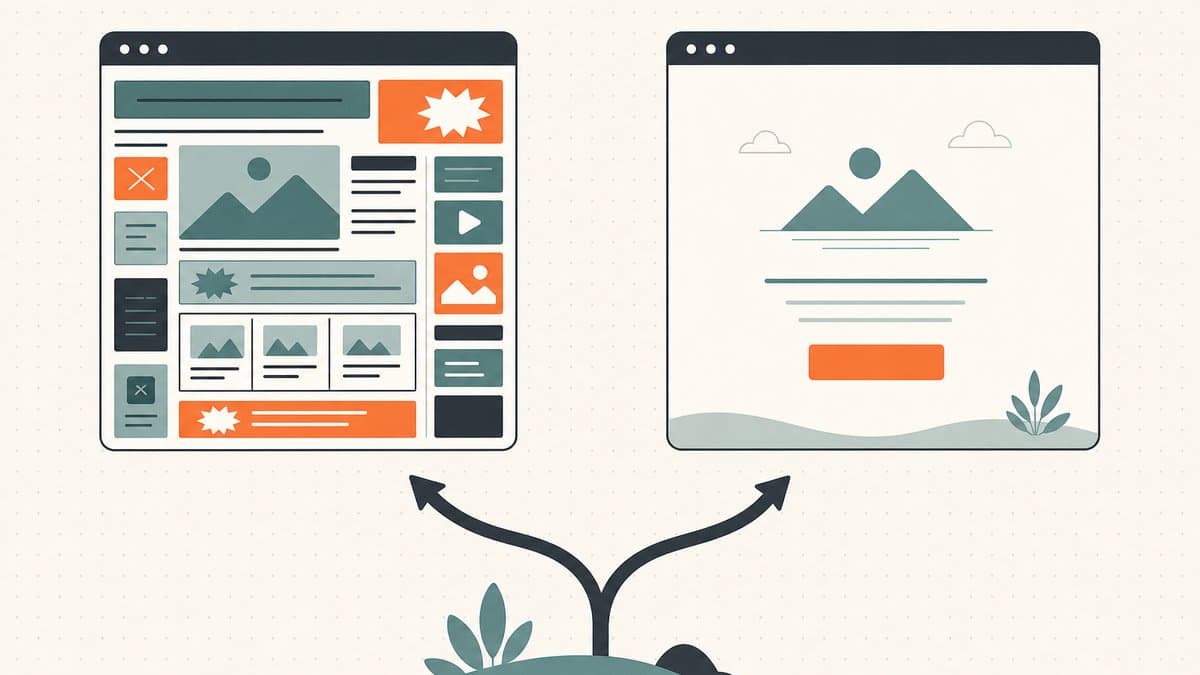
Not every for-sale page is the same animal. A parking page monetizes traffic with ads while the name sits unsold; a for-sale lander is built to convert that traffic into a sale. The two goals pull against each other: ads distract from your offer, and a clean sales page earns no ad clicks. On a name you're actively flipping, the sales lander wins — ad revenue is usually rounding-error money next to a single completed sale. On a name you're holding indefinitely, monetization can defray renewal cost. The tradeoff, and how to run both, is the subject of domain parking and monetization.
One thing both pages share: they're discoverable. A lander that no buyer ever reaches can't convert, so basic on-page SEO hygiene — the name as the headline, a crawlable title, a clear description — helps the page surface when someone searches the string rather than typing it directly. That overlaps with marketplace SEO for domain listings, where the same instincts apply to listing pages on third-party platforms.
Mistakes that quietly kill conversions
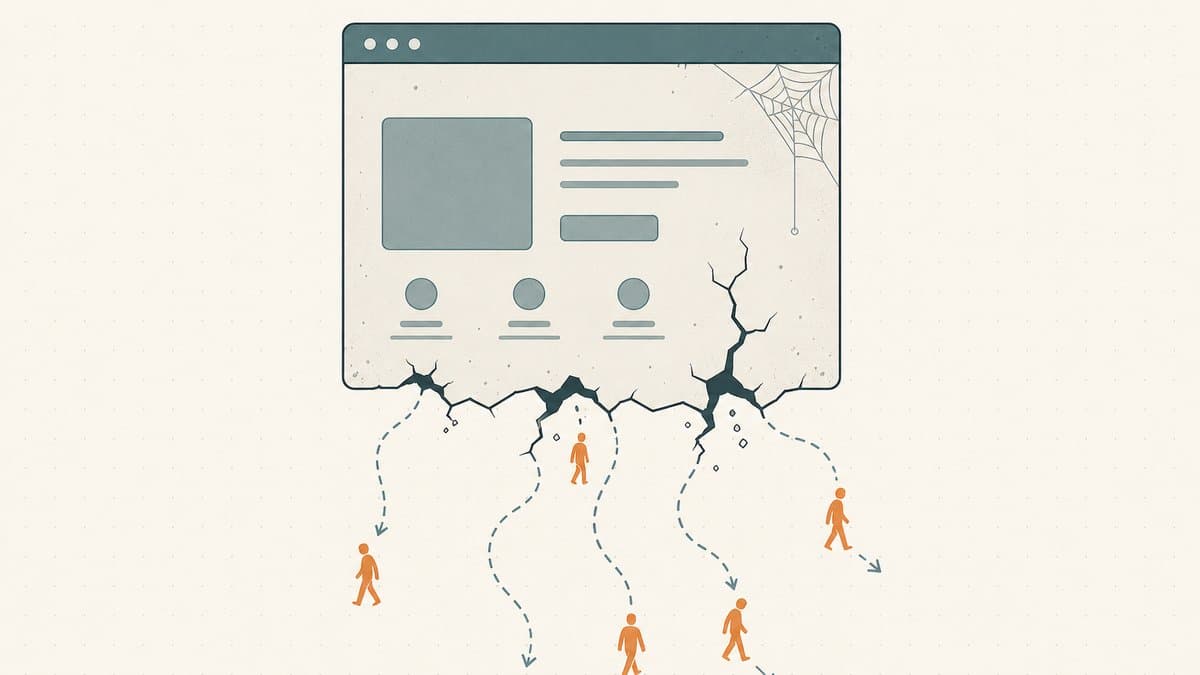
Most for-sale landers fail in predictable ways:
- The registrar default. Leaving the name on a generic "this domain is parked" placeholder with no sale offer wastes every type-in visitor. If the name is for sale, the page must say so.
- Ads where the offer should be. A wall of pay-per-click ads tells a serious buyer you're not serious about selling, and it gives them somewhere to click that isn't your offer.
- No price and no offer button. The most common own-goal. Pick one path and make it obvious.
- Friction in the contact flow. Required accounts, captchas stacked on long forms, and slow human follow-up all convert "ready to buy" into "moved on."
- Nothing that signals legitimacy. No named seller, no escrow mention, no ownership proof. The buyer's default assumption is "scam," and silence confirms it.
- A page that looks abandoned. Broken styling, a name that doesn't resolve cleanly, or DNS that intermittently fails all read as "this seller isn't reachable." A name that flickers offline during the exact window a buyer is inspecting it is a deal you'll never know you lost.
Where the lander hands off
The lander's job ends the moment the buyer decides. What happens next — agreeing terms, settling payment, transferring the name — is where high-value deals get tense, because the buyer won't pay before receiving the domain and the seller won't transfer before getting paid. That standoff is why escrow exists, and why naming a clean settlement path on the lander reduces friction before the buyer ever clicks.
This is the seam Namefi is built to smooth. Tokenized ownership makes control of a real ICANN domain easier to verify and transfer, with DNS continuity so the name keeps resolving through the handover — no dark hours where a live site goes down mid-deal. A lander that converts is only valuable if the deal behind it closes; the newer model of settlement is covered in how tokenized marketplaces replace escrow. A great storefront earns the click. A clean, auditable transfer turns the click into a check.
Friendly Disclaimer (Read Me!)
We're not lawyers, accountants, financial advisors, or doctors, and nothing in this article is legal, financial, tax, accounting, medical, or any other flavor of professional advice. We write these posts to educate ourselves and as a convenience for our customers. Info here may be out of date, geography-specific, or just plain wrong. We make mistakes too.
For any important decision, please consult a real professional (seriously!). Or if that's not your vibe, ask a friend, ask Twitter, ask Reddit, ask an AI, or ask a psychic. In short: DOYR - Do Your Own Research. Let's learn and have fun.
Sources and further reading
- Wikipedia — Landing page (definition)
- Wikipedia — Conversion rate optimization (definition)
- Wikipedia — Call to action (marketing) (definition)
- Wikipedia — Escrow (definition)
Contributors

Aileen Wright is a student in her twenties living in New York City, where the distance between a museum wall and a library reading room is a short walk and a long afternoon. She came to name writing through art and history — the way a single portrait, coin, or manuscript margin can carry a name across centuries and change its meaning on the way.
Most weeks you can find her in Central Park with a paperback, or in the quiet of a public reading room chasing down where a name actually comes from rather than what a name-list says it means. She is also teaching herself to code, which has made her oddly precise about spelling, sorting, and the small details that decide whether a name ages well.
For Namefi she writes about the history and culture behind domain names, the stories brands carry as they rename, and the difference between a good story and a verified source.

Victor Zhou is a technology founder and standards editor focused on digital identity and trust. He founded Namefi, edits Ethereum Improvement Proposals, and previously led smart-contract architecture work at Google Labs.
His work sits at the intersection of naming, ownership, and the systems people use to establish identity online. That perspective makes him especially interested in the way names move between personal meaning, public recognition, and digital infrastructure.
For Namefi, Victor edits and writes about domains as durable digital identity: how names become ownable onchain assets, how tokenization changes custody and trust, and what naming can learn from the systems people use to establish identity online.
Related guides
- Running a Domain Portfolio Like a BusinessRun your domains like inventory: track cost basis, watch sell-through rate, control renewal drag, prune losers, and keep the books clean.
- Domain Pricing Psychology: Buy-Now vs Make-OfferHow listing mode and initial numbers can influence a domain sale: anchoring, when to name a price, planned concessions, and buy-now vs make-offer.
- Hand-Registering Domains to Flip: Finding Available GemsHow to find still-available domains worth a registration fee: wordlists, TLD permutations, brandable patterns, and the filters that beat impulse buys.
- How to Find Domains to Flip: Every Sourcing ChannelThe four ways to source domains to flip — hand-registration, expired drops, auctions, and the aftermarket — and each channel's risk and price profile.