
Renewal Costs and Sell-Through Rate: The Real Math of Domaining
The honest economics of domaining: renewal drag, sell-through rate as a rule of thumb, and why one good sale has to fund many years of renewals.
- domains
- domain-investing
- domain-flipping
- analysis

Every domain you hold sends you a bill once a year. That single fact is the gravity every domain investor lives under, and it's the part the success stories leave out. A five-figure sale makes a great headline. The two hundred names that didn't sell, quietly drawing a renewal fee apiece every twelve months, never make it into the story.
This piece is about that quieter half of the ledger. It walks through the two numbers that actually decide whether a domain portfolio makes money: what it costs to carry names year after year, and how many of them you can realistically expect to sell. Get honest about both and the whole business stops looking like a lottery and starts looking like what it is — an inventory operation with a steady carrying cost and a small number of outsized wins. This is the math behind domain flipping, and it's the foundation under domain portfolio management.
You don't own a domain, you rent it
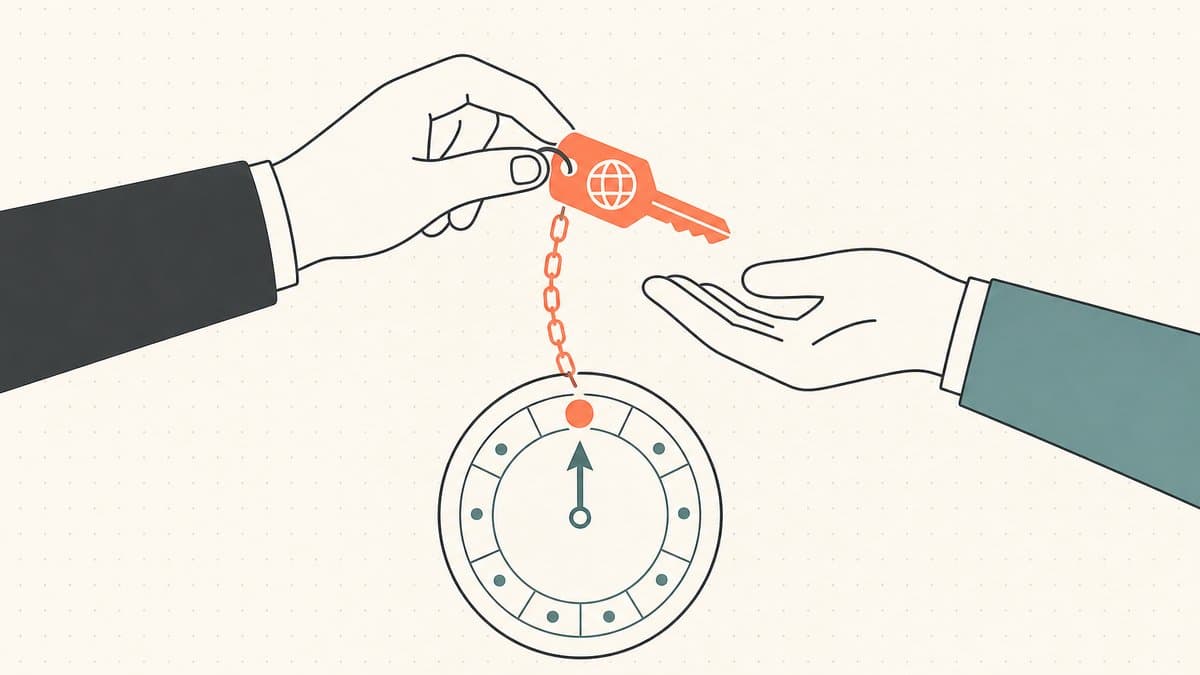
Start with the thing that makes domaining different from buying baseball cards or art: you never own a domain outright. You hold it for a registration term and you keep it only by paying to renew. Miss the renewal and the name can leave your control through a registrar- and registry-specific expiration lifecycle.
The term has a ceiling. Per Wikipedia, the maximum period of registration for a gTLD domain name is 10 years, so even if you pay as far forward as the system allows, the clock restarts at least once a decade. Most investors renew annually, which means the bill arrives every year on every name. The work of deciding which names earn another year is the job at the center of when to drop a domain — and it never stops.
The renewal isn't a formality, either. Let it lapse and the name doesn't vanish instantly, but it does start a process you do not fully control. For gTLDs, a registrar may delete an expired registration at different times under its own published policy. Once deleted, ICANN's Expired Registration Recovery Policy generally requires a 30-day Redemption Grace Period, during which the prior registrant can request restoration through the deleting registrar, usually for a disclosed restore fee. If it is not restored, a typical gTLD then enters a five-day Pending Delete phase before release. Registrar terms may also permit an expired-name auction before registry deletion, so do not assume the domain remains exclusively recoverable until the final drop.
What renewal actually costs
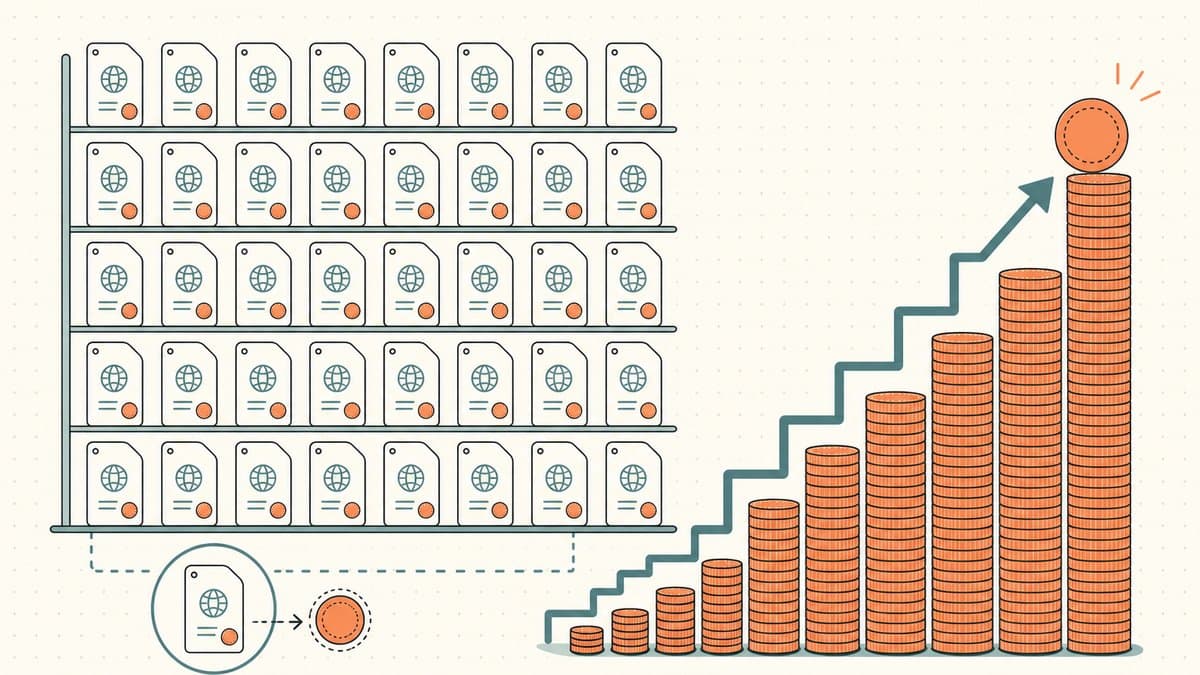
A single .com renewal can look trivial. But retail renewal fees are set by each registrar and may include a margin, taxes, privacy, or other services, so a dated market-wide retail range is a poor planning input. The auditable floor beneath that price is the registry fee: Verisign's .com fee schedule charges registrars USD $10.26 per domain-year for a renewal through October 31, 2026. Verisign has announced an increase to USD $10.97 per domain-year effective November 1, 2026. Check your registrar's current renewal table before forecasting your own bill.
It is not forgettable on three hundred. At the current USD $10.26 registry fee, the wholesale registry component alone is USD $3,078 per year for 300 .com renewals; after the announced increase, the same component becomes USD $3,291 per year. Your retail invoice may be higher, and that's before you've spent a dollar acquiring anything new. The cost scales linearly with how many names you hold and not at all with how many of them are any good. Renewal drag doesn't care whether a name is a future five-figure sale or a typo you should have dropped two years ago.
Two forces can push that number up over time, and both work against you. First, the wholesale price under your retail price can rise. ICANN's 2024 registry-agreement renewal decision says the agreement permits Verisign to increase the wholesale price by up to 7% per year, no more than four years out of every six; that is permission, not a guarantee of an increase every eligible year. The announced November 2026 change is one increase you can put into a dated forecast. Second, your bill grows whenever you acquire faster than you sell. Model both factors explicitly instead of assuming today's renewal price will hold forever.
Extension choice changes the picture, too. The conventional .com floor is one thing; a premium extension like .io or .ai often renews for many times that, while a discount .xyz may renew cheaply but resell rarely. A portfolio of expensive-to-renew extensions needs a correspondingly higher sale rate just to break even. The registrar you choose matters at the margin as well, since renewal pricing is where registrars quietly differ most.
Sell-through rate: the number nobody can prove
Here is the second half of the math, and the honest part. Against that steady renewal cost you set your sell-through rate — the share of your portfolio that actually sells in a given year. It's the metric that decides everything, and it's also the one with no authoritative source.
Treat any specific figure you see as an estimate, not a measured statistic. The widely repeated rule of thumb for a hand-registered portfolio is a sell-through rate in the low single digits per year — often cited around 1% to 2%. We're flagging that as a community rule of thumb, not sourced fact: there is no neutral registry that publishes portfolio sell-through across all domainers, the number swings wildly with the quality of the names and the channel they're listed on, and the people quoting it are usually quoting each other. Anyone who hands you a precise sell-through percentage as gospel is selling confidence they don't have.
What you can trust is the shape of the number, which everyone in the business agrees on. Sell-through for speculative, hand-registered names is low — a small fraction of a portfolio moves in any given year, and the rest sits and renews. That low rate is structural, not a sign you're doing it wrong. It's a direct consequence of how the aftermarket works: most names appeal to a tiny set of buyers, and in any given year most of those buyers aren't shopping. A name can be genuinely good and still not sell for years simply because the one company that needs it hasn't had its naming meeting yet.
The fix isn't to chase a higher percentage by listing junk. It's to know your own number. Track how many names you actually sold last year against how many you held, and you have a real sell-through rate for your portfolio and your sourcing — worth more than any industry average. That tracking is the discipline at the heart of portfolio management, and it's the input every other decision depends on.
One sale funds many renewals
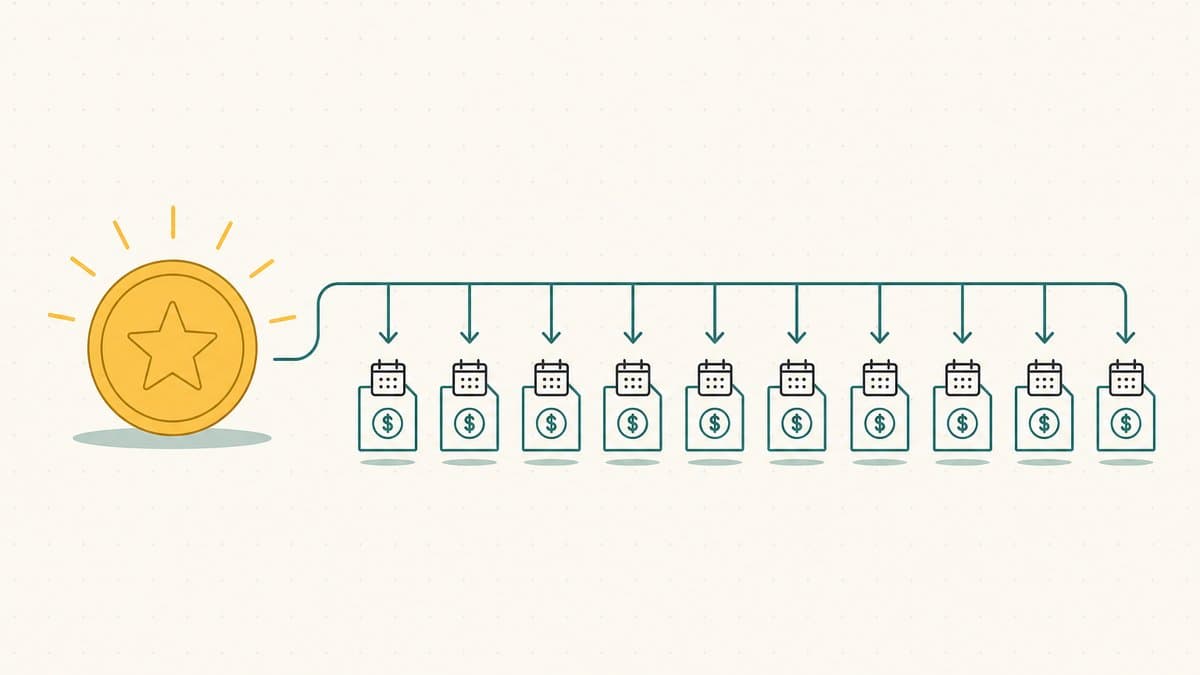
Put the two numbers together and the entire economics resolve into a single sentence experienced domainers repeat like a mantra: one sale funds many renewals.
The arithmetic is unforgiving but simple. If your portfolio sells 1% to 2% of its names in a year, you are paying renewals on 98% to 99% of a book that produced no revenue. The model survives only because the price of a sale can be wildly out of scale with the cost of a renewal. As a hypothetical comparison, USD $2,000 of gross sale proceeds equals the current USD $10.26 wholesale registry component for 194 .com domain-years, with USD $9.56 left over; actual retail renewal charges, marketplace fees, taxes, and acquisition costs reduce how many renewals the net proceeds can fund. A single four- or five-figure sale may carry a large portfolio for a year or more, but only after you run the calculation with your real net proceeds and registrar invoices.
This is why domaining is a portfolio game and never a single-name bet. You are not trying to win on each name; you are trying to make sure the rare winners are big enough, and frequent enough, to outrun the renewal drag on everything that doesn't sell. Frame it as a break-even and the test gets concrete: your expected annual sales revenue has to clear your total annual renewal bill with room to spare, or you don't have an investment — you have a subscription you keep paying for the privilege of hoping.
That framing also explains why pricing and selling matter more than acquiring. A portfolio with a mediocre sell-through but disciplined pricing — names that, when they do sell, sell for real money — beats a portfolio with a great hit rate of low-value sales. The leverage is in the size of the wins, which is why the selling craft in how to sell a domain name you own sits at the revenue end of the whole operation.
Running the math like a business
If you treat domaining as a business rather than a hobby, three habits keep the math honest.
Know your cost basis and holding cost per name. Cost basis is what you paid to acquire; holding cost is every renewal you've paid since. A name you've renewed for six years has a much higher real cost than its sticker price, and that accumulated holding cost is what should drive the keep-or-drop call. Tracking it is also what makes tax time tractable — see taxes and accounting for domain investors for why cost basis and holding period are the numbers your accountant will ask for first.
Prune ruthlessly and on schedule. The single highest-leverage move against renewal drag is dropping names that will never sell, before the renewal hits, not after. Every name you let go is a renewal you don't pay forever. The instinct to hold "just one more year" in case a name finally moves is exactly how a portfolio turns into a money pit. When to drop a domain is the discipline that protects your winners from being subsidized into the red by your dead inventory.
Offset carry where you can, but don't count on it. Some investors park unsold names to recover a little of the renewal cost. As the domaining literature notes, registrars allow unused domains to be parked with the registrant receiving a share of the PPC revenue earned. For the typical brandable name with no type-in traffic, parking revenue is rounding-error money and won't move your break-even — but on names that do draw traffic it can quietly cover a slice of the renewal bill. Treat it as a small offset, not a strategy.
Do all three and the renewal bill stops being a vague dread and becomes a managed number you can forecast against expected sales. That forecast is the difference between investing and hoarding.
Where the mechanics meet the math
The economics above decide whether to hold a name. The other half of every flip is the mechanics of moving it when a sale finally lands — and that's where a hard-won sale can still slip. High-value transfers carry the classic standoff: the seller won't hand over the name before payment, the buyer won't pay before delivery, which is the whole reason escrow exists. We walk that workflow in domain escrow explained.
Namefi narrows that friction at the settlement step. Tokenized ownership makes control of a real ICANN domain easier to verify and transfer, with DNS continuity so a live name keeps resolving through the handover. For the math in this article, less settlement friction means the rare sale that's supposed to fund a year of renewals is more likely to actually close — and a sale that closes cleanly is the only kind that pays the bill.
Friendly Disclaimer (Read Me!)
We're not lawyers, accountants, financial advisors, or doctors, and nothing in this article is legal, financial, tax, accounting, medical, or any other flavor of professional advice. We write these posts to educate ourselves and as a convenience for our customers. Info here may be out of date, geography-specific, or just plain wrong. We make mistakes too.
For any important decision, please consult a real professional (seriously!). Or if that's not your vibe, ask a friend, ask Twitter, ask Reddit, ask an AI, or ask a psychic. In short: DOYR - Do Your Own Research. Let's learn and have fun.
Sources and further reading
- Wikipedia — Domain name registrar (10-year maximum gTLD registration term)
- ICANN — Expired Registration Recovery Policy (post-expiration renewal, 30-day RGP, DNS interruption, and fee disclosure)
- ICANN — Domain renewal and expiration FAQs (30-day RGP followed by five-day Pending Delete)
- Verisign — First-quarter 2026 results and announced
.comwholesale increase to USD $10.97 effective November 1, 2026 - Verisign —
.comregistry-registrar agreement and USD $10.26 fee schedule effective September 1, 2024 - ICANN — 2024
.comregistry-agreement renewal decision (7% annual cap, no more than four increases per six years) - Wikipedia — Domain name speculation (parking and PPC revenue share on unused domains)
Contributors

Fenwei Bian is a software developer in her thirties who spends her working hours in pull requests and her weekends with her hands in soil or sawdust. Years of open source on GitHub taught her that names are interfaces: a good one is clear, honest about what it does, and kind to whoever has to use it next.
She gardens because it rewards patience and punishes wishful thinking, and she does woodwork because a joint either fits or it doesn't. Both habits show up in how she writes about naming — measure twice, check the source, and don't sand over a rough spot and hope no one notices.
For Namefi she writes about how domain markets actually move, the practical trade-offs of tokenizing and flipping names, and picking a domain you'll still be glad you own in twenty years.

Victor Zhou is a technology founder and standards editor focused on digital identity and trust. He founded Namefi, edits Ethereum Improvement Proposals, and previously led smart-contract architecture work at Google Labs.
His work sits at the intersection of naming, ownership, and the systems people use to establish identity online. That perspective makes him especially interested in the way names move between personal meaning, public recognition, and digital infrastructure.
For Namefi, Victor edits and writes about domains as durable digital identity: how names become ownable onchain assets, how tokenization changes custody and trust, and what naming can learn from the systems people use to establish identity online.
Related guides
- How We Cut AI Buyer Discovery Cost by 85%: Start Lean, Escalate With EvidenceA practical method for cheaper buyer discovery using progressive model escalation, LLM-as-judge gates, and Laminar traces and evals.
- Appraising ENS and Tokenized Domains: Reading Onchain CompsHow to appraise ENS and tokenized domains using onchain comps, floor-versus-premium reasoning, and ENS club factors — and why it differs from DNS.
- Brandable vs Keyword Domains: Which Sell Better?Brandable invented names vs exact-match keyword domains: who buys each, which resells more reliably, and the trademark angle every flipper should know.
- Domain Appraisal Tools Compared: Estibot vs GoDaddy vs RealityHow automated domain appraisers like Estibot and GoDaddy actually work, where they systematically miss, and how to use them as a first filter.